




Laini Taylor – Daughter Of Smoke And Bone
Posted 6th June 2014
Category: Reviews Genres: 2010s, Angst, Fantasy, Political, Romance
5 Comments
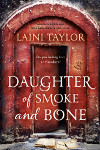
Will anyone tell her what’s going on?
Publisher: Hodder (Hachette)
Pages: 418
Type: Fiction
Age: Adult
ISBN: 978-0-091-94924-2
First Published: 27th September 2011
Date Reviewed: 5th June 2014
Rating: 4/5
Karou lives with chimeras, but she’s human and knows that there’s a story to be told, if only her friends would tell it to her. They won’t. Instead Karou has to keep running errands all over the world, using portals to collect teeth from various countries for yet another story she’s not allowed to know. She does get to make wishes, a small benefit when you consider she only gets the slight ones like making people itch. She’d much rather know how to fly. She’s at university now and pretty frustrated with her lack of knowledge. Surely it’s time she learned the truth?
Daughter Of Smoke And Bone is a low-fantasy tale, the start of a trilogy, that is often engrossing and promises much for the series as a whole.
Taylor makes sure her world is amply populated with interesting characters. She explores the world – our world – a fair amount. Karou visits many places in her time, using doors to move from her newest residence in Prague (she moves a lot and asks for languages for her birthday) and illustrating just how routine such a ‘dream’ of fast travel can be. The routine, coupled with Karou’s otherwise usual life does a good job of both stunning you and keeping you down to earth. Travelling is downright boring for Karou at times, and you come to emphasise with her from the start due to her approach. All this to say that Taylor is very good at making the awesome average, and rather than being a drawback it’s an interesting and absorbing concept. It makes Karou feel real, which is always a good thing.
This is a book to set up a trilogy but it’s complete in itself aside from the open threads at the end. Given it’s a trilogy, you might be surprised by how much happens. And it’s just fun. Daughter Of Smoke And Bone is exciting to read, it lets you escape into another world, it drenches you in culture even if only for moments at a time, it has wars and wings and… well, Karou doesn’t know yet, so it’d be unfair to tell you first.
Many people have written favourably of the twist – it’s a fair twist. How much you like it, however, will depend on the amount of YA and which types of YA you’ve consumed over the past few years. The twist is similar to those of other books so it’s likely you’ll predict it early on. This said, the evidence so far (as in this far into the series) indicates that Taylor is going to treat the trope differently.
This difference, the maturity and overall respect of reader’s intelligence, is the overall takeaway that will end this review. Beyond the general appreciation you’ll have of Daughter Of Smoke And Bone, you’ll appreciate the handling of the themes. Taylor has taken a genre and a handful of tropes that many people like, that half of those people have felt lacking in execution elsewhere. She’s taken them and she’s written something that matches what they were wanting. Daughter Of Smoke And Bone is quite possibly the YA fantasy romance that you’ve been looking for. If you’re jaded, give the tropes one more chance, here.
Before this review repeats its repetitiveness let’s leave it there. This is a good book. You’ll like it.
Related Books
Jenny Barden – The Lost Duchess
Posted 4th June 2014
Category: Reviews Genres: 2010s, Historical, Political, Social, Spiritual
4 Comments

America – freedom.
Publisher: Ebury Press (Random House)
Pages: 424
Type: Fiction
Age: Adult
ISBN: 978-0-091-94924-2
First Published: 7th November 2013
Date Reviewed: 4th June 2014
Rating: 4/5
Emme was lured into a room by Lord Hertford, who raped her. Unable to tell anyone, knowing that her reputation would be shattered, and worried about her position as a lady-in-waiting to Queen Elizabeth if it was revealed, Emme sets her sights on joining a ship-full of colonists heading to the New World.
The Lost Duchess is a rather good book that is so well-written and entrenched in its history you might have to remind yourself of the differences in views between then and now to fully appreciate it.
The book is about the first voyages to America and the confrontations with the Native Americans, however given the context of Emme’s inclusion and the unfailing and careful consideration, by Barden, of Emme’s abuse, it would be impossible to write about the book without speaking of the inclusion at length.
The abuse happens at the very start of the book and it’s the catalyst for much of what happens, informing the narrative. What is good about Barden’s handling of the aftermath is the consistency. It’s a careful inclusion, so thoughtful that you may at times think that Emme will suddenly move on from it. Ultimately Emme learns to live with what has happened to her, but it isn’t forgotten by the book. It informs her feelings; it makes her actions towards the man she comes to love hot and cold. Readers are asked to understand Emme in our modern context, but lest we forget that Emme is of her time, Barden, both to show us and to simply portray the era, fills Emme’s thoughts with worries that she is ruined, that to speak will be her downfall. There is also some arrogance in Emme that could be the result of her previously semi-independent self trying to claw back who she was.
He was nothing but a knave trying to dominate her, just as every man she had ever known had tried to dominate her, and she wanted no more to do with him.
The above is about a man who never harms or does Emme any wrong. At once you see the way Emme’s mindset has changed, but it could also be read as a no-holds-barred statement of the era in general. This historically-focused, more than ‘usual’, storytelling is what makes you appreciate what Barden is saying about difference.
Leading on from Barden’s concentration on the era, nowhere in the book are there questions about the ‘right’ to use land that does not belong to England. The only place this concept arises is in the speech of a Native American chief. To our modern selves this seems crazy; Barden’s book is very realistic and isn’t about morality or lessons. Instead of being mollified by a 1500s Englishman questioning the right to invade (which, let’s face it, likely happened on a very limited basis), the reader has to do the thinking. You’re left to think about why no one brought this idea up, why Kit, who is a ‘good guy’, doesn’t respond to the chief’s very true statement, why caring Emme thinks about a future where the city of Raleigh thrives without considering anything else. Kit does discuss the irony of calling an intelligent, peaceful people, ‘savage’, but that is all. That said, there is true compassion to be found in the relationships between the English sailors and the Native Americans. (Here ‘relationship’ means both love and friendship.) These relationships are about love, about sacrifice, and show how peace could have been created had it not been for the racist leaders in the group of sailors.
There is little to speak of in terms of setbacks. Barden has written a good book, obviously conducted a lot of research, and knows the period well. She wishes to explore personality and society as well as take a look at the mystery of the initial settlers (whilst Barden provides an answer, her Author’s Note explains that the colony she has written about is lost to history). There are a couple of modern slang phrases but then the book is written in modern English, and there are a couple of scenes in which Barden wants to inform the reader of facts but goes on a little too long.
The plot is important, very important to Barden, but it should be noted that the book is much about Emme and to a lesser extent Kit, and so although the voyage and trials are there all along, they might not always be as exciting as you expected. This is definitely a book for those who like their stories character-driven.
The Lost Duchess looks at history and asks us to forget our modernity. It looks at ageless issues and respects all, and it does this whilst never being sorry for what it leaves out.
Emme is brave and it could be said that Barden is, too. The reader must fall in line if they wish to sail across the sea with them.
I received this book for review from the author for Historical Fiction Virtual Book Tours.
Related Books
None yet
Johanna Lane – Black Lake
Posted 19th May 2014
Category: Reviews Genres: 2010s, Angst, Domestic, Political, Social, Spiritual
5 Comments
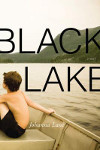
Moving home is often disruptive, but not quite as much as this.
Publisher: Little, Brown (Hachette)
Pages: 212
Type: Fiction
Age: Adult
ISBN: 978-0-316-22883-1
First Published: 20th May 2014
Date Reviewed: 19th May 2014
Rating: 5/5
Marianne locks herself and Kate in the ballroom. Marianne may seem mad but it soons becomes apparent that there’s more than meets the eye, for the ballroom is stale and she won’t leave the building, and something has obviously happened to Philip.
Black Lake is a stunning début, a novel with a purposefully spoiled plot that explores the effects of displacement on a person.
If you have ever visited a historical country estate knowing that the reason you’re able to be there is an owner’s lack of money, this is a book for you. In Black Lake, the house of Dulough is somewhere between a character in itself and a catalyst. Lane looks at the various ways an extreme version of moving home can affect people based on how they feel about the place and how much knowledge is provided or kept from them. We see John, inheritor of a house without the funds to pay for it, upset at the prospect of government involvement but with the will that comes with calling the shots (as much as you can once papers have been signed). We see Marianne, his wife, a woman from a humble background who took a while to get used to the idea of not making the dinner and living away from the city but who is now happy, proud of her home, and under the impression that her children will always have that home. And we see the children, in particular Philip, who understandably has trouble with the new literal boundaries and the idea visitors can use his bedroom whilst he no longer can himself.
Lane shows us the differences. On the surface it seems that Marianne is the most affected, and it can be easy at first to think that the children will get used to things. But Lane shows how children can be affected by the smallest elements of change and how adults are slow to realise this when it happens. For example, take the defining moment – Philip telling a tourist that he’ll get his food for free because it’s his house and finding that he does actually need to pay. Lane handles Philip’s sections with care and the way she relays information is just as telling – Philip shows upset but never tears, and it is in this that the confusion of a previously happy child is shown.
Talking of Philip’s narrative, Lane has chosen a particular format for her story. She begins with the near-end, goes back in time, includes a long ‘never before seen’ account, before leaving the reader with a slightly opened-ended last page which infers much but confirms nothing. The third-person narrative switches between John, Philip, and, later, Marianne. A couple of chapters are written as descriptions from no one’s view in particular. It is written in the sort of literary style that is often prefaced with ‘nothing really happens’, and the style is likely to interest many. Something, many things, do happen, but Lane’s slow-moving seemingly dull writing is very deceptive. You’ll note, whether during or after having finished reading it, that there’s a layer of boredom to the book, yet what happens is anything but boring. It’s interesting to compare this illusion to the way the ‘government’ sees their semi-acquisition of the house. Having replaced the furniture and having prepared scripts for tour guides that are untruthful, it’s easy to imagine that the defining moment in the family may be passed over by the new staff, and not included. The Campbell family is of little importance now that the house can be enjoyed by the public and it’s ironic that the new, true, shocking fact in the family history would be glossed over or left out. Or, maybe, as can be the case, made overly vivid and expanded upon for money.
At the heart of the novel, more than the moving, is communication. John thinks Marianne has gone mad, but once you read her account, even before then, you see the lack of knowledge the aloof country man has of his social city girl. Perhaps if John spent time with her and discussed the money issues, the necessary transition might have been easier, or, if two heads are better than one, another option for upkeep might have presented itself. John’s secrecy is the main issue here, but one could also consider the difference between adults’ and children’s’ methods of coping and their knowledge of each other.
To be sure, in choosing to read Black Lake you have to be in the mood, or just open to, a book that has much to say whilst making you wonder if anyone cares. Black Lake is character-driven entirely, and the lack of emotion on the surface does mean that it requires your attention.
Black Lake is a magnificent study and story of family and upheaval. Fill up the teapot and get a whole place of biscuits ready, because this relatively short book is going to consume your afternoon.
I received this book for review from the publisher.
Related Books
None yet
Isla Morley – Above
Posted 9th May 2014
Category: Reviews Genres: 2010s, Angst, Domestic, Political, Science Fiction, Social, Thriller
5 Comments

Can’t let the monster in.
Publisher: Two Roads (Hachette)
Pages: 370
Type: Fiction
Age: Adult
ISBN: 978-1-444-79700-8
First Published: 4th March 2014
Date Reviewed: 8th May 2014
Rating: 4/5
On the day of the parade, at sixteen years old, Blythe was abducted by the school librarian. Locking her in an old missile silo with provisions for many years, Dobbs told her he was protecting her from the apocalypse that was soon to hit. Unable to escape, Blythe is forced to live with him and his madness, his passive aggressiveness, his abuse, and she watches as he often leaves to go Above, back to the world he tells her is falling apart. Throughout, Blythe’s hope, though faded, never dies – one day she will escape and get back to her family. And Dobb’s madness can be put to rest. Or can it?
Above is an epic story that spans a fair few decades, many themes, and culminates in a rather tidy ending. It is an interesting book, as it could be said that it isn’t sure what it wants to be – there are two parts to the story that, whilst sharing a general element vary greatly – yet the overarching idea of theme exploration does manage to keep the two plots together.
Whilst the first half of the story is inevitably dull on occasion, the second half transforms the book into the afore-mentioned epic. Above is a lot longer than the almost 400 pages suggest, partly because the time scale is convincing and partly because there are so many moral elements considered.
Beyond the dullness of a lot of the first half – the days spent with nothing to do, the literal dullness of a world without sunlight – there is of course the times in which abuse takes place. Dobbs tends to ere on the side of caution, that is to say that generally the horror of Blythe’s situation is the fact of imprisonment and Dobb’s removal of things that make her happy. However, as may be expected, there is some violence involved. It’s a creepy sort of violence – Dobb’s doesn’t beat Blythe up but he does enough, and he does it in a ‘careful’ way as to make it sobering. Morley affectively shows how a person can seem average, even good, and keep a certain façade or even belief around them, which can make others think they are okay. Even Blythe, though she is strong at heart, feels sorry for him despite what he does to her.
This abuse and manipulation is the biggest thought of the novel. Morley puts the reader, and Blythe too, in a particular situation. We hate Dobbs because he is a bad man. There are no two ways about that – he forces himself on Blythe and his kidnapping does not begin and end with her. The man is bad. However once you reach the second half of the book you are presented with confusion. Blythe’s confusion. The confusion of both the prisoner she was and the person she is right then in that moment. This confusion doesn’t change the fact that Dobb’s is a bad person, but in the context of the book, and in the context of science fiction, it asks its main character and the reader questions. Blythe makes you question.
(The rest of this review will contain references to the twist in the tale, by necessity.)
Because what Dobb’s had been saying all along turns out to be true. Blythe has been abused by Dobbs, but she has also been protected. This means that Dobbs, in some ways, occupies a grey area. Both the character and the author herself constantly refer back to Dobbs, and it is obvious that Morley wants you to really hone in on this question of right and wrong. She never suggests Dobbs should be pardoned, of course he can’t, but she opens up all the sorts of thoughts we as a society tend to push aside. What exactly is right? What exactly is wrong? Can wrong ever be right, just a little bit? Do we truly try to understand victims or do we pretend we do? More than the questions surrounding Dobbs, Morley urges us to relate to Blythe.
Once you’re ‘familiar’ with this line of questioning, the rest of Morley’s ideas become apparent. Above isn’t ‘simply’ a story of abuse, nor an apocalyptic book. It is much more than that. It’s a study, a constant questioning of morality, of race, of government, of the news, of disability. The last on that list becomes prevalent towards the end. Most everyone is disfigured, and Morley compares viewpoints. Blythe, born before the apocalypse and kept safe, notices the disfigurements. Adam, her son, having lived solely below ground, doesn’t notice any differences. Or if he does (because he has read books and seen films) it doesn’t bother him. With Morley telling the story from Blythe’s viewpoint, every new person or group of people is detailed, their scars, burns, and lack of features brought to the forefront. You could even say it’s too much, that Blythe sees too much even after she’s been Above for a good few days. It’s interesting to contrast this detail with Blythe’s unhealthy pallor but ultimately flawless (as far as radiation is concerned) person. Especially when she notes her pale, now freckle-less face, and notes that her old crush would likely not find her attractive now. It takes us, the reader, to remember that, saying her crush is still alive, he is likely disfigured beyond compare.
Included in this study of the view of disability is the way the medical group of people are trying to create a perfect baby (to recreate humanity as it was) and the group of average citizens who are saving the creations who haven’t turned out correctly. This is now a world that values difference. Difference is all there is.
There are other things to consider, such as Blythe’s naming her son Adam – a stated plot device that infers who Adam may end up to be – and the experience, though only a minor part of the story, of a black albino woman. There is the effect that sudden freedom can have on a person, the effect of a difference that wasn’t expected (of course this particular difference wasn’t expected, but you know that Blythe would never be returning to life as it was when she was sixteen, the world moves on, and this is what she hasn’t really thought about), the struggle to regain what’s loss, and control, possession. In Adam you see the world in a new light, literally and metaphorically, in Blythe you may end up appreciating what we have now just that little bit more.
Above isn’t a masterpiece. There is a disjointedness to the duel plot-line that is likely only to be healed with prior knowledge of the duality, the writing is average, and once Blythe has escaped she’s not quite the person you may expect or even like, and not simply because of her displacement and longing for the past. The epic nature also makes it seem a little too long and there are reports from people familiar with Kansas that the numbers aren’t correct. But the morality and the way Morley uses a society harmed in order to make her point clearer is good to read and, as the length of this review suggests, leaves you with plenty to think about.
Combining ideas and repeating details, Above may not be the book you were expecting it to be, but judged on contents alone it is very much worth the read and the time it takes to reach the end.
I received this book for review from the publisher.
Related Books

Speaking to Isla Morley about Come Sunday, Above, and The Last Blue) (spoilers included)
Charlie and Isla Morley discuss growing up and travelling back to South Africa, creating a negative heroine, the 1800s medical phenomenon wherein people were literally blue, and what it’s like owning five tortoises.
If you’re unable to use the media player above, this page has various other options for listening.
Nancy Bilyeau – The Crown
Posted 26th March 2014
Category: Reviews Genres: 2010s, Domestic, Historical, Mystery, Political, Social, Spiritual
7 Comments

Curses at the convent.
Publisher: Orion Books
Pages: 470
Type: Fiction
Age: Adult
ISBN: 978-1-409-13579-1
First Published: 1st January 2012
Date Reviewed: 25th March 2014
Rating: 4/5
Joanna, a novice at Dartford Priory, leaves secretly to be at the execution of her cousin. She expects to bear witness and return to Dartford, but when the fateful time comes, her father rushes to assist the condemned and she, Joanna, finds herself in the Tower of London. Few leave the Tower alive but Bishop Gardener has a proposition for Joanna. He’ll spare her father if she’ll seek the crown of the old king, Athelstan, a legendary item said to bring greatness – and ruin.
The Crown is a particularly well-researched and well-written Tudor suspense that may not have the shock factor of some books but continues on steadily and with a good few surprises in store.
The strongest element, the stand out element, is the writing and construction. Whilst of course not written completely correctly (because a book written in true Tudor text would be difficult to decipher) the language is good, there are no sudden uses of modern slang, and the times when modern phrasing is used are slight, few and far between, and in such small supply that it doesn’t matter.
This leads on to construction – Bilyeau has done her research. As in the later The Chalice – mentioned here because this reviewer read it beforehand – the history is accurate, the biases are taken from the historical views of the people rather than placed upon the characters by the author, and the times when Bilyeau swerves towards fiction fit together with the factual history like gloves. Joanna is a fictional character, but her family and those she meets are often not, and there are never any occasions where it is unbelievable that these events could have happened. Those looking to learn about the Henrican era will find plenty of true history here, and Bilyeau does not shy away from discussing where her imagination plays its role.
Except in the case of the cursed crown, of course. But this is supposed to be. In the creation of the Athelstan crown, Bilyeau has drawn from the questions for which we have no, or at the very least scant, answers. The crown’s curse affects those royals who did not live long or who died of mysterious causes. The make-up of the crown is not unbelievable when given all the relics in the world and in many ways it echoes such legends as the holy grail and the shroud of Turin.
Bilyeau has populated her book with a vast number of primary and secondary characters. The most developed are fictional, which makes sense; it must be said that in terms of history itself a basic grounding, perhaps even a fair grounding, in the Tudor dynasty and court politics will add to the understanding and enjoyment – the factual characters are well-known. There are a few meetings that can seem too easy but the suggestion of romance means that it is not necessarily a drawback, and of course in a book where the dissolution of the religious houses is a key point, Joanna’s future is a constant question.
Also included as themes are sexual abuse and prejudice against women. Both of these are explored as potential reasons for a woman to choose the life of a nun. A religious life was a way for women to escape the average existence of a woman of the times, to gain an education and make their own choices rather than be subject to the whims and demands of their families, and Bilyeau brings in these and a variety of other reasons to her book.
The book ends quite swiftly, being perhaps a little less striking than you may think, but in choosing the path she has, Bilyeau looks at yet another issue in Tudor England, one which is likely to strike a chord with the reader as the world has changed so much since.
The Crown focuses on not just a person but a community rarely studied in fiction. It examines what is often simplified to a brief schedule the day-to-day life of a nun and the true happiness that could be found therein. And it does this whilst being accurate to the time, unbiased, and packed full of information.
Related Books


Speaking to Nancy Bilyeau about the Joanna Stafford trilogy, The Blue, and Dreamland (spoilers included)
Charlie Place and Nancy Bilyeau discuss the lifestyle of Dissolution-era nuns, using a website’s ‘contact me’ form to great success, there being more relics than there were items, using your family’s name in your work, and the grand amusement parks and luxury hotels of New York’s past.
If you’re unable to use the media player above, this page has various other options for listening.


