





Kristy Cambron – The Butterfly And The Violin
Posted 20th August 2014
Category: Reviews Genres: 2010s, Domestic, Historical, Inspirational fiction, Political, Romance, Spiritual
3 Comments

This is the first time I’ve read Christian fiction (besides C S Lewis and Tolkien) and I’ll be reviewing this book as I do any other so it may be the case that this review differs in its main focus than it ‘ought’.
Finding a painting, discovering history, and perhaps (hesitantly) falling in love.
Publisher: Thomas Nelson
Pages: 323
Type: Fiction
Age: Adult
ISBN: 978-1-401-69059-5
First Published: 8th July 2014
Date Reviewed: 19th August 2014
Rating: 3.5/5
Gallery owner Sera has been searching for a painting, seen once as a child and instantly loved, for several years. When her assistant tells her another is looking for it and wants the gallery’s help, she jumps at the chance and flies to the other side of the country. The family looking for the painting is wealthy but that wealth is in jeopardy and the painting is the key. In 1940s Austria, the subject of the artwork and the daughter of a general of the Third Reich is branded a traitor and sent to Auschwitz after it is discovered she aided an attempt to provide safe passage to a Jewish family. Both Adele and Sera search for security and happiness, hoping that God will provide.
The Butterfly And The Violin is a Christian dual plot line historical that looks at art, the Holocaust, and the plight and faith of two young women.
It’s often the case that a reader will prefer one plot line over another when there are two of them, however The Butterfly And The Violin is a book less likely to pull you one way. This is because although very different, both stories are of equal strength, the characters somewhat similar, and the stories well balanced. Though of course nowhere near as significant as Adele’s, Sera’s life has that present-day regularity that is compelling simply because of the emotions included in it. Whilst the time periods are fairly standard for dual plot stories, the fact of the Holocaust and Adele’s ‘role’ in it make the book stand out from others. Although Adele may be in a place of privilege, even in Auschwitz, Cambron never shies from showing you what was going on.
The biggest similarity between the women is their faith. We know more about Sera’s, descriptively, than we do Adele’s, but still it is not simply that both women are Christians. In The Butterfly And The Violin the emphasis is on the way faith is playing its part at that very moment, and for both Sera and Adele, at the time we join them, falling in love and being happy in love are two of the most important aspects of their lives. Both look to God for help, Adele prays she will see Vladimir again, and Sera prays that she will trust another after having had her heart broken. Indeed Sera’s faith is a little shaky – she still believes, and would never not believe, but the disappointments and losses have taken their toll and she hasn’t made much time for her faith since.
Obviously there are quite a number of references to God, faith, and Christianity (also Judaism, but as that isn’t a ‘subject’ so to speak, Christianity is what I’ll be focusing on). More often, at least for the first two thirds or so of the book, God is present in Adele’s story. On the surface it can seem that the references are too many and placed at inappropriate times. However if you step back from your reading and put yourself in the situation of the characters, in this case Adele, it seems perfectly natural. It is really more the case that where faith happens so much more in the mind than in conversation (generally) it’s simply that it can seem odd being actually stated, the things most often thought but not said are here, being voiced. This said, there is a sudden increase in references towards the end in both stories that do not work as well for different reasons. In Adele’s case it’s inevitable that in a crisis, a group of faithful people will look to God – it’s simply that the constant references slow down the pace and pull the focus away from the tragedy of the situation at hand. In Sera’s case it’s that it becomes a bit confusing, although it’s well placed as part of her self-discovery and improvement.
The confusion is part of a larger aspect that needs discussing. There are a few sections of the story that don’t quite add up and occasions where there is too much detailing. People tap their feet a lot, for example, and we have many descriptions of hair. Some of the phrasing doesn’t work. And there are also frustrating occasions wherein questions – literal, spoken questions – are not answered for a while and it seems the case that it’s so Cambron can keep the story going longer. There is one place where answers are ignored so that the author can detail a room, and by this time the reader just wants to know what’s going on. It’s not that the characters ignore the questions, it’s that they are left out completely until detail has been included.
Where Sera and the confusion come in is in the numerous references to faith. The problem is that the issues get lost behind the references so that you realise Sera’s faith has been tested and that she wants to trust and get back to God more fully, but you’re not always sure what’s happening to cause this transition. As it’s not a transition from faithless to faithful (Sera never speaks of going to church but one can assume she does sometimes) it is a problem. Simply put, sometimes narrative is not clearly explained.
Unclear is the way the inheritance issue is concluded. That William and everyone else is happy is not believable and the grandfather’s plans come across as thoughtless, having emphasised William’s role and not really considered the rest of his family. Yes, it allows William to be able to choose the life he has always wanted, but it leaves his family in the lurch and we’re not given all that much information about it. It may work for William, but are his family going to be happy with what is effectively a loss for them? It’s also not clear exactly why the grandfather decided to change his will and leave the fortune previously left to his family to someone else.
Yet still on the whole, The Butterfly And The Violin works. There is a lot of information about the Holocaust, including much that isn’t covered by your usual school education, and Cambron has taken a path rarely if ever used, applying a specific sort of artwork and using that as the basis for one of the stories.
The romance, too, works very well. Whilst we don’t read all that much about Sera and William, appropriate time passes off stage to suggest they make a good couple and the somewhat inevitable discovery of a shared faith is included to very good effect. Adele’s relationship with Vladimir successfully details both the horrors of WWII and your everyday social prejudice. And both the painter and the owner of the painting may prove to be unexpected (but welcome).
And finally the characters are believable and people you’ll find yourself rooting for. Adele’s impulsive choices are maddening sometimes, but exactly the choices you’d expect a naïve, hopeful person in her situation to make, and whilst Sera becomes cross and can’t always see what’s staring her in the face, again, in her situation it makes perfect sense.
Definitely, obviously, this book will be appreciated most by those who share the characters’ faith, but there is enough here for a general historical romance reader or dual plot line lover to enjoy as well.
The Butterfly And The Violin isn’t perfect, but nevertheless you may find yourself racing through it.
I received this book for review from the publisher.
Related Books
None yet
Suzanne Collins – Mockingjay
Posted 4th August 2014
Category: Reviews Genres: 2010s, Angst, Political, Science Fiction, Social
7 Comments

The beginning of the beginning.
Publisher: Scholastic
Pages: 436
Type: Fiction
Age: Young Adult
ISBN: 978-1-407-10937-4
First Published: 24th August 2010
Date Reviewed: 3rd August 2014
Rating: 4.5/5
Katniss was rescued, Gale helped her mother and Prim to safety, and now everyone who could flee has left District 12. District 13 is more controlling than they would’ve thought, but it’s a lot better than the torture Peeta is almost certainly facing. The president of 13 believes that now is the time, even if they’ve Katniss when they’d prefer Peeta.
Mockingjay is the final book of The Hunger Games trilogy and is a tough call. On one hand the difference between this and the previous books is welcome – we couldn’t really have yet another Hunger Games because Collins was admittedly pushing her luck somewhat in Catching Fire. (I think Alice’s comment sums it up well, for all I enjoyed that book.) On the other hand the book being so different means that you will possibly find it less interesting or at the very least not what you were expecting. For starters Mockingjay takes Peeta away from us for a long time. This of course affects everything and whilst the remainder and his treatment are realistic, the mood is changed.
The pace is still there and if you rushed through the first two you’ll likely rush through Mockingjay, but whereas the first two were fast because you wanted to know what would happen and because the books pulled you along, here the pace is only down to the first point. Mockingjay is fast because having read the others you just want to find out how it will end.
This lack of interest (it’s a perfectly fine amount of interest when considered on its own; very lacking when placed in the context of the trilogy) is in part to do with the inevitable comparisons with other dystopian novels and films. The rebels that are everywhere, the underground city not unlike Zion from The Matrix, the samey-ness of love triangles that Collins books had previously just about stayed away from. The book is been-there-done-that. It’s like any sci-fi video game and whilst there were comparisons to Battle Royale before, this time the comparisons are numerous.
I’m not going to discuss the ending in any way as I have too much to say to fit in a review (a further thoughts post is forthcoming), but I will point out that many people will be disappointed. I actually think it’s better to know that disappointment is a possibility because you may then like it more.
The issue with Mockingjay is that it doesn’t satisfy. You want a final book to be triumphant whether it ends well or not and this one just isn’t the send off it could’ve been.
As said, however, the book is good on its own. Katniss remains the reluctant heroine and the battles are strong. The mental workouts are good, more for Katniss than the reader this time, but Collins does run with the thought of ‘remember who the enemy is’, keeping Katniss focused on what’s most important. The prelude to the end is really very good and it could be argued that it’s even better for the ambiguous finale. In essence, there is an ending but the part you truly want to know about is left unanswered. This is important – Collins leaves it up to you. Perhaps you’ll decide that ultimately who the true enemy was isn’t what matters, and if so you’ll see another layer to the story.
District 13 is controlling, necessarily so – but it’s edging close to the control in Panem. This is also something to think about. In order for there to be freedom, some liberties must be given up – this Collins says… or does she? Certainly the start of the end suggests that no matter what, those in Panem will never free.
There are cameras in this one as there were in Catching Fire; the cameras of the rebels. Collins shows that even those doing the reporting are often part of the war, suggesting that it’s more important to actively take on a role – a hero may be considered best safe, but that won’t offer the best outcome.
Mockingjay is very good, it’s just not excellent. And in many ways, Katniss does not get to choose.
Read it – you should end the series – but be aware of the issues.
Related Books


Suzanne Collins – Catching Fire
Posted 23rd July 2014
Category: Reviews Genres: 2000s, Political, Science Fiction, Social
9 Comments
Having struck the match…
Publisher: Scholastic
Pages: 437
Type: Fiction
Age: Young Adult
ISBN: 978-1-407-10936-7
First Published: 2009
Date Reviewed: 22nd July 2014
Rating: 5/5
Katniss and Peeta, free of the games, moved into District 12’s Victor’s Village. Three people now take ‘pride of pride’ in the exclusive neighbourhood, but it was never going to last. President Snow sees Katniss as the catalyst in the rebellion just as everyone else does – excepting the girl herself. But Snow isn’t worried. As far as the Capitol’s concerned, the rebellion will soon be over because the Quarter Quell is about to begin and there’s always a twist…
Catching Fire is the awesome second book in Collins’s trilogy and whilst repetitive (somewhat expectedly) the book is on a par with the first: no holds barred; quick pace; a writing style that makes you want to skip meals so that you can read on.
Due to the similarities, let’s focus first on the differences. There are new characters, including a new master gamesmaker, and a whole set of tributes to get to know. (In this book there is more of an emphasis on getting to know the tributes, and for good reason.) Of course there is the furthering of the rebellion of which our strong, brave, but still naïve heroine finds herself the projected leader.
This naïveity first began in The Hunger Games, however this time it is more frustrating than understandable, the reverse of what it was. Not too frustrating – it won’t put you off reading – but enough that you wish Katniss would just get with the times, as it were. She’s reluctant, she doesn’t believe she’s the best person for the job, and as the novel’s told from her perspective the reader can understand this. But as she’s inspired others and wants to be part of the rebellion it’s hard not to wish she would have more confidence and desire.
Honestly, however, beyond that there’s little to dislike or consider in terms of whether it works or not. There is another Hunger Games, the Quarter Quell, and your expectations as to what it is and who will be entered will be met. Perhaps you may feel that Collins could’ve been more original, but it’s hard to deny that another games wasn’t a good idea. There is something that could technically be considered a cop-out at the end, however the Quarter Quell is on the whole a success for the book. The games are different in setting, colour scheme, costume, you name it, it’s only the goal and the manipulation that remains the same. And as if the last games weren’t bad enough, Collins attempts to make this one worse. The tributes are a new set of people altogether and at first glance you may think it a lesser evil, but the author is at pains to show you that it’s not. The hideous injustice doesn’t end with children here.
New also is the war and the place the war originates from. If the previous book was about the Capitol and emphasised how bad it was, Catching Fire hones in on all the things you aren’t supposed to know about what remains and has been kept secret.
You will still forget the evil, maybe not so much because this time you’ve come prepared, knowing Collins will manipulate you as the Capitol manipulates its residents, but it will happen. However what you will see is a stronger attempt to right the wrong, a better display of rebellion than the aborted nightlock poisoning (that is to say the display here is easier to set in motion and not quite as drastic, all things considered). You will be with the tributes, at one with almost all of them, as they work their way through the games. The careers are still there, but the difference in who they are means that even they are not quite as straightforward as last time.
Collins hasn’t let us down and it’s clear that she’s a writer to continue watching long after the games are over, long after they are hopefully over for good.
The odds are in your favour; Catching Fire is excellent.
Related Books
Ai Mi – Under The Hawthorn Tree
Posted 18th July 2014
Category: Reviews Genres: 2000s, Angst, Historical, Political, Romance, Social, Translation
3 Comments
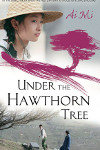
First love – a time to worry.
Publisher: Virago
Pages: 352
Type: Fiction
Age: Adult
ISBN: 978-1-844-08703-7
First Published: 2007
Date Reviewed: 18th July 2014
Rating: 3/5
Original language: Mandarin Chinese
Original title: 山楂树之恋 (Shan Zha Shu Zhi Lian – Hawthorn Tree)
Translated by: Anna Holmwood
Jingqiu’s family has been written off as the lowest of the lowest. Landowners, in the time of Mao they are hated. Jingqiu works hard to provide for her mother and sister and sees her future as one of inevitable manual labour. She would hope to return one day. On a field trip, as a writer for the new school textbooks, she meets Old Third, the so-called foster brother of her teacher’s family. He’s obviously not as poor as Jingqiu – there would be issues if they became more than friends.
Under The Hawthorn Tree is a book that starts very well and offers much to those interested in the history, but slowly descends into what is to all intents and purposes stupidity.
The stupidity can be found in Jingqiu’s choices. She is a fair enough character and works more than is healthy so that her family has money, but she declines all offers of support and legitimate ways to get around her situation. The love interest, Old Third, has much to offer and asks for nothing in return; he wishes Jingqiu out of danger. Jingqiu rejects his money and puts her life on the line working in factories that use poison and taking on heavy lifting duties that could kill her. Perhaps it is meant to be endearing, but instead it comes across as silly and selfish. It’s a miracle the character survives at all.
Some, only some, of Jingqiu’s concerns are valid. She worries about being seen with Old Third in a society that will reject her if they believe she’s lost her virginity out of wedlock. She worries about her family’s already low status. But by and large her worries don’t hold water. There are the constant musings on what people are referring to (metaphors and innuendo). Jingqiu’s innocence is believable up to a point, but it’s hard to believe that by 25 she still dismisses those happy to clarify matters and to be the only person (seemingly, at least) in her home town who has not learned anything. Personal experience doesn’t enlighten her, either. Sex itself is one of the few things that is discussed openly in the city, at least enough that everyone knows a good amount, everyone except Jingqiu.
Jingqiu’s love isn’t believable. She goes through some motions, and perhaps it is down to the lack of knowledge, but it’s hard to phantom that one day she won’t fall in love for real and relegate Old Third to a crush. Old Third loves her, that is certain, by Mi does not present the love on Jingqiu’s side very well.
The writing is hit and miss, however because we’re talking of a translation, it’s hard to say for definite whether or not the repetitive words and juvenile phrasing is down to the author or the translator’s choices. (The translator is Anna Holmwood.) It is safe to say that the translation needed editing, because you’d expect errors in the original text to have received some sort of mention, if just to clear the translator’s name.
What’s good about the book is the pace – it’s quick and easy to read – and the history. Beyond the silliness there is a lot of interesting information, and it’s localised to Jingqiu’s community. You can learn much from this first-hand account, albeit fictional, and its status as a best-seller (it was adapted for the screen, too) goes some way towards informing you about how much you should believe. Jingqiu may not be devoted to Mao but she refers to the rules and texts enough that you see how people were affected.
As an insight into the history it’s not bad, but you shouldn’t pick up Under The Hawthorn Tree expecting to be wowed. If you are, all well and good, but most likely you’ll be happy to move on.
Related Books
None yet
Suzanne Collins – The Hunger Games
Posted 11th July 2014
Category: Reviews Genres: 2000s, Fantasy, Political, Science Fiction, Social, Thriller
7 Comments
A dystopian future. An ancient-style blood lust.
Publisher: Scholastic
Pages: 434
Type: Fiction
Age: Young Adult
ISBN: 978-1-407-10908-4
First Published: 14th September 2008
Date Reviewed: 9th July 2014
Rating: 5/5
The reaping. Every year the Capitol picks from each district two children, a boy and a girl, to face all the others in a fight to the death. Whoever is left last wins and is ensured food and shelter for the rest of their days. This is the final year Katniss is eligible to be chosen. It’s her sister’s first. Her sister wouldn’t survive, but maybe Katniss can.
The Hunger Games is the first book in a trilogy about a deprived dystopian world. With a big helping of Battle Royale, a seasoning of Lord Of The Flies, and a side dish of reality TV, the book is an unapologetic violent young adult novel that brings horror, suspense, and fine characters to an often-lacking list of books.
That it is violent is of course something to be considered, but in a way you could say that Collins is respecting young people’s intelligence. Young people know a lot about violence and horror, with video games and advertisements never far from view, and by not treating her readers with kid gloves, Collins better aligns herself with her target audience. Yet, whilst violent, The Hunger Games doesn’t linger over the gore for very long at a time, only once spending more than a couple of pages on a scene that even then is told whilst narrator Katniss is hiding from it. The gore is often something the reader conjures up themselves – the first bloodbath is related third-hand.
The characters win you over, whether they are good or ‘bad’ (because the villains are only villains because they have to be). Katniss is a hunter, a poor person transported to a rich person’s world. She never succumbs to the damsel-in-distress syndrome that claims so many other intelligent young women in today’s YA, and the stereotypes remain flipped over. Peeta may be a hero, a protector, but the terms are equal. Despite the fact that many characters will die before this first book ends, Collins give each a personality. You might not know them for long, but by and large you would be able to take a fair guess of who they were in life.
The plot keeps moving; the pace is pretty fast. The author has split the story into sections, meaning the the Games themselves are not too long. (It’s fair to say that if it had been the entire content, you may have become almost used to the horrors.)
This being used to horror, this immunity, is a fascinating aspect of the book – the way Collins interacts with her readers. Through the not long but long enough Games, and also through the relative lack of (reported) gore compared to the numerous deaths that occur, Collins effectively exploits the idea of normality. What I mean by this is that the reader won’t ever see the violence as okay, of course they won’t, but because you get all the extra plot threads you start to see how the horrific practise has become acceptable to the city residents. And the part of your reader-self that is involved in the bare basic task of reading the book from start to finish does become somewhat immune.
Awful, isn’t it? To think that there might come a point in the reading when the horror ceases to affect us so much. But whilst this could be attributed to a lack of knowing when to call it a wrap on the writing of the Games, given that Collins’s book is to teach children about war (further information here) it could be said that this immunity was planned. (As I learned after writing this, it was indeed planned, as this interview implies.) It is such that you know it is happening to you and you wonder why you’re not as moved by it. Isn’t this what happens in real life? We see so much war that we can often just turn off the television, make a coffee, forget about it. Then something ‘worse’ is reported and the immunity is gone. And the cycle starts again.
Back to the writing. Collins’s text focuses on story and meaning rather than sounding nice. The balance of the sections works well, as said, and the build-up to the Games leaves you fully informed. The reality TV nature of the book keeps you in context.
Beyond all this it must be said that the book offers some true survival tips. This is not nearly as important, obviously, but readers interested in roughing it will find an additional source of reader pleasure.
There is so much to his book, both in-text and otherwise, that you will be spending a lot longer than I have here, discussing it all. And I think I’ve discussed enough. The Hunger Games is excellent, no matter the comparisons to other works. It has much to offer even as it forcibly takes away. As a reader you are in a similarly safe position as the city dwellers. Make the most of it – even if this sounds bad, enjoy the book.
Related Books


