

J K Rowling – The Casual Vacancy
Posted 25th February 2015
Category: Reviews Genres: 2010s, Angst, Commentary, Domestic, Political, Social
6 Comments

An excellent book about awful people.
Publisher: Little Brown
Pages: 501
Type: Fiction
Age: Adult
ISBN: 978-0-316-22853-4
First Published: 1st January 2012
Date Reviewed: 24th February 2015
Rating: 5/5
On his wedding anniversary (which his wife would tell you he spent writing about the life of a girl on the council estate) Barry Fairbrother dies. The semi-rural town of Pagford is struck by it, tossed into chaos. The death means there’s a vacant seat on the parish council and it seems everyone wants a look in or has an opinion. Howard and Shirley Mollison who are secretly glad their rival is dead; Miles and Samantha Mollison, one running to take the free spot, the other trying to run clear away from it; Colin Wall and Parminder Jaswant who were friends of Barry and want to keep his dreams alive; Simon Price who will beat up anyone who might ruin his quest to be the next councillor; the teenage children who are affected by their parents’ narrow-mindedness; Krystal Weedon who lives on the council estate so many want divided from Pagford; everyone has something to win or lose.
The Casual Vacancy is a long in-depth novel that looks at the way classes are divided, at social and political problems at a local level, and about how prejudice can obstruct communication, understanding, and empathy. Likely to offend or shock (in fact I’d say it’s likely to shock most readers at some time or other) Rowling leaves nothing to ambiguity – she has things to say and come hell or high Pagford river water, she’s going to say them.
It will come as no surprise, then, when I say that the book is character-driven. The potential bestowal of Barry’s place forms the nucleus around which everything else spins.
It is worth mentioning that there are no good characters in this book apart from the innocent – one cannot call the toddler bad, for example, and likewise young Paul Price, eternally frightened by his abusive father, cannot be seen in a bad light either. Everyone else has a degree of hatred in them. You will be satisfied at some point, yes, by certain downfalls, but it must be noted that Rowling’s message, her reason for writing, requires her to expose this hatred.
At the same time, there are positive traits shown. Of course many characters have very little good in them, at least in the context of this novel, but others have a fair amount of goodness going for them. What Rowling does is look at stereotypes – this is where we initially acknowledge the offensive content; Rowling takes the stereotypes and runs with them. The stuffy, backwards-thinking white-majority middle class country residents? Check. The council-house-and-violence definition known by an acronym? Check. It can be quite difficult to read this book – more at the beginning when you’re not sure what Rowling’s point is, of course, especially as Rowling is so honest. She writes the accents, the ones we all know, the stereotypical speech patterns. She discusses the exclusive meetings and fake niceties, the drugs and the poor home environment. Abuse, self-harm, infidelity, health. The communication problems between children and their parents, parents not thinking of the affect their choices have on their children.
But then you’ll find the author is far from finished. Rowling shows the good side to both sides. She shows what can happen when the closeted look beyond themselves. She looks at the way poverty and hardship isn’t clear-cut – at how it’s often any endless cycle, at how people try to better themselves to no avail when the ‘other half’ won’t let them in. Certainly there is more ‘good’ time spent on The Fields, Pagford’s detested council estate, but then that becomes what you expect. It becomes what you expect even if you acknowledge what the residents of Pagford are saying (acknowledge but not quite accept). Yes, there is the sense that Rowling has a clear side she wants to win, and she’s not afraid to state her piece in the face of potential backlash (backlash that seems to have happened if articles are anything to go by) but there is never a metaphorical stride in. Rowling doesn’t break the fourth wall so much as remain beside the journalist who sits on the sidelines of the council meeting. Rowling’s primary goal is to make you think, and think hard. What’s really worth arguing over? What’s the worth of one person compared to another? And, of course, where much of the situation is so similar to arguments in real life, it is all the more important.
As for the characters themselves then, they are very believable. As well as the accents and realism it’s easy, at least if you’re familiar with the varying cultures (this is where I acknowledge that my Britishness may have aided my reading), to create the image in your head and supply any details that Rowling may have left out. You inevitably create a stereotype but, as you’ve probably guessed by now, again that’s the point and another way to make you uncomfortable. This creation will work no matter who you are; the diversity is yet another purposefully included element.
And if you can get through the hatred there is a lot to like about The Casual Vacancy. Rowling’s writing is fair. The attention to detail is meticulous. The amount of time each character gets is equal to the others. The issues are written without apology, in a way your Victorian melodramatic matriarch would find intolerable. There is reward for persevering, and whilst the ending may not be quite what you expected (it certainly surprised me), you’ll close the book with enough to work out the final message Rowling wants to leave you with. Ambiguity takes its place, but Rowling often withdraws its invitation at the last moment, the writer making use of her character’s personalities for a gain they would despise. Whether you agree with Rowling’s thoughts or not is of no consequence – the important thing is that she makes you think.
Political and very damning, The Casual Vacancy is one you’ll want to set a time for rather than sit down with on a relaxing Sunday afternoon. And whilst you’ll be sticking your finger up at the most basic etiquette by choosing such a time, it’d be hard to say it isn’t worth it.
Related Books

H G Wells – The Time Machine
Posted 28th January 2015
Category: Reviews Genres: 1890s, Commentary, Philosophy, Political, Science Fiction, Social
3 Comments

Perfection, utopia, would be our undoing.
Publisher: N/A
Pages: N/A
Type: Fiction
Age: Adult
ISBN: N/A
First Published: 1895
Date Reviewed: 21st January 2015
Rating: 4.5/5
Gathering together various types of people, the time traveller tells them of his plans for a time machine and later his experiences of the year 802701.
The Time Machine was the first science fiction book to feature a machine for time travel. It’s short without seeming so, brimming with messages, and, almost shockingly, impossible to read without taking the author into account. It’s also a very, very, good book.
Told in the same way as More’s Utopia, The Time Machine is the report of a person who was at both gatherings and who provides the details and dialogues from those evenings. This means that you get both a first-hand account and the benefit of various opinions (even if they may not actually be benefits in the literal sense). You do not witness the time traveller’s adventures for yourself, however the story is engrossing all the same as Wells spares no details.
The messages at the heart of the story are about the future of humanity (the moral, emotional, sympathetic kind) and humanity as a society. Also studied is the eradication of the world’s woes, intelligence, and any sort of work. Wells, a socialist, looks at an extreme version of communism and speaks of the shocking consequences, but later draws back a little. It is interesting to note how the time traveller’s perceptions change the longer he spends in the future and how easily he fears a secondary people perhaps, simply, because he just happened to meet the others first. It’s ironic to watch how a man so bent on moving into the future suddenly realises he should have stayed in his own time – it begs the question of whether time travel should remain a fantasy.
There are no aliens in the book, no wars or fights for survival. The book is rather unique except for the very end of the journey. It’s the case that you may have read a lot of futuristic science fiction, but you won’t have come across anything quite like this.
Of special note is the conversation leading up to the time travel discussion during which Wells looks at philosophy, physics, mathematics. Questions are asked, interesting answers as well as supposedly true (I’m no scientist) answers provided, and even if your takeaway will be the future, the physics makes interesting reading.
There is fun to be had in the conversation. The Medical Man says ‘our ancestors had no great tolerance for anachronisms’ which he might as well have extended to the present day. Someone points out that investments could be made in the past and the rewards reaped in the present. And there is the fine point made that we already travel in time when we remember past events from our lives.
The Time Machine delves into the future only to long for the past. It portrays a possibility that is as relevant to consider today as it was in the year the book was written, and it looks at the way misunderstandings can occur, even between people who do not exist. It is an excellent work that provides much food for thought and much to study and all this for only a couple of hours of your time – you could visit and return from 802701 in less.
Related Books


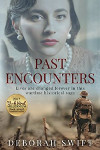
Davina Blake – Past Encounters
Posted 3rd December 2014
Category: Reviews Genres: 2010s, Domestic, Drama, Historical, Political, Psychological, Social
1 Comment
When the past isn’t in the past.
Publisher: (self-published)
Pages: 431
Type: Fiction
Age: Adult
ISBN: 978-1-499-56825-7
First Published: 30th June 2014
Date Reviewed: 22nd October 2014
Rating: 4.5/5
Rhoda finds her married life difficult and always has. Neither she nor Peter are particularly close, and when she discovers he’s been meeting another woman she decides to find out about his supposed affair. Rhoda herself is hiding something from Peter, an event that happened whilst he was in a prisoner of war camp, and just as Rhoda has never spoken of her time, neither has Peter spoken of war.
Past Encounters is an excellent novel that looks at the way secrets, events in the past, continue to affect the way the characters treat each other. The book is a multi-plot novel, of sorts, moving between two decades for the two main characters and including a brief sojourn into the life of another.
In writing Past Encounters, Blake has delved into WWII in a way that is different to many other writers. It may not neccersarily ‘read’ different – others have written about the war camps as have films – but there is a difference nonetheless.
As said, the majority of the book switches between Rhoda and Peter – Rhoda in the 1940s and 1950s, and Peter almost exclusively in the 1940s. Rhoda’s chapters are written in the first person, Peter’s in the third, and perhaps in part because of this, both points of view are equally compelling. In Rhoda’s case you are reading about her search for the truth and the event that changed her, in Peter’s you are finding out about war and why he may not have wanted to speak of it. What’s interesting here is that Blake spends much time telling you all of this yet shows at the end that it’s obviously not black and white. There is a hint – though only a hint – of unreliability, or, rather, the fact that it’s best to remember there are two sides to every story.
The characters aren’t particularly special; apart, perhaps, from Peter’s trials in war, you’re likely not going to remember them for themselves, however this is a point worth considering. It is often more what Rhoda and Peter represent, how they remind you to look at your own life from different perspectives, that is most important. They are two ordinary people living lives in ordinary situations (but for the war), and this makes the book shine.
Blake doesn’t hold back on her descriptions of war. She doesn’t describe everything in gory detail, but her word choice, her style of writing, says so much. You get the facts and you get the raw feelings. And sometimes, because she includes the happier moments and always reminds you of the thoughts of the regular people, even the soldiers, it is all the more compelling. Blake repeats details and talks of the mundane because that was the reality of the situation, and it keeps you reading. Never should you forget how war affected the other side and how most simply wanted to live their lives.
Yet this doesn’t mean that the book falls prey to that known situation wherein a reader prefers one plotline to another, as often occurs when a book switches back and forth. Yes, you may prefer one or the other, but you’ll likely enjoy reading both nonetheless and be happy to catch up. In Rhoda’s story there is longing, there is the change in character that is of course less ‘important’ than Peter’s changes but still important, and there is also the foray into film.
The book’s title owes a lot to the film, Brief Encounter, and it is the production of it that features in the story. The title sports many references therein – the literal past, the brief encounter during Brief Encounter and the way the filming affects Rhoda, the way words and small arguments can cause major changes. The film doesn’t take up a lot of the time, but it’s enough to give you a fair background of it, the working methods during war, the differences between people that remained during war, and so on. And then there is the way the filming clashes with Peter’s internment which may not speak for everyone’s experience but does show how people might have coped in such a situation.
There is that third narration, but it can’t really be discussed without spoiling the story, suffice to say it serves to show how chances taken at the right or wrong moment can have a major affect on everything else.
The sole element that stops the book taking the top spot is the text. There are batches of errors – proofreading and copy editing problems. The story and the book in general is so good it’s very possible to overlook the errors, but in terms of objectivity and the whole, it must be taken into account.
Past Encounters is masterful. It is compelling, and whilst diligently keeping to the specific topics at hand, it never becomes boring or falls into the trap of filler content. It is epic without requiring lots of action and changes, an epic about war without battles.
This book is wonderful.
I received this book for review from the author for Historical Fiction Virtual Book Tours.
Related Books

Suzannah Lipscomb – A Visitor’s Companion To Tudor England
Posted 14th November 2014
Category: Reviews Genres: 2010s, History, Political, Social, Theological
2 Comments

History and the roofs under which it occurred.
Publisher: Ebury Press (Random House)
Pages: 281
Type: Non-Fiction
Age: Adult
ISBN: 978-0-091-94484-1
First Published: 15th March 2012
Date Reviewed: 12th November 2014
Rating: 4/5
In a work that is a combination of reference book and good old straightforward non-fiction, Lipscomb focuses on 50 different locations with a background either exclusively Tudor or worthy of a visit by those interested in the popular history.
There are two ways to read A Visitor’s Companion To Tudor England. Lipscomb herself introduces it as a guide for the general reader, bereft of footnotes and too much information so that it’s accessible to all. This makes the first way of reading that of the previously uninformed. The second way is obviously one that is more natural to myself and quite likely many who read this review – as yet another book that will enable you to spend even more time on something you already enjoy learning about.
Lipscomb’s introduction sets out all you might have wanted to know about the selection of these houses, castles, tombs, and ruins, which is important to read because no matter your prior knowledge you’ll likely say ‘but what about such and such a place?’. Lipscomb tells us why some prominent places did not make the cut, why less well-known places did, and whether or not you agree with her choices you get to see all the planning involved.
However the book does not entirely live up to its promise and this is because of the criteria. The specific criteria listed in the introduction means that some places are of only minor interest overall (perhaps more interest if you’ve had time to visit all the major places before) and this is compounded by the fact that the approach to the chapters vary. Some focus on describing what you will see, others leave that out in favour of writing about the occupants, and there will be times you’ll likely wish another slice of the history had been focused on instead of the one chosen, the abode of a person of more interest written of instead. This means that the book as a ‘handbook’ is less useful unless you’re using it as a quick reference when deciding where to go on your next day trip.
There is a lot of well-known history included, but also a lot of lesser-known facts. In this way both those with prior knowledge and those without are catered for – for every fact you may know, there is a new one, and for the new learner it’s fair to say this gets you up to speed. Whilst there are no footnotes (another decision discussed in the introduction) Lipscomb includes various views from primary sources as well as her own and those from her peers; much as in her work for television, views are discussed before thoughts are given as to her own, so you also get a good taste for the study of history here, too.
What doesn’t work so well are the suppositions. There are many ‘probablys’ in this book, and this is of course more problematic given the lack of footnotes, as there are ‘probablys’ without reasoning behind them. This may work for new learners but means that you won’t learn as many facts as you might think. The cross-references to other chapters are a few too many and there is a lot of repetition – though this is to aid the reader who wants only to dip in to one or two chapters. There are also sections about Tudor life included in chapters that aren’t related to the subject at hand wherein you might wish more had been written about the location.
A Visitor’s Companion To Tudor England is good, but (necessarily) brief. It sports enough to please all readers but is most likely to satisfy the new reader. The inclusions of lesser-known places, however, make it a worthwhile quick read for all.
Related Books

Elizabeth Chadwick – The Leopard Unleashed
Posted 29th September 2014
Category: Reviews Genres: 1990s, Domestic, Historical, Political, Romance, Social
3 Comments

A leopard can/can’t change its spots – delete as applicable.
Publisher: Sphere (Little Brown)
Pages: 376
Type: Fiction
Age: Adult
ISBN: 978-0-751-54136-6
First published: 1992
Date Reviewed: 28th September 2014
Rating: 4/5
Renard has been in Antioch for a good few years, and as those years draw to an end he meets Olwen. He’s had dancing girls before, but Olwen sets him on fire and when she tells him she’s pregnant and needs to return with him, he allows it as his betrothed at home does not interest him. But Olwen’s after power as always, and when Renard finds he does like Elene, she moves on to his rival – a man who wants Renard’s lands far more than he wants to fight in the war between Stephen and Matilda.
The Leopard Unleashed is a solid offering from Chadwick, the last of her purely fictional works (the others being The Wild Hunt and The Running Vixen) with a story that may not have you staying up all night but will definitely have you reading until the end.
The editing isn’t so good; there are the usual errors and the usual sudden leaps in time that can be disappointing, however in this case they are particularly disappointing because they come at times such as a major disagreement or where an illustration of chemistry is needed. Instead of a continuation the issues are worked out off the page with simply a sentence or two to summarise and whilst in the case of Renard and Olwen’s affair it later makes sense, other times it does not.
This said the structure of the story overall is good. This book is one in which Chadwick concludes the story at the end of the story (sometimes books are continued passed their natural conclusion) and the balance between war and romance works well. Whilst Chadwick writes excellent scenes in the bedroom that for the most part further the development of the characters, The Leopard Unleashed contains few but still manages to show the characters well. The book is shorter for it, and it could be said that the structure is better, too. The book is certainly a romance but the rivalry strong. This doesn’t mean everything is clear, however – you will need to keep your wits about you as you read, not only because there are a few names repeated but because there are a few battles fought, numerous occasions where the men are waiting for war or entrenched in war, and there are various reasons for all of them. Indeed Chadwick’s book offers the reader a good reminder that whilst the royals might have been fighting for the kingdom, and their subjects chose sides and fought with them, as always local feuds can be more important.
As always, as expected, the characters are extremely well written and development. If Chadwick wants you to feel for a character you will, and she provides enough narrative for the rivals that whilst you won’t be able to say they are particularly good people, you can see how with a simple switch of view, the story could just as well have been able them. Chadwick suggests who is good and who is bad, but reminds you that it’s not quite as simple as that when heritage, proclamations, and royalty are concerned. Also as expected, the chemistry is excellent, the dialogue fun, informative, and believable, and the historical details abundant. Being about a fictional family, you know much of the history is made up, simply woven into the factual history, but (or ‘and’, depending on your thoughts) it doesn’t matter a jot.
The book may not be thrilling as, for example, the later Lords Of The White Castle that aimed for the reader to be riding full pelt with the horses, but there is a whole lot to like in The Leopard Unleashed.
Yet despite the pace still, when unleashed, the leopard bites, and feel free to read into this statement both the expected might of war and innuendo because both are intended. It’s not going to be your favourite Chadwick, but you’re going to have a whale of a time regardless, forget the fact that there are no whales in the book.
Related Books