





Nancy Bilyeau – The Crown
Posted 26th March 2014
Category: Reviews Genres: 2010s, Domestic, Historical, Mystery, Political, Social, Spiritual
7 Comments

Curses at the convent.
Publisher: Orion Books
Pages: 470
Type: Fiction
Age: Adult
ISBN: 978-1-409-13579-1
First Published: 1st January 2012
Date Reviewed: 25th March 2014
Rating: 4/5
Joanna, a novice at Dartford Priory, leaves secretly to be at the execution of her cousin. She expects to bear witness and return to Dartford, but when the fateful time comes, her father rushes to assist the condemned and she, Joanna, finds herself in the Tower of London. Few leave the Tower alive but Bishop Gardener has a proposition for Joanna. He’ll spare her father if she’ll seek the crown of the old king, Athelstan, a legendary item said to bring greatness – and ruin.
The Crown is a particularly well-researched and well-written Tudor suspense that may not have the shock factor of some books but continues on steadily and with a good few surprises in store.
The strongest element, the stand out element, is the writing and construction. Whilst of course not written completely correctly (because a book written in true Tudor text would be difficult to decipher) the language is good, there are no sudden uses of modern slang, and the times when modern phrasing is used are slight, few and far between, and in such small supply that it doesn’t matter.
This leads on to construction – Bilyeau has done her research. As in the later The Chalice – mentioned here because this reviewer read it beforehand – the history is accurate, the biases are taken from the historical views of the people rather than placed upon the characters by the author, and the times when Bilyeau swerves towards fiction fit together with the factual history like gloves. Joanna is a fictional character, but her family and those she meets are often not, and there are never any occasions where it is unbelievable that these events could have happened. Those looking to learn about the Henrican era will find plenty of true history here, and Bilyeau does not shy away from discussing where her imagination plays its role.
Except in the case of the cursed crown, of course. But this is supposed to be. In the creation of the Athelstan crown, Bilyeau has drawn from the questions for which we have no, or at the very least scant, answers. The crown’s curse affects those royals who did not live long or who died of mysterious causes. The make-up of the crown is not unbelievable when given all the relics in the world and in many ways it echoes such legends as the holy grail and the shroud of Turin.
Bilyeau has populated her book with a vast number of primary and secondary characters. The most developed are fictional, which makes sense; it must be said that in terms of history itself a basic grounding, perhaps even a fair grounding, in the Tudor dynasty and court politics will add to the understanding and enjoyment – the factual characters are well-known. There are a few meetings that can seem too easy but the suggestion of romance means that it is not necessarily a drawback, and of course in a book where the dissolution of the religious houses is a key point, Joanna’s future is a constant question.
Also included as themes are sexual abuse and prejudice against women. Both of these are explored as potential reasons for a woman to choose the life of a nun. A religious life was a way for women to escape the average existence of a woman of the times, to gain an education and make their own choices rather than be subject to the whims and demands of their families, and Bilyeau brings in these and a variety of other reasons to her book.
The book ends quite swiftly, being perhaps a little less striking than you may think, but in choosing the path she has, Bilyeau looks at yet another issue in Tudor England, one which is likely to strike a chord with the reader as the world has changed so much since.
The Crown focuses on not just a person but a community rarely studied in fiction. It examines what is often simplified to a brief schedule the day-to-day life of a nun and the true happiness that could be found therein. And it does this whilst being accurate to the time, unbiased, and packed full of information.
Related Books


Speaking to Nancy Bilyeau about the Joanna Stafford trilogy, The Blue, and Dreamland (spoilers included)
Charlie Place and Nancy Bilyeau discuss the lifestyle of Dissolution-era nuns, using a website’s ‘contact me’ form to great success, there being more relics than there were items, using your family’s name in your work, and the grand amusement parks and luxury hotels of New York’s past.
If you’re unable to use the media player above, this page has various other options for listening.
M J Rose – The Collector Of Dying Breaths
Posted 14th March 2014
Category: Reviews Genres: 2010s, Domestic, Historical, Mystery, Paranormal, Romance
2 Comments
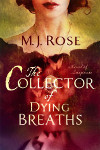
In hopes that the last breath isn’t the last at all…
Publisher: Simon & Schuster
Pages: 307
Type: Fiction
Age: Adult
ISBN: 978-1-451-62153-2
First Published: 8th April 2014
Date Reviewed: 14th March 2014
Rating: 3.5/5
In 1500s France, an apothecary’s apprentice is saved by Catherine de Medici and becomes one of her favourites, providing her with perfumes, potions, and poisons. He is happy in his position but his ultimate goal is to put into practise the theories of his old friend who believed life could be reborn. In present-day France, Jac looks at continuing the work of her brother Robbie, who died of a mysterious illness. History and modernity come together and Jac knows she is taking on the past. She also knows about her brother’s belief that her hallucinations are windows into days long gone, but she doesn’t know just how far it goes.
The Collector Of Dying Breaths is a dual-story book that uses history to good effect but to mixed results.
The story is predictable but it in a way that doesn’t spoil it too much – there is nothing that suggests the answers shouldn’t have been easy to guess. What may prove difficult, however, is the notion of dying breaths that the book rests on. Superstitions and theories about magic and the unknown where rife in the 1500s, but it can be hard to believe that anyone nowadays would consider the possibility that a breath captured in a bottle could recreate life. Whilst the theory is of course fine as a fantasy element, there is not enough of the genre overall to aid in the suspension of what is realistic required by the reader and so the resolution of the story may not be as compelling as it is supposed to be.
This is also true of the way the two time periods are woven together. Because Jac’s ‘ability’ is known from the start, the conclusion of this theme may not seem as interesting. However the biggest issue with the way the periods connect is one of belief, similar to that of the experiments. The past lives idea works by itself, but the way it is dealt with by the characters is overdone – and this is because the main character switches back and forth between being strong and weak, knowledgeable and naïve in odd ways, that make the answers unsatisfying.
Part of the issue has to do with the writing style. There is a lot of telling involved, in fact Jac remains undeveloped for a fair amount of time. Information about her is suddenly included as though you’ve walked in during the middle of a conversation, and facts are dropped randomly that it’s hard not to feel should’ve been stated within the first few pages. Where there is a lot of unnecessary information about historical people and perfumes (more than is needed for this story of perfumers) the book could do with more information on Jac, shown. Nationalities are also difficult to discern and the historical language, whilst generally good, does veer towards the 21st century on occasion.
The history itself is believable and well written. Catherine de Medici is portrayed in a somewhat bad light that might be worse than reality but is far from awful, and you can see where the author has filled gaps in history and used certain factors as a springboard into fiction. The author has no qualms about showing the dark side of court and how quickly an enemy or simply a person of higher standing would be quietly removed.
There are sex scenes in both eras, fairly graphic and in the case of the 1500s showing the religious hypocrisy apparent. One of the contemporary scenes provides a moment of contemplation for the character that seems to be a way for the author to explore a trend and is a little out of place overall, but otherwise, especially where the historical chapters are concerned, the scenes work.
Due to the predictability and sudden switches in thoughts early on, it is hard to get a handle on the story and difficult to say you really know the characters and care about them – the story can be confusing. That said, the history is interesting and accurate enough, and the mystical aspects appealing if not used to full effect.
The Collector Of Dying Breaths is unlikely to make your best of list, but it isn’t bad and the history is informative.
I received this book for review from for Historical Fiction Virtual Book Tours.
Related Books
None yet
Tanya Byrne – Follow Me Down
Posted 13th November 2013
Category: Reviews Genres: 2010s, Mystery, Social
4 Comments
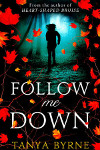
Down in the woods where everyone goes…
Publisher: Headline (Hachette)
Pages: 454
Type: Fiction
Age: Young Adult
ISBN: 978-0-755-39307-7
First Published: 9th May 2013
Date Reviewed: 7th November 2013
Rating: 4/5
Adamma started school at Crofton College in England when her father, a Nigerian ambassador, moved country once again. More familiar with the US, Adamma is somewhat surprised by the reality of the British boarding school, but she finds a friend in Scarlett, a girl who is obviously not prim and proper but not necessarily bad either. The village in which the College is situated is dinky and quiet, but where there are many young people there is surely to be an issue someday.
Follow Me Down is a mystery that twists and turns, ties itself in knots deliberately, and uses red herrings to the extent you wish other mysteries would whether or not you work it out early on. Told via two time instances – the before and after, that descend towards the two mystery threads simultaneously – the story is a quick read whilst sporting a lot of suspense.
Let’s deal with the mysteries first. Byrne has made a valiant effort to stop the reader from truly working them out, in particular the later of the two, and it must be sad that even if you do work them out, it’s quite likely you will still doubt yourself. Byrne’s use of twists and the structure that affords a lot of ambiguity are two of the highlights of the book and worthy of inclusion in the ‘reasons you should read this book’ stakes. Some may find the twists and red herrings annoying, and it must be said that the ending is just as ambiguous as the overall structure – there is an ending but a lot is left unsaid.
But it’s easy to say that the author’s intention may not have been to shock or surprise as much as to study social conventions and ever-present issues. The ‘initial’ heart of the mystery, a possible rape, whilst surrounded by the ‘thriller’ threads, is studied as though it might form the basis of an essay. The book delves into the reasoning victims can be wary of telling the police what happened, it casts a light on the concept of linking clothing and drunkenness with fault, and it also shows how the perception of other women can be an issue where instead there should be support. This spotlight doesn’t run the entirety of the book, but it does cause you to wonder whether your approach to the story and your belief that it’s a ‘simple’ mystery to be enjoyed, is correct.
Going back to the ‘reasons you should read this book’, perhaps the most compelling aspect of Byrne’s creation is her handling of culture and contrasts. The origins and cultural influences of the characters mean that Follow Me Down is a true blend, and Byrne makes every effort to get it right. Adamma is from Nigeria but has spent a lot of time in the US – her narration, when she speaks of herself, is naturally peppered with American terms as well as the understandable various comparisons between England and the States. Her American terminology and nature is matched by her Nigerian roots – she often speaks to her mother in Igbo, for example. This is matched by the British characters – when Adamma relates their conversations they always use the British terms for everything. This approach is a delight in a world where a lack of correct dialect is rife, and it means that the parts of Adamma’s nature – her Nigerian birth, her American schooling, her English Sixth Form years – are each given equal baring. As a study in diversity with characters being ‘different’ just because, it is excellent.
There are some flaws in the plan – there are strange turns of phrase and ways of describing actions, for example Adamma lifts her eyelashes instead of opening her eyes, and these seem stylistic choices rather than dialect ones. There is some repetition and curious uses of emphasis. There are occasions where people don’t speak as you’d expect them to – using very colloquial language where they otherwise use an ‘older’ style, for example – and this can be jarring. Yet as a whole the writing is simply different, not bad, and just something to get used to.
It would be fair to say that if you’re going to find Follow Me Down difficult, it’s likely going to be dissatisfaction with the ending. As Byrne ceases use of red herrings and the answer is allowed out into the open, it may not be as clear as you feel it ought to be. It will be obvious what’s happened, in a literal sense, but it may seem as though Byrne is still trying to hold things back. This isn’t a book for people who like stories neatly tied at the end.
Follow Me Down is in many ways abstract. It is ambiguous and written in a style very much its own. But it also packs quite a punch long before the mysteries are resolved and is a shining example of cultural differences in one place done well. It is a quick read whilst not being particularly fast-paced, it explores the thin line between love and hate, and it makes a very good attempt (and is successful in many ways) at confounding the reader.
The best way to conclude is to say this book is like Marmite. You’ll either love it or hate it, but even if you hate the story you will likely love other aspects of it.
I received this book for review from Headline.
Related Books
None yet.
Mary Stewart – Stormy Petrel
Posted 20th September 2013
Category: Reviews Genres: 1990s, Domestic, Mystery, Social
8 Comments
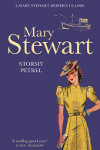
Of strangers and birds.
Publisher: Hodder
Pages: 143
Type: Fiction
Age: Adult
ISBN: 978-1-444-71507-1
First Published: 1991
Date Reviewed: 20th September 2013
Rating: 3.5/5
Rose, a tutor at Cambridge, wanted a holiday somewhere quiet so that she could work on her writing. Coming across an advert for a metaphorical ivory tower, she made her way up to a Scottish island. It’s peaceful, there are few residents, and the cottage is two miles walk from the village. Perfect. Until someone unlocks the back door and says that it’s their home.
Stormy Petrel is a novel that is as quiet as its heroine would have liked, whilst sporting a mini mystery. A blend of cosy mystery and straight forward travel, the book is perhaps at its best in its descriptions of Moila, the imaginary island in the Hebrides.
Because the descriptions have the ability to sweep you away. Stewarts’ creation is fantastic, and in many ways it’s a pity that Moila does not exist, even if similar places do in reality. The writing is soft, almost dreamy, and incredibly readable. The edition this reviewer read was full of editing mistakes but given the time between the first publication and our current day it is difficult to become too ‘taken’ by it.
It must be said that there is little action in the book. This is suggested by the overall set up, the length of the novel, and Stewarts’ writing style, but it is easy to let yourself get carried away – and one shouldn’t. The book lies firmly in the realm of the comfort read and provides a leisurely way to spend an afternoon. The mystery is fair enough but it does not last the length of the book, nor is it particularly satisfying.
The book is most suited to those with a love of the outdoors and nature. It will also please those who enjoy books about writers. Rose discusses her writing a lot and also delves into the process; this book presents a fantasy for anyone who enjoys writing in any way.
The outdoors is almost a character in itself. It is not personified (as some authors like to create characters from nature, houses, and so forth) but it plays perhaps the biggest role in the book. The wildlife is important, and the midges are there constantly (initially this seems over the top, but Stewart has a plan).
The major issue with the book is the use of convenience. Whilst Rose does speak of convenience in novels, the way Stewart goes on to use it as the author takes the element too far. Instead of being simply sweet, the continual use can become irritating. The lack of mystery in a book that initially promises it is not such a bad thing, but the convenience difficult to read.
Stormy Petrel is a comfy novel that is perfect for a rainy day complete with blankets and a hot cup of tea. It may be set in summer, but the weather and the setting suit a dreary autumn day well. Just don’t become too invested in the story.
Related Books

Kieran Shields – The Truth Of All Things
Posted 3rd July 2013
Category: Reviews Genres: 2010s, Historical, Mystery, Theological
2 Comments
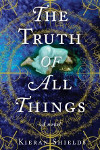
Far more sinister than bubble bubble toil and trouble.
Publisher: Broadway (Random House)
Pages: 401
Type: Fiction
Age: Adult
ISBN: 978-0-307-72029-0
First Published: 2011
Date Reviewed: 2nd July 2013
Rating: 3.5/5
It’s late 1880s Portland, Maine, and a witchcraft fanatic has murdered a prostitute. No one has any idea why and if it weren’t for Grey and his outlandish plans for fingerprint taking and other evidence collecting, it might have been a lot harder to discover. There appears to be a connection to the Salem witch trials, but also to native Indians and a potential link with a pagan group in the town. It’ll be up to Archie Lean, Grey, Lean’s friend Steig and Steig’s niece Helen, to work out what happened and bring the killer to justice.
The Truth Of All Things is a historical mystery based on fanaticism – a nice town setting with some gruesome murders and a narrative that is both plot and character driven. This mixture can keep you reading even during the slow moments.
Shields has created a good cast of characters. It’s obvious from the text that time is to be spent on them as a group in future – whilst the plot may end sufficiently, the situation of the characters is such that even if it wasn’t now the case that a second book is out, the stage is set for a continuation. This doesn’t mean they are particularly developed however, as the bias is towards the plot.
Of particular note is Helen and Shields’s writing of her. Not only is it good to have a woman included in the investigation, Shields makes her role fairly sized and also includes slight social context. Helen is both a product of her time (she doesn’t speak out when the men worry about how she’ll react to bad news) and someone who is pushing for change in that she wants to play her part. This is improved by her status as a mother, albeit that she is a widow and therefore has no one but her uncle to answer to.
Grey’s part is also worth considering as he is partly native Indian. Although he lives in a time where he has some respect, there are occasions where he is discriminated against and, like the crafty detective he is, he uses this to his advantage, lurking in the shadows so that he and Lean get two perspectives of a scene. Indeed whilst it is slight, Shields book provides a commentary of the society in general. It’s there, but it never takes over the story. But nor is it so minute as to not be noticed.
The history (the 1600s Salem witch trials rather than the 1800s setting of the book) is used to good effect. It is of course important to the story itself, yet Shields never allows it to take over here, bringing in other factors to influence the crimes. When reported, however, there is a lot of detail provided. The issue is that sometimes it could be considered info-dumping. It’s far from a major negative, especially as it’s confined to dialogue, but it is noticeable, namely because it slows the dialogue down to a halt. The 1800s history is all that you’d expect from such a setting, that is to say if you like reading about the period at all, you will like Shields’ Portland.
The dialogue can be grating at times. Shields includes a lot of banter between the characters, and much of this happens during odd moments. It also isn’t very successful as it’s based on the characters’ natures which, given that this is a first book of a series and there is a whole thread dedicated to murders, isn’t something that one can appreciate as the characters are not known yet. There is the sense that the reader ought to know them already.
The book picks up pace around the three-quarters mark, gaining momentum and showing off what Shields can do when not bogged down by detailing. He pulls the wool over your eyes to success. You do need to keep your wits about you as most of the minor cast are referred to at this time, all at once.
The Truth Of All Things isn’t bad. It’s a good début and good enough that you might want to check out the next book. But you won’t be waiting impatiently for it.
I received this book for review from Crown Publishers.
Related Books


