





Sue Gee – Trio
Posted 27th May 2016
Category: Reviews Genres: 2010s, Domestic, Historical, LGBT, Music, Spiritual
2 Comments
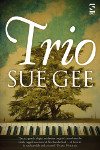
The healing powers of music.
Publisher: Salt
Pages: 308
Type: Fiction
Age: Adult
ISBN: 978-1-784-63061-4
First Published: 16th May 2016
Date Reviewed: 23rd May 2016
Rating: 4/5
Margaret dies early in the marriage; Steven is devastated but knows he must keep going. One day his colleague at school invites him to a concert and though Steven has no knowledge of music he enjoys it, and comes to enjoy the company of his colleague’s childhood friend. His loss will always be with him but in Margot and her music he sees light ahead.
Trio is a book set in the couple of years prior to the Second World War that looks at sadness, tragedy, and the way we deal with it. A beautiful work of literary fiction, it’s full of originality and sports a lovely uniqueness.
And then the gas masks came. In every classroom, throughout the lunch hour, came the struggle to fit the things on, the coughing and heaving at the rubbery smell, the helpless laughter as the trunks were waved about; the trumpeting.
‘Look at you, Hindmarsh!’
‘Look at yourself, Potts. You look prehistoric.’
‘All right, boys, that’s enough.’
Gee’s been writing for years and it shows. Her writing style is rather like a script; the author includes description in the third person but will then switch to dialogue in a way that means you hear a lot more about the situation in a sort of faux first person. Many of the descriptions of thoughts turn out similarly. It won’t be to everyone’s tastes but it is something that everyone is likely to appreciate, at the very least. It’s a literary dialogue, at once between the author and her characters – rendering them in a realistic fashion – and also between the author and the reader, both a breaking of the fourth wall and a hiding behind it. It means that every single character who speaks – every pupil in Steven’s class who gets a mention – stays in mind as though they were all main characters.
Sadness informs most every part of this book. It’s everywhere but Gee never lets it burden the text itself, meaning that whilst this book may be triggering if you’ve recently lost a loved one, it’s not a book you’ll need to avoid for long. But whilst not burdening the text, Gee never covers up, showing how sadness carries on, lingers far longer than our speaking of it shows. In this way she demonstrates how that point wherein society says ‘okay, enough moping now’ shouldn’t be taken as wholly as we often do – everyone suffers losses and it’s okay to refer to it in the future.
There are various tragedies: Steven’s loss of Margaret, a person’s ‘loss’ of the friend they are in love with (twice over in this case), the way a rebuff of affections can lead to awful conclusions. Many of the losses are connected but few are vocalised. Gee uses a bit of mystery in order to explain certain emotions – they aren’t mysteries you need to work out as it’s pretty clear who is who and what is what, it’s that the emotions need to be hidden between the characters because of a feeling of shame or worry that is down to their situation, their relation to one another, and the time in which they are living.
The book is fantastic right up until the last couple of dozen pages. Everything ebbs along and you’re ready for the inevitable start of the war and in seeing where it takes the characters and then suddenly you’re pulled forward to our present day. There is no conclusion to Steven and his friends’ stories, instead you move on to the latter years of Steven and Margot’s son, a person you’d not met. Why this was done is not clear – presumably it was so that we could learn the outcome of everyone’s lives, but this is small compensation; the information could have been provided in an epilogue or, because there’s really only one character you ‘need’ to hear about, communicated naturally at the end.
As for the musical episodes they are mainly good, if a bit overwritten. Steven’s lack of knowledge means that Gee goes into a lot of detail, romanticising the sounds and effects of music; when it’s part of the subtext it’s glorious. The trio of the title don’t quite make the book what it is – that’s Steven’s role – but they play their part; it’s more that they’re the ones through whom people are connected.
Trio is difficult to put down. It’s a gorgeous escape back in time that for all its – needed – sadness, is gripping. The end does come out of left field but the overall product is wonderful.
I received this book for review from the publisher.
Related Books
None yet
V H Leslie – Bodies Of Water
Posted 16th May 2016
Category: Reviews Genres: 2010s, Historical, LGBT, Paranormal, Science, Social
2 Comments
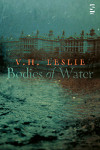
Not just a siren’s call.
Publisher: Salt
Pages: 130
Type: Fiction
Age: Adult
ISBN: 978-1-784-63071-3
First Published: 15th May 2016
Date Reviewed: 3rd May 2016
Rating: 4/5
Following a sad breakup, Kirsten moves into an apartment building situated beside the Thames, which used to be a wing of a Victorian hospital. Drawn by the location, she starts to unpack but is relieved to find she’s not the sole resident of the renovated block. Then there’s Evelyn, rescuer of fallen women in the late 1800s, who has been sent by her father to a hospital for the Water Cure. She’s haunted by the loss in her life of her former lover, a woman she rescued, and hopeful that her stay can help her.
Bodies Of Water is a paranormal, gothic, novella that looks at the way water has had an effect on lives through the decades. It’s a dual plotline work that doesn’t go the way of many others, making it more unique (there are no revelations of connections between the characters).
Leslie has compiled a few concepts and it works very well. The book studies the treatment of women in the Victorian times, contrasting it slightly with the present day. The author works from the diagnosis of hysteria, that Victorian concept of a particularly feminine illness often associated with what we’d now consider the repressed sexuality of women. Leslie never says what caused Evelyn’s hysteria directly – in a way it’s up to the reader to decide – but this works in the book’s favour, allowing for more thought as much as it ushers you to concentrate on the bigger picture. Because whilst Evelyn seems fine, her stay at the hospital speaks of the wider issue.
It’s the basis behind Evelyn’s calling that Leslie wants you to focus on; Evelyn works for the Rescue Society, going out into the streets to aid prostitutes, hoping to save them from the abuse many suffer, from sexually transmitted infections. She likes the idea of bringing the women to a better, higher life, though through the chapters we see her realising that this cannot always happen – in the case of Evelyn’s lover, Milly, for example, Evelyn can’t get away from the fact she’s got Milly a set of rooms but no society to mix in, and that their relationship may be about love on her own side, but Milly may see it as just more of the same.
It’s Milly’s death that gives the study its backbone; Milly is one of many women who have taken their lives, fallen into the Thames, so that whilst Kirsten, who comes to see the paranormal in her leaky ceiling and in the drenched woman on the river bank, is more a bystander, learning about what happened at the scene abstractly, Evelyn’s direct relationship with the river allows a more poignant mode of thought. And as the Victorian character comes to understand the finer details of the hospital and suffers a setback, so her thoughts take quite a shape:
As for lust, it seemed to be the curse of every man. The Rescue Society would have no fallen women to rescue if men could only control what was between their legs. Evelyn had read in her father’s medical journals that hysterectomies and clitoridectomies were often performed to cure women of the very condition Dr Porter had diagnosed Evelyn with. They were so ready with the scalpel, these medical men, to cut and slice, yet no one had thought that castration was the logical solution to venereal disease.
A running point through the book is this plight of women to be heard and to gain freedom; Virginia Woolf’s thought of a room of one’s own is given space, her demise compared to that of the many fallen women ending their lives in the river. There are echoes of Kate Chopin’s The Awakening, too. Kirsten’s introduction to the relative reality of what’s going on is in the form of drawings of bodies being pulled out, doctor’s knives at the ready. Because how else were women to be understood?
Leslie’s study is a good one, just a little short. There is some confusion in the story that would not be there if the plot had been teased out more, given more time between revelations. Everything happens a bit too quickly and questions are left unanswered. In terms of the text there are patches of proofreading errors that are noticeable and add to the confusion on occasion.
But all in all Bodies Of Water is a solid article. It’s well-researched and it puts a different spin on a well-used format. It’s got enough of the history that intrigues many people without treading the same path. Recommended.
I received this book for review from the publisher.
Related Books
None yet
Jessie Burton – The Miniaturist
Posted 18th March 2015
Category: Reviews Genres: 2010s, Angst, Drama, Historical, LGBT, Magical Realism, Mystery, Social, Theological
4 Comments

He knows when you are sleeping; he knows when you’re awake.
Publisher: Picador (Pan Macmillan)
Pages: 424
Type: Fiction
Age: Adult
ISBN: 978-1-447-25089-0
First Published: 3rd July 2014
Date Reviewed: 16th March 2015
Rating: 2.5/5
It’s 1686 and Nella moves to the home of her new husband in Amsterdam. She expects happiness but instead receives a frosty reception – she’s not particularly wanted, her sister-in-law is clearly mistress of the house, the servants seem too big for their boots, and her husband makes no move to consummate the marriage. Instead of the life she thought she would have, Nella finds herself living in a mystery and this only increases further when her husband buys her a miniature of their house and the creator she assigns to complete it appears to know an uncanny amount about the family.
The Miniaturist is a book that could have been amazing but is sadly held back by a lack of focus, poor writing, and a decisive gap between the characters and the readers.
Burton seems to have chosen the 1600s to gain the attention of history lovers. The book could have been set at some other time at no cost, and the characters do not at all conform to the time period. By this I do not mean the way they defy convention – indeed servants on a par with their masters is not unbelievable – more it’s the way Burton wields power that is an issue. As an example, Nella has a fit over something most of her era would naturally have a fit about, before doing an about turn and completely changing her opinion within hours, emulating views of the present day.
Is Nella confident or nervous? Burton cannot decide. One moment her character is close to being obnoxious, the next she’s a delicate flower who will not speak a word. She leaves the house without question one day, then stays in her room and lets people make all the decisions for her the next. It is clear that Nella is a device – this is a plot-driven novel – but there is nothing to hang on to, so to speak. Burton hasn’t made up her mind and wants both worlds.
The characters never come into their own. You’re never given a reason to care about them; they are distant from the first page to the last. A lot of this is down to the way the author chose to write her story – the particular way she uses the present tense, third person narration, does not allow the reader to feel they are at all close to what’s happening. Instead there’s the sense Burton realised, at some point, that she should have been writing in the first person but didn’t want to rewrite what she already had. Nella does lots of thinking and imagining when dialogue would work better. Everything is too detailed, info-dump is common.
Much of the issue is that The Miniaturist is full of drama. Full of drama to a melodramatic, unnecessary degree. As the book progresses it reads ever more like a prose version of a theatrical production, the problem being that theatre has to be expressive to reach the audience at the back of the room but a book by its very nature has no requirement for it. Disaster follows disaster to a silly level and social issues are packed in like sardines.
As said, this book is not very well written. Whilst modern language is natural – a book in old English would be difficult to read – very modern slang and colloquialisms pull you out of the story. Burton moves between ‘oldy-worldy’ English grammar, modern English grammar, and American grammar, making for dialogue that doesn’t ring true. (The characters may be from Amsterdam, but they would not have peppered their language with Spanish grammar, for example.)
Lastly, it must be said questions are not answered. The question of the miniaturist is never answered. There is a half answer that spells out who they are in terms of background, but you never learn the mystery nor do you ever really meet the miniaturist. The question of what will happen to these characters now they are in a bad position is completely forgotten.
The Miniaturist is strictly okay. Read it if you will, but don’t pass up the chance to read another book for this one.
Related Books
None yet.
Elizabeth Fremantle – Sisters Of Treason
Posted 4th March 2015
Category: Reviews Genres: 2010s, Domestic, Historical, LGBT, Political, Social, Theological
5 Comments

Heads held high as others fall.
Publisher: Michael Joseph (Penguin)
Pages: 450
Type: Fiction
Age: Adult
ISBN: 978-075-38232-48
First Published: 22nd May 2014
Date Reviewed: 1st March 2015
Rating: 4/5
When Lady Jane Grey is killed the future becomes uncertain for her mother and sisters. Regulars at court and related to Queen Mary, no one knows whether or not they will be safe and as time goes on and this doesn’t change, it’s up to the family to try and find a solution.
Sisters Of Treason is the second novel by Fremantle, which looks at the trials (sometimes literal) of the Greys that remained. It also looks at the little known life of minature artist, Levina Teerlinc, filling in the gaps in the history.
It has to be said that this is no Queen’s Gambit, however this is not entirely down to the author. Whereas previously Fremantle chose to write about a queen with plenty of history behind her, this time her subjects are somewhat obscure and did not lead as eventful a life as Katherine Parr. This, then, presents a conundrum: the book is not particularly riveting, but then Fremantle has followed what is known of the history.
Essentially this book was always going to be limited in scope; yet this limitation itself is worth discussing. Katherine and Mary were rarely away from court and, in Mary’s case especially (at least here in this book), they are not particularly fond of court. This means that whereas we are often told – by teachers, television, evidence – that court was a blustering, busy, exciting place, this novel shows us that actually in many ways it was boring. We all know it was stifling, rife with jealousies and full of backstabbing, but ‘boring’ is rarely a word used.
This is to say that Fremantle effectively shows the reader how dull Katherine and Mary’s lives were. Not dull as in to say unworthy of study, but dull because they had to remain at court when they may not have wanted to. There is the threat of death ever lingering in the background, but as a conflict it is not very strong – it could be said that this is a character-driven story when generally factually-based historical novels straddle both plot and character, tending towards plot as their backbone. It could thus be said that this would have made better non-fiction.
Fremantle makes as much as she can of the known history, and chooses to incorporate less reliable evidence only when it suits her plot. As an example we have Mary, who has a crooked back, scoliosis perhaps. It is interesting to look at this example in light of the recent discovery of Richard III’s body. It was constantly debated whether or not Richard had scoliosis, whether or not we should trust the words of those historical figures who may simply have hated him, and in discovering his body it was found that those people were speaking the truth. All this to say that, given Richard III, if Mary was reported to be crook-backed then it’s very possible she was and thus despite the general lack of evidence in the pictures we have of her, Fremantle’s decision to incorporate a disability into her fictionised Mary’s life is something to savour. Fremantle makes a point of studying the culture in terms of disability, which is aided by her extra focus on Levina Teerlinc.
Teerlinc, a rarity in medieval history – a female artist – is little known, and so Fremantle’s dealing of her is largely similar to the character of Dot from Queen’s Gambit. Through Teerlinc Fremantle explores not only the Tudor working woman but the world beyond the court and the politics in the wider world that merit a totally difference handling when discussed inside the privy chamber.
It should be noted that the dispositions of queens Mary and Elizabeth are not favourable, which in the case of the latter may surprise you. However it is perfectly reasonable considering the viewpoints used – Katherine and Mary were not going to like Bloody Mary and if Elizabeth held them prisoner, it’s safe to say they wouldn’t have considered her especially wonderful, either.
Sisters Of Treason looks at the life of those who might have wished for something that would have rendered them even less well-known. Whether you will like it or not really depends on how open you are to the idea of sitting sewing beside the window whilst the world passes you by. It is likely to interest those with a prior interest in the sisters; as for others it is hard to say. The book is certainly well written and full of factual information you won’t forget in a hurry. Indeed the only written element that is cause for thought is the French of Frances Brandon, of which there is a lot.
Sisters Of Treason focuses on hope when everything else is lost. It’s packed with history and is an excellent example of good research and writing. It is respectful of the historical figures it uses, but it should be noted that it is steeped in anxiety and sadness and that the conflict is less apparent then is generally expected.
I received this book for review from the publisher.
Related Books


Philip Pullman – The Broken Bridge
Posted 15th August 2014
Category: Reviews Genres: 1990s, Angst, Commentary, Domestic, Drama, LGBT, Social, Spiritual
2 Comments

Who am I? Who are you? Do we care?
Publisher: Macmillan
Pages: 295
Type: Fiction
Age: Young Adult
ISBN: 978-0-330-39797-1
First Published: 1990
Date Reviewed: 14th August 2014
Rating: 4.5/5
Ginny’s not really sure whether or not she fits in. At sixteen, she’s happy in Wales, has a great relationship with her devoted father, and a fair few friends. But being one of only two black people in her town, she doesn’t feel quite… right. Okay, so she’s not completely black, unlike Andy, because her father is white, but when her skin colour is added to her artistic nature the question of who she is starts to become more prevalent. Yet suddenly this isn’t so important. Her father’s about to bring an unknown brother home. If he’s never told her she has a brother, what else is he hiding, and if she was wondering where she fit in before, where does this leave her now?
The Broken Bridge is a fantastic little novel that, although a YA book, has just as much if not more to offer the adult reader. I’ve read it three times now – as a child, as a teenager, and just yesterday, and each experience has been very different, but this last time had the most impact on me.
Perhaps it’s to do with the book’s age – as in all Pullman’s books, the content is not censored and real issues are confronted, and in the 90s when subjects such as homosexuality and racial diversity weren’t discussed quite so openly, and given that The Broken Bridge was written for teenagers, it is somewhat ahead of its time, or at least it feels as though it is. This is a major reason why I say it offers a lot to adult readers.
The story revolves around the theme of identity. Racial identity, familial identity, identity in the world in the long term. Pullman effectively pits one after the other, showing that everything is just as important – Ginny feeling happy in herself is important, but here’s her brother and her identity in this new set-up is just as important, and hey, look, here are a bunch of questions about her mother and where all her memories of her childhood stem from and what impact do these have on her?
There is the furthering of the theme beyond Ginny, and it touches on her brother, father, and in a rather compelling way her mother, too, but the main focus of course remains on Ginny as she makes mistakes, makes rash but good decisions, and works out who and what she is.
Pullman asks us to consider what makes a family and what is and isn’t ‘right’ in this context. He sets some difficult challenges for the reader – reunions that do not go the way you would expect them to and for their subject are very hard to read, relationships that are full of angst. He challenges the status quo almost to excess when you consider the book as a whole. But it’s a good excess. And, anyway, what is family and what is important? Almost everyone in the book lies somewhat or keeps the truth hidden, but Pullman does let go at the end, explaining everything. It’s particularly unsavoury but a good look at how people view independence differently, and how others can view dependence and routine as important.
And, somewhat obviously, the author takes time to look at racism. He shows how it isn’t always in your face, so to speak, how it can be quiet, how it can be worse depending on the situation, and how sometimes it can be part of a bigger burst of anger.
Lastly, if you are an artist or lover of art, of any kind – not just painting or drawing – you will love the detailing in this book. Pullman doesn’t just inform you about the great artists and about good paintings, he brings to mind the utter pleasure and passion that comes with working out what another is saying through their art, and the sparks, the love, that creators and enthusiasts feel.
The Broken Bridge is one you don’t want to miss. My copy, at least, looks to be very much a children’s book, and as Pullman’s writing is at times quite literary and of that earlier decade, you would be forgiven for starting it and wondering if it’s going to be a satisfying read. But it is, so much.
Mend this bridge – read this book.
Related Books


