




Rachel Elliot – Whispers Through A Megaphone
Posted 22nd August 2016
Category: Reviews Genres: 2010s, Comedy, Domestic, LGBT, Psychological, Spiritual
2 Comments
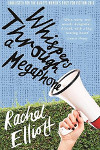
It’s no good keeping it all to yourself.
Publisher: Pushkin Press
Pages: 342
Type: Fiction
Age: Adult
ISBN: 978-0-992-91826-2
First Published: 26th August 2015
Date Reviewed: 22nd August 2016
Rating: 4/5
Miriam hasn’t left her house for three years. All her life she’s been dealing with the effects of her mother – first as it happened as a child, then the repercussions as an adult. She’s also suffering from a worry over her ‘feral’ reaction when someone attacked her. But now she wants to leave the house. Ralph’s been married to Sadie for sixteen years but it’s not a happy marriage; there is something amiss with Sadie and she’s always on her phone. One day, thrown a birthday party he doesn’t want to have, Ralph decides to leave.
Whispers Through A Megaphone is a witty book about healing and living life with its various neurotic aspects.
Jilly Perkins was a genius. Ralph wanted to tell her this, but she hated compliments. They filled her with wind and suspicion.
Elliot’s story is one that’s based in reality with a bit of a bizarre twist that one could say has been added in part to make it easier to relate to. Beyond Miriam’s stay in her house the narratives, numerous on occasion (Elliot details a few strangers every so often, all with their own quirks), and situations are easy to relate to and because of this the humour and skewing slightly towards the extreme mean the book remains light and nice to read instead of bogged down, depressing.
Because the subjects are depressing. The abuse Miriam experienced at the hands of her mother is painful to read and something that happens a lot in our world. It’s affected Miriam to her core; there’s a constant voice in her head that she recognises as her mother’s. Miriam whispers because her mother hated hearing her and threatened her with atrocious punishments. But she’s always been aware of what’s outside her mother’s clutches – in leaving the house and meeting people she knows it’s potentially going to take some getting used to. This is what happens when a child is abused, says Elliot.
Alongside healing, regret is one of the subjects. Ralph’s wife, Sadie, has spent their marriage pushing back memories of her time at university, at the almost-relationship she had with Alison, wishing she’d done things differently, and for lack of anywhere to go, her grief has spilled into all other aspects of her life. She blogs and tweets almost compulsively, telling everyone about what’s going on at home and including things about her husband whose patients (he became a Psychoanalyst to please Sadie, who didn’t like him gardening) are following her. She has developed a crush on her best friend who is already married. She is what people would call ‘high maintenance’ – Elliot shows there’s generally a reason for neurotic personalities. The family is very normal in their dysfunction.
The writing is nice; it’s short, snippy, always to the point. There’s a lot of white space during the many dialogues because the lines are often just a few words long. The pace speeds up during some narratives, Sadie’s, for example, and then back down for Miriam, but it’s never slow. There are some tweeted sections to give you a good idea of Sadie and a brief look-back at the lives of periphery characters. The only difficulty here is when the narrative moves back in time; it’s not always easy to tell what period you’re reading about. It can also be hard not to see Ralph and Sadie with heads of white hair though they’re said to be in their 30s.
This is a book that doesn’t necessarily go the way you think it will. It has an ending of sorts but it’s far more about the exploration. It’s quite clever really, this book that’s about the absolute everyday, looking into the smallest of smallest details – it’s an ‘ah ha’ sort of book, Elliot’s keen sight for what’s behind the surface and her way of interpreting it for us. She says what we often know deep down but have trouble connecting to other aspects of our lives.
Joe Schwartz was the first guest to arrive. He was early, nervous, drenched in aftershave.
Stanley answered the door.
“You look amazing,” said Joe.
“Thanks,” said Stanley, his nose twitching. He hoped he wasn’t allergic to Joe. It was too early in their relationship for hypersensitivity, aversion, turning into his parents.
Whispers Through A Megaphone shows that one shouldn’t be afraid to speak up, that it’s in keeping quiet that regrets are formed (obviously it’s a little different in the case of abuse). It’s a lovely book that uncovers a lot in a short period of time, wading into tough waters whilst remaining something you want to go back to.
I received this book for review from the publisher.
Related Books
None yet
Dan Richards – Climbing Days
Posted 17th August 2016
Category: Reviews Genres: 2010s, Adventure, Biography, History, Social
6 Comments

Almost every mountain.
Publisher: Faber & Faber
Pages: 322
Type: Fiction
Age: Adult
ISBN: 978-0-571-31192-7
First Published: 14th June 2016
Date Reviewed: 15th August 2016
Rating: 5/5
Dan Richards discovers his great-great aunt by marriage, Dorothy Pilley, was a well-known mountaineer in the early 1900s. He sets out to find out more, staying in Cambridge to read the letters and articles left there by his aunt and her husband, Ivor, interviewing friends and family, and making various journeys of his own to cover the routes taken all those years ago.
Climbing Days is a humorous and intelligently written book that blends biographical history with a personal journey and nature writing. For its mix of subjects and the overall tone, it has wide appeal.
The book sports history in abundance. Richards spends a good few chapters sharing his research and the day to day of his time in Cambridge before he goes on to detail his own climbing ventures, adhering to his own chronology to set the scene. This means there’s a lot to get through but it’s peppered with anecdotes; the pace is swift. When it comes to Dorothy and Ivor themselves, the author favours subject over timeline, sectioning his text by mountain climbed. Richards writes from his own interests, telling the stories from a certain viewpoint with the result that you feel you know the couple very well. And he’s big on facts, using quotations liberally so you’re always hearing the thoughts of others.
As a reading experience it’s a delight. Richards’ style is friendly and inviting. There are footnotes aplenty, sometimes for reference purposes but mostly because the larger story surrounding the one being told he finds too good to leave out:
My mother’s Scottish grandmother, Margaret Greenland, was also famous for wearing a hat but she wore hers whilst she did the housework so that, should anyone come to the door, she could claim that she was ‘just on her way out’ and so not have to invite them in. She was a great exponent of ‘You’ll have had your tea’ as well, I’m told, from earliest afternoon onwards.
The writing is incredibly readable with the sort of attention to detail that means errors are few. It’s got that literary factor, good language, and articulation that at times may require a dictionary but never suggests the author used a thesaurus – there’s no pretentiousness here.
I picture the Pinnacles assembling – travelling to North Wales by train and motor car, collecting each other like raindrops on a window pane.
A lot of learning is part and parcel to the reading experience. Much of the studious detail is down to Ivor’s career in academia. Want to know why we as students in school and university have those difficult, often annoying exams in which we must study poems without knowing the context or who the poet is? Ivor Richards. Author Dan includes his own schooling, his time following the exam structure without knowing he was related to the man who created it.
‘In those days, even up in the Lakes, a girl couldn’t walk about a village in climbing clothes without hard stares from the women and sniggers from the louts.’1
Naturally there’s a lot of focus on women and independence. Women were not allowed to venture up a mountain alone so Dorothy’s younger brothers had to learn to climb. She left them far behind her when the time came. There is information about the first ladies’ climbing clubs, one of which Dorothy co-founded. And there are the blue prints for Richards’ 21st century follow-up journeying – Dorothy’s memoir, the original Climbing Days.
The climbs themselves see Richards travel to The Dent Blanche, The Lake District, and Barcelona among other places. Not a climber by nature, there are technical details included but a lot more about the room for error and danger, about training, and the process of climbing when you don’t know what you’re doing, all contrasted with Dorothy and Ivor’s passion and competence in a time when there were fewer safety measures.
It is Richards’ passion that makes Climbing Days what it is, that creates the broad appeal and enjoyment. There are no big surprises, no plot-like thrills, just that overall pleasure of reading, of the slow progress of the journey. It’s both escapist and anything but.
References
1 Taken from Pilley, Dorothy, ‘The Good Young Days’, Journal Of The Fell And Rock Climbing Club, no. 50, Vol. 17 (III), 1956; cited on page p.67.
Related Books

Speaking to Dan Richards about Climbing Days, and Outpost (spoilers included)
Charlie and Dan Richards discuss asking to join well-known people for lunch and producing fascinating interviews for your book, travelling the less beaten paths of your mountaineering great-great aunt, finding society in isolated places, and looking ahead to how we might continue to approach humanity’s harming of nature after the benefits to scaling back have been shown by this current crisis.
If you’re unable to use the media player above, this page has various other options for listening.
Xiaolu Guo – A Concise Chinese-English Dictionary For Lovers
Posted 10th August 2016
Category: Reviews Genres: 2000s, Domestic, Social
2 Comments

Learning and living.
Publisher: Vintage (Random House)
Pages: 356
Type: Fiction
Age: Adult
ISBN: 978-0-099-50147-3
First Published: 27th February 2007
Date Reviewed: 23rd June 2016
Rating: 3/5
Zhuang Xiao Qiu has come to England to learn English so she can have a better career in China. Early on she meets a British man at the cinema and they quickly become lovers. He’s twenty years older than her and, as she comes to realise, very different in personality, but she loves him. And with her ever improving language skills she hopes it will all work out.
A Concise Chinese-English Dictionary For Lovers is a pretty easy-going book about cultural and personal differences that hold sway over even the hottest sexual chemistry (though not all of it’s graphic; I’m saying it to allude to the slightly humorous nature of the book). Told in a broken English that begins with little knowledge of the language and slowly improves over the course of the novel until it’s edging towards fluent, it’s quite a lovely book even if it’s far from perfect.
In regards to the language, obviously it is part of the whole concept. Guo wants to show not only the literal improvement of someone with only a basic knowledge when they first land in England but also how much can be conveyed no matter the speech, and this works. Granted, in choosing this book you have to be happy to read a whole novel in this broken language, but there is much to like about it. The chapters are driven by dictionary definitions, each chapter revolving around the aspects and real-life examples of a word definition. There are also a few pictures, mostly basic maps, and the passing of time is marked in months, episodes segregated by the months they occur.
One of the best things about Guo’s development of the story as a whole is the way you get a very clear picture of Xiao Qiu’s lover no matter her terminology. Guo succeeds in fleshing out the nameless male main character without our ever hearing from him directly (we only hear of him through Xiao Qiu and through a couple of letters he writes to her), and whilst some of his characteristics elude Xiao Qiu for some time, you as the reader cotton on to him pretty quickly. You see the drifter in him, the non-commitment that he tries to explain to Xiao Qiu but fails to do so well enough for her to truly understand (and that’s not to do with her English but to do with his dithering). On the other hand, this man seems to be unaware that he may feel more than he says, more, even, than he realises, and so at times the novel is quite powerful emotionally.
At the same time, Xiao Qiu is rendered rather stereotypically and with a strong focus on sex. I’ve noticed this about Guo, that she spends a lot of time, needlessly, on sexual subjects and it’s the case here, too (hours spent at a peep show, for example). It means that, because Xiao Qiu is understandably meant to be, at least somewhat, a reflection of a Chinese immigrant, that reflection comes off badly. Doubtless most people will recognise that she isn’t representative of Chinese women except in the ‘proper’ sections on culture (as in the sections where she speaks of things that are more a true representation of a Chinese woman’s thoughts) but this doesn’t change the confusion – why did Guo write Xiao Qiu this way? Especially as Guo moved to Britain from China herself? (And we could also question the way Xiao Qiu moves in with her lover soon after meeting him when we’ve been informed of how traditional her mother is and, later, that Xiao Qiu wants the married-with-house-and-children life herself.)
To reference a later book of Guo’s that I’m including because I read it first, there is the same plot detouring here as there is in I Am China, but its impact is not as overwhelming on the story. Xiao Qiu goes off to travel for a few months and it’s just a series of train journeys and meet and greets with a particularly negative ratio of creepy strangers to caring strangers that doesn’t advance the plot and, despite Guo’s suggestions to the contrary, doesn’t contribute to character development either. But as soon as Xiao Qiu is back in Britain the story picks up again.
There is some commentary on Communism here, as well as Mao’s era and the distinct differences between British and Chinese culture. A good half of Xiao Qiu’s relationship with her lover is composed of conflicts caused by both parties’ relative inability to accept the other’s cultural differences, and this is where the showing of both personalities is most prevalent. You as the reader can see where Xiao Qiu has made a relationship with someone who is not a good fit – and that’s without any of the cultural differences – and where both could do with better communication of the sort that is not down to language.
A Concise Chinese-English Dictionary For Lovers isn’t perfect. There’s the filler section, the gratuitous references to sex and the plot that’s not particularly compelling – a fact that manages to slip under your radar at times due to the language, a fact that may or may not be considered convenient. But it’s a nice read, it’s got a lovely literary fiction aspect to it that can be enjoyed by both lovers of the genre and those who don’t tend to like it, and it makes you look at situations in a particular way. Those who have learned English as a second language may relate directly to some of Xiao Qiu’s frustrations and those who haven’t will appreciate what Guo is trying to do.
Related Books

Colette Dartford – Learning To Speak American
Posted 8th August 2016
Category: Reviews Genres: 2010s, Domestic, Romance, Spiritual
Comments Off on Colette Dartford – Learning To Speak American

Sidewalks and pavements.
Publisher: Twenty7 (Bonnier)
Pages: 371
Type: Fiction
Age: Adult
ISBN: 978-1-785-77002-9
First Published: 1st October 2015
Date Reviewed: 7th August 2016
Rating: 3/5
Lola and Duncan lost their daughter two years ago. They’re still suffering as though it was yesterday; their marriage, once very happy, is a fragment of what it was before. Desperate to make her happy again, Duncan agrees to Lola’s idea of buying a holiday home in California – they are spending their anniversary across the pond – but doesn’t factor in his own issues. Duncan’s been unfaithful for a long time, though he’d never admit it, and there are problems at work.
Learning To Speak American is a quick, easy read, that has a nice premise – hope for healing – but doesn’t achieve its potential.
This is largely down to the writing – the level of telling over showing is very high and it means there is little room for imagination. Lola boils pasta and we’re told her face steams up, the dog brings back the ball and we’re told it’s soggy. On these occasions there is no space to feel for the characters – at times it can seem as though they are puppets, walking around so that things can be detailed.
When the narrative turns to dialogue, the book is a lot better. The first few chapters and the scenes in the book that are mostly dialogue are great examples of showing. The dialogue itself is generally very good. It isn’t always perfect grammatically as the phrasing doesn’t always ring true – the book could have done with more editing and proofreading – but as an overall element it works and the pages pass swiftly. The characters come into their own.
Unfortunately the editing issues involve repetitive statements that should have been noted and some of the plot elements are odd, for example the estate agents that sell Lola and Duncan the house know the neighbours, which makes sense on some level as the house had been on the market for a while, but they all seem bosom buddies and it’s not explained. The details of daughter Clarissa’s fatal accident are kept from you until the end. And it has to be noted that many will find Duncan’s infidelity, the nature of it and the way it carries on, difficult. When does the story take place? Bush and Blair are mentioned, but Lola’s forty-two years and no computer or phone knowledge don’t add up. Mobile phones that everyone has speaks more of our present time.
Learning To Speak American is an easy read and that’s due to the good parts but it really needed more time spent on the drafting and editing process.
I received this book for review from Midas PR.
Related Books
None yet
Olumide Popoola and Annie Holmes – breach
Posted 3rd August 2016
Category: Reviews Genres: 2010s, Commentary, Political, Short Story Collections, Social
Comments Off on Olumide Popoola and Annie Holmes – breach

The hole in the fence. The gap in the conversation.
Publisher: Peirene Press
Pages: 146
Type: Fiction
Age: Adult
ISBN: 978-1-908-67032-8
First Published: 1st August 2016
Date Reviewed: 18th July 2016
Rating: 4.5/5
breach – lower-case first letter intentional – is a collection of short stories about the current refugee camp in Calais. It is a specially commissioned project – Meike Ziervogel, publisher, sent the two authors to Calais to interview refugees so that they could write a collection inspired directly by the situation. Set almost exclusively in the camp and featuring stories about both refugees and volunteers, the book is a timely creation amidst the current political climate.
The stories deal with a variety of nationalities. The writing has been divided, each author contributing four stories. The stories can be slightly vague: those from the point of view of the refugees don’t always show you exactly what’s happening; but because the stories from the point of view of volunteers are a lot easier to understand on a literal level, it could be said there’s an intentional use of language barriers – the authors showing how the refugees haven’t mastered English. There’s also the language/situation barrier wherein the refugees don’t know exactly what will happen. And you could point to the authors’ commission as to a reason for the vagueness, the difficulty of it.
The vagueness makes for something of an emphatic vein – it might be frustrating not to know exactly what’s going on in some of the stories but it enables you to learn more about the uncertain situation from the important point of view of the people actually living it. Because this book is providing the first person point of view and every so often reminds us of worried residents of the longed-for countries, without bias, this book is more of a report but not selective – Popoola and Holmes have made a book that revolves around the discussion we need to have but aren’t having, the questions and answers that get set aside when big politics is at hand. The title itself invokes the breach in the UK’s security, that allows illegal immigration – stories of smuggling and the deaths we know are associated with it, alongside the reasons people feel the need to try it nonetheless – as well as many other definitions: breach of empathy; crossing the breach; healing it.
Then there are the stories of the volunteers. These are quite meta because the authors are, in effect, commentating not only on the work of the relatively privileged but also on their own visit. They may not have written a story about writing a story, the ultimate meta situation – though some dialogue comes close – but they comment from the refugees’ points of view of the people who come to help them. In the questions posed by volunteers, Popoola and Holmes are talking about themselves – what use are some of these people, what use are we other than in writing this book which is for the benefit of people back home? And refugees are wondering ‘who are these volunteers?’ when interaction is all on the surface. In this way, the authors comment on a ‘problem’ posed – the way, for example, the volunteers put on a smile but it can seem patronising and at the end of the day they are free to go back home. They can leave whenever they want. There’s also some fictional appropriation going on.
Stand outs include Popoola’s Extending A Hand, in which two refugees grapple with the expectations of a volunteer, Holmes’ aforementioned Paradise wherein a refugee and young volunteer connect with each other on a romantic level whilst the volunteer’s aunt looks forward to finishing up her time at the camp and getting away from it – a story of attraction in an awkward situation – and Holmes’ Ghosts, which shows the other side of the smuggling story, where payment is a necessity for the danger the various third parties are put in, where refugees are repeatedly sent back to the camp when caught but keep trying, again and again, because they see no other hope, and Popoola’s Lineage, a story that features the appropriation I’ve alluded to above, a Frenchman choosing to live in the camp.
This book isn’t out to cause a sudden change of mind in those who are worried about immigration, indeed it’s unlikely to do so – the authors haven’t written heroes or particular sob stories, the refugees are just average people who’ve found trouble. The authors have included stories of illegal activity, as discussed above. But it will likely sow a seed and make you think about that third side of the equation and that is in its favour more than anything sudden could be. The success isn’t in what is actually said but in the subtext, in what you take away.
breach gives a voice to those we so rarely hear from. It may well start a more comprehensive discussion.
I received this book for review from the publisher.
Related Books
None yet


