





John Green – The Fault In Our Stars
Posted 7th July 2014
Category: Reviews Genres: 2010s, Angst, Romance, Social, Spiritual
14 Comments
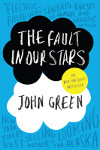
There is life in cancer.
Publisher: Penguin
Pages: 311
Type: Fiction
Age: Young Adult
ISBN: 978-0-141-34563-5
First Published: 10th January 2012
Date Reviewed: 30th June 2014
Rating: 5/5
Hazel has cancer. She’s not likely to ever be in remission but she’s able to live a fuller life than she had with illness so far. At the support group her mother insists she goes to she meets Augustus, someone who matches her in wit and thought. He’s lost a leg but is in remission, and although things will always be difficult, the two teens begin to fall in love.
The Fault In Our Stars is every bit as good as you’ve heard. Green’s writing is very unique and rather excellent, no matter that he has a few novels already under his belt. The book moves far away from the idea of pity, allowing you to see reality.
Green writes teenagers very well and the dialogue seems true to life. There has been no attempt to make the book beautiful – this is no literary feat and frankly it would suffer if it was. To be sure it’s a particular type of writing (this reviewer took a good few pages to get used to it even though she liked it), and it may not appeal to everyone. This is perhaps the only possible issue – where everything is so fresh and specific the book may put readers off by it’s technical nature.
Putting that aside, however, the characters are fantastic. These are teens of a particular personality. They use ‘big’ words, often to excess, and there are so many subjects covered as metaphors and evidence for otherwise simple conversations, it’s unlikely you will know all of them. The sheer life implied by the way the characters act just goes to emphasise how awful it is that we have these diseases that kill. They are simply two fictional people, but they represent a great many more, real, people.
The metaphors are many. A particularly prominent concept throughout is of cigarettes and the potential to kill. Augustus disgusts Hazel when he takes a cigarette from his pocket, but he explains the theory behind his action, that something that kills, stripped of the power to kill by his failure to light it, is not a threat. There are semi-subtextual ideas, such as Hazel’s naming transition, changing what she calls her boyfriend, and there is the controversial scene in Anne Frank’s house in which the teenagers cause a stir.
There is, as you may expect, a lot of humour. You are meant to laugh. You are meant to have a good time. You are not meant to pity, but you are of course meant to feel. There is the sadness – of course there is, you may say, but the point here is that because it’s balanced by the humour and normality, it is all the more powerful.
A special mention must be made of the novel Hazel loves, that she passes on to Augustus. It forms a big part of Green’s book and contains a great many concepts and metaphors. Does it signal what will later happen in the book? The scenes with the author of this book within a book remind you that sometimes life sucks, and it can continue to suck even when it’s already reached the lowest of lows.
Metaphors, concepts, themes. These, apart from the C word, are what The Fault In Our Stars is about. Green wants you to get to the heart of the matter and knows that often, subtlety is the best way. The book gets you thinking, analysing as though it is literature set for class discussion, and will leave you considering it for days.
Both a fast read and a slow burner, The Fault In Our Stars will change you by way of making you think. It’s not out to change the way you approach disease (or even, it could be said, disability). At least not obviously.
Think. Consider. Laugh. Cry. There is a fault in the stars, but it isn’t Green’s book.
Related Books

Hanne Ørstavik – The Blue Room
Posted 9th June 2014
Category: Reviews Genres: 1990s, Angst, Domestic, Psychological, Spiritual, Theological, Translation
6 Comments

Don’t move – not because you can’t, but because you fear doing so.
Publisher: Peirene Press
Pages: 164
Type: Fiction
Age: Adult
ISBN: 978-1-908-67015-1
First Published: 1999 in Norwegian; 2014 in English
Date Reviewed: 8th June 2014
Rating: 4.5/5
Original language: Norwegian
Original title: Like Sant som jeg er Virkelig (As True as I Really Am)
Translated by: Deborah Dawkin
Johanne can’t leave her room. She’s woken up on the day she’s set to fly to America with Ivar and her door is jammed, or locked. She could call to someone from the window, or she could wait for her mother to return to the apartment. Whilst trapped she ruminates over recent events, on her relationship, and on her mother. Has Unni locked her in? If she has, Johanne can understand why.
The Blue Room, translated from the Norwegian by Deborah Dawkin, is a short, little-action story of fear, manipulation, and what you as the reader will recognise as decisions that have the potential to lead to regret. It is often confusing because of the sudden changes in time and place, but this matches Johanne’s mind and the way we flit from subject to subject when there is nothing to do but think.
At the heart of the story is the manipulation and control you see (or think you can see), the mother exerting over her daughter, and the way Johanne’s relationship with her parents has made her, Johanne, prefer routine and the safety of home over anything that little bit different. Even if the fun in difference is to her liking. This isn’t to say that Johanne gives up straight away each time, because sometimes she doesn’t – note that ‘sometimes’ – but when it really, really matters, when it’s the equivalent of reaching the last rung on the ladder, she ultimately gives in. Gives in, not gives up.
What’s interesting about Unni’s (the mother) control is that you are never quite sure whether she is manipulative or whether it’s the case that Johanne is holding herself back. This is one of the best elements of the book because Ørstavik keeps the whole truth from you by way of the first-person narration. Maybe it’s the effect of many unreliable narrators in the past – perhaps if this is your very first first-person book you’ll see through the clever storytelling and structure – but the conditioning that you have, your experience of unreliable narrators means that Ørstavik can play games with you. Is Johanne thinking too much? Obviously she is in some respects – her innocent relaying of Ivar’s response to the things she says shows she thinks too much sometimes – but when it comes to Unni, you’ll think you have it worked out only to be thrown back into confusion.
For a time. There comes a point when the answer is undeniable, and yet even then perhaps there is something ‘off’. As you go about trying to work it all out, trying to work out whether Johanne is locked in or whether she hasn’t tried enough or isn’t bothered enough about leaving, you are effectively introduced to the mistrust that can accompany a victim’s account of their troubles.
In Johanne’s memories, and once you’re back to the present for good, and the dialogue between the two, Unni says some strange, some bad things. She suggests, in a passive-aggressive manner that Johanne is deaf to, that Johanne dump a nice boyfriend. Or does she see something in Ivar that Johanne has missed? It is obvious that The Barns, the housing development the family will build (‘with what money?’ is an assuming but obvious question here) sometime in the distant future, is both a lie to keep Johanne at home and a reason for Johanne to want to forgo any attempt to better her life. Why have a boyfriend and live independently when you’ll be able to live with your mother in a nice house with your brother (who’s no longer there), setting up your business there and thus never needing to leave?
It’s worth noting that some things Unni remarks upon would be simply laughed at or ignored by most people. This is a prime point to the debate over Johanne’s decisions (she thinks up some peculiar ideas that seem not to be influenced by anything). We wonder – we mistrust again.
Whether or not Unni is to blame (in a big way – we could never rule her influence out completely) for the following, Johanne has a fear of difference, of the unknown. It’s worth considering that if Unni has locked the door, then this is Johanne’s strongest effort to leave so far. If Unni’s locked her in, she must feel as if Johanne is slipping from her grasp. It’s the same with Johanne’s self-worth. There is a punishment and reward system at work, both solely resting with Johanne, and at the behest of Unni.
There are the erotic, perverted, thoughts. The blurb of the book speaks of our erotic fantasies being influenced by our parents and as you read on you see how Johanne’s arousal from horrible ideas has happened. Johanne doesn’t want to be in those situations, she apologises to God and worries about it all the time (Johanne’s faith in God itself is seemingly her choice but possibly furthered by those she knows).
It sounds like Johanne’s brother doesn’t see his mother any more, or at the most he’s got away from the family and is in America. If we consider this and Johanne’s chance to spend time in that country, then perhaps Ørstavik is using the ideals about America, the land and the freedom. There is nothing wrong with Oslo – unless your name is Johanne. And if your name is Johanne then every reader will be rooting for you no matter what they think about you.
Is Johanne held back? Is she too like her mother? Will she just repeat the cycle and not break it?
Johanne has a chance to get away, even if she misses this opportunity, even if she loses Ivar. She needs you to support her, and the best way you can do that is to read The Blue Room.
I received this book for review from the publisher.
Related Books
None yet
Jenny Barden – The Lost Duchess
Posted 4th June 2014
Category: Reviews Genres: 2010s, Historical, Political, Social, Spiritual
4 Comments

America – freedom.
Publisher: Ebury Press (Random House)
Pages: 424
Type: Fiction
Age: Adult
ISBN: 978-0-091-94924-2
First Published: 7th November 2013
Date Reviewed: 4th June 2014
Rating: 4/5
Emme was lured into a room by Lord Hertford, who raped her. Unable to tell anyone, knowing that her reputation would be shattered, and worried about her position as a lady-in-waiting to Queen Elizabeth if it was revealed, Emme sets her sights on joining a ship-full of colonists heading to the New World.
The Lost Duchess is a rather good book that is so well-written and entrenched in its history you might have to remind yourself of the differences in views between then and now to fully appreciate it.
The book is about the first voyages to America and the confrontations with the Native Americans, however given the context of Emme’s inclusion and the unfailing and careful consideration, by Barden, of Emme’s abuse, it would be impossible to write about the book without speaking of the inclusion at length.
The abuse happens at the very start of the book and it’s the catalyst for much of what happens, informing the narrative. What is good about Barden’s handling of the aftermath is the consistency. It’s a careful inclusion, so thoughtful that you may at times think that Emme will suddenly move on from it. Ultimately Emme learns to live with what has happened to her, but it isn’t forgotten by the book. It informs her feelings; it makes her actions towards the man she comes to love hot and cold. Readers are asked to understand Emme in our modern context, but lest we forget that Emme is of her time, Barden, both to show us and to simply portray the era, fills Emme’s thoughts with worries that she is ruined, that to speak will be her downfall. There is also some arrogance in Emme that could be the result of her previously semi-independent self trying to claw back who she was.
He was nothing but a knave trying to dominate her, just as every man she had ever known had tried to dominate her, and she wanted no more to do with him.
The above is about a man who never harms or does Emme any wrong. At once you see the way Emme’s mindset has changed, but it could also be read as a no-holds-barred statement of the era in general. This historically-focused, more than ‘usual’, storytelling is what makes you appreciate what Barden is saying about difference.
Leading on from Barden’s concentration on the era, nowhere in the book are there questions about the ‘right’ to use land that does not belong to England. The only place this concept arises is in the speech of a Native American chief. To our modern selves this seems crazy; Barden’s book is very realistic and isn’t about morality or lessons. Instead of being mollified by a 1500s Englishman questioning the right to invade (which, let’s face it, likely happened on a very limited basis), the reader has to do the thinking. You’re left to think about why no one brought this idea up, why Kit, who is a ‘good guy’, doesn’t respond to the chief’s very true statement, why caring Emme thinks about a future where the city of Raleigh thrives without considering anything else. Kit does discuss the irony of calling an intelligent, peaceful people, ‘savage’, but that is all. That said, there is true compassion to be found in the relationships between the English sailors and the Native Americans. (Here ‘relationship’ means both love and friendship.) These relationships are about love, about sacrifice, and show how peace could have been created had it not been for the racist leaders in the group of sailors.
There is little to speak of in terms of setbacks. Barden has written a good book, obviously conducted a lot of research, and knows the period well. She wishes to explore personality and society as well as take a look at the mystery of the initial settlers (whilst Barden provides an answer, her Author’s Note explains that the colony she has written about is lost to history). There are a couple of modern slang phrases but then the book is written in modern English, and there are a couple of scenes in which Barden wants to inform the reader of facts but goes on a little too long.
The plot is important, very important to Barden, but it should be noted that the book is much about Emme and to a lesser extent Kit, and so although the voyage and trials are there all along, they might not always be as exciting as you expected. This is definitely a book for those who like their stories character-driven.
The Lost Duchess looks at history and asks us to forget our modernity. It looks at ageless issues and respects all, and it does this whilst never being sorry for what it leaves out.
Emme is brave and it could be said that Barden is, too. The reader must fall in line if they wish to sail across the sea with them.
I received this book for review from the author for Historical Fiction Virtual Book Tours.
Related Books
None yet
Noelle Adams – Married For Christmas
Posted 30th May 2014
Category: Reviews Genres: 2010s, Domestic, Romance, Social, Spiritual, Theological
6 Comments

Charlie asks a question: Is it out of line, so to speak, to post reviews of books set during a holiday on another day? (I read this last week, hence the review now.)
To have and to hold, in convenience.
Publisher: (self-published)
Pages: 141
Type: Fiction
Age: Adult
ISBN: 978-1-492-76514-1
First Published: 30th November 2013
Date Reviewed: 24th May 2014
Rating: 2.5/5
Jessica is going to propose to her childhood friend, Daniel. She loves him, and although he doesn’t love her that’s neither here nor there – this marriage will not be about love. Jessica wants a family but has never met the right man, and Daniel needs a wife if he’s to be selected as the next pastor of his home town’s church. Jessica’s adamant that love is not important, and Daniel says he can never love another as he loved his deceased wife. So the set-up is perfect… surely.
Married For Christmas is a short tale about the first month of marriage between two friends who both see an advantage in getting married. The characters are Christian but there are a few detailed sex scenes so, as the author points out, this isn’t a book for those looking to read a ‘fade to black’ and/or typical Christian romance.
The book begins well, and at first the characters are good – well developed, and showing much potential. Many readers have said it would’ve been nice to have read a few chapters from Daniel’s point of view and this reviewer would agree. Daniel is a solid, very good, character throughout, whereas Jessica changes somewhat, and not in a ‘regular’ way, but in that way that suggests the author really wanted to write about someone else. You have to be wary of Jessica, in this sense, and know that she will quite possibly get on your nerves.
Jessica’s thoughts about her past are consumed by the idea that men don’t like her, no one has been in love with her, and that she was never going to find anyone. However, as becomes apparent, there have been men who liked her. And, whilst it’s perfectly okay that Jessica has limited her pool of available men by discounting anyone who doesn’t share her religion, it does make the constant refrain unbelievable, even when considering insecurities and quietness. Men who liked her but were turned down because they weren’t Presbyterian nevertheless count as men who liked her. With her limits and the limited-by-design scope of her social life, the ‘no one likes me’ track doesn’t work.
The book could do with an overhaul. Missing words, poor grammar, and strange statements mar what would otherwise be fairly good writing.
What’s good is Daniel. Daniel remains a good guy throughout the book despite Jessica’s belief to the contrary. The change he undergoes is well-written and even if it’s predictable, it brings forth the sweet romantic element that was sorely needed. The sex scenes are written well and there are a fair number of them. They are detailed and verge towards erotic fiction at times, however this is somewhat influenced by the mixing of genres and they are less graphic when considered away from that context.
Married For Christmas is cute, but being upset about the marriage you planned working out as planned doesn’t invite empathy, especially when the marriage is only 4 weeks old. Similarly, the annoyance at the help offered (understandable somewhat out of the context of a close community, not understandable in it) doesn’t ring true given the amount of thought Jessica would’ve given to being a pastor’s wife. Strictly alright.
Related Books
None yet
Johanna Lane – Black Lake
Posted 19th May 2014
Category: Reviews Genres: 2010s, Angst, Domestic, Political, Social, Spiritual
5 Comments

Moving home is often disruptive, but not quite as much as this.
Publisher: Little, Brown (Hachette)
Pages: 212
Type: Fiction
Age: Adult
ISBN: 978-0-316-22883-1
First Published: 20th May 2014
Date Reviewed: 19th May 2014
Rating: 5/5
Marianne locks herself and Kate in the ballroom. Marianne may seem mad but it soons becomes apparent that there’s more than meets the eye, for the ballroom is stale and she won’t leave the building, and something has obviously happened to Philip.
Black Lake is a stunning début, a novel with a purposefully spoiled plot that explores the effects of displacement on a person.
If you have ever visited a historical country estate knowing that the reason you’re able to be there is an owner’s lack of money, this is a book for you. In Black Lake, the house of Dulough is somewhere between a character in itself and a catalyst. Lane looks at the various ways an extreme version of moving home can affect people based on how they feel about the place and how much knowledge is provided or kept from them. We see John, inheritor of a house without the funds to pay for it, upset at the prospect of government involvement but with the will that comes with calling the shots (as much as you can once papers have been signed). We see Marianne, his wife, a woman from a humble background who took a while to get used to the idea of not making the dinner and living away from the city but who is now happy, proud of her home, and under the impression that her children will always have that home. And we see the children, in particular Philip, who understandably has trouble with the new literal boundaries and the idea visitors can use his bedroom whilst he no longer can himself.
Lane shows us the differences. On the surface it seems that Marianne is the most affected, and it can be easy at first to think that the children will get used to things. But Lane shows how children can be affected by the smallest elements of change and how adults are slow to realise this when it happens. For example, take the defining moment – Philip telling a tourist that he’ll get his food for free because it’s his house and finding that he does actually need to pay. Lane handles Philip’s sections with care and the way she relays information is just as telling – Philip shows upset but never tears, and it is in this that the confusion of a previously happy child is shown.
Talking of Philip’s narrative, Lane has chosen a particular format for her story. She begins with the near-end, goes back in time, includes a long ‘never before seen’ account, before leaving the reader with a slightly opened-ended last page which infers much but confirms nothing. The third-person narrative switches between John, Philip, and, later, Marianne. A couple of chapters are written as descriptions from no one’s view in particular. It is written in the sort of literary style that is often prefaced with ‘nothing really happens’, and the style is likely to interest many. Something, many things, do happen, but Lane’s slow-moving seemingly dull writing is very deceptive. You’ll note, whether during or after having finished reading it, that there’s a layer of boredom to the book, yet what happens is anything but boring. It’s interesting to compare this illusion to the way the ‘government’ sees their semi-acquisition of the house. Having replaced the furniture and having prepared scripts for tour guides that are untruthful, it’s easy to imagine that the defining moment in the family may be passed over by the new staff, and not included. The Campbell family is of little importance now that the house can be enjoyed by the public and it’s ironic that the new, true, shocking fact in the family history would be glossed over or left out. Or, maybe, as can be the case, made overly vivid and expanded upon for money.
At the heart of the novel, more than the moving, is communication. John thinks Marianne has gone mad, but once you read her account, even before then, you see the lack of knowledge the aloof country man has of his social city girl. Perhaps if John spent time with her and discussed the money issues, the necessary transition might have been easier, or, if two heads are better than one, another option for upkeep might have presented itself. John’s secrecy is the main issue here, but one could also consider the difference between adults’ and children’s’ methods of coping and their knowledge of each other.
To be sure, in choosing to read Black Lake you have to be in the mood, or just open to, a book that has much to say whilst making you wonder if anyone cares. Black Lake is character-driven entirely, and the lack of emotion on the surface does mean that it requires your attention.
Black Lake is a magnificent study and story of family and upheaval. Fill up the teapot and get a whole place of biscuits ready, because this relatively short book is going to consume your afternoon.
I received this book for review from the publisher.
Related Books
None yet


