

Aimee Bender – An Invisible Sign Of My Own
Posted 21st February 2014
Category: Reviews Genres: 2000s, Angst, Commentary, Domestic, Psychological, Romance, Social
4 Comments

Bizarre – but then that’s life.
Publisher: Windmill Books (Random House)
Pages: 242
Type: Fiction
Age: Adult
ISBN: 978-0-099-55852-1
First Published: 2000
Date Reviewed: 17th February 2014
Rating: 4/5
Mona’s childhood came to an effective end when her father became ill. Holidays ceased to occur, her father stopped being interested in anything, and Mona coped by becoming a quitter. Successful and talented, she slowly quit everything she was good at before she became too successful or happy. Passionate about maths, the one interest she didn’t give up, she is given a teaching job despite a lack of formal qualifications, and comes to love the job, but her coping method isn’t quite usual, even amongst those who are also unusual.
An Invisible Sign Of My Own is a focused take on life and all its idiosyncrasies. Further than the superstition mentioned in the blurb, the book studies obsessive compulsiveness and depression. It is, at its heart, a look at two groups of people who are often one and the same – those who cope in unique ways, and those who live in ways that aren’t the norm.
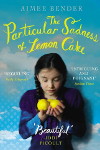
The book is at once very positive and negative. It looks at idiosyncrasies and dark issues in the same bizarre way as Bender’s later work, The Particular Sadness Of Lemon Cake, whilst having a foundation of pure despair. This is not the book to read whilst you are upset yourself, indeed whilst the conclusion may show a sort of conquering of depression, the atmosphere of the story and characters are dark enough to be almost too easy to relate to if you’re having a bad day. This is of course as much a drawback as a triumph. Bender’s choice of idiosyncrasies may for the most part be unrealistic, as much as the word can be used when dealing with the subject, but if anything this helps the reader emphasise and/or understand more. By having that distance between reader and book – the distance of the distinct behaviours – the content is more welcoming, because anyone who has experienced depression, OCD, and/or the sort of tragedies in the book, is going to find it easier to see it from a fly-on-the-wall perspective. The pain may be the same, but the difference in delivery means that you’re not going to feel targeted and at the mercy of an author whose other characters dislike what they see in those who aren’t coping.
The story, in which no quotation marks are used, is somewhat predictable, but it is obvious that this is part of the idea. In order to understand Mona as the author wishes you too, you have to see where the book is headed. Mona is at once the main character and one of many. She may be the narrator but the story focuses on, for example, the plight of a child whose parent is dying of cancer, just as much. What Bender shows, via the subtext, is how important it is that society in general truly recognises that people cope with pain and despair in different ways and that when those ways do not fit the norm, or what is expected, these people are still looked after. An Invisible Sign Of My Own isn’t about leaving people to fend for themselves (so long as the issues are known), indeed it is very much the opposite, and due to that it forces you to look beyond appearances. In the case of the child of the parent with cancer you have a child that looks for cancer – indeed almost hopes for cancer – in everyone she meets due to her undisclosed feeling of detachment, whose idea of numbers in nature is morbid, naïve, and dangerous, and who, for her young age, suggests things such as suicide as though they were something to do when bored. This is a girl too young to really realise what she is saying whilst knowing exactly what is happening. Other children, albeit not faced with terminal illness, show how naïvety about subjects they don’t yet understand have disastrous consequences. And Bender lets the disaster happen, to shock, to teach, to illustrate just how important care and education are.
An Invisible Sign Of My Own is at once easy and difficult to read. It’s strangeness can at times bely its message, suggesting that Bender just wrote a lot of madness without anything in particular to say, or worse, that she thinks it is okay. It’s tough getting to the heart of it, and likely often times you’ll wonder what in the world you’re reading. It may be barmy but that’s the surface dressing; it’s worth reading to get a glimpse of lives that don’t tick boxes, and there is plenty relevance in its content to fit our lives in the non-fictional world, too.
Related Books
Irène Némirovsky – Suite Française
Posted 20th January 2014
Category: Reviews Genres: 2000s, Commentary, Domestic, Political, Social, Translation
11 Comments

A book written during the events it tells of.
Publisher: Vintage (Random House)
Pages: 342
Type: Fiction
Age: Adult
ISBN: 978-0-099-48878-1
First Published: 2004
Date Reviewed: 16th January 2014
Rating: 5/5
Original language: French
Original title: [As above] (French Suite)
Translated by: Sandra Smith
As the Germans invade France, numerous people head to the regions still free. The refugees are composed of all the social classes, including the middle class Pericands, regular bank workers the Michaunds, and an uppity novelist. As the invasion becomes occupation, a German moves into the Angellier house, where an unhappy Lucile awaits the someday arrival of her unfaithful husband. No one, neither French nor German, knows what will happen in the days ahead.
Suite Française is a theme and character driven book that defies tradition and looks at war with a unique, humorous, and tragic lens. Published posthumously, decades after the author was killed at Auschwitz, the book as it stands is composed of two of a planned five novellas, still in the drafting stage.
What a draft this is. Némirovsky’s book, translated into English by Sandra Smith, reads as though it were almost ready for publication. Beyond a few errors, some of which the translator has edited, there is little to suggest that the work, beyond the obvious lack of a conclusion, had not been through several rewrites already.
The writing is exceptional. Némirovsky speaks of the horrors of her time yet includes a constant thread of humour. It is not laugh-out-loud humour and mostly pertains to social class differences, but for its use it shows that in times of plight some light-heartedness goes a long way – the characters don’t find much funny; the humour is from the author. The book is very literary and may prove easy to loose yourself in. This is particularly interesting when you consider that the book, beyond the basic thread of the war, lacks a plot.
There are ‘mini’ plots here and there, for example the story of one character’s love for another, but by and large the book simply discusses the day to day life, if it can be called such, of the characters. Indeed the major aspect of this book isn’t the characters per se, it is society. In looking at the war, Némirovsky isn’t describing the acts of the enemy and saying how awful they are. She does include horrors, of course, but the awfulness focused on in Suite Française is the lack of compassion and community of the refugees. The middle classes thank God the lower classes were bombed instead of them, the lower classes don’t understand the middle classes, an egotistical man thinks his celebrity will continue to get him whatever he wants, and everywhere people are stealing everything from everybody else. For the most part no one helps anyone else, and that is the point Némirovsky makes in the first novella, Storm In June. Not that being out for oneself leads to long-lasting complications – though, again, this is another point that is made; maybe being out for themselves should affect the characters.
Class divides remain in times of strife. A prime example of the irony of a Christian woman of the middle class is shown here:
“Do you see how good our Lord Jesus is? Just think, we could be those unfortunate wretches!”
In the above case, the author is blunt – the sentence is a flashback a young man has of his mother after he has returned from running off to join the army, and, as he says, “Hypocrites, frauds!”
What is particularly interesting about the book, yes, beyond the theme work and different approach, is Némirovsky’s writing of the Germans in the second novella, Dolce. Whilst the Germans were written as one mass in the first novella, in Dolce there are various individuals assigned to live in certain French homes, and these men are written in a way that borders on compassion. This may not sound so strange as a whole, as war is known to be more important at the top than the bottom, and the German soldiers want to fit in despite being the conquerors, but it is somewhat strange when you consider that Némirovsky was writing of the enemy sitting outside her window, so to speak. In Dolce, the author gives personality and voice to the people despised as she wrote her book, to an enemy that wanted those of her background dead – an enemy that would later arrest and kill her. For this personification, Dolce makes for uncomfortable reading, most especially now in our present day (who knows how it might have been received if the work had been published just after the war?), where we know what happened and we know a lot more than Némirovsky would have at the time. How should the reader respond to the feelings of compassion the author invites – should we just read the book as a work of fiction or is it Némirovsky’s hope that we look inside ourselves and question those feelings? Should we be chastising ourselves for even considering these invaders’ thoughts? Should we be viewing them as people that are as human as the French? Should we be thinking about how easy it is to be led by someone to believe they are a good person?
Finally, another factor that is interesting due to the time and situation in which the book was written, there is a somewhat ironic (sadly ironic) comparison to be made between the French soldier, Jean-Marie Michaund, and the author herself. Jean-Marie wants to be a writer, and during his stay at a farm, Némirovsky writes:
He wrote with a chewed-up pencil stub, in a little notebook which he hid against his heart. He felt he had to hurry: something inside him was making him anxious, was knocking on an invisible door.
Suite Française is a masterpiece; it makes no difference that it is unfinished. (Though it must be said that, at least in the English translation, Némirovsky’s notes and a rough plan for the rest of the book have been included.) It may be low on plot, but it is high in social studies, in character development, and in beautiful language. Sporting vast appeal for those interested in social history as well as those who simply enjoy reading, Suite Française is one you shouldn’t pass up.
Related Books




Eloisa James – An Affair Before Christmas
Posted 11th December 2013
Category: Reviews Genres: 2000s, Comedy, Domestic, Historical, Romance, Social
1 Comment

An affair to remember, because it is between a husband and his wife.
Publisher: Avon (HarperCollins)
Pages: 386
Type: Fiction
Age: Adult
ISBN: 978-0-061-24554-1
First Published: 2007
Date Reviewed: 20th November 2013
Rating: 4/5
Poppy and the Duke of Fletcher have been married for four years. They started their wedded life in love, and they may still be in love, but the marriage has gone sour. Does Poppy love him? – Fletcher does not know. Certainly she hates having to be intimate with him. With Poppy’s mother ruling her daughter’s head, and a society that expects a man to be unfaithful, it’s going to be a difficult journey if there is to be no divorce.
An Affair Before Christmas is the second book in James’s hilarious duchess series that sees the continuation of the many couples’ lives in the background whilst focusing on the Duke and Duchess of Fletcher.
James’s characters are, once again, magnificent. It is true that these Georgian nobles might indeed scandalise even the most scandalous of real-life Georgians, but it is rather obvious from the start that James’s work isn’t your standard historical romance. The ladies and gentlemen do everything you ‘expect’ them to do, and then go and behave particularly ahead of their time in a way that isn’t quite unbelievable, but is certainly a whole lot more entertaining than reality. Once in a while the entire plot will get a little too silly, but again, that is half the fun. Make no mistake – the covers may suggest a lot of sex and nudity, and that’s really quite correct, but it is far from the main takeaway of the book.
Whereas Roberta of Desperate Duchesses had her own mind but was rather naïve, Poppy’s naivety is similar yet vastly different. In Poppy there is a budding scientist just waiting to be allowed into university, which of course will never happen; a woman who if she can just separate her mother’s thoughts from her own, will be quite the popular person. She may be silly, but she’s endearing all the same.
The Duke of Fletcher isn’t far behind, indeed he is only slightly less well drawn than Poppy simply because as a man in a male-led society he already has an advantage. The cautious reader will love Fletch, the handsome duke who could have anyone he chooses but is not interested in being unfaithful, and the way his success in his career is aided by Poppy, even though she actually has little knowledge, is particularly appealing for the modern reader. Make no mistake – James writes for the modern reader, no matter how obvious that may sound.
The writing is great, and befitting of the time, if not quite historical. There are a few errors, modern American terms that could be categorised as certain English dialects but not ones that are relevant to the characters, but they are used more often in the narration rather than in dialogue.
The themes are both historical and eternal – it is less likely today that a woman would know nothing of the pleasures to be had during sex, but it is all too common for communication to break down in a marriage. Poppy’s mother is both the Georgian matriarch would believes a woman should obey her husband, and an example of the eternal stereotype of the interfering mother-in-law. All these clauses come together to form the bulk of the content.
However the themes do take their toll on the narrative. The romance in this book, the active love between the characters (as opposed to the feelings themselves), does not start until the book is nearing its end. The miscommunication is there throughout, and Poppy’s first (bad) ideas of how to deal with her husband dominate the book, leaving very little time for the couple once they come to realise what went wrong. Of course it is lovely (and predictable, which is why this reviewer isn’t worried about spoilers) that the book ends with the happy couple, but when so much time later on is taken up by the secondary characters it is hard not to wonder why the book was marketed as Poppy and Fletch’s story. This ultimately means that sex ends up taking what’s left of that short space of time which, while expected, does mean the resolution is even shorter. That said, given the reason for the estrangement, perhaps it makes sense – it’s just that it doesn’t particularly make for a great story structure.
Beyond the mother’s rule, which, yes, does seem strange given the four years, there is as aspect of Poppy’s lack of desire that may irritate the reader, and the pun here is most definitely intended – Poppy suffers an allergy that renders a lot of her lack silly. But it does depend on the reader. If you can believe the miscommunication would extend to Poppy’s silence over it you may be okay, likewise if you view James’s decision as one concerned with comedic value. Otherwise it may just render the book too over the top, the pun here not intended, to continue.
It should be noted that whilst Christmas is specified on the cover, the book isn’t confined to the holiday season. While it may seem better when read beside a tree, there is enough of the story based in summer to make it an option at any time of year. The book could be read as a standalone, but the reader will appreciate it much more if it’s read in sequence.
An Affair Before Christmas isn’t quite as strong as the first book, but it is well worth the read. The characterisation is brilliant, the comedy is laugh-out-loud, and it’s good to have the same background setting written about from another angle. The secondary stories mean that you’re looking forward to the next book very early on, which in this case isn’t a bad thing.
Related Books


Andrew Blackman – On The Holloway Road
Posted 11th October 2013
Category: Reviews Genres: 2000s, Commentary, Law, Philosophy, Political, Social, Spiritual
5 Comments

A trip for freedom.
Publisher: Legend Press
Pages: 202
Type: Fiction
Age: Adult
ISBN: 978-1-90655-808-2
First Published: 2009
Date Reviewed: 7th October 2013
Rating: 5/5
Jack lives a monotonous life. He wakes up in his mother’s house, tries to continue writing his novel, fails, goes out every now and then, rinse and repeat. One evening he decides to eat a dreary kebab in a dreary shop but his meal is interrupted by Neil Blake, a man of a similar age who has led a more colourful, slightly illegal life. Whisked away by Neil’s friendly nature, Jack finds himself at pubs and parties. Then Neil suggests a trip to Scotland.
On The Holloway Road is a clever and well written book, inspired by Kerouac’s On The Road, that deals with the themes of life and freedom. Written in hindsight from Jack’s perspective, the story is slow, aptly lazy in its pace at times, and a little satirical.
The characters are complete opposites, and not supposed to be liked particularly. Neil is impulsive, he dislikes any limitations placed upon him by outsiders, and he is full of charm, but he can be thoughtless and selfish. Indeed he would laugh at being told to think about repercussions – the reader is likely to think ahead and question Neil’s decisions, and it is exactly that action that Neil would denounce. Neil lives in the moment, lives for freedom, has experienced the other side of the coin and sees its flaws. In comparison, Jack has little will, in fact what will he does have is a side effect of his spending time with Neil. Jack is content in his monotony, his typical life that fits neatly into the slot, and though he isn’t happy he won’t do anything to change that.
Jack’s overall dullness is a major reason the book is slow. Rather than an error on the part of the author, the pace is a decided upon element that shows you just how different Jack and Neil are. Neil’s dialogues are fast paced and full of words, as Jack says, but it is the difference in nature that allows the reader to see where Jack’s safe life might be too safe, whilst of course showing that Neil falls a bit too much towards the other extreme. The book is very much a character study as well as a different take on Kerouac.
It is character-driven, and it is plot-driven, yet at the same time it would be difficult to say that there is a plot as such. The plot is vastly in the realm of the book’s themes. Blackman has crafted a commentary, a very sharp commentary that strikes at the heart of current political, social, and law elements that protect/hinder (depending on the way you see it) the people of the United Kingdom. Through Neil and Jack, Blackman shows the limits of the people’s freedom, the limits imposed by the government and councils. There are many scenes where Jack finally lets go a little, Jack the good lawful if boring citizen, and is rewarded by a penalty of the exact type the duo are trying to escape. As an example, a trip to a country park costs them £100 in car parking fines when they get back to the car and notice the fine details of the parking space.
Freedom here is woven into the larger political context. The story shows the differences between someone who is institutionalised, or just used to, the way of the land, and another who isn’t. And of course what is interesting as well as understandable is the way it’s the person who has been to jail that wants to be free, especially as it is a freedom in lifestyle that Neil wishes for (in other words Neil isn’t wanting the ability to go and kill someone). It’s the case that everywhere they go, Neil says they are or should be free. The government soon tells them they aren’t.
Leaving my Figaro marooned in the grass, I walked forward to get a better look. Warnings were being shouted through a megaphone. Acts of Parliament were being invoked. Arrests were being promised. The appearance of fairness, of reason. Disperse now. A chance to avoid arrest.
And if reason failed, as it surely would, then violence would be justified. Protocol would have been followed. The blows of the batons would have legal sanction, while any retaliatory violence would be grounds for prosecution.
Jack is no one without Neil, and indeed it comes as no surprise to understand, through Jack’s words, that he relies on Neil to ‘live’. It’s one of those things you know instinctively, and it just takes Jack’s words to cement it. And as for Neil, it seems that freedom he wants is nowhere – no matter restrictions or not, you get the sense he will always be against something. In this way the ending is very appropriate, the particular ending for him says a lot about the character and what Blackman is trying to say.
To refer to the inspiration, Kerouac’s On The Road is used both behind the scenes, so to speak, and in the story as an element in itself. Jack and Neil listen to the audio book whilst travelling; it is almost a double usage of the work, between the tape cassette and Blackman’s references to it as the author. It forms a lot of the philosophy and quotations are borrowed and reworked so that they fit in with Neil and Jack.
As the book reaches its ending, another clever aspect becomes apparent. The way it is written, the way the story is referenced, makes it seem possible that it could be about Blackman, that it could be about anyone. Twisted into the last chapters is the final resolution – the answer to what happens after the book concludes, there is even a hint as to what happens a lot further down the line. If only Jack takes the chance.
It seems he did, or perhaps he hired Blackman to do it for him as the author clearly knows more than Jack, just as Neil does. Blackman is almost the unbiased third party, the person in the middle of the two.
On The Holloway Road is superb. It is likely to appeal most to British readers, as they will be able to relate to the political details well, but the references to Kerouac and the commentary will interest readers of other nations too. And the theme of freedom is universal as are likely some of the civil elements.
I know the author as a fellow book blogger.
Related Books


Speaking to Andrew Blackman about On The Holloway Road, and A Virtual Love (spoilers included)
Charlie Place and Andrew Blackman discuss life on the road, following in Jack Kerouac’s footsteps, offline and online identity, writing an entire book about a character but never giving them a voice, current climate change activism, and withholding – for very good reason – the endings your readers expect.
If you’re unable to use the media player above, this page has various other options for listening.
Sherry Thomas – Private Arrangements
Posted 25th September 2013
Category: Reviews Genres: 2000s, Domestic, Historical, Romance
2 Comments
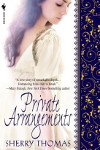
To have and to hold – at arm’s length.
Publisher: Bantam (Random House)
Pages: 351
Type: Fiction
Age: Adult
ISBN: 978-0-440-34431-8
First Published: 2008
Date Reviewed: 11th February 2013
Rating: 4.5/5
Camden and Gigi, married for ten years, have been living separately since the day after their wedding due to a betrayal on Gigi’s part. Now Gigi wants a divorce so she can marry her latest beau. It’s not going to be that easy. Camden doesn’t want to lose her, and at the end of the day was her betrayal so bad?
Private Arrangements was Thomas’s début. Whilst it may not be perfect, what a début it was (please excuse the usage of present and past tense here). The unconventional storyline – the infidelity of the characters – may divide opinion, but it cannot be said that this does not create originality in a genre that is already predictable due to its very theme.
The storyline is strong. It works in part because there is no infidelity within the confines of the book itself. Neither character has remained chaste throughout the separation, but when they are reunited there are no other physical relationships. Gigi puts off sexual relations with her lover for the duration of what is to be Camden’s yearlong time limit to get her pregnant with an heir. This on-page lack of extramarital sex may not be sufficient for every reader, but to those who are comfortable with the set-up of a marriage that is a marriage in name only, it will likely prove fair enough.
The characters are particularly well developed. Whilst neither could be called affable, they are strong people (to an extent) who know who they are, what they want, and take the necessary steps to get it. Gigi is the strong woman of wealth who has compassion for all, and Camden, whilst an alpha hero, has a sensitive side.
The chemistry is something special. The characters are a good fit and both their meetings and sexual relations are believable. Though in this there is cause for contention. It could easily be argued that some, if not most, of the sex is non-consensual – Gigi agrees to the plan of getting pregnant, but Camden’s solo decisions to suddenly ‘take’ her can seem rather selfish and arrogant. And whilst Gigi takes precautions (yes, this, because she’s not so sure about having children), Camden’s overruling of it is difficult to read, even if there is some thread of understanding in it.
There is also the issue of angst. This book is a fine recommendation for those who like hardships and, well, angst, in their reading, but as the story continues it can become difficult to take character decisions and assertions seriously. To put it simply, having a character continuously going against blatantly correct decisions just becomes silly. It is a reflection of stubbornness and some readers may enjoy it, but it doesn’t quite fit the rest of the book, making the characters weaker than they were. Then again, it could be said that their passion for each other has weakened their resolve.
The plot is proffered as a duel storyline with a secondary plot to boot. Flashbacks throughout keep you informed as to those first few weeks of the metaphorical honeymoon period and the literal but wretched honeymoon period, as well as everything you need to know about the ten year gap. It works well, meaning that when the present-day (1893) incarnations of the characters are in focus, their stubbornness is somewhat offset. It does mean you don’t know as much about the “now” but it is not a bad thing, per se.
The secondary plot line consists of Gigi’s mother’s attempt to find a new husband for her daughter. It may not be original, but if you enjoy reading about Austen’s Mrs Bennett, you’ll likely enjoy Victoria Rowland. It can detract from Camden and Gigi, but it is strong enough to keep you reading.
Lastly a special mention must be made regarding the writing. This is the sort of romance book that would likely appeal to typically non-romance readers. The writing is eloquent, almost historical itself, and it’s undeniably beautiful. Even language pertaining to things not considered beautiful, actions during intercourse, are written with taste.
Private Arrangements may not appeal to everyone for its story, but seen simply as a book rather than for its genre, it cannot be said that it isn’t good. Indeed it incorporates a great many elements considered crucial to a good novel and manages to break convention whilst not alienating the reader. It’s just as well the privacy of Camden and Gigi was breached else we’d be lacking a brilliant work.
Related Books