




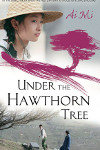
Ai Mi – Under The Hawthorn Tree
Posted 18th July 2014
Category: Reviews Genres: 2000s, Angst, Historical, Political, Romance, Social, Translation
3 Comments
First love – a time to worry.
Publisher: Virago
Pages: 352
Type: Fiction
Age: Adult
ISBN: 978-1-844-08703-7
First Published: 2007
Date Reviewed: 18th July 2014
Rating: 3/5
Original language: Mandarin Chinese
Original title: 山楂树之恋 (Shan Zha Shu Zhi Lian – Hawthorn Tree)
Translated by: Anna Holmwood
Jingqiu’s family has been written off as the lowest of the lowest. Landowners, in the time of Mao they are hated. Jingqiu works hard to provide for her mother and sister and sees her future as one of inevitable manual labour. She would hope to return one day. On a field trip, as a writer for the new school textbooks, she meets Old Third, the so-called foster brother of her teacher’s family. He’s obviously not as poor as Jingqiu – there would be issues if they became more than friends.
Under The Hawthorn Tree is a book that starts very well and offers much to those interested in the history, but slowly descends into what is to all intents and purposes stupidity.
The stupidity can be found in Jingqiu’s choices. She is a fair enough character and works more than is healthy so that her family has money, but she declines all offers of support and legitimate ways to get around her situation. The love interest, Old Third, has much to offer and asks for nothing in return; he wishes Jingqiu out of danger. Jingqiu rejects his money and puts her life on the line working in factories that use poison and taking on heavy lifting duties that could kill her. Perhaps it is meant to be endearing, but instead it comes across as silly and selfish. It’s a miracle the character survives at all.
Some, only some, of Jingqiu’s concerns are valid. She worries about being seen with Old Third in a society that will reject her if they believe she’s lost her virginity out of wedlock. She worries about her family’s already low status. But by and large her worries don’t hold water. There are the constant musings on what people are referring to (metaphors and innuendo). Jingqiu’s innocence is believable up to a point, but it’s hard to believe that by 25 she still dismisses those happy to clarify matters and to be the only person (seemingly, at least) in her home town who has not learned anything. Personal experience doesn’t enlighten her, either. Sex itself is one of the few things that is discussed openly in the city, at least enough that everyone knows a good amount, everyone except Jingqiu.
Jingqiu’s love isn’t believable. She goes through some motions, and perhaps it is down to the lack of knowledge, but it’s hard to phantom that one day she won’t fall in love for real and relegate Old Third to a crush. Old Third loves her, that is certain, by Mi does not present the love on Jingqiu’s side very well.
The writing is hit and miss, however because we’re talking of a translation, it’s hard to say for definite whether or not the repetitive words and juvenile phrasing is down to the author or the translator’s choices. (The translator is Anna Holmwood.) It is safe to say that the translation needed editing, because you’d expect errors in the original text to have received some sort of mention, if just to clear the translator’s name.
What’s good about the book is the pace – it’s quick and easy to read – and the history. Beyond the silliness there is a lot of interesting information, and it’s localised to Jingqiu’s community. You can learn much from this first-hand account, albeit fictional, and its status as a best-seller (it was adapted for the screen, too) goes some way towards informing you about how much you should believe. Jingqiu may not be devoted to Mao but she refers to the rules and texts enough that you see how people were affected.
As an insight into the history it’s not bad, but you shouldn’t pick up Under The Hawthorn Tree expecting to be wowed. If you are, all well and good, but most likely you’ll be happy to move on.
Related Books
None yet
Irène Némirovsky – Fire In The Blood
Posted 9th July 2014
Category: Reviews Genres: 2000s, Angst, Domestic, Social, Translation
3 Comments

Passion before everything – even love.
Publisher: Vintage (Random House)
Pages: 151
Type: Fiction
Age: Adult
ISBN: 978-0-099-51609-5
First Published: 2007
Date Reviewed: 30th June 2014
Rating: 4/5
Original language: French
Original title: Chaleur du Sang (Blood Heat)
Translated by: Sandra Smith
Silvio sees his relatives a fair amount, as well as the various other people of his village. Their lives are full of intrigue, but as for himself he is boring and set in his ways. He would tell you this himself; he used to be far more active, travelling around the world. Now others can live life.
He does indeed sound dull, doesn’t he? Némirovsky’s Fire In The Blood is a slow read that ambles on, being everything about everybody else until the conclusion.
The book is very short; an afternoon read. It spans many seasons, switching suddenly, which has the effect of illustrating both how monotonous Silvio’s life is, and how long people willing live unhappily. It’s not as literary as Suite Française, in the way that there are fewer themes to study, and it is a step down from the masterpiece, its length suggesting what its nature is. Considered on its own, however, it’s not bad at all.
Silvio is boring (repeated because this is something you will be thinking constantly as you remember Lockwood and the accompanying wish that another had told that tale) but this allows his narration to be good. He never gets distracted. There are few themes in this book, understandably. Passion. Love. There is the sense of a question – how/when do we break the cycle started long ago, of children following in their parents’ mistaken footsteps? Némirovsky looks at why people do what they do, which, given the time in which she lived, is inevitably caught up in appearances, marrying for money and marrying because it is expected and so forth. And she looks at how people can give up when things don’t go according to plan. She looks, too, at pretence, at faux normality, and at how a change on either person’s upkeep of pretence can bring everything crashing down. In this Némirovsky makes you question all you’ve read so far, beckoning that desire to want to read the book again because no matter what former ideas you had, you’re going to want a second look at that series of events.
Short but not sweet, Fire In The Blood is relatively untaxing but a fair choice of reading material. It may not be Némirovsky’s best but when her best exceeds all else, anything a little less is quite fine enough.
Related Books

Hanne Ørstavik – The Blue Room
Posted 9th June 2014
Category: Reviews Genres: 1990s, Angst, Domestic, Psychological, Spiritual, Theological, Translation
6 Comments

Don’t move – not because you can’t, but because you fear doing so.
Publisher: Peirene Press
Pages: 164
Type: Fiction
Age: Adult
ISBN: 978-1-908-67015-1
First Published: 1999 in Norwegian; 2014 in English
Date Reviewed: 8th June 2014
Rating: 4.5/5
Original language: Norwegian
Original title: Like Sant som jeg er Virkelig (As True as I Really Am)
Translated by: Deborah Dawkin
Johanne can’t leave her room. She’s woken up on the day she’s set to fly to America with Ivar and her door is jammed, or locked. She could call to someone from the window, or she could wait for her mother to return to the apartment. Whilst trapped she ruminates over recent events, on her relationship, and on her mother. Has Unni locked her in? If she has, Johanne can understand why.
The Blue Room, translated from the Norwegian by Deborah Dawkin, is a short, little-action story of fear, manipulation, and what you as the reader will recognise as decisions that have the potential to lead to regret. It is often confusing because of the sudden changes in time and place, but this matches Johanne’s mind and the way we flit from subject to subject when there is nothing to do but think.
At the heart of the story is the manipulation and control you see (or think you can see), the mother exerting over her daughter, and the way Johanne’s relationship with her parents has made her, Johanne, prefer routine and the safety of home over anything that little bit different. Even if the fun in difference is to her liking. This isn’t to say that Johanne gives up straight away each time, because sometimes she doesn’t – note that ‘sometimes’ – but when it really, really matters, when it’s the equivalent of reaching the last rung on the ladder, she ultimately gives in. Gives in, not gives up.
What’s interesting about Unni’s (the mother) control is that you are never quite sure whether she is manipulative or whether it’s the case that Johanne is holding herself back. This is one of the best elements of the book because Ørstavik keeps the whole truth from you by way of the first-person narration. Maybe it’s the effect of many unreliable narrators in the past – perhaps if this is your very first first-person book you’ll see through the clever storytelling and structure – but the conditioning that you have, your experience of unreliable narrators means that Ørstavik can play games with you. Is Johanne thinking too much? Obviously she is in some respects – her innocent relaying of Ivar’s response to the things she says shows she thinks too much sometimes – but when it comes to Unni, you’ll think you have it worked out only to be thrown back into confusion.
For a time. There comes a point when the answer is undeniable, and yet even then perhaps there is something ‘off’. As you go about trying to work it all out, trying to work out whether Johanne is locked in or whether she hasn’t tried enough or isn’t bothered enough about leaving, you are effectively introduced to the mistrust that can accompany a victim’s account of their troubles.
In Johanne’s memories, and once you’re back to the present for good, and the dialogue between the two, Unni says some strange, some bad things. She suggests, in a passive-aggressive manner that Johanne is deaf to, that Johanne dump a nice boyfriend. Or does she see something in Ivar that Johanne has missed? It is obvious that The Barns, the housing development the family will build (‘with what money?’ is an assuming but obvious question here) sometime in the distant future, is both a lie to keep Johanne at home and a reason for Johanne to want to forgo any attempt to better her life. Why have a boyfriend and live independently when you’ll be able to live with your mother in a nice house with your brother (who’s no longer there), setting up your business there and thus never needing to leave?
It’s worth noting that some things Unni remarks upon would be simply laughed at or ignored by most people. This is a prime point to the debate over Johanne’s decisions (she thinks up some peculiar ideas that seem not to be influenced by anything). We wonder – we mistrust again.
Whether or not Unni is to blame (in a big way – we could never rule her influence out completely) for the following, Johanne has a fear of difference, of the unknown. It’s worth considering that if Unni has locked the door, then this is Johanne’s strongest effort to leave so far. If Unni’s locked her in, she must feel as if Johanne is slipping from her grasp. It’s the same with Johanne’s self-worth. There is a punishment and reward system at work, both solely resting with Johanne, and at the behest of Unni.
There are the erotic, perverted, thoughts. The blurb of the book speaks of our erotic fantasies being influenced by our parents and as you read on you see how Johanne’s arousal from horrible ideas has happened. Johanne doesn’t want to be in those situations, she apologises to God and worries about it all the time (Johanne’s faith in God itself is seemingly her choice but possibly furthered by those she knows).
It sounds like Johanne’s brother doesn’t see his mother any more, or at the most he’s got away from the family and is in America. If we consider this and Johanne’s chance to spend time in that country, then perhaps Ørstavik is using the ideals about America, the land and the freedom. There is nothing wrong with Oslo – unless your name is Johanne. And if your name is Johanne then every reader will be rooting for you no matter what they think about you.
Is Johanne held back? Is she too like her mother? Will she just repeat the cycle and not break it?
Johanne has a chance to get away, even if she misses this opportunity, even if she loses Ivar. She needs you to support her, and the best way you can do that is to read The Blue Room.
I received this book for review from the publisher.
Related Books
None yet
Irène Némirovsky – Suite Française
Posted 20th January 2014
Category: Reviews Genres: 2000s, Commentary, Domestic, Political, Social, Translation
11 Comments
A book written during the events it tells of.
Publisher: Vintage (Random House)
Pages: 342
Type: Fiction
Age: Adult
ISBN: 978-0-099-48878-1
First Published: 2004
Date Reviewed: 16th January 2014
Rating: 5/5
Original language: French
Original title: [As above] (French Suite)
Translated by: Sandra Smith
As the Germans invade France, numerous people head to the regions still free. The refugees are composed of all the social classes, including the middle class Pericands, regular bank workers the Michaunds, and an uppity novelist. As the invasion becomes occupation, a German moves into the Angellier house, where an unhappy Lucile awaits the someday arrival of her unfaithful husband. No one, neither French nor German, knows what will happen in the days ahead.
Suite Française is a theme and character driven book that defies tradition and looks at war with a unique, humorous, and tragic lens. Published posthumously, decades after the author was killed at Auschwitz, the book as it stands is composed of two of a planned five novellas, still in the drafting stage.
What a draft this is. Némirovsky’s book, translated into English by Sandra Smith, reads as though it were almost ready for publication. Beyond a few errors, some of which the translator has edited, there is little to suggest that the work, beyond the obvious lack of a conclusion, had not been through several rewrites already.
The writing is exceptional. Némirovsky speaks of the horrors of her time yet includes a constant thread of humour. It is not laugh-out-loud humour and mostly pertains to social class differences, but for its use it shows that in times of plight some light-heartedness goes a long way – the characters don’t find much funny; the humour is from the author. The book is very literary and may prove easy to loose yourself in. This is particularly interesting when you consider that the book, beyond the basic thread of the war, lacks a plot.
There are ‘mini’ plots here and there, for example the story of one character’s love for another, but by and large the book simply discusses the day to day life, if it can be called such, of the characters. Indeed the major aspect of this book isn’t the characters per se, it is society. In looking at the war, Némirovsky isn’t describing the acts of the enemy and saying how awful they are. She does include horrors, of course, but the awfulness focused on in Suite Française is the lack of compassion and community of the refugees. The middle classes thank God the lower classes were bombed instead of them, the lower classes don’t understand the middle classes, an egotistical man thinks his celebrity will continue to get him whatever he wants, and everywhere people are stealing everything from everybody else. For the most part no one helps anyone else, and that is the point Némirovsky makes in the first novella, Storm In June. Not that being out for oneself leads to long-lasting complications – though, again, this is another point that is made; maybe being out for themselves should affect the characters.
Class divides remain in times of strife. A prime example of the irony of a Christian woman of the middle class is shown here:
“Do you see how good our Lord Jesus is? Just think, we could be those unfortunate wretches!”
In the above case, the author is blunt – the sentence is a flashback a young man has of his mother after he has returned from running off to join the army, and, as he says, “Hypocrites, frauds!”
What is particularly interesting about the book, yes, beyond the theme work and different approach, is Némirovsky’s writing of the Germans in the second novella, Dolce. Whilst the Germans were written as one mass in the first novella, in Dolce there are various individuals assigned to live in certain French homes, and these men are written in a way that borders on compassion. This may not sound so strange as a whole, as war is known to be more important at the top than the bottom, and the German soldiers want to fit in despite being the conquerors, but it is somewhat strange when you consider that Némirovsky was writing of the enemy sitting outside her window, so to speak. In Dolce, the author gives personality and voice to the people despised as she wrote her book, to an enemy that wanted those of her background dead – an enemy that would later arrest and kill her. For this personification, Dolce makes for uncomfortable reading, most especially now in our present day (who knows how it might have been received if the work had been published just after the war?), where we know what happened and we know a lot more than Némirovsky would have at the time. How should the reader respond to the feelings of compassion the author invites – should we just read the book as a work of fiction or is it Némirovsky’s hope that we look inside ourselves and question those feelings? Should we be chastising ourselves for even considering these invaders’ thoughts? Should we be viewing them as people that are as human as the French? Should we be thinking about how easy it is to be led by someone to believe they are a good person?
Finally, another factor that is interesting due to the time and situation in which the book was written, there is a somewhat ironic (sadly ironic) comparison to be made between the French soldier, Jean-Marie Michaund, and the author herself. Jean-Marie wants to be a writer, and during his stay at a farm, Némirovsky writes:
He wrote with a chewed-up pencil stub, in a little notebook which he hid against his heart. He felt he had to hurry: something inside him was making him anxious, was knocking on an invisible door.
Suite Française is a masterpiece; it makes no difference that it is unfinished. (Though it must be said that, at least in the English translation, Némirovsky’s notes and a rough plan for the rest of the book have been included.) It may be low on plot, but it is high in social studies, in character development, and in beautiful language. Sporting vast appeal for those interested in social history as well as those who simply enjoy reading, Suite Française is one you shouldn’t pass up.
Related Books



Kristina Carlson – Mr Darwin’s Gardener
Posted 16th August 2013
Category: Reviews Genres: 2010s, Historical, Psychological, Social, Spiritual, Translation
3 Comments

Everyone but themselves.
Publisher: Peirene Press
Pages: 112
Type: Fiction
Age: Adult
ISBN: 978-1-908670-09-0
First Published: 2011 in Finnish; 2013 in English
Date Reviewed: 1st August 2013
Rating: 3.5/5
Original language: Finnish
Original title: Herra Darwinin Puutarhari (Mr Darwin’s Gardener)
Translated by: Emily and Fleur Jeremiah
In a village in the 1800s, people are concerned about Charles Darwin’s research, and are preoccupied by his garderner.
Mr Darwin’s Gardener is a book in which people worry about change, about the lack of change, and things they don’t know about.
The style of the book is poetic. For the most part the book fits the concept of a prose poem and to a person unused to poetry it may thus prove confusing. The writing itself, translation or not (this edition has been translated from the Finnish by Emily and Fleur Jeremiah), emphasises the erratic changes in the thought patterns of the villagers and keeps a steady pace.
The thoughts are told in the first person with an introduction of sorts in the third. It is somewhat ironic that at times it’s difficult to tell who is speaking, as Carlson’s writing emphasises the similarities between her characters and she writes in the same voice for each of them – presumably, in part, to ensure the poetic nature of the book. Due to the irony, the way the book is poetic, it is impossible to say that in this case not being about to tell the characters apart is a bad thing. Indeed the creation of an almost completely solo voice says much about what Carlso is looking to achieve. It is a crowd of like-minded people that is anxious about the gardener, rather than the individual.
There are a lot of details about all manner of subjects owing to the erratic thought processes. By and large thoughts begin with Darwin or his gardener and can end up anywhere. This darting about can create some confusion that echoes the characters’ minds.
The themes of the book are identity, the world (in a way), and a subtheme, of sorts, of everyone concerning themselves in the lives of everyone but themselves. Indeed although it begins with everyone worrying about the soul of the gardener, it soon becomes a worry about everyone and their dog. At times it would seem that no one has anything to do, barring think, and whilst in some cases that may be true, in general it’s not.
So, as you can tell just from this review, the book is thin on plot. It is a character-driven story, a series of monologues, yet the only person who develops in any way is Mr Davies, the gardener. But then the plot isn’t what is important, and instead of the otherwise-expected character development there is the reinforcement of views. It is difficult to explain, but the book is extremely character-driven without being character-driven.
The book shows ‘busybodyness’ in the extreme, and illustrates how individuals’ lives might be better if they just concentrated on themselves. Mr Darwin himself doesn’t feature, which is just as well really, because it wouldn’t be nice to feel an outcast in your own village.
Mr Darwin’s Gardener won’t please everyone. And it will render some readers very confused. But as a study it works well enough. Definitely requiring the utmost of your attention, this is a book to really delve into and read slowly.
I received this book for review from Peirene Press.
Related Books
None yet


