Martin Wagner – Deutschland
Posted 18th September 2013
Category: Reviews Genres: 2010s, Domestic, Psychological
1 Comment

Will you make the right choice?
Publisher: Pinter & Martin
Pages: 151
Type: Fiction
Age: Adult
ISBN: 978-1-905177-66-0
First Published: 6th September 2013
Date Reviewed: 9th September 2013
Rating: 5/5
Sam and her brothers are staying at their grandparents’ for the summer holidays, and when oldest sibling Tony gets bored he prefers subjecting his sister and brother to somewhat nasty games, often dangerous. Sam doesn’t like it and worries about the effect on young Jeff, but she hasn’t the confidence to stick up for what’s right. Kate, their aunt, gets through boyfriends like there’s no tomorrow, always managing to ruin the relationship. This time, with a holiday booked for her and her newest boyfriend, who has lasted 2 months so far, things will be different. And then there is Richard, the step-grandfather who has sent a letter and ordered a package sent from his homeland to England. He’s not sure he should be showing it to anyone.
Deutschland is a fantastic short book that deftly combines the lives of three sets of people, albeit that they are related, to create a solid overarching study. Focusing on the themes of free will and choice, the book jumps back and forth between Sam, Richard, and Kate in a way that few authors master.
This is down to the suspense in the stories (‘stories’ here means the particular version of the few days for each character). Each story rests on an element of suspense so that the reader does not feel disappointed when the focus shifts – you want to read about Kate, yes, because her story is intriguing and you can see that there’s the possibility she’s going to ruin yet another relationship and you want to see what happens, but you want to find out what Richard is hiding just as much. And likewise with Sam and her brothers. What is especially interesting is that the stories by themselves are very much in the genre of the short story – separated they are concentrated character and theme studies that may or may not conclude perfectly and may end a little ambiguously – but due to the linking and the family ties the stories also work as one novel. This is perhaps the strongest aspect of the book, the strength in the structure and storytelling.
But the use of themes is up there, too. It may take a while for the reader to work out that this isn’t your standard story to get lost in, that there is a particular concept that Wagner hopes you’ll take away. The ending of the book is the most obvious sign, but as you read through the chapters (a couple of pages each) it’s easy enough to identify them. Every character in the book has a choice to make – sometimes it is one bigger choice, for others it’s a combination of multiple decisions that will align later on – and there is very much a sense of free will, too. This second theme is a little blurred, so to speak, not so obvious, but the atmosphere of the stories and choices are not adequately described by the word ‘choice’ alone.
As for the writing it fits the ‘literary fiction’ category and is rather lovely. It is at understandable and intriguing odds with the contents, and there is much attention to detail. The book has a grittiness to it, a certain darkness that affects each story, but if the cover is quite alarming rest assured that there is no horror or gore in it. The characters are written well enough that despite the short time you spend with them you feel you know them as well as you would in a 400 page novel, and there is a lot of mileage remaining in the book after you finish it and think about how different choices could have helped/destroyed the week or so it is focused on.
Deutschland is a fine novel that is sure to be loved by anyone who likes a bit of suspense with their top-notch writing.
I received this book for review from Pinter & Martin.
Related Books
None yet
Kristina Carlson – Mr Darwin’s Gardener
Posted 16th August 2013
Category: Reviews Genres: 2010s, Historical, Psychological, Social, Spiritual, Translation
3 Comments

Everyone but themselves.
Publisher: Peirene Press
Pages: 112
Type: Fiction
Age: Adult
ISBN: 978-1-908670-09-0
First Published: 2011 in Finnish; 2013 in English
Date Reviewed: 1st August 2013
Rating: 3.5/5
Original language: Finnish
Original title: Herra Darwinin Puutarhari (Mr Darwin’s Gardener)
Translated by: Emily and Fleur Jeremiah
In a village in the 1800s, people are concerned about Charles Darwin’s research, and are preoccupied by his garderner.
Mr Darwin’s Gardener is a book in which people worry about change, about the lack of change, and things they don’t know about.
The style of the book is poetic. For the most part the book fits the concept of a prose poem and to a person unused to poetry it may thus prove confusing. The writing itself, translation or not (this edition has been translated from the Finnish by Emily and Fleur Jeremiah), emphasises the erratic changes in the thought patterns of the villagers and keeps a steady pace.
The thoughts are told in the first person with an introduction of sorts in the third. It is somewhat ironic that at times it’s difficult to tell who is speaking, as Carlson’s writing emphasises the similarities between her characters and she writes in the same voice for each of them – presumably, in part, to ensure the poetic nature of the book. Due to the irony, the way the book is poetic, it is impossible to say that in this case not being about to tell the characters apart is a bad thing. Indeed the creation of an almost completely solo voice says much about what Carlso is looking to achieve. It is a crowd of like-minded people that is anxious about the gardener, rather than the individual.
There are a lot of details about all manner of subjects owing to the erratic thought processes. By and large thoughts begin with Darwin or his gardener and can end up anywhere. This darting about can create some confusion that echoes the characters’ minds.
The themes of the book are identity, the world (in a way), and a subtheme, of sorts, of everyone concerning themselves in the lives of everyone but themselves. Indeed although it begins with everyone worrying about the soul of the gardener, it soon becomes a worry about everyone and their dog. At times it would seem that no one has anything to do, barring think, and whilst in some cases that may be true, in general it’s not.
So, as you can tell just from this review, the book is thin on plot. It is a character-driven story, a series of monologues, yet the only person who develops in any way is Mr Davies, the gardener. But then the plot isn’t what is important, and instead of the otherwise-expected character development there is the reinforcement of views. It is difficult to explain, but the book is extremely character-driven without being character-driven.
The book shows ‘busybodyness’ in the extreme, and illustrates how individuals’ lives might be better if they just concentrated on themselves. Mr Darwin himself doesn’t feature, which is just as well really, because it wouldn’t be nice to feel an outcast in your own village.
Mr Darwin’s Gardener won’t please everyone. And it will render some readers very confused. But as a study it works well enough. Definitely requiring the utmost of your attention, this is a book to really delve into and read slowly.
I received this book for review from Peirene Press.
Related Books
None yet
Sheryl Sandberg – Lean In
Posted 31st July 2013
Category: Reviews Genres: 2010s, Business, Commentary, Domestic, Psychological, Social
4 Comments

Sit at the table. Don’t wait to be asked. Your parents might moan but your career will flourish.
Publisher: WH Allen (Random House)
Pages: 171
Type: Non-Fiction
Age: Adult
ISBN: 978-0-75354-162-3
First Published: 11th March 2013
Date Reviewed: 9th July 2013
Rating: 3.5/5
A mixture of memoir, research, and experience, Sandberg, Facebook’s COO, discusses what holds women back from having successful careers. Looking at how social expectations create barriers, she details what we can do to change the workplace to further equality. Drawing on her time as an intern, at Google, and, of course, at Facebook, Sandberg’s book is as much about personal experience as the experiences of others.
Lean In is a comparatively short book that, although it could have been longer as well as better edited, presents good evidence and is a fair motivator. Sandberg is honest from the beginning – this book isn’t of a particular genre and she is very aware that she is not perfect with gender herself. This contributes to the success of the book, even if it doesn’t quite heal the inconsistencies.
Sandberg makes it clear from the word ‘go’ that her word isn’t the be all and end all, that equality means having a choice (for example between being a stay-at-home mum and a working parent), and that whilst the book will likely resonate most with women, there is something for men, too.
These are promises she keeps. Partly due to her own status as a mother, she constantly considers points about child well-being, contact time, and the reasoning against leaving children to go on trips. This is a good aspect of the book and yet as it is obvious and understandable that she defends her own choices, inevitably Sandberg ends up unconsciously reinforcing why there is the social expectation to stay at home in the first place. This isn’t to say you’ll necessarily end the book thinking she’s a bad mother, but she does unfortunately bring into focus the very thing she didn’t want to. This sort of thing also happens with other unrelated accounts, such as when she says crying is good between employees but makes herself sound weak.
On the promise of choice, Sandberg never waivers. Her opinion is that if women want to work they should, if they want to look after their children they should, if they want to combine both they should. She also highlights the need for men to have a choice as well – in that a stay-at-home father is seen as a bad life style when it shouldn’t be. And she reminds you how people will ask a woman how she intends to change her life to accommodate her child, but a man is never asked.
As suggested above, the promise of making the book interesting for men is kept. This reviewer, as a woman, may be saying this from an ‘outsider’ perspective, but Sandberg spends much time speaking about the lack of paternity leave and about how men who wish for equality are not given support or credit.
What of the major aspects, then? Beyond choices and parenting, Sandberg discusses the fact (backed up by evidence) that the sole difference of gender on an otherwise identical profile will illicit different responses from study groups. She explains how we don’t even notice our own biases, how she doesn’t notice hers, and how research suggests that it’s people who say they are not biased who are actually the most subjective. She talks of how women are often the issue, not supporting each other, and how it’s unfortunate, even if understandable, that a woman’s view of another woman is considered most important – unfortunate because a woman will often be more negative of another woman than a man will be.
Sandberg looks at the differences in our perceptions of successful people. A strong successful man is liked, a strong successful woman is considered bossy. Likeability doesn’t match success. She discusses catch-22’s – a woman who helps a colleague is less likely to have the favour returned due to the stereotype of caring, a woman who doesn’t help will be penalised more than a man would be. And she debunks the old saying that people are different as they get older – “nothing has changed since high school; intelligence and success are not clear paths to popularity at any age”.
Perhaps surprisingly, whilst Sandberg hopes for change she says that sometimes stereotypes and little ideas must be bought into to gain success. She speaks of women assuming dominate poses, such as physically taking up more space, to aid the mentality of strength. The focus on faking it until you make it is, in the context of Sandberg’s main ‘lesson’, both understandable and a contradiction.
Unfortunately there are more of these contradictions in the book. One is the focus on women with children. Up until half-way through Sandberg’s advice and opinion is generalised and useful. This then stops suddenly. The initial reason is that there is a chapter that isn’t nearly as worthwhile as the rest and the book becomes very repetitive. But the second and more obvious reason is the exclusive focus on motherhood. There is very little in this book written specifically for women who have no desire to parent. This may fit Sandberg’s own position as a mother, but it renders the book inaccessible, creating a bit of a ‘them and us’ situation. There is a lot about women who are thinking of having children and women who want them someday, contrasted with one single story of a woman (who nevertheless wants children one day) speaking up for those burdened with extra hours so their colleagues can spend more time with their own families. Women with or who want children may indeed have a tougher time succeeding in their careers, but the premise of this book did not suggest such a level of positive discrimination. And to go back to Sandberg’s accidental reinforcement of the mother stereotype, much of what she says in the latter chapters only reminds the reader of why ‘we’ have discrimination.
Taking the positive discrimination further, the book is, perhaps obviously, inaccessible and irrelevant to those on lower incomes. Indeed Sandberg talks of wage gaps, single parent families, and how she happens to be lucky, but this doesn’t make the situation any better. If this was to be about helping women to succeed she needed to cover those not fortunate enough to have the money to afford university, to not have the wealthy and supportive parents, partners, social contacts, those who are stuck in dead-end jobs. As other reviewers have pointed out, Sandberg acknowledges the help of many many women in the creation of the book, but nowhere is there a mention of the women she employs to look after her house or children, excepting a single reference to a faceless woman she was jealous of for owning her, Sandberg’s, son’s affection.
This lack of accessibility is cemented by the name-dropping. Sandberg has worked at Google, Facebook, in countless privileged positions – and that is the point, the continual reminders of luck, money, and a nice but rare modern office culture will likely divide many readers from the text. If the target audience was high-income women then the book wasn’t particularly necessary in the first place, or at the very least Sandberg should not have brought in mentions of lower-income families.
And it’s a pity because as the book moves into its second half there is enough repetition that could have been replaced with a whole new chapter about how to get that first good job, and the book wouldn’t have had to have been any longer. Sandberg is in a position to have written this book, in so much as people will give her book deals without persuasion, but she displays a distinct lack of knowledge or at the very least has left such knowledge out, out of convenience.
But then given the contents of the acknowledgements, how much of this book did she actually write and how much is simply paraphrasing?
Sandberg’s book provides a lot to think about, and her honesty is refreshing. But it’s not perfect by any means and is full of contradictions and missing information. Read it, it’s worth it on the whole, but don’t expect many answers.
Related Books

Bianca Zander – The Girl Below
Posted 4th March 2013
Category: Reviews Genres: 2010s, Angst, Domestic, Magical Realism, Mystery, Paranormal, Psychological
2 Comments
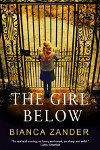
Returning to childhood when memories seem wrong.
Publisher: Alma Books
Pages: 308
Type: Fiction
Age: Adult
ISBN: 978-1-84688-235-7
First Published: 19th June 2012
Date Reviewed: 28th February 2013
Rating: 4.5/5
After ten years in New Zealand and twenty years away from home overall, Suki has returned to London hoping to get back to being who she was; but it’s not going to be that simple. Friends have moved on and no one wants her staying with them, but when she returns to her old apartment block she discovers her family’s neighbour, Peggy, still lives there. She might have found some stability with Peggy and the woman’s daughter, but Suki finds herself haunted by the air-raid shelter that used to be in the garden, no longer there, and what happened the night she descended the stairs.
The Girl Below is a compelling novel, equally driven by characters and plot, that is perhaps best described as realistic magical realism. Mostly consisting of thoughts but having an element that suggests the otherworldly, the book focuses on the reasons a person’s life can spiral completely away from what they had intended, and the need to recover from it when it’s not been a positive factor.
Aiming for detail, Zander tells her story by way of a duel plot line – Suki describes her former life and what is happening in the present. Unlike many stories with such a structure, Zander’s tale invites, perhaps, an equal amount of interest in both storylines, meaning that whilst you inevitably want to get on with the story and find out what happened, there isn’t that ingredient part and parcel of many books where one era is more interesting than the other. There is no divide between the two periods, perhaps because they are not so far apart compared to other books. And the number of characters that inhabit both eras mean you don’t feel like you’re reading two stories.
‘Who am I and how can I be me again?’ is the theme, with Suki’s constant nocturnal travels, in the present day, taking her back to that night she could have died in the flooded air-raid shelter. Because of her parents’ style of living and her father’s choices there has been much for Suki to understand. Whilst understandable, Suki’s character may prove difficult for some, however her actions fit the time period. She does think some thoughts which seem odd for her age, yet this is the first sign of the issues of the book. And as Suki discovers more she realises her childhood memories may not be correct.
The problem with The Girl Below is that whilst Zander wraps some of the plot points up in that dark, complex, and not-quite-obvious-but-fully-implied way that authors of magical realism do, a good half or so of all the questions you have are never answered or referred to at all. You could make guesses of course, but there is scant evidence or reasons for which to back those guesses up, and unfortunately these lost points are some of the most intriguing, the ones most likely to have kept you up at night to find out the truth.
It is for this reason that Suki’s development is stilted at the end. The author has Suki tell you, if not in so many words, that she understands now, but there is not enough showing for the reader to know why. And so abundant are Suki’s strange thoughts, for example that a statue is real, that there really needed to be explanations rather than very very vague suggestions. Suki’s sexual decisions needed more time, too, especially as they are taboo. It’s a case of feeling that the author wants you to be able to relate to Suki without giving you the information you need to know. The reader has to get used to an anxious, childishly scared, and unmotivated person, without a full discloser. It would have also been good to have further insight into Peggy’s grandson, Caleb, who presented an interesting addition to the tale but, whether to illustrate Suki’s anxiety or otherwise, has the focus on his behaviour somewhat diminished in the end.
And this is a pity because overall the book is fantastic and with more attention paid to reasoning it would have been a triumph. The pace is steady, the plot and atmosphere spooky, and there are plenty of times where, for the magical realism, you wonder if you’re reading a suspenseful scene (this wondering itself causes the suspense). One can work out a lot about Suki in the realm of possibility, but it’s not enough.
Writing-wise the book is on the whole very good. The author switches between contemporary British language and some rather old fashioned slang. Zander’s skills as a journalist shine through and it’s obvious she’s brought her own story of the immigrant to the table.
So the difficulty comes, then, in explaining why in general this is a superb book and why you should want to read it. Perhaps the best way to recommend it is to say that in choosing this book you are choosing to be scared, choosing atmosphere over story. Certainly you have to be willing to use the untied threads as a springboard for your own imagination. This book will, without a doubt, divide opinion. It will cause many people to wonder at the fact of a seemingly incomplete manuscript being published, whilst yet providing a satisfactory way to spend reading time. Maybe you will come to a conclusion that trumps all others, the issue is there is absolutely no way of knowing if you are anywhere near correct.
Still, I got the thing open, and propped up the sash with a hardback Dickens omnibus from Harold’s schoolboy collection. With much trepidation, I leaned a little way out. the night air was still but also sultry, humid. With one eye on Dickens – his long-windedness holding fast – I leaned out a bit further and dared to look down.
The Girl Below is unfinished, but brilliant.
I received this book for review from Alma Books.
Related Books
None yet.
J R Crook – Sleeping Patterns
Posted 24th September 2012
Category: Reviews Genres: 2010s, Domestic, Experimental, Psychological, Romance
7 Comments
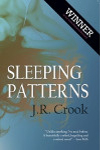
Wherever the story ends…
Publisher: Legend Press
Pages: 106
Type: Fiction
Age: Adult
ISBN: 978-1-908775-52-8
First Published: 2012
Date Reviewed: 19th September 2012
Rating: 5/5
Annelie Strandli (Grethe to her friends) presents to the reader a fictional story written by her friend, who is dead. Annelie is herself included in the story, a story of a girl who meets a boy, which in turn contains another story. It seems she took a while to work it all out, but might the reader understand it quicker? The basic plot is that Annelie meets Berry and Annelie wants to read Berry’s work, and he in turn is unhappy that she has a boyfriend.
Many novels have been called unique and powerful, and described as containing incredible depths. If such a number of novels is categorised as a group then Crook’s short work is destined to join it. And yet it can’t, because what Crook has written here is truly different; it is the structure of the plot, the layers of meaning that aren’t contained in the pages and that must be experienced afterwards, that are so individual. What is especially intriguing about the relationship between the text, the reader, and what is implied rather than spoken, is the way in which you can spend a long time, whilst reading, wondering whether or not you will be able to work it out, and a lot more time wondering if for all the reading you have done in the past you might be completely stupid. This being before you work it out. Was such a thing considered by Crook? This in itself is pause for thought because either way the conclusion yields more discussion, of both the text and what the overall purpose is.
Indeed if the summary of the plot, if plot is the word, sounds intriguing, then the structure is all the more so. The reader must start at the dedication page; whereas it is fine to bypass dedication pages in general, in this case to bypass would be to make a mistake. This is because the dedication tells you that Crook is dead, however he is not – it is he who sent this reviewer a copy of the book. And due to the many layers of story, if Crook is not dead and there are already a good few layers of repetition already, then the possibilities are endless and the book may even have a higher level than the reader themselves – in other words the reader may in fact be yet another layer of the story, who knows? Once you’re past the dedication page there is one other element of intrigue and then you start reading the story itself – starting at chapter 5. You don’t need to worry about getting chronological order wrong however, it’s easy enough to keep up. And whilst you could read the chapters in order, there is no bonus to doing so, you might even miss something.
There is a story within a story within a story, possibly with another story before all of that. The reader ought to find it out for themselves. The most inner story, however, is appealing in the way that it is written; Crook is a very good writer yet suddenly this inner story has sections where the plot is written very simply, almost dull in places, juxtaposed with other sections that are more highbrow. Luckily for the reader, apart from the subtext the book is very easy to follow.
The story – whichever story that is – has a romantic basis, subtle so that it will appeal to all, whilst having emotion pouring from it. And the story – this time the obvious one of Crook being the writer of the book – transcends fiction, making the author fictitious as a character himself and Annelie, presented by Crook as fictional, real.
There is a connection between all the stories. At the heart of everything, the author presents himself in the story (the one Annelie presents) as a fly-on-the-wall. But is he? And if Annelie is supposedly real is this non-fiction of sorts? Are we looking into real lives or fictional ones? And why is the author written as dead? We can take what Berry says as fact, but of the rest there is no knowing.
These are questions you will ask yourself, and whilst this reviewer has answers gathered from reading Sleeping Patterns, they could always be wrong and other readers will likely have other questions in addition.
It is impossible to explain this book further without giving the entirety away. Sleeping Patterns requires all of your attention but it will give as good as it gets. If you are looking to be awed and inspired, to be challenged intellectually, and to find love in a different way, this is the one.
I received this book for review from the author.
Related Books