




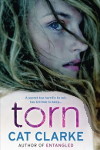
Cat Clarke – Torn
Posted 21st May 2012
Category: Reviews Genres: 2010s, Angst, Paranormal, Psychological, Romance, Social
2 Comments
No matter what, do what is right.
Publisher: Quercus
Pages: 372
Type: Fiction
Age: Young Adult
ISBN: 978-0-85738-205-4
First Published: 22nd December 2011
Date Reviewed: 18th May 2012
Rating: 4/5
Something happened on the school trip to rainy Scotland. Tara died. And although it was an accident, it could have been prevented. Alice knows all about it, she would do. But it’s difficult to tell people because of the repercussions – on her, on her friends. Yet not telling also leads to difficulties. When Tara appears as a ghost to Alice, asking her to do something about it, or rather, knowing Tara, jesting her about it all, Alice knows she has to do something. But can she, especially when there’s love in the air for her, a love that is now somewhat impossible?
Here. Now. Jack. Me. And a room full of dead lizards.
The first thing that strikes you about Clarke – it did in Entangled and does again in Torn – is just how blunt and straight to the point her writing is. Clarke doesn’t hold back, confining views and words to subtext, no, she lets it all out, hitting you smack in the face so that you are under no illusions. And it means that you become more invested in what’s going on than you might have otherwise, because if you are going to read the book, then you are damn well going know everything and accept it.
You would think that this would make for an offensive style, but Clarke is one of the best authors of young adult literature in getting to the real issues and not glossing over them. She doesn’t use lovely language in order to make her stories bittersweet, but she succeeds every single time in presenting the reader with exactly why they should do this or that or believe in something.
Because Clarke’s talent is most certainly in her storytelling, and it’s clear that she has something to say. And while she is blunt, there is no pressure, which mixed together makes a strong impact. You follow Alice’s story, her days when she wonders what she should do, and while the emphasis is on doing the right thing, Clarke does show you why it would be tempting to keep quiet, to think of how speaking out would affect your self, your life. The book is a very easy read with no slow moments, it looks like it will take no effort, but the power lies between the words, it’s woven around them and before you know it you’re knee deep in a multi-threaded story.
While the overall concept is basic, it allows the author to really analyse everything and to go into the small details. What is most interesting is that there are no sub-plots. Although at first it appears that some plot points are secondary stories, every part relates back to the main plot. You get the present, you get the future, you get the back story and the back back story, and you get it from various points of view while never straying from Alice’s first-person present tense monologue.
Alice proves an interesting choice of character because her strength takes a long time to develop, and for the most part she is very passive. Yet she represents the average teenager who wants to fit in while making sure others aren’t left out, and wanting a good life while acknowledging that doing so would cause issues. Ultimately it’s a case of everything happening at the wrong time, and the worst things that could happen colliding with the best things that could happen. And when things don’t happen as they should, there are repercussions.
The bluntness of Clarke’s writing, together with the passiveness and very much usual (in YA) personality of Alice means that the book can appeal to and catch the eye of the regular paranormal and dystopian teenage audiences, whilst giving them a few life lessons. Indeed while Lauren Oliver’s Before I Fall is a great example of how to present issues to readers, there is a lot of emphasis on the romance that somehow blurs your thoughts to the other issues at times. Clarke, on the other hand, uses romance purely to aid what she wants to say, and to demonstrate just how bad things can get. Romance is a big draw in teenage stories, and she adheres to it, but she’ll use it to get the result she wants. Not surprisingly the romance in Torn is very believable and true to life. You can believe in it because you can relate to it in some way.
And when it comes to the romance, Clarke uses her influence as a writer to educate on safe sex, in fact she makes it so that it’s the boy who points out that there is no contraception and thus it would be an idea to wait. And again, it’s real, and Clarke doesn’t portray Alice in a bad light for having said that contraception didn’t matter. The author shows that forgetting things in a moment of lust is natural and okay, but be sure you realise what the consequences would be before you continue so that you don’t continue – in other words, lust is there and that’s fine, but don’t let it control you. And always put one on. It’s a short scene with a strong message, but because she has used the message as content for dialogue it does not sound like preaching, it sounds natural, the sort of conversation a person should have, and will thus surely make readers think.
Clarke isn’t one for finishing her books with a full ending, and her work is surely better for it because it leaves you wondering about all the possibilities and dissecting which one is most likely from what you have read. She does give you all the information you need to work it out, however.
Entangled was a very promising start. Torn has cemented Clarke’s importance and talent in the young adult market.
Related Books

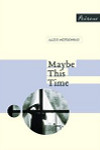
Alois Hotschnig – Maybe This Time
Posted 10th September 2011
Category: Reviews Genres: 2000s, Angst, Psychological, Short Story Collections, Translation
4 Comments
Are you sure you know who you are?
Publisher: Peirene Press
Pages: 99
Type: Fiction
Age: Adult
ISBN: 978-0-9562840-5-1
First Published: 2006 in Austrian; 2011 in English
Date Reviewed: 25th August 2011
Rating: 4.5/5
Original language: Austrian
Original title: Die Kinder Beruhigte das Nicht (That Didn’t Reassure the Children)
Translated by: Tess Lewis
In this collection of short stories, Hotschnig examines identity, it’s loss, and the desire to find or create it.
In Maybe This Time, the locations never appear to be what they first seem – neither do the people, or indeed the narrators. The effect it has is similar to what happens when a near-sighted person takes off their glasses. One moment you can see everything clearly, or at least you think you can see clearly. Then you take off your glasses and everything is blurry, in fact sometimes the more you try to focus, the harder it becomes. And then a bit later you might realise that some things are clear again – it’s only a few things, those close up, but you can see them even better now than you could with the glasses. The stories in Maybe This Time are layered, and you’ll likely only ever understand some of it, and you’ll likely have a different idea of what’s happened than someone else.
This is a lot of what works about the book, the mystery. Like Peirene Press’s other releases, Maybe This Time is a short book that stays in the mind much longer than many long books, but because of the abstract nature of it you’ll be pondering on it even longer than, say, Tomorrow Pamplona. There really is nowhere to establish your bearings for any period of time and when you do think you’ve a grasp on what’s happening something that doesn’t relate to your idea pops up.
And before you know it, just as you think you might be getting somewhere, it’s ended. In fact some of the stories don’t even span two pages. Hotschnig will not provide you with an explanation either, and there are no conclusions in his tales.
The stories are very poetic, and although you have to take into account the translation (by Tess Lewis, who has made splendid work of the descriptions) it is hard not to believe that in Austrian German the effect would be similar.
And speaking of the descriptions, which are so detailed and given you a real sense of life as though you are an art gallery patron who has viewed the same work for an hour and have thus notice the smallest of brush strokes, these too help the stories sound poetic. Truly the book is poetry in prose.
The stories are about loss of identity, which makes a lot more sense than the stories themselves for their abstract structure. Because the general theme is so specific the book favours a dip-in approach rather than the usual recommended single sitting of Peirene Press. That’s not to say you can’t read it all at once but the characters can become blended together. Then again, judging by that general feel, they could be one and the same!
Each of the narrators is male and the book has a definite masculine feel to it. And there are some very strange and sometimes spooky things that go on, for example the last story is reminiscent of the book, Before I Fall. It would appear that each one is searching for something – themselves, certainly, and in different ways, but also a better world. Where the man in the last story keeps meeting people who know him for different reasons and in what seems to be a different sort of guise, there is the sense of crowds and the rush of people going about their day.
In fact, there is an atmosphere of expectation in the stories. The characters want or need to act as expected and it is this that runs most perfectly alongside the goal of Hotschnig to present identity in today’s world.
As someone who openly accepts that they have only come to a bit of an understanding of the book, and would only be prepared to discuss with others a smaller part of that bit for fear of being totally wrong I must say that rating this book is most hard. On the surface you have a collection of mostly mundane stories, on another level confusing ones, and on a third deep stories with a powerful message. Please excuse me for taking everything into account when I rate it.
Maybe This Time is marvellous, and Hotschnig very clever. So clever, in fact, that he has left this reviewer baffled. Highly recommended, particularly for those who can read it in a group.
Translated by Tess Lewis, received for review from Peirene Press.
Related Books

Louise Douglas – The Secrets Between Us
Posted 4th September 2011
Category: Reviews Genres: 2010s, Crime, Domestic, Paranormal, Psychological, Romance, Social, Thriller
1 Comment

The truth can haunt you.
Publisher: Bantam Press (Random House)
Pages: 451
Type: Fiction
Age: Adult
ISBN: 978-0-593-06708-6
First Published: 7th July 2011
Date Reviewed: 31st August 2011
Rating: 5/5
Sarah left Laurie after he’d decided to sleep with her friend because he couldn’t understand her [Sarah’s] depression over giving birth to a stillborn baby. She travelled to Sicily with her sister in order to get away from everything and it’s there she meets Alexander and his son Jamie. Alexander’s wife has left him after a turbulent marriage and no one knows what’s happened to her, but to Sarah that’s not as important as the feelings she is starting to have for him. When Alexander suggests she move in with him and Jamie and live in the village of Burrington Stoke, where outsiders are not welcome, she joins him on impulse. But the mystery of the wife is far from over.
Douglas has created a work that binds different genres together into something quite extraordinary. What’s intriguing about it is the way in which it’s told. Douglas favours a sort of detailed abstract style – there is plenty of detail in it but sometimes it feels as though she’s left things out, the not so important things, even if in actual fact she hasn’t. It’s a unique style and means that you come away with a completely different experience than you do with so many writers who are hard to tell apart from style alone.
The story is well plotted. There is never a dull moment, during the mundane activities Douglas never lets her narrator stop thinking. The book takes place over several months yet it could just as easily have been a few days for how quickly it moves, and rather than be strange this aspect is interesting. It shows how rapidly problems can escalate.
Now Sarah is a difficult one to place on the spectrum of good or bad because she is clearly affected by the death of her child, and the reader can see times where her judgment is affected because of it where she can’t herself. Because her depression continues throughout the book one only knows her in this state. Yet a few things she does makes you wonder how much is due to her trauma and how much is due to that usual feeling of jealousy in love. Does what Sarah does sometimes illustrate control from outside, her mental state, or a spiteful character?
The book dissects the idea of a perfect living situation and shows how undercurrents can produce more harm than situations generally thought to be harmful. When everyone is living in everyone else’s pockets, everyone seems to know everything. But this feature of the village actually introduces the situation where no one actually knows anything and had there been true discretion the mystery might have been solved a lot quicker. Lives lived in public produced more secrets.
There is so much detail and thought given to the twists in the plot and the red herrings. Unlike a lot of books where at least some of the results are obvious early on, in The Secrets Between Us you really can’t say for certain what’s happened or who played a part. It’s like a whodunit only in pure “literary fiction” style and without the detective narrator.
The characters and their secrets affect the reader’s knowledge, as the reader only ever knows as much as Sarah does about Alexander. In this way the book’s title takes on a second meaning – not only are there secrets between the couple, those secrets spill over to the reader.
Some things are never used in the plot, such as the similarities between the wealthy mother and her daughter. When Virginia discusses her theories with Sarah never does the irony of the situation come into play, whether in discussion or in thought. And an idea about police involvement doesn’t get resolved.
But the few negatives are nothing when placed in the whole. Douglas is an extremely talented author whose ability to spread out a plot over a vast number of pages without once waning, still has this reviewer in awe. When she does exploit the idea of drama she still keeps a hold of the element of realism and possibility and so the book is truly spooky. And even though it’s spooky you just can’t stop reading it.
You will take away with you knowledge – the knowledge that you still have so little knowledge about the characters, which is something you don’t actually realise until you think back on the book. Douglas had you going there for a minute, thinking you know everything, but you don’t. Those secrets that were between you and the book are actually still there. And that feeling is incredibly satisfying.
The Secrets Between Us is for anyone who is looking for one of those elusive blow-me-away books, those that are off the scale for reasons you could never quite explain.
I received this book for review from Transworld Publishing, Random House.
Related Books



Véronique Olmi – Beside The Sea
Posted 23rd March 2011
Category: Reviews Genres: 2000s, Angst, Domestic, Psychological, Translation
3 Comments

When obsession takes over everything else.
Publisher: Peirene Press
Pages: 103
Type: Fiction
Age: Adult
ISBN: 978-0-9562840-2-0
First Published: 2001 in French; 2010 in English
Date Reviewed: 9th March 2011
Rating: 5/5
Original language: French
Original title: Bord de Mer (By The Sea)
Translated by: Adriana Hunter
A mother takes her children out of school to go on a trip to the seaside. She wants to take them and herself away from everything and thinks that they should see the sea. They spend the time in a grotty hotel and have little money to spend. It will be the last journey they take.
All that I’d heard about this book could never have prepared me for what I was going to experience. Beside The Sea deals with depression, obsession, and mental illness, although the only one of these issues actually confronted by the mother in words is depression, and then only swiftly. A big part of the problem is that the mother is having a hard time accepting that she has a problem, rather than everything that affects her being caused by society and the world in general. Practically every sentence uttered is to do with a certain issue.
The way the book is written aptly projects the mother’s mindset. Short sentences, the sudden inclusion of swear words and other harsh statements indicate she’s become extremely irrational, as does the way she recounts the conversations of others. This means that the book is, to use a metaphor, one punch after another, repeatedly, beginning in a way that you feel you can understand her reasoning and ending in a way so incomprehensible to anyone but the mother.
It’s been the same sailor for thirty years, what I mean is the way I see him’s still the same, he’s still got his torn clothes and holes in his boots because it’s the bit about “boots all worn” that really matters, it’s terrible having sore feet, and shoes are the ruination of many a mother.
Olmi also shows us how troubled the woman has become by allowing us to see how others have responded. We are told about visits from the social worker and about things that other people have commented on, all described from the mother’s point of view. This means that the reader can understand what other people have done to try and help, and we see the reasons why the woman is against it. Unfortunately it also means that the reader is the one in the middle, wishing the social workers had made more inquiries in order to know what they, the reader, do.
The sad thing is that although the woman is staunchly against her children mixing in the world and she’s afraid of it for herself, you can tell that a part of her is desperate to be included and that perhaps if she was accepted by people, no matter how many (for it seems she has no friends) she might be alright. But then she is her own worse enemy in that respect, making a point of only leaving her home when others aren’t around outside.
One of the biggest issues is a spin-off of the woman’s personal problems – neglect. Because the woman thinks mostly of herself, even when she believes she is thinking of her children, we see, through what she says, that the children, especially the eldest, are not coping. The youngest is still at an age where he doesn’t understand but Stan is nine and has ultimately become the adult in the family. The mother sees what Stan does as being against her, and at times she’s right, but when he is against her it is because he is becoming both frustrated and depressed himself. Stan’s actions, such as the episode at the seashore where the mother describes how he runs into make-believe walls, show the boy’s torment. Stan clearly understands what has happened to his mother and understands that he has to look after both her and his younger brother, but at the same time he sees that the world isn’t as bad as his mother makes out. The wall incident provides the metaphor for the times when he is trying to get through to his mother and fails, and the later dream his mother has of his walking into the sea but not drowning shows her misunderstanding of the other situation. Stan walks into the sea. The sea represents the world, but unlike what the mother is expecting, the sea doesn’t swallow him up, rather he walks through it boldly. Although we are shown that Stan is bullied we are also shown his strength and when he hits his mother all the hurt and burdens he carries with him are presented.
The above is summed up by the following statement:
…he looked so alone… how could he cope so well without me?
Unfortunately because of the difference in age and understanding of the two boys, Kevin and Stan are not always happy together, but the reader can see where Stan is trying to pull Kevin to “safety” as his mother holds onto the child’s unconditional love.
…it’s like he’s laughing to hear himself laugh, that he’s making the most of that laughter, having fun with it, and I know that a laugh like that runs away the minute you grow up.
To refer back to Stan’s strength I would like to comment that the metaphors and usage of imagery to demonstrate the other character’s emotions is absolutely fantastic. It’s rare to find a book so powerful in so many respects.
Why did the mother tell this tale? We are not given an explanation – was it just because she was thinking of it as one might as they write a diary, are we seeing it as it plays out, or is she giving a statement to the authorities? The last is a possibility purely because of what occurs – the book ends without the reader knowing what happens afterwards. But it gives you a glimpse as to how a mind can be thus affected, even if we do not know how long she has been like this or if there was a specific event or thought that triggered it.
The book has a truly haunting quality in that the issues at hand are never resolved and because they are supplied in such detail they are more difficult to accept than the unresolved issues in many other books.
The writing, and dare I say this English translation, for we must give Adriana Hunter her good due, is exquisite, the structure is superb, and what is at once a simple book and a complex one is just incredible.
Beside The Sea is a difficult read but is of great importance for the frank reality it shows of the workings of a mind in such turmoil.
Beside The Sea was originally written in French, and, as previously said, was translated into English by Adriana Hunter.
Related Books
None yet
Marghanita Laski – The Victorian Chaise-Longue
Posted 28th February 2011
Category: Reviews Genres: 1950s, Psychological, Social
2 Comments

The definitive caution for any wannabe time traveller.
Publisher: Persephone Books
Pages: 99
Type: Fiction
Age: Adult
ISBN: 978-0-9534780-4-0
First Published: 1953
Date Reviewed: 27th February 2011
Rating: 4.5/5
Melanie is recovering after months of suffering Tuberculosis. She is much better, but when she moves out of the bedroom to sit on the chaise-longue she bought from an antique shop, she wakes up to find herself in the body of a very sick woman in the Victorian times.
The Victorian Chaise-Longue is a rather weird book in the sense that it is confusing and unsettling. It is not really the horror as described when it was first published, but there are some horrific moments in it.
You may come to the table thinking that the book revolves around doctors and medical treatment, I certainly thought that the bad elements would include Melanie being subjected to medical procedures that we have long since abandoned, but Laski makes the issue very simple.
Melanie’s problem is that she doesn’t know why she’s back in time, what the circumstances of the person whose body she inhabits is (except that they are sick), and that she is unable to articulate herself because of the limitations of the body. Melanie is in the body of one Milly Baines, a young woman who of course has no idea of the concept of things we take for granted, for example aeroplanes. Melanie can think about telling the Victorians about aeroplanes but she cannot say the word because it doesn’t exist in the time she is in. The discovery of what Melanie can and cannot do is perhaps the most interesting aspect of the book because it involves many different things, not just speech.
As well as the above-mentioned frustration, Melanie spends a lot of time trying to work out exactly why and how she got to the past. The how may be obvious, but the why is not. In fact because the reader’s knowledge is no more than Melanie’s the frustration crosses over from fiction to reality – part of the genius of this novel is that the reader never has more or less comprehension than the character. The topics covered are relevant today in much the same way as in Melanie’s time – the book was written in the 1950’s and the concepts explored match our own current way of thinking so today’s reader can understand the differences between Melanie’s life and Milly’s perfectly.
One topic I’d like to highlight is spiritual ecstasy, because Laski’s writing on it really got me thinking. Melanie likens the feeling of ecstasy after she has had sex to the feeling one has when in deep prayer. The two situations may be poles apart, but you can see where her theory lies in reference to spiritual feeling. I noted down the following quote:
It is the ecstasy that is to be feared, she said with shuddering assurance, it is a separation and a severance from reality and time, and it is not safe. The only thing that is safe is to feel only a little, hold tight to time, and never let anything sweep you away as I have been swept – and perhaps that is how, only how I can be swept back.
From this quote one can understand not just Melanie’s thoughts but also their progression as she moves from one idea to the next. It would be useful for me to say at this point that prior to the switch Melanie was bubbly and comes across as someone who acts on impulse. Thus one can see just how confused her mind becomes as she begins to question the intimate details of who she is and how it might relate to the switch.
There are other concepts that I haven’t covered because I can’t really tell you everything. Suffice to say that, like Melanie, the reader must dissect every last bit of information available.
The Victorian Chaise-Longue is a brilliant little snippet of writing that will leave you wondering for days. The page count may be small but the legacy is huge. It’s definitely made me think twice about wanting to explore the past first-hand.
Related Books


