





Louise Douglas – In Her Shadow
Posted 23rd April 2014
Category: Reviews Genres: 2010s, Angst, Domestic, Mystery, Psychological
3 Comments

Three’s a crowd.
Publisher: Bantam Press (Random House)
Pages: 372
Type: Fiction
Age: Adult
ISBN: 978-0-593-07021-5
First Published: 2012
Date Reviewed: 8th April 2014
Rating: 4.5/5
Ellen drowned and Hannah has never got over it. The event haunts her still, twenty years later. When she starts to see Ellen in places that reference their past together as friends, as well as at her work place, Hannah wonders if it’s time to go back for therapy. But there’s something nagging at her, and, illusion or not, she feels it’s time to finally discover what happened whilst she herself was in Chile.
In Her Shadow is Douglas’s beautifully written fourth book. It’s a lot slower in pace than the author’s previous work, The Secrets Between Us, but the pace is warranted and it gives Douglas a lot of time in which to explore the themes she chose to include. Likewise the plot is fairly predictable, and this appears to be intended so that you focus on the ‘right’ things.
The book sports an unreliable narrator who presents a fantastic opportunity for the reader to really delve into what’s going on. Hannah is quite obviously unreliable from the very start and with good reason – during the chapters where the adult Hannah looks back on her childhood you’re inevitably presented with a child’s view of life. Where Hannah says that Ellen is a drama queen, where she says that Ellen is too lucky, beyond a couple of choice quotations (that of course could be coloured by jealously themselves), it is apparent that Hannah isn’t seeing reality. Hannah, once good friends with a boy called Jago, becomes the third-wheel when she introduces Ellen to the ‘circle’. That she is, in a way, third wheel, is true, but she is very wrong about the friendship in general.
What is most interesting, as the reader reads on and learns just how wrong Hannah’s thoughts of Ellen are, is that it’s Hannah who is better off. Due to Hannah’s unreliability, the reader can see for themselves not only the truth, easily, but also explore the way jealously affects people, and the extent to which it can destroy a person. And it is exactly because Hannah is too young to know what’s she’s doing that she enables you to see what’s really going on. Because she does not understand what she sees, she ends up telling you the reality just as much as her erroneous thoughts. Indeed it’s intriguing to think that whilst the first-person generally means less knowledge of others, usage of the third-person in this book would ironically have led to less knowledge of Ellen.
And so Douglas shows us just how much perception can play in the construction of opinions. Of course we all know this, but by using a child and making what’s actually going on a horrendous abuse, the author really hones in on it. And it shows how children will latch on to what works for them – a father who hugs his child when their own parent doesn’t, means he must be a good person and that his daughter is lying. Hannah isn’t mature enough to recognise dangerous obsession and abuse; she sees what’s on the surface.
It’s not a spoiler to say that abuse and mental illness is at the heart of this novel. Throughout the reader is presented with the questions – is this man violent? Is this man interested in young girls? Is he mad? There is also Hannah’s mental stability to consider. Jealousy is of course an issue in itself but in her case it’s intertwined with anxiety, fear, and regret. Perhaps it makes Hannah feel better to confine her feelings of guilt to the same box as her jealousy – it’s easier to push bad memories away if you believe the person was awful.
Hannah also has an issue with identity – the boy who kissed her becomes her brother, Hannah isn’t happy in her career, and her parents, though supportive, are not the affectionate kind.
This is where the slow-pacing makes the most sense – in that at first you might find it slow without reason, but as the book continues you see why Douglas has opted to use it. There is just so much to consider. Douglas wants you to really understand Hannah, to see what she thinks and how she got it wrong, to see what her life is really like, and as the book progresses you realise that perhaps it’s not ‘just’ that Hannah was wrong about Ellen, maybe Hannah isn’t as good a person as you thought. Is she misguided, is she led by her lack of information? And what on earth will she do to make things right? There are no huge shocks in this book, no big climax. There isn’t supposed to be.
In Her Shadow is a book with a main character you may not completely like but who you can relate to; you will find yourself rooting for her to learn the truth. There are many injustices and misunderstandings here and it is not a simple case of age making someone wiser. The book does end relatively quickly, and one plot thread in particular is wrapped up in a couple of pages and not particularly satisfactorily, but there are no threads left hanging.
In Her Shadow is a wonderful study of personality, mentality, and its extremes. It may make you want to praise it to the hills or it may not – either way it’s likely you’ll find it difficult to put down.
Related Books

Aimee Bender – An Invisible Sign Of My Own
Posted 21st February 2014
Category: Reviews Genres: 2000s, Angst, Commentary, Domestic, Psychological, Romance, Social
4 Comments

Bizarre – but then that’s life.
Publisher: Windmill Books (Random House)
Pages: 242
Type: Fiction
Age: Adult
ISBN: 978-0-099-55852-1
First Published: 2000
Date Reviewed: 17th February 2014
Rating: 4/5
Mona’s childhood came to an effective end when her father became ill. Holidays ceased to occur, her father stopped being interested in anything, and Mona coped by becoming a quitter. Successful and talented, she slowly quit everything she was good at before she became too successful or happy. Passionate about maths, the one interest she didn’t give up, she is given a teaching job despite a lack of formal qualifications, and comes to love the job, but her coping method isn’t quite usual, even amongst those who are also unusual.
An Invisible Sign Of My Own is a focused take on life and all its idiosyncrasies. Further than the superstition mentioned in the blurb, the book studies obsessive compulsiveness and depression. It is, at its heart, a look at two groups of people who are often one and the same – those who cope in unique ways, and those who live in ways that aren’t the norm.
The book is at once very positive and negative. It looks at idiosyncrasies and dark issues in the same bizarre way as Bender’s later work, The Particular Sadness Of Lemon Cake, whilst having a foundation of pure despair. This is not the book to read whilst you are upset yourself, indeed whilst the conclusion may show a sort of conquering of depression, the atmosphere of the story and characters are dark enough to be almost too easy to relate to if you’re having a bad day. This is of course as much a drawback as a triumph. Bender’s choice of idiosyncrasies may for the most part be unrealistic, as much as the word can be used when dealing with the subject, but if anything this helps the reader emphasise and/or understand more. By having that distance between reader and book – the distance of the distinct behaviours – the content is more welcoming, because anyone who has experienced depression, OCD, and/or the sort of tragedies in the book, is going to find it easier to see it from a fly-on-the-wall perspective. The pain may be the same, but the difference in delivery means that you’re not going to feel targeted and at the mercy of an author whose other characters dislike what they see in those who aren’t coping.
The story, in which no quotation marks are used, is somewhat predictable, but it is obvious that this is part of the idea. In order to understand Mona as the author wishes you too, you have to see where the book is headed. Mona is at once the main character and one of many. She may be the narrator but the story focuses on, for example, the plight of a child whose parent is dying of cancer, just as much. What Bender shows, via the subtext, is how important it is that society in general truly recognises that people cope with pain and despair in different ways and that when those ways do not fit the norm, or what is expected, these people are still looked after. An Invisible Sign Of My Own isn’t about leaving people to fend for themselves (so long as the issues are known), indeed it is very much the opposite, and due to that it forces you to look beyond appearances. In the case of the child of the parent with cancer you have a child that looks for cancer – indeed almost hopes for cancer – in everyone she meets due to her undisclosed feeling of detachment, whose idea of numbers in nature is morbid, naïve, and dangerous, and who, for her young age, suggests things such as suicide as though they were something to do when bored. This is a girl too young to really realise what she is saying whilst knowing exactly what is happening. Other children, albeit not faced with terminal illness, show how naïvety about subjects they don’t yet understand have disastrous consequences. And Bender lets the disaster happen, to shock, to teach, to illustrate just how important care and education are.
An Invisible Sign Of My Own is at once easy and difficult to read. It’s strangeness can at times bely its message, suggesting that Bender just wrote a lot of madness without anything in particular to say, or worse, that she thinks it is okay. It’s tough getting to the heart of it, and likely often times you’ll wonder what in the world you’re reading. It may be barmy but that’s the surface dressing; it’s worth reading to get a glimpse of lives that don’t tick boxes, and there is plenty relevance in its content to fit our lives in the non-fictional world, too.
Related Books
Gillian Flynn – Gone Girl
Posted 24th January 2014
Category: Reviews Genres: 2010s, Domestic, Psychological, Thriller
16 Comments
A match made in hell. Happily.
Publisher: Phoenix (Orion Books)
Pages: 461
Type: Fiction
Age: Adult
ISBN: 978-0-7538-2766-6
First Published: 24th May 2012
Date Reviewed: 22nd January 2014
Rating: 5/5
Amy is missing. Nick was out at the beach having a coffee and when he received the call he drove straight back. The door was open; the living room showed signs of a struggle and mopped up blood; his wife was nowhere to be seen. Nick doesn’t really like his wife. And his wife doesn’t like him. They’re no longer getting on and Nick is the prime suspect. Because it makes sense, doesn’t it? The husband killed his wife; it happens in all the TV shows.
Gone Girl is a twisted, unreliable, yet undeniably magnificent thriller. Told from Nick and Amy’s perspectives – or is it? – the book keeps you on your toes for the entire ride.
The characters give Heathcliff a run for his money in the anti-hero stakes, both taking turns, in the way it is written if not in reality, of making you feel a (little, only ever a little) sympathy for them before you scorn them instead. It’s all rather akin to the way the public and media are swept along in the book. Flynn never once lets you find your feet. Is she going to have her characters present the truth? No; oh, perhaps in a moment? Nick and Amy are as unreliable as the British weather – far more ferocious than the wind, as quick and shocking as lightening but always ready to show a sunny smile. The book may have an ending, but even then you will leave not knowing whether somewhere buried in what you know – the various ‘truths’ – is the real (really, really, real) truth or not.
Needless to say the characters are shocking. These characters weren’t written to be liked or related to. Perhaps one of the characters is more shocking in particular – it’s hard to really say if one is worse than the other due to the unreliability – but either way they stoop to low depths. Calculating, manipulative, and that word again, twisted. It’s one of those ironic situations where you can see that two characters are absolutely made for each other but you can’t say you care.
Flynn’s writing is exceptional. It’s not literary (literary would have ruined this one) – it’s the dialogue, the characterisation, the overall feel. Even the excessive swearing has its place. Flynn’s writing style as a whole is simply different. She brings the characters to life in a way that is rarely seen. The first-person narrative makes it even more damning and sly.
There are many turns in this book as well as the literal switching back and forth in mind set. There are purposes the characters don’t let you in on until later on, too. This point is worth mentioning because a fair way through the book the narrative seems to change – it seems Flynn isn’t going to give the reader what they want, but she’s better than you’ll assume. And no matter whether you like the ending not, it is difficult to say it doesn’t fit the book. Various endings are possible here, some that would provide instant gratification for the readers, some the instant gratification for the characters, others that appear to weaken the characters or to push the book to end quickly, those with loose threads, and those that would be most satisfying a while after you’ve finished. Like the characters, Flynn’s authorship is unreliable – purposefully – and she isn’t going to budge. If you want to know the details you’ll have to stay put and keep reading.
With it’s numerous twists and turns, the diversions to places that suggest a loss of the iron grip Flynn has, the book can seem long at times. Yet except for those moments when you wonder if Flynn will keep her end of the bargain, it’s never disappointing. It doesn’t feel as lengthy as it is, and when you look at the amount of time in which the majority of the story occurs, it’s really no time at all.
The best way to sum Gone Girl up is to say that whether or not it’s exactly what you pictured, this book is one of those few that are unlikely not to meet your expectations in terms of the genre, the hate, and the overall package.
Amy wants you to read this book, and if you’ve been at all intrigued it’s likely she’ll get her way. She always does.
Related Books

Matthew D Lieberman – Social
Posted 17th January 2014
Category: Reviews Genres: 2010s, Psychological, Science, Social
6 Comments
We were not made to be alone, not even for a short while.
Publisher: Crown (Random House)
Pages: 305
Type: Non-Fiction
Age: Adult
ISBN: 978-0-307-88909-6
First Published: 1st January 2013
Date Reviewed: 7th January 2014
Rating: 2.5/5
Looking at various regions of the brain, Lieberman tells the reader how each section revolves around sociability and how we evolved to be social creatures.
Social sports an interesting topic that is unfortunately marred by a lack of reasoning and a lot of bizarre and poorly thought out propositions. On the surface the book presents itself as the antithesis of Susan Cain’s Quiet and will therefore likely attract those readers who enjoyed Cain’s work. However where Cain was mostly objective, Lieberman is incredibly biased.
The book is structured so that different brain regions are examined one after the other with statements about evolution, information about relevant experiments, and short resolutions created by Lieberman, scattered throughout each chapter. The book ends with Lieberman’s most ‘pressing’ resolutions for society in general. It’s not a bad set-up, per se, but it does mean that the book is monotonous and that for the reader who is not intimately aware of the brain regions it will likely be all too easy to become confused by what is what, given the inevitable similarity between acronyms and names that seems apparent when you know little.
Whilst the book begins with promise and the author writes with due attention and care, the content soon devolves into the simple explanation that everything is the way it is because of evolution, and the author’s views of anyone who doesn’t fit the box he has constructed drench the book with a bias that by the end of the work displays more than a hint of intolerance.
There are areas of the book in which it’s usual to find issues in texts, for example there are too many references to the author’s particular country. In this case there is too much Americanisation, which means that some examples of pop culture, used to explain concepts, are likely to be lost on many readers and therefore these readers won’t be able to understand the point being made through them. Sometimes the examples Lieberman chooses are those that are known worldwide, but otherwise the choices are so specific that there may even be some American readers not familiar with them, and due to this it is a particular problem.
The book is incredibly repetitive. Experiments are detailed only to be detailed again a few chapters later, referred to in the chapter after that, and detailed once again further on. Regarding these experiments and researches, Lieberman is inconsistent. He always names the scientists involved but doesn’t always afford the reader the information of who the person is – what field they are in, what university they work for and so forth. Having the names is of course necessary for citation but for the reader having the names without any further information is meaningless.
Looking into the experiments, the cautious reader should note that nowhere in the book is it mentioned that experimenting on animals is considered by some to be immoral. This is the case in other similar works, such as Lynne McTaggart’s The Bond, which was more graphic than Social, but in Lieberman’s book the point is particularly worth noting, not just because of the topic (thinking about others as was the likewise ironic topic of McTaggart’s book) but because of the way Lieberman gives information as to why humans are not experimented on in the same way. For example, consider this extract:
For obvious reasons we do not conduct experiments with humans that involve giving people morphine after they have been rejected, excluded, or cheated on.
The irony here is that this statement appears right after a paragraph about puppies being given morphine after being forcibly separated from their parents.
As an aside, if you find yourself distressed by this story, [about rats having emotional neurons being removed, thereby meaning that they start shunning their young] it probably means your own dACC is intact.
When you consider that you are more likely to be distressed by this story simply because the experiment happened, the author’s statement is artless to say the least.
The downside to studying rodents is that we can’t measure their experiences or even verify that they have them. The upside is that more invasive studies can be conducted to examine how individual septal neurons respond or how surgical removal of the septal area alters behaviour.
In the same way as the above extracts, this is said without any thoughts of wrongdoing or an acknowledge that to many people the ‘upside’ is seen as a downside.
The issue with the experimentation is that everyone knows it takes place and that it is of course going to be included in works involving science, but given the subject of this book and the way it is presented as a work on something that is of general interest, some sort of deliberation or debate (given that very idea of being social and caring for others) ought to have been included.
There is a major focus on autism that isn’t apparent from the book cover or summary that bares commenting on because of Lieberman’s approach. Lieberman, as becomes plain the further you read, is fixated on the idea of the social, of us being social creatures and, especially towards the end of the book, he shows how overtaken he is by this idea to the exclusion of all else. It should come as no surprise then that, when it comes to autism, denigration is the mode of the day. As autism is related to a lack of ‘normal’ social skills, it is easy to see where Lieberman’s issues lie.
The author says that if empathy is the peak of the social mind, autism is sadly one of its low points, showing no positivity whatsoever. Lieberman wonders if when he took drugs he ‘didn’t seem a bit autistic that day’ – does he also say, upon finding his fridge devoid of chocolate, that he knows what it must be like to be a child starving in Africa?
It’s important to note that, strictly speaking, this description is far more accurate than the normally developing child’s… Although the description from the child with autism is more accurate [reviewer’s note: it is completely accurate] it is far less useful. It doesn’t give us the kind of insight we all crave into the psychological drama that unfolded.
This comes after an image of shapes on a page, which is what the autistic child described. There is no drama to unfold, there is no usefulness in the normal child’s description of the shapes bullying each other because that would give you a false idea of what the image shows. What the children questioned do intimate is the possible difference in imagination and storytelling between ‘normal’ children and autistic children.
The denigration of autism is very odd, especially when you consider that a person with autism is as likely as anyone else to be interested in reading this book. And whilst Lieberman may make some good statements that are unfortunate but true, his attitude mars them. It is also interesting to consider that the fact autistic people have ‘problems’ with social skills implies that Lieberman’s theory of the social mind could actually be wrong, for who is to say what is truly normal?
Further denigration is conferred on introverts (whose qualities also beg the question of whether Lieberman’s theory holds any water):
Being smart and motivated, without being able to connect with others in the lab just won’t cut it. I’ve had a couple of students in the lab over the years who never really integrated socially with the rest of the team, and they often struggled. They could leverage their own intelligence and hard work, but they were less able to access the intelligence and expertise sitting in the next office over. From this perspective, social connection is a resource in the same way that intelligence and the Internet are resources. They facilitate getting done what needs doing.
It would not be wrong to say that Lieberman does not understand introverts. It is also apparent why, at least in part, the students referred to in the extract struggled – a lack of support and understanding of your students is going to affect their progress because they are likely to pick up on it.
The assumption that productivity is about smart people working hard on their own has been masking the fact that individual intelligence may only be optimised when it is enhanced through social connections in the group.
This is where we see Social as the antithesis of Quiet. In the latter work, Cain says introverts need their own time and space. But whereas Cain is respectful of extroverts, Lieberman is not respectful of introverts. Furthering this difference, Lieberman states that only those with good social skills should be leaders in the workplace, neglecting to consider the negative impact that this would have if the leaders were not also of good intelligence. He also states that ‘the greatest ideas almost always require teamwork to bring them to fruition’, saving himself by saying ‘almost’ but still showing his lack of research and overall knowledge of the present day that suggests that people can be just as successful working by themselves.
Lieberman suggests a vastly different education system which betrays his age. He says that history classes should teach the whys and the social effects – they do. Perhaps they did not when Lieberman was a boy, but as they do now this section is irrelevant. The author suggests that English lessons should be scrapped in favour of ‘communication classes’. This would be problematic given that such classes are not viable alternatives – language (if we assume he is referring to language rather than literature) is not quite the same as communication – both are indeed about society and communication but there are differences. There is also the fact that the world remains in accordance with, for better or worse, the idea that those who can read and write have power and more opportunities to get ahead in the world.
Lieberman says:
Why would bullying, which typically takes place outside the classroom, affect performance in the classroom?
This is one of the first times where the author’s lack of knowledge really starts to become an issue. To suggest that victims of bullying should just leave their issues at the door displays a complete misunderstanding of what bullying is and how it affects a person. Lieberman somehow does not know that bullying can affect someone’s overall well-being and, furthering that, he should know that bullying isn’t restricted to school corridors and is more often than not just as bad in the classrooms where bullies torment children behind the backs of clueless teachers.
Lieberman suggests cutting back on school lessons that are forgotten so that more time can be spent on the important ones. This is a good idea in theory, but the way Lieberman speaks of it he is in favour of removing the sorts of classes that inspire lifelong interests and passions. Algebra may be boring for many people, but without it would the mathematicians our world needs have been inspired to become mathematicians?
The author is in favour of letting older children learn lessons to then teach them to younger children. A fantastic idea, but how long would it be until the novelty wore off, and would children pay attention to a lesson essentially learned twice when they already find a lesson taught once boring?
It is this lack of knowledge and understanding of children, of people, ironically, that ends the book. Lieberman turns to preaching. The subtext is evident – Lieberman’s way of life, the way his residential area revolves, is superior and ought to be introduced worldwide. He suggests that apartment blocks have socialising areas and appointed people to curate social lives – “Throughout our childhoods and young adulthoods, our social lives are curated by others. Couldn’t we find a way to replicate that in our adult communities as well? Why don’t we have someone on each apartment floor designated to create social activities?” The author does not seem to think that maybe having had their lives curated as children, most people would prefer to control their adult social lives themselves. He does not account for those who just want to live their lives, who don’t want to be social all the time – which, it could be argued, accounts for most people. He suggests closing streets at the weekends for social events without thinking about how this would disrupt traffic, how it would result in noise, how many people prefer to just relax at home.
The author even takes on the individuals who run companies, complaining at the way they focus their efforts ‘incorrectly’. He suggests that most employees would take recognition over more money, which doesn’t sound so bad – until he ruins the sentiment entirely by saying that the profits from the savings the company would make would therefore be able to enter the company coffers and so the company would benefit. Recognition is a ‘free’ and ‘infinite’ resource – which, when used in place of pay rises, would ultimately make a boss a measly employer.
Lieberman does have some interesting things to say, for example that botox disabling a person’s ability to mimic expressions means that the person will be worse at recognising emotions in others. He says that “society values our self-control more than it values our quality of life”, a very sobering thought, and he in no way suggests that the book is all his own work, always attributing research to those responsible. But at the end of the day it is hard to believe that Lieberman didn’t decide to live away from society for several years to write this book, losing touch with everyone in the process.
Ill-informed, rose-tinted, repetitive, and lacking in tact, Social may have a few ideas and statements to astound, but by and large it does not come anywhere near the convincing argument, of humanity being social, that it declares.
I received this book for review from Random House.
Related Books


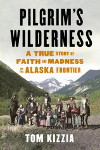
Tom Kizzia – Pilgrim’s Wilderness
Posted 8th November 2013
Category: Reviews Genres: 2010s, Angst, Domestic, Law, Political, Psychological, Social, Theological
2 Comments
When God is no longer that man in the sky but the father of a family that has no choice but to follow him.
Publisher: Crown Publishing (Random House)
Pages: 296
Type: Non-Fiction
Age: Adult
ISBN: 978-0-307-58782-4
First Published: 16th July 2013
Date Reviewed: 30th October 2013
Rating: 4/5
Tom Kizzia recounts the story of the ‘Pilgrim’ family who appeared at first to be naïve wannabe pioneers in rural Alaska, but later proved to be problematic to the National Park Service, the local residents of McCarthy, and a group of people with a horrific secret.
Pilgrim’s Wilderness is the generally well-paced and well-written tale of a family that was not all what they seemed to be. Including tales of what came before McCarthy, and his own then-present reporting of the Pilgrims for the newspapers, Kizzia creates a strong and shocking story, reminding you that appearances can be deceptive.
Kizzia’s approach to the work is one of the biggest, if not the biggest, recommendations for it. Kizzia’s approach is both biased and highly objective. And whereas a bias can often detract from unpersonal non-fiction, here it is necessarily apt. The actions of Bob Hale (‘Papa Pilgrim’) warrant an incredible and understandable bias against him, and it is to Kizzia’s credit that he, the writer, stays away from slandering. Kizzia could not help but be biased, it would be intolerable any other way, and it is interesting that it may take the reader a while to realise why.
This is because for a long while the issues are all to do with land ownership and the way many dislike governmental take overs of land in the name of preservation. Kizzia is fair here, telling the reader why the Pilgrims had a good claim, and why the National Park Service had a right to feel irritated. He includes the various thoughts of the long-term residents of McCarthy. But the reader who is still on this section, if they haven’t realised where the Pilgrim’s tale is headed, may see Kizzia’s bias as unfair – it will all depend on which side of the debate (parkland or private property) they fall. Kizzia includes, one can assume, the whole debate, but he is bias towards the National Park Service whilst giving the Pilgrims’ opinions plenty of time.
Depending on how much prior information the reader has, it may only be after other details of the Pilgrims’ lives begin trickling into the narrative that Kizzia’s viewpoint can be truly appreciated. Providing all sides and quoting everyone when your story has a darkness to follow is admirable, and for all Papa Pilgrim and others’ thoughts on Kizzia’s reporting, he has strayed from the traditional picture of the entertainment-creating out-for-himself journalist.
Quotations are another element that should be noted. Kizzia’s book is full of the words of others; his sources are identified, his commentary backed up, and his views of people as objective as possible when possible. Crucially, he includes the words of the Pilgrim children, and rather than just telling the reader that they changed, he often writes in a way that almost hands the narrative over to them. It is obvious from the specifics of the writing style that Kizzia went straight to the primary sources whenever he could.
By now it will come as no surprise to say that the darkness in the tale is one of abuse. Whilst Papa Pilgrim based his life and rulings, in his mind, on a literal reading of the Bible, this was a man who acted in every way but the way his God wanted. Kizzia does not gloss over facts.
Referring once more to Kizzia’s style, the author has made a brilliant contrast, showing that whilst the Pilgrims did not live a truly Christian life (at least not so long as their father was controlling them) there are other families of similar appearance who do. When the Pilgrim children finally saw freedom it was in the form of a family who were not so different. The Buckinghams wore (and presumably still wear) the same sorts of clothes, share the same deference to gender roles, put God first, live in a cabin, and promote the virtuous way of life – but they are as different to Papa Pilgrim and his views as chalk and cheese. It is perhaps surprising to hear that the Pilgrim children did not escape their father to be introduced to the mainstream way of life but simply to a positive version of their own, and yet it feels very appropriate. These children were so far from twenty-first century life with its television, video gaming, sexual liberation, and shopping, that there is no saying how they would have faired, but the Buckinghams’ similar (but true) focus on God enabled them to stay true to who they had become. In any other book, the Buckinghams may have been regarded as a worry, given the Pilgrims’ background, but Kizzia shows that just because people do not meet expectations, that they share a visual similarity to problematic cases, it does not mean they are the same.
There are but a few places where Kizzia’s work is brought below masterpiece level. There is a lot of superfluous information in the book, of other people’s pasts and of Alaska, that could have been edited out to keep the pace of the narrative going – especially when those people play only a bit-part. There is a constant switch back and forth between eras of the Pilgrim family’s movements that becomes confusing to follow. And there is the unfortunate story of Kizzia’s wife who died from cancer. Sally’s life is of course important to discuss, but the tale of a law-abiding beloved wife who died of cancer included in the story of a lying, cheating, sexual and domestic abuser who raped his children and had no connection to Sally, is out of place. A memoir would be wonderful.
But, as suggested by this review, the work is, as a whole, an excellent one. Kizzia has given a long-lasting voice (as opposed to disposable daily news) to the children and wife of Bob Hale, as well as a voice to McCarthy. His handling of the subject matter and his approach to it are superb and it is safe to say that this book is one that won’t leave you any time soon.
Pilgrim’s Wilderness suggests reflection, asks for empathy, and relates triumph in the face of adversity. It is a difficult book to read, but it is a story that begs to be heard.
I received this book for review from Crown Publishers.
Related Books
None yet.


