




Mikhail Elizarov – The Librarian
Posted 16th March 2015
Category: Reviews Genres: 2000s, Books About Books, Commentary, Fantasy, Magical Realism, Political, Psychological, Social, Translation
1 Comment

Taking fandom a little too far.
Publisher: Pushkin Press
Pages: 408
Type: Fiction
Age: Adult
ISBN: 978-1-782-27027-0
First Published: 2007 in Russian; 2015 in English
Date Reviewed: 7th March 2015
Rating: 4/5
Original language: Russian
Original title: Библиотекарь (Bibliotyekar) (Librarian)
Translated by: Andrew Bromfield
In the mid 1900s, a man called Gromov writes several books that don’t do particularly well and are thus forgotten. As time moves on, however, various readers start to find an inherent value in his work. They form ‘libraries’ of people and these libraries often fight to the death to obtain original copies (the only copies worth bothering about) and supremacy. Alexei finds himself in this world; due to his uncle’s death he was looking to sell an apartment and was accosted by these ‘readers’. They want him to be their leader.
The Librarian is a somewhat ambiguous book that looks at obsession, power, and the Soviet Union in a darkly humorous satirical manner. Heavy on gore and strict in its dealings, the content presents a rather unique premise to study.
Elizarov takes the basic idea of literary interest and runs with it. The ‘readers’, as they call themselves, are in essence fans who have taken their loyalty too far. Elizarov essentially looks at the way people find meaning in books and heightens the effect, giving the books power to change readers’ lives. Of course there is always the unanswered question: did Gromov know about this effect? (And did he plan the effect to happen?) This is cause for some of the humour because Elizarov provides extracts from the texts for your perusal and these extracts are undeniably dull. Whilst it is never studied, there is reason to believe that Gromov’s work is truly mundane to the extent that it means Elizarov’s characters are stereotypical fanboys and fangirls. Essentially, we’re looking at the extremely dedicated side of fandom here, the people who find meanings no one else would, and whilst Elizarov isn’t laughing at this concept itself, the way it is placed on those of older generations makes it easier to accept.
So, whether ‘true’ or not, these people are finding power in Gromov’s books. Regular people who work in factories; mothers and daughters; old ladies in nursing homes. The various books when read in one sitting with rapt attention instil inhuman strength, dominance of mind, incredible happiness, beautiful (if unreal) memories and so forth. A lot of the humour can be found in the first section of the book, which reads like a factual report and details the sudden coming to power of a group of elderly women who break through the ward doors, kill all the staff, and take over the building.
This book is very, very violent. Elizarov doesn’t shy from the details, presenting battles in all their graphic detail. And much of the book is about battles, which means it can be hard going. This said, it’s difficult to become numbed to the violence here, as it can be in other books (The Hunger Games comes to mind). You may find it repetitive after a while, but the battles are all as horrific as the first and you never get used to it.
There is a lot of commentary here about the Soviet Union. I can’t pretend to know a lot about this slice of history and it’s fair to say you may feel as though you’ve missed something if it’s not a period you’re particularly familiar with, however considering everything I’ve said above it should be noted that there is enough to ‘get’ in this book that doesn’t depend on knowledge. The basic ideas are obvious and aspects like false memories can be viewed as possible propaganda.
In view of knowledge, however, the writing must be examined. Be it due to the original prose or simply the decisions of the translator, The Librarian is rather dry. It can be difficult to read and unfortunately the eloquence and rather exceptional language doesn’t help. It’s fair to say some of the points and subtlety are lost in the words and where the plot is composed mainly of battles this is more prominent than it could have been otherwise. There is also the fact that many of the characters are referred to by both their full names (and patronymic) and a pet name, and then also a ‘comrade’ name and additional pet names; it’s more confusing than your average Russian novel may be. This, coupled with the constant usage of full names and a basic lack of characterisation (this is very much a plot/meaning-driven novel) takes the issue further. The translation comes with a great many proofreading errors, enough that it does impact the reading.
The book changes its focus towards the end, and this is where most of the ambiguity kicks in. There are a fair number of possibilities but you may still be surprised where it ends up. It could be argued that it finishes without finishing, forever loitering on the borders of an ending, however this is part of the point and something to take heed of when you come to sort through your thoughts. Much can be said: should we consider Alexei the author of the book? Have Alexei’s dreams come true, albeit in a roundabout way? What is Elizarov suggesting by the intimation that all these books can be read one after the other?
The Librarian is an exceptional example of hidden meanings and messages; making the reader work it out doesn’t get much stronger than this. It is dull, writing wise, and it is graphic, and it is absolutely, incredibly, bonkers, but it is also a very good book.
Unique and fascinating, be careful not to let yourself be too enthralled by The Librarian; you never know how much the cost of such a love may be.
I received this book for review from the publisher.
Related Books
None yet.
Paula Lichtarowicz – The First Book Of Calamity Leek
Posted 13th March 2015
Category: Reviews Genres: 2010s, Commentary, Crime, Psychological, Social
Comments Off on Paula Lichtarowicz – The First Book Of Calamity Leek

Is it a bird? Is it a plane? No; it’s something else entirely.
Publisher: Hutchinson (Random House)
Pages: 296
Type: Fiction
Age: Adult
ISBN: 978-0-091-94422-3
First Published: 7th February 2013
Date Reviewed: 11th March 2015
Rating: 4/5
Calamity Leek lives with her ‘sisters’ in Mother’s garden. It’s mainly aunty who looks after them. They have lovely furs to wear, work in the garden, and gain an excellent education. Oh, and they are being trained to fight and sleep on straw. Calamity is reaching the age where she’ll be sent off to war, but one day sister Truly decides to climb The Wall. Nothing will be the same again.
Let’s get this out of the way – The First Book Of Calamity Leek is not a book about books. The title relates to the way in which Calamity must think through her life and come to terms with everything that does not align with what she’s read in her aunty’s appendix. What Lichtarowicz’s book actually is is a very strange, silly-sounding but surprising story.
The writing style is odd. Calamity talks strangely, a particular sort of childish language; uppity, almost. So odd is it, that’s it very possible you’re going to read a few pages and want to move on to something better. (It’s also strangely humorous, both naturally and in that way children can be when you know you shouldn’t be laughing.) Calamity can be irritating, obnoxious, a bit of a pain when compared to her sisters. The truth is that even if you persevere it’s going to take quite a while before you become used to it as well as understand it all.
Understanding. There are two schools of thought here. One is that Lichtarowicz is a genius, that the way she lures you into considerations of a bizarre fantasy world is wonderful. The other is that the subject has been handled in a way you may not find comfortable. Is this a book about pigs living in a barn, about animals? Is it about children? Perhaps it is about birds? Fairies? Ghosts? Suffice to say the confusion, alongside the oddity, is likely going to put you off. Upon working it out you may want to flick through the previous pages.
References to modern media abound to confuse you further. Aunty’s actress days ensure plenty of singalongs: Mary Poppins, The Sound of Music, Grease, and a nod to The Phantom Of The Opera. Whether these were designed to confuse or whether they suggest something more is never explained, but there is plenty to wonder about. The children watch show-reels to learn about men, videos wherein aunty is, to the reader at least, acting in various musicals; they’re are taught that these are real events, or that at least they represent the reality of aunty’s life.
There is much that can be said as to the realistic possibility of what happens – in both the past and present sections. Whether Lichtarowicz wanted realism here is not obvious: it’s more than possible that the things that go on, and the reactions that would be frowned upon in reality are based solely on the way Calamity perceives them. At the same time it’s also possible that it’s the result of the adult way of doing things that may not always gel with a child’s understanding, especially not one in Calamity’s state.
The First Book Of Calamity Leek is incredibly odd and difficult to get through. Its narrator is irritating and it takes a long time until you realise exactly why. The ending is a little ambiguous. This is a book in which you are thrown into a situation with only so much explanation given.
Nevertheless it’s a good book and worth reading. What you discover may shock or surprise you and it will certainly make you consider what you’ve read and the reasons the author has chosen to write the tale the way she has. Calamity is not trustworthy but she’s innocent enough not to realise it and not to see that by reporting what she’s experienced, we will learn the truth.
Give it a go; see what you think. And make time to chew it over afterwards.
Related Books
None yet.
Adelle Waldman – The Love Affairs Of Nathaniel P
Posted 20th February 2015
Category: Reviews Genres: 2010s, Books About Books, Commentary, Domestic, Psychological, Social
5 Comments

One of us is wrong, but is it her or me?
Publisher: William Heinemann
Pages: 207
Type: Fiction
Age: Adult
ISBN: 978-0-434-02232-8
First Published: 16th July 2013
Date Reviewed: 19th February 2015
Rating: 5/5
Nathaniel Piven (Nate) is doing fairly well. He writes book reviews, freelances for various newspapers and magazines, and his book proposal has been accepted. Women-wise, he’s also doing well, at least as far as number is concerned. He doesn’t stay with any one person too long; it starts out well and they’re intelligent, attractive, fun, and so forth but after a few months he’s had enough. But that’s okay, isn’t it?
The Love Affairs Of Nathaniel P is an extremely pleasurable literary experience. Whilst the official line is that it’s about the literary scene in New York – particularly Brooklyn – there are many interpretations and readings to be had.
“It’s hard not to feel irrelevant in a world where a book that does really well sells maybe a hundred thousand copies. Even the lamest television show about time travel or killer pets would be cancelled instantly if it did that badly.”
The book’s appeal is two-fold. It is half a character study, in which Waldman adeptly takes the reader back and forth between believing the women are at fault and believing Nate is at fault. Whilst Waldman doesn’t exactly hide her thoughts and main points, whether or not the conclusion will have you feeling more for, say, Elisa and Hannah, than Nate, is never quite certain. The other half of the appeal is that this is a book about books – about books, about writing, about the writing and publishing industries, about the people who write articles for a living. Reading the book you may well have that euphoric feeling that I think it’s safe to say everyone reading this review is versed in, simply because you like reading. That feeling that accompanies discussing books that is perhaps stronger and more wonderful for the very fact that, let’s face it, it can be a rare occurrence – be it the discussion of books in general terms (“I liked such and such”) or the more involved debate or conversation of themes and styles. Yet, this said, at the same time the literary conversation between a group almost completely composed of privileged middle-class white people can be difficult to read – and it’s difficult because of the privilege and importance, the smugness they don’t realise they own. As far as reading the book is concerned, it’s often a heavy mix of delight in the subjects discussed, and unease because you know about the rest of the world ‘outside’ (Nate loves to ponder upon the less-privileged, which he does in a quasi-intellectual, distant and affectedly caring way).
Waldman’s writing itself is an interesting beast. It becomes evident early on that Waldman just ‘gets it’: the way you meet someone whom you instantly click with, a person who seems to understand that certain aspect of your personality or interests that no one else ever has, this is the way it feels to read Waldman’s words. It’s not that her subject will resonate with you, rather it’s the way she addresses you as the reader, is intimate and devoid of secrets. It’s the way she delves into detail, the way she narrates. In literal terms, the book is one long exercise in ‘telling’ – in what writers are told to stay away from and readers appreciate not having to read; however Waldman has written what is essentially an account, a third-person past tense story of what happened, and she’s successfully managed to get around the issues of over-detailing and info-dump. The style has allowed her to get right into Nate’s head and give the reader an exact idea of what he’s like; she gives you his inner life. In sum, Waldman has stimulated the effect of first-person narrative despite the limited amount of dialogue and Nate never addressing the reader himself.
The writing style is a bit of a mash-up. It’s not completely literary but it’s not casual or easy either. Waldman favours lesser-used words, long descriptions that you may have to read twice simply because she’s packed her sentences with so-called highbrow terms – this even though it’s likely you’ll know the meaning of the words without looking them up (at least in most cases). Following such highbrow sentences will be a sentence which uses very modern slang. Literary fiction meets ‘at her place where they had chips and guac’.
What’s interesting is that whilst on the surface this writing is incredibly pretentious, that’s both not quite the case and quite the idea. Due to the overall feel of the book it’s hard to say the language is flowery, really. Waldman is highbrow without being highbrow – she makes intellectual and affected language assessable, whilst remaining consciously, pointedly, pretentious.
There is very little plot in this book; it’s all about character – a study of relationships, a what-we-do-and-how-and-why-it-affects-us study. All the characters could easily be exchanged with others and it wouldn’t alter the book because the point is the overriding factor, rather than the people. (Although, this said, you will undoubtedly find yourself feeling sympathy for someone in the bunch and whilst Waldman may spend more time on a particular character you’re ‘able’ to focus on another.) Nate himself could be switched and it wouldn’t matter.
The title is both alluring and mundane. That Nathaniel isn’t afforded a surname is both off-putting in a ‘who cares, he could be anyone’ way, and intriguing for that very reason. One could speculate that Waldman has used the censoring method of Victorian writers and opted for something that could be swapped for something, someone else (it’s interesting to note that Waldman lives in the factual version of her fictional world).
Given the literary, bookish, content of the book, it’s not going to surprise you when I say that references abound. Be wary of the last fifth if you’ve not read Middlemarch as there are minor spoilers. Bask in the paragraph about Nabokov and enjoy the points about less literary works being good reads, too. However, the point I wish to make in this literary regard is something that is more subtle yet, as far as I am concerned, there for the taking. The nod to Gone With The Wind:
He was too tired to think about this right now. He’d think about it when his head was clear. Tomorrow. Later.
The idea of leaving thoughts until tomorrow occurs twice, and this second mention is accompanied by the Scarlett-esque thought that perhaps Nate’s book is the most important thing to him.
Somewhat related to comparisons is the following:
He told her about his book, the way it had evolved in the years he’d spent working on it. He’d first intended to write a scathing critique of the suburbs, featuring an immigrant family with one child. A Son. This son was intended to be the book’s central character, from whose lips precocious wit and wisdom would flow and whose struggles – girls and popularity – would arouse readers’ sympathy. He told her how the novel had started to come together only when his “insufferable” character had been shunted to the sidelines.
If you like the sound of that, even just a little, it’s fair to say bets could be placed on this book-proposal-within-a-book being Waldman’s novel itself.
The Love Affairs Of Nathaniel P is first-rate. It has everything to make the avid reader swoon with reader love, it has a writing style to get excited about for various reasons, and it never meanders from the points it is trying to make, points that are worth reading.
If you’ve been wondering about it, you shouldn’t wait any longer, and if you’ve not encountered it previously, you should look into it now that you have. Just don’t expect it to last long, because like Nate’s relationships, it’s fairly short.
I received this book for review from the publisher.
Related Books
None yet.
Davina Blake – Past Encounters
Posted 3rd December 2014
Category: Reviews Genres: 2010s, Domestic, Drama, Historical, Political, Psychological, Social
1 Comment
When the past isn’t in the past.
Publisher: (self-published)
Pages: 431
Type: Fiction
Age: Adult
ISBN: 978-1-499-56825-7
First Published: 30th June 2014
Date Reviewed: 22nd October 2014
Rating: 4.5/5
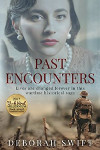
Rhoda finds her married life difficult and always has. Neither she nor Peter are particularly close, and when she discovers he’s been meeting another woman she decides to find out about his supposed affair. Rhoda herself is hiding something from Peter, an event that happened whilst he was in a prisoner of war camp, and just as Rhoda has never spoken of her time, neither has Peter spoken of war.
Past Encounters is an excellent novel that looks at the way secrets, events in the past, continue to affect the way the characters treat each other. The book is a multi-plot novel, of sorts, moving between two decades for the two main characters and including a brief sojourn into the life of another.
In writing Past Encounters, Blake has delved into WWII in a way that is different to many other writers. It may not neccersarily ‘read’ different – others have written about the war camps as have films – but there is a difference nonetheless.
As said, the majority of the book switches between Rhoda and Peter – Rhoda in the 1940s and 1950s, and Peter almost exclusively in the 1940s. Rhoda’s chapters are written in the first person, Peter’s in the third, and perhaps in part because of this, both points of view are equally compelling. In Rhoda’s case you are reading about her search for the truth and the event that changed her, in Peter’s you are finding out about war and why he may not have wanted to speak of it. What’s interesting here is that Blake spends much time telling you all of this yet shows at the end that it’s obviously not black and white. There is a hint – though only a hint – of unreliability, or, rather, the fact that it’s best to remember there are two sides to every story.
The characters aren’t particularly special; apart, perhaps, from Peter’s trials in war, you’re likely not going to remember them for themselves, however this is a point worth considering. It is often more what Rhoda and Peter represent, how they remind you to look at your own life from different perspectives, that is most important. They are two ordinary people living lives in ordinary situations (but for the war), and this makes the book shine.
Blake doesn’t hold back on her descriptions of war. She doesn’t describe everything in gory detail, but her word choice, her style of writing, says so much. You get the facts and you get the raw feelings. And sometimes, because she includes the happier moments and always reminds you of the thoughts of the regular people, even the soldiers, it is all the more compelling. Blake repeats details and talks of the mundane because that was the reality of the situation, and it keeps you reading. Never should you forget how war affected the other side and how most simply wanted to live their lives.
Yet this doesn’t mean that the book falls prey to that known situation wherein a reader prefers one plotline to another, as often occurs when a book switches back and forth. Yes, you may prefer one or the other, but you’ll likely enjoy reading both nonetheless and be happy to catch up. In Rhoda’s story there is longing, there is the change in character that is of course less ‘important’ than Peter’s changes but still important, and there is also the foray into film.
The book’s title owes a lot to the film, Brief Encounter, and it is the production of it that features in the story. The title sports many references therein – the literal past, the brief encounter during Brief Encounter and the way the filming affects Rhoda, the way words and small arguments can cause major changes. The film doesn’t take up a lot of the time, but it’s enough to give you a fair background of it, the working methods during war, the differences between people that remained during war, and so on. And then there is the way the filming clashes with Peter’s internment which may not speak for everyone’s experience but does show how people might have coped in such a situation.
There is that third narration, but it can’t really be discussed without spoiling the story, suffice to say it serves to show how chances taken at the right or wrong moment can have a major affect on everything else.
The sole element that stops the book taking the top spot is the text. There are batches of errors – proofreading and copy editing problems. The story and the book in general is so good it’s very possible to overlook the errors, but in terms of objectivity and the whole, it must be taken into account.
Past Encounters is masterful. It is compelling, and whilst diligently keeping to the specific topics at hand, it never becomes boring or falls into the trap of filler content. It is epic without requiring lots of action and changes, an epic about war without battles.
This book is wonderful.
I received this book for review from the author for Historical Fiction Virtual Book Tours.
Related Books

Hanne Ørstavik – The Blue Room
Posted 9th June 2014
Category: Reviews Genres: 1990s, Angst, Domestic, Psychological, Spiritual, Theological, Translation
6 Comments

Don’t move – not because you can’t, but because you fear doing so.
Publisher: Peirene Press
Pages: 164
Type: Fiction
Age: Adult
ISBN: 978-1-908-67015-1
First Published: 1999 in Norwegian; 2014 in English
Date Reviewed: 8th June 2014
Rating: 4.5/5
Original language: Norwegian
Original title: Like Sant som jeg er Virkelig (As True as I Really Am)
Translated by: Deborah Dawkin
Johanne can’t leave her room. She’s woken up on the day she’s set to fly to America with Ivar and her door is jammed, or locked. She could call to someone from the window, or she could wait for her mother to return to the apartment. Whilst trapped she ruminates over recent events, on her relationship, and on her mother. Has Unni locked her in? If she has, Johanne can understand why.
The Blue Room, translated from the Norwegian by Deborah Dawkin, is a short, little-action story of fear, manipulation, and what you as the reader will recognise as decisions that have the potential to lead to regret. It is often confusing because of the sudden changes in time and place, but this matches Johanne’s mind and the way we flit from subject to subject when there is nothing to do but think.
At the heart of the story is the manipulation and control you see (or think you can see), the mother exerting over her daughter, and the way Johanne’s relationship with her parents has made her, Johanne, prefer routine and the safety of home over anything that little bit different. Even if the fun in difference is to her liking. This isn’t to say that Johanne gives up straight away each time, because sometimes she doesn’t – note that ‘sometimes’ – but when it really, really matters, when it’s the equivalent of reaching the last rung on the ladder, she ultimately gives in. Gives in, not gives up.
What’s interesting about Unni’s (the mother) control is that you are never quite sure whether she is manipulative or whether it’s the case that Johanne is holding herself back. This is one of the best elements of the book because Ørstavik keeps the whole truth from you by way of the first-person narration. Maybe it’s the effect of many unreliable narrators in the past – perhaps if this is your very first first-person book you’ll see through the clever storytelling and structure – but the conditioning that you have, your experience of unreliable narrators means that Ørstavik can play games with you. Is Johanne thinking too much? Obviously she is in some respects – her innocent relaying of Ivar’s response to the things she says shows she thinks too much sometimes – but when it comes to Unni, you’ll think you have it worked out only to be thrown back into confusion.
For a time. There comes a point when the answer is undeniable, and yet even then perhaps there is something ‘off’. As you go about trying to work it all out, trying to work out whether Johanne is locked in or whether she hasn’t tried enough or isn’t bothered enough about leaving, you are effectively introduced to the mistrust that can accompany a victim’s account of their troubles.
In Johanne’s memories, and once you’re back to the present for good, and the dialogue between the two, Unni says some strange, some bad things. She suggests, in a passive-aggressive manner that Johanne is deaf to, that Johanne dump a nice boyfriend. Or does she see something in Ivar that Johanne has missed? It is obvious that The Barns, the housing development the family will build (‘with what money?’ is an assuming but obvious question here) sometime in the distant future, is both a lie to keep Johanne at home and a reason for Johanne to want to forgo any attempt to better her life. Why have a boyfriend and live independently when you’ll be able to live with your mother in a nice house with your brother (who’s no longer there), setting up your business there and thus never needing to leave?
It’s worth noting that some things Unni remarks upon would be simply laughed at or ignored by most people. This is a prime point to the debate over Johanne’s decisions (she thinks up some peculiar ideas that seem not to be influenced by anything). We wonder – we mistrust again.
Whether or not Unni is to blame (in a big way – we could never rule her influence out completely) for the following, Johanne has a fear of difference, of the unknown. It’s worth considering that if Unni has locked the door, then this is Johanne’s strongest effort to leave so far. If Unni’s locked her in, she must feel as if Johanne is slipping from her grasp. It’s the same with Johanne’s self-worth. There is a punishment and reward system at work, both solely resting with Johanne, and at the behest of Unni.
There are the erotic, perverted, thoughts. The blurb of the book speaks of our erotic fantasies being influenced by our parents and as you read on you see how Johanne’s arousal from horrible ideas has happened. Johanne doesn’t want to be in those situations, she apologises to God and worries about it all the time (Johanne’s faith in God itself is seemingly her choice but possibly furthered by those she knows).
It sounds like Johanne’s brother doesn’t see his mother any more, or at the most he’s got away from the family and is in America. If we consider this and Johanne’s chance to spend time in that country, then perhaps Ørstavik is using the ideals about America, the land and the freedom. There is nothing wrong with Oslo – unless your name is Johanne. And if your name is Johanne then every reader will be rooting for you no matter what they think about you.
Is Johanne held back? Is she too like her mother? Will she just repeat the cycle and not break it?
Johanne has a chance to get away, even if she misses this opportunity, even if she loses Ivar. She needs you to support her, and the best way you can do that is to read The Blue Room.
I received this book for review from the publisher.
Related Books
None yet


