

Benjamin Wood – The Ecliptic
Posted 5th December 2016
Category: Reviews Genres: 2010s, Art, Commentary, Historical, Magical Realism, Mystery, Psychological
3 Comments

Do not disturb.
Publisher: Scribner (Simon & Schuster)
Pages: 463
Type: Fiction
Age: Adult
ISBN: 978-1-471-12672-7
First Published: 2nd July 2015
Date Reviewed: 28th November 2016
Rating: 4/5
It’s some time in the 1960s or 70s and Elspeth is living at Portmantle, a mansion and grounds on an island near Turkey, a place for the most talented artistically-minded people who are finding creating impossible. Elspeth has been there a number of years – how many exactly she’s not sure, watching, together with similar residents, others come and go whilst her own project evades her. One day a new resident turns up and won’t fall in line with the status quo. And Elspeth starts looking back at what led her to escape the world.
The Ecliptic is a great novel that is at once very different and rather familiar, a book in which the themes are those not often studied in fiction but the overall presentation resonates in a literarily-relatable fashion.
Wood has a lot to say about artists and the creative process; he uses the book as a base, the story as the means by which he dissects various thoughts, conversation, and points of debate, to a highly effective degree.
The mansion and grounds of Portmantle are, of course, a well-placed – literally! – device by which Wood can look at the way art of all types is often created in isolation at the behest of its creator. The solitude and freedom from distractions, from criticism and review, from opinions whether positive or not so. And no one need do their laundry at Portmantle, either. The only chore is, potentially, that of creating. It’s a haven, an artistic utopia.
But like all fictional utopias, things aren’t as perfect as they are first presented to both reader and residents. Wood’s Portmantle is full of rules – meal times, the ability to stay or leave – that replace all the distractions of sociability at home with things that are perhaps even more stifling to those creative minds. Even the rules regarding the journey to the mansion – don’t bring your possessions, disregard your name, take this many moves before a phone call (I’m simplifying it but that’s the basic idea) – are far more controlling than any professor’s university assignment. And no names, thank you. Pick up a new one because no one’s work should be referenced to or put in the context of another’s.
I walked up to the board as though it were a boy I had decided to kiss and streaked a layer of phthalo blue across the surface with a palette knife, the floppy baking kind my mother owned, making an impulsive shape upon the wood. There was no history standing on my shoulders then, no classical references hanging in my head like dismal weather. I was alone, uninfluenced, free to work layers of chalky stolen paint with a big lolloping knife, to smudge with my fingers, pad flat with my fist, thumb, scrape, and scratch. No judgements of technique arose in my mind, because I did not invite them, did not think to. I simply acted, expressed, behaved, made gestures of the knife that seemed unprompted and divined.
It is the way formal education can have an impact on one’s inspiration, raw talent and subsequent work, that is seen as bad. Wood doesn’t say as much directly about the positive impacts of lessons but then he doesn’t need to, it’s shown in the subtext and in references to other ideas.
Another thing that mills in the background, less studied presumably because Portmantle is fiction, is the way that taking time out of life in such a context would impact the eventual reception of the work created. If Elspeth joined Portmantle in the 1960s and has been there a long time without access to the rest of the world – years, decades even – then won’t much of what she creates be irrelevant? The world would have moved on. As much as we like older works we need, crave, new ones. The world is in fact the antithesis of what pianist James Rhodes recently said on the subject of classical music; Rhodes said that people should not write new classical music, that anything new will never match the work of the masters.
But new is surely inspired by a love of the old, is the natural result of that love, and to discourage it would be to lessen the popularity of the old.
It’s interesting that it’s the ‘short-termers’ at Portmantle, those disliked by Elspeth – who actually get work done, that Elspeth and crowd are those no nearer to finishing.
Does Portmantle keep culture away from humanity? One of the possible answers to the mystery of the place is a prison for the highly talented.
The creativity in general, in this book, is exquisite. Yes, there is a lot about the process of painting to the extent you’d think Wood an artist rather than a writer, but there’s a lot for readers of any artistic persuasion. Reams of paragraphs that beg quotation. We should dissect art somewhat but, as Wood’s use of psychiatry shows, dissections should be limited. Some things really aren’t related, they are the result of pure in-the-moment inspiration. Not everything has a meaning behind it and nor should it have to.
There are a couple of aspects that skim the top from this book. The ending – the reveal – which may be considered a bit too been-there-done-that. And the text – Elspeth is in her 20s in the 1960s yet she uses a lot of present day language, colloquialisms from the 21st century – ‘towel off’, ‘unseeable’, for example – rather recent terms and ways of speaking.
So The Ecliptic is imaginative, awesome in its studies and more than worth a read if you’re a creative type, but it does have some draw backs.
One to explore, this book will make you think, want to debate, and quite possibly make you want to create. Get your paintbrush/pen/instrument; you’ll be here for a long time but unlike Elspeth and co you’ll make use of every moment.
This book is shortlisted for the 2016 Young Writer Of The Year Award. I’m on the Shadow Judging Panel.
Related Books


Paul McVeigh – The Good Son
Posted 30th November 2016
Category: Reviews Genres: 2010s, Historical, Political, Social, Spiritual
2 Comments
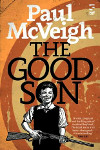
The Milkybar kid is strong and tough.
Publisher: Salt
Pages: 234
Type: Fiction
Age: Adult
ISBN: 978-1-784-63023-2
First Published: 15th April 2015
Date Reviewed: 29th November 2016
Rating: 3.5/5
Mickey Donnelly lives in Troubled times. Northern Ireland is at war and he can’t go too far from home or he’ll end up on the wrong turf; he has to be careful of the Protestants. Living with the shadow of a new, unwanted, school in front of him he tries to get to grips with girls and with being cool, particularly as the other children believe him to be gay. And there’s always his Da upsetting his Mammy, the parent he loves most.
The Good Son is a book set some time during the 1980s and 90s that looks at the conflict but concentrates on its coming-of-age storyline, blending profound commentary with the ordinary.
It would be quite natural to expect this book to hinge on the conflict but whilst it doesn’t quite do that, there is a fair amount in it that shows how life was, how split the country. McVeigh never shields the reader from the violence and he makes it clear in the way the fighting effects Mickey, physically most often, that he’s going to be blunt. Mickey takes a lot of metaphorical and literal punches, including from his mother. McVeigh also includes raids and the British – English – actions in the conflict, the disturbance of the regular people due to the worry, often founded in truth in the case of this book, that there were weapons and IRA members around.
But McVeigh’s setting acts more as context, as the difficult background information that shows what fuels Mickey’s behaviour. Violent evenings preface run-of-the-mill days in the streets, skipping and playing chase with the neighbours. Neighbours who may be harbouring army members. Just as Mickey’s family could be.
Mickey is ten years old so there are a lot of sudden changes of scene and a lot of talking about things that he doesn’t understand. McVeigh has written the book in the first person in full Belfast dialect; it’s quite unusual especially when joined by everything else and makes the book a little like Marmite – you will likely either love this book or dislike it (‘hate’ is a bit too strong). What’s true across the board is that Mickey comes across clearly, enough that one could speculate some autobiographical elements to his character. And the rendering of a ten year old is perfect in all its minor pomposity and silliness.
The drawbacks to the book rest in the structure, that use of childhood amongst the conflict. It’s that Mickey’s story takes place during one summer and whilst there is an ending the relative shortness of the book means that it’s relatively minor. It’s more ten-year-old character study than story, the voice being superb but the plot – away from the conflict – being pretty average; whether it works for you will rest on how much more you want to hear about the social history rather than the growing up. It’s your evening television series rather than a film destined for the cinema, an apt comparison to make considering the number of then-popular cultural references included (there are enough that one could argue there are too many even if it does show Mickey’s love of television).
The Good Son is good but as is often the case in situations where labels are assigned, there are also not-so-good times. It is best to go in with few expectations so that what works will work very well.
I received this book for review from FMCM Associates.
Related Books
None yet
Jessie Greengrass – An Account Of The Decline Of The Great Auk, According To One Who Saw It
Posted 21st November 2016
Category: Reviews Genres: 2010s, Commentary, Domestic, Historical, Science Fiction, Short Story Collections, Spiritual
3 Comments

A long title well worth typing out.
Publisher: John Murray (Hachette)
Pages: 179
Type: Fiction
Age: Adult
ISBN: 978-1-473-61085-9
First Published: 30th July 2015
Date Reviewed: 18th November 2016
Rating: 4.5/5
A sailor/explorer tells the story of a species’ extinction; a child wants to go back in time, further than the years spent in a neglectful home; a visit to the zoo reiterates just how little a girl’s father cares.
An Account Of The Decline Of The Great Auk, According To One Who Saw It is an incredible collection of short stories that share basic themes – some, human intervention, others, choice. Spanning from the medieval period to some decades into the future (2050, to be exact), Greengrass’s book is one of beautiful writing and subtle shocks.
The overall reading experience of this book is one of ‘clicks’, or ‘ah ha!’ moments as we often call them. Light bulbs over heads. Greengrass’s general process, the ‘subtle shocks’ referred to, means that after a few stories have been completed you get into the habit of looking closely at the narrative to see what the nub of it all is; even the few unassuming tales in this book have at least a small moment behind them. Sometimes you get answers, a more or less bluntly-spoken meaning. Other times you have to piece it together yourself. The storytelling means that there is always something there to keep you reading; even at those times it seems the story is lengthy (in relative terms) you know that there’s a reason.
And these shocks, these points, that Greengrass includes… they could never be called brilliant, exactly, because they tend to be harrowing, but they do lean towards the exceptional in their telling. A few stories tell of cold climates and the harm done to them so you get those tales of extinction in all their violence; the author spares nothing.
To collect the feathers, there were different ways. We could not take the bodies all the way back across the Atlantic because they would spoil. At first we killed the birds and plucked them, and we tossed the corpses off the cliff and they fell into the sea. The birds looked so much smaller without their feathers on. Then we told ourselves this method took too much of our time.
The title story does this best, containing precisely the sort of information you would think it does. A report of how the Great Auks fell into extinction, which echoes the stories of the sailors of 1840; Greengrass writes from the explorer viewpoint but her thoughts of protection, environmentalism, seep out from the text. The story is full of human destruction, how in exploring and charting we are inevitably, for all our good intensions, bringing harm to places humans had never previously been and, it could be argued, should still stay away from. Echoes of the future abound – will this happen more in time? Greengrass gets to the point, and yet the story is purposefully vague. And full of excuses of the sort seen constantly – it’s not the humans’/this particular group of people’s fault this happened!
Another standout is On Time Travel, in which a child speaks of her longing for the distant past whilst recounting episodes in her dysfunctional family’s life. Rose-tinted glasses abound as the girl explains the benefits of that past time; the reader sees the flaws but then it doesn’t seem to matter when it’s just a dream. It would spoil the effect to discuss anything further, but it’s enough to say that Greengrass’s ending is surprising and incredibly poignant.
Although I am not able to deviate from the set scripts, I do sometimes alter my voice when I speak to the people who call premium phone lines in the thin hope that I will be able to help them. I do this on the occasions when I am for some reason unable to dissociate my mind from my body to the extent that time can pass over my unhindered. On these occasions, my awareness of my existence within the warehouse as unbearable comes in waves; it throbs in my temples and fills my mouth with the taste of sour milk…
Something that may or may not work in the book’s favour depending on what you think of it is Greengrass’s use of the same basic voice and writing style throughout. It’s an incredibly literary style that harks back to Victorian monologues, first-person narratives – her words are not historic, rather it’s a gentle, flowing style, full of beauty. The potential issue then is not in the style itself but in the constancy of it. Some may enjoy the stability of it as well as the way it can suit a person looking back on their life, using adult language to explain their childhood. Others may not find the maturity of the vocabulary matches the ages or personality of the narrators and that that is problematic. It’s very subjective – Greengrass has a lovely style, but does it fit the book as a whole? In regards to the first-person, on occasion the author defers to third. It appears a choice made in order to tell the story in the most expressive way each time and the switching points of view do not seem out of place.
This book warrants your attention but never demands it. It has a lot to say but it can be wistful, both an escape and a work-out for the mind. If you like the sound of the narration you will most likely find it a wonderful reading experience that is difficult to sum up – the way it can leave you speechless has a real-world impact.
An Account Of The Decline Of The Great Auk, According To One Who Saw It is a very fine collection by a very talented and thoughtful writer. One to savour… and potentially scribble all over.
This book is shortlisted for the 2016 Young Writer Of The Year Award. I’m on the Shadow Judging Panel.
Related Books

Louisa Young – The Heroes’ Welcome
Posted 4th November 2016
Category: Reviews Genres: 2010s, Angst, Commentary, Domestic, Historical, Psychological, Social
2 Comments

We’ll meet again.
Publisher: Borough Press (HarperCollins)
Pages: 322
Type: Fiction
Age: Adult
ISBN: 978-0-007-36147-2
First Published: 22nd May 2014
Date Reviewed: 16th August 2016
Rating: 3.5/5
Riley returned from WWI a changed man, half his jaw missing. Surgery made up for some of it; Nadine still wants to marry him though her family worry about his prospects – it doesn’t seem to matter to employers that he served his country when he’s disfigured and thus deemed a discomforting presence. Riley’s worried about how Nadine will view him and in turn Nadine is worried about Riley’s depression; she doesn’t care that his looks have changed. Then there’s Peter and Julia – Peter served with Riley and came back physically unharmed but the war has taken its toll on his mind. Julia, in an attempt to reach him, experimented with cosmetics and has damaged her skin. Will either couple return to how they were?
The Heroes’ Welcome is the sequel to Young’s previous book, My Dear, I Wanted To Tell You. This fact is not noted; fortunately the book works as a standalone or at least it seems to – readers of the first book say it does matter, that you need to read them in order. The Heroes’ Welcome is a fair look at disability in the context of the war, it just doesn’t have much of a plot or character development going on.
On that word, ‘fair’, it’s fair to say the book goes a good way towards showing social issues and personal rehabilitation but doesn’t go quite as far as one might hope. It shows PTSD and the effects of the disorder on families – one of those topics that doesn’t get looked at much – but the main bulk of the development in this way is confined to a few pages. Young knew about the hospitals and healing through the work of her aunt (I discovered this after having read the book) which means that when the subject is concentrated it’s special. In those few pages is a wonderful overview of what you’re already starting to understand, the juxtaposition of society saying, ‘welcome back and thank you for your service!’ and ‘I’m not sure you can do this work and anyway you’ll scare people – no job for you’. It both harks back to the post-war days and illustrates what is unfortunately still the case today.
The writing is pretty good. It flows well and in the main rings true, however there are some anachronisms – ‘epically’, ‘those ones’, and the rather odd ‘losable’, for example. Young slots a first person thought narrative into the third person narration which makes the text choppy at times. Phrasing can be vague.
Young was inspired by the work of another writer who used Homer in conjunction with the events of WWI, showing how related the ancient text is to the later war. It’s interesting but the sense of fascination and seeming originality in Young’s book is marred by this fact of copying – something only divulged in the afterword, after you’ve finished it. And if you haven’t read Homer or don’t know the stories well, it may be a problem. It may be best to read Homer or to get your knowledge of The Iliad down to pat first… which given the nature and length of that text…
In sum, The Heroes’ Welcome sports nice language, good ideas, and isn’t a bad read, but there’s not much going on and for all the promise in the veterans’ stories, the book is lacking in substance. The ending is a bit of a rushed, convenient, job. The book would work best as further reading, say if you’ve completed Anna Hope’s Wake and want something that looks at the war in a similar light. It’s not, as the quotation on the cover says, the book to read about the war if you’re only ever going to read a single one.
Related Books

Shan Sa – Empress
Posted 28th October 2016
Category: Reviews Genres: 2000s, Drama, Historical, Political, Social, Spiritual, Translation
2 Comments

Reigning for ten thousand years. It may indeed seem that long…
Publisher: Harper Perennial (HarperCollins)
Pages: 319
Type: Fiction
Age: Adult
ISBN: 978-0-061-14787-6
First Published: 2003; 2006 in English
Date Reviewed: 16th June 2016
Rating: 3/5
Original language: French
Original title: Impératrice (Empress)
Translated by: Adriana Hunter
Wu Ze Tian, as she would become known to history, begins life as the child of a privileged mother and a well-known but commoner father. After spending some years in a convent she is recommended to the Imperial City; a man who once aided her has found her a position as a royal concubine. Ze Tian finds no favour with her husband, the Emperor, but her ability as a horsewoman attracts the attention of his son who comes to desire her. She agrees to be his wife and thus starts a controversial era wherein for the first and only time a woman will rule China as Emperor.
Empress is an epic, fictionalised, account of Empress Wu’s life from her time in the womb and beyond her death. It’s the sort of book to read if the history intrigues you but you want to begin your lessons slowly.
Sa’s character is a difficult one. In Ze Tian you have a woman who was pulled from her life and put in a position that was both a source of envy and a horrible prospect – to be a concubine or wife was a high position in society, but most of the thousands of women kept in the City for the Emperor’s enjoyment would spend their days waiting for acknowledgement in vain. But you also have a woman who, once she gained power, was incredibly ruthless. Sa has balanced it all exceptionally well. For the most part the kindness of Ze Tian is kept to her early years – admittedly a lot shorter, page wise, than her reign – and her tyrannical decisions to said later reign. Sa does allow for moments of goodness and kind thoughts during Ze Tian’s time as emperor, but considering there is little chance at this point of your feeling any sympathy for the monarch, the author keeps it in the region of self-absorption and reflection. Sometimes this reflection just makes the horror worse, but one senses Sa just had to shrug her shoulders.
Ze Tian made a lot of positive changes in her time, even if many were later reverted. She set up a system wherein the regular person could state a grievance that would be listened to, she adjusted exams for hopeful scholars so that commoners could have a shot at governmental roles. She was a role model for women. Sa gives her what positivity she can but is realistic about the tyranny. Of course there’s always the thought in the background, which Sa addresses in the first person narrative – how much of the punishment Ze Tian metes out is due to any evil versus how much does she deem crucial to the success of her status? The narrative revolves around Ze Tian’s thoughts, everything that happens is couched in its relevance to her, how it impacts her, so, again, Sa ensures you’re getting as objective a picture as you can, at least as far as the limits of first-person go. (The book is limited by this narrative choice.)
Jousting with the graphic violence for Most Gratuitous Aspect is the sex. There’s no getting away from sex in this book; the women in the Inner Court had no choice and neither do you – there’s a lot of it, in various guises, sometimes because it’s a reflection of the facts and sometimes because – unfortunately – it seems Sa has run out of ideas. What’s interesting is that you eventually become numb to the idea of incest and old women having sex with consenting-but-under-pressure-to-do-so teenagers because it’s just so prevalent; and it’s interesting that you become numb because there’s a great possibly that that’s something Sa is wanting you to feel – the conquests were acceptable in the situation and so by becoming attuned, study-wise, to it yourself, you stop feeling so nauseated by it and start to see the societal concepts behind it.
The writing is very poetic. The translation reads well and it certainly matches the poetic nature of historical Chinese writings and artwork enough that you can assume it a faithful version. In terms of the writing’s impact on one’s reading, however, the book is very slow and can be a bit too flowery – sometimes it seems as though Sa is exploiting poetry in order to make her story longer than it should be. There is also a lot of info-dumping, Sa likes to go into meticulous, few-pages-long detail about events that could be summarised in a paragraph, and friends supposedly of many years pop up without you having heard of them before. It’s difficult to remember who anyone is in this book, the repetition makes everything so similar. No one is as important as Ze Tian and it shows.
And this is where we come to the main problem with the book – after a point, about two thirds of the way through, once Ze Tian is firmly ensconced on her throne, the novel becomes a series of repetitions. Ze Tian will worry about getting older; someone will suggest another is out to steal the throne; said accused person is condemned to death; Ze Tian is sad because she liked them; someone turns up in the royal bedroom to help the monarch remain young and energetic; that person is taken away; a pilgrimage or other journey happens; Ze Tian dreams of gods and her goodness… over and over again. Undoubtedly there was boredom to the routine of life at court and in the tedious nature of every action, every breath, having to adhere to etiquette… perhaps it is to show that tedium, and the slow decline of the body, but it’s overdone.
You’re never going to feel sorry for Ze Tian. You’re not going to like her and quite frankly it’s a relief to get out of her head. But if you can deal with the ennui I’ve mentioned, or if you’re happy to skip those sections, you might want to flick through Empress. Ze Tian’s reign was an important one, and if you’re at all interested in history your interest will be improved by knowing about her.
Or you could look for articles on the Internet and be just as, if not better, informed.
But I became a symbol of a corrupt woman… Novelists invented a life of debauchery for me, attributing their own fantasies to me.
This may be ironic.
Related Books