

Laini Taylor – Daughter Of Smoke And Bone
Posted 6th June 2014
Category: Reviews Genres: 2010s, Angst, Fantasy, Political, Romance
5 Comments
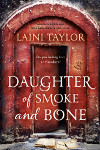
Will anyone tell her what’s going on?
Publisher: Hodder (Hachette)
Pages: 418
Type: Fiction
Age: Adult
ISBN: 978-0-091-94924-2
First Published: 27th September 2011
Date Reviewed: 5th June 2014
Rating: 4/5
Karou lives with chimeras, but she’s human and knows that there’s a story to be told, if only her friends would tell it to her. They won’t. Instead Karou has to keep running errands all over the world, using portals to collect teeth from various countries for yet another story she’s not allowed to know. She does get to make wishes, a small benefit when you consider she only gets the slight ones like making people itch. She’d much rather know how to fly. She’s at university now and pretty frustrated with her lack of knowledge. Surely it’s time she learned the truth?
Daughter Of Smoke And Bone is a low-fantasy tale, the start of a trilogy, that is often engrossing and promises much for the series as a whole.
Taylor makes sure her world is amply populated with interesting characters. She explores the world – our world – a fair amount. Karou visits many places in her time, using doors to move from her newest residence in Prague (she moves a lot and asks for languages for her birthday) and illustrating just how routine such a ‘dream’ of fast travel can be. The routine, coupled with Karou’s otherwise usual life does a good job of both stunning you and keeping you down to earth. Travelling is downright boring for Karou at times, and you come to emphasise with her from the start due to her approach. All this to say that Taylor is very good at making the awesome average, and rather than being a drawback it’s an interesting and absorbing concept. It makes Karou feel real, which is always a good thing.
This is a book to set up a trilogy but it’s complete in itself aside from the open threads at the end. Given it’s a trilogy, you might be surprised by how much happens. And it’s just fun. Daughter Of Smoke And Bone is exciting to read, it lets you escape into another world, it drenches you in culture even if only for moments at a time, it has wars and wings and… well, Karou doesn’t know yet, so it’d be unfair to tell you first.
Many people have written favourably of the twist – it’s a fair twist. How much you like it, however, will depend on the amount of YA and which types of YA you’ve consumed over the past few years. The twist is similar to those of other books so it’s likely you’ll predict it early on. This said, the evidence so far (as in this far into the series) indicates that Taylor is going to treat the trope differently.
This difference, the maturity and overall respect of reader’s intelligence, is the overall takeaway that will end this review. Beyond the general appreciation you’ll have of Daughter Of Smoke And Bone, you’ll appreciate the handling of the themes. Taylor has taken a genre and a handful of tropes that many people like, that half of those people have felt lacking in execution elsewhere. She’s taken them and she’s written something that matches what they were wanting. Daughter Of Smoke And Bone is quite possibly the YA fantasy romance that you’ve been looking for. If you’re jaded, give the tropes one more chance, here.
Before this review repeats its repetitiveness let’s leave it there. This is a good book. You’ll like it.
Related Books
Kay Kenyon – A Thousand Perfect Things
Posted 19th March 2014
Category: Reviews Genres: 2010s, Fantasy, Historical, Political, Romance, Social
4 Comments

An alternative to the British occupation of India.
Publisher: Premier Digital Publishing
Pages: 312
Type: Fiction
Age: Adult
ISBN: 978-1-624-67096-1
First Published: 27th August 2013
Date Reviewed: 17th March 2014
Rating: 3/5
In 1800s Londinium, those with power want to use the bridge that spans from their land to Bharata so that they can control the inferior continent and destroy the magic that has made its way from the east. Astoria wants to go to Bharata, too, but for a very different reason. Having been schooled in botany by her grandfather, and with no possibility of marriage ahead of her due to disability, she wants to find the legendary golden lotus, complete the herbarium, and find acclaim. But in a world where men rule, this will be difficult, and as the Bharati people begin to rebel against foreign rule, everything is subject to change.
A Thousand Perfect Things is a book with an interesting premise and thematic concept, but one that doesn’t always deliver.
The most obvious issue is the writing. The narrative, and more so the dialogue, are full of modern phrasing and Americanisms, meaning that the story reads as though not enough research was conducted. American ways of speaking such as ‘in back’ and ‘also was’, where Britons, and most definitely the Victorian middle classes, would say ‘in the back’ and ‘was also’, are jarring.
Along with the writing comes the transliterations of Hindi words. This isn’t an issue as such, but there are some well-known words, even to people otherwise unfamiliar with the language, that are written in a confusing form, such as ‘rani’ being written as ‘ranee’. Some of these words are actually more correct – that is to say that in Hindi the spelling is ‘raanii’ – but it does tend to be written as ‘rani’. Words like ‘pyaari’ become confusing when spelt ‘piari’, and again whilst the former is not completely correct, it is as correct as it could be without making words too long. There is a lot of Hindi which is then always translated, suggesting the dialogue is more a language lesson than part of the story.
There are some characters that aren’t developed enough, or are inserted into the story suddenly, that for the lack of information about them are hard to care for. These tend to be the characters who are killed off, but it is sad that they can be so easily forgotten.
Kenyon has included enough factual information about both England and India to make the story appealing as a historical, but the best part is undeniably her focus on the British occupation of India. In Kenyon’s Londinium and Bharata, Indians travel easily to London and vice versa, making, if not for equality (because after all, the English built the bridge for their own gain) then a good prelude to the later action. This is because Kenyon has, by way of historical fantasy, written the occupation in the way we might wish it had happened – namely that the English didn’t gain much control and were pushed back, the Indians retaining control of what was theirs. (Comparisons can be drawn between Kenyon’s story and the Sepoy Rebellion, however Kenyon’s action is on a larger scale.) In A Thousand Perfect Things, Kenyon shows how the cultural exchange, even if largely a one-way import of English to India, could be of interest to the receiving country, but that that should have been where it ended. The author sticks to history enough to make her point obvious – she has the English seeing the Indians as inferior, and takes a sharp look at the entitlement to discipline the English felt they had – and then changes the continuation and conclusion.
Through Tori, Kenyon shows how cultures can work more in harmony if given the chance, and whilst it’s the case that Tori’s change and views of Bharata are fanciful and sometimes a little condescending, they fit the idea of magic and the exotic fantasy that Kenyon uses. In some ways the exoticism is over the top, but it works as an extra study into how the Victorians saw India.
It should be noted that although the book begins with Tori being interested only in science, there is some romance in the book, and less time spent on science as the story continues. In regards to this romance, by itself it is an interesting element. First there is the sad fact that a woman with a relatively minor condition (at least we would view Tori’s club foot as such today as it is easily treated) has been told she’ll never marry. She is essentially a second-class person. The prejudice of Victorian society is matched by the second, happier, fact that by not having any thoughts of marriage, Tori is free from the limitations placed on married women. She may not be allowed to be a female Faraday, but she could devote herself to a scientific path nevertheless. It is these factors that make the romance one to watch – who will accept Tori; how will a romance impact her studies? The answer to these questions, and your reception of them, will depend on your reading preferences and whether you’re after a romantic thread. It must be said that Tori’s wish for a sexual awakening does appear out of the blue, but either way you feel about the romance you will likely appreciate the way that difference was not as much of a problem as Tori’s family believed.
The book has issues, but it also has an excellent theme, a very different idea in the design of the world, and a section on travelling that never becomes boring.
There may have been A Thousand Perfect Things for the people of Bharata to find, but in this story the better things help to overturn history and the book is finer for it.
I received this book for review from the publisher.
Related Books
None yet
N K Jemisin – The Hundred Thousand Kingdoms
Posted 7th February 2014
Category: Reviews Genres: 2010s, Domestic, Fantasy, Political, Romance, Social, Spiritual, Theological
8 Comments
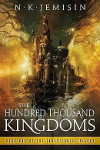
Where Gods walk amongst us.
Publisher: Orbit Books
Pages: 234
Type: Fiction
Age: Adult
ISBN: 978-1-909039-45-2
First Published: 1st January 2010
Date Reviewed: 4th February 2014
Rating: 3/5
Yeine, happily living in Darr, was commanded to ‘return’ to her maternal family’s palace in Sky to become one of three heirs to the kingdom and the world. As she learns what her role is to be, she’s given a proposition by the earth-bound gods that may not save her but will save her homeland.
The Hundred Thousand Kingdoms is a book that sports a different sort of fantasy but is unfortunately rather confusing, static, and badly written.
The world itself, or, rather, the possibilities for it, are wonderful and promising but Jemisin only goes so far in the building of it, and albeit that detailing the palace is understandable (the story is almost exclusively located there) it does make it hard for the reader to really see Yeine’s plight and her reasons for her actions.
The writing is often confusing. There is a constant switch between Yeine’s usual narration and her inner thoughts and torment, and there are times when she looks back at the day just passed in order to tell you something she forgot to tell you earlier. Whilst the style lends the book an individuality and Yeine a distinct voice, it also hints at a lack of planning, or, at least, the look of such. And at the end of the day the look of poor planning has the same result as an actual lack of planning.
The constant ‘switch’ in narration is a pity because it becomes apparent later on in the book that there was a real reason for it. The problem is, of course, that it is too little too late. What could have been an interesting exploration of Yeine’s sense of self is simply left to hindsight. It means that the switch may indeed work for the remainder of the book but that this doesn’t atone for the confusion of what came before.
The book lacks a true focus – is Yeine concerned about the gods, her homeland, or does she simply want to find out the truth of her mother? Yeine’s mother’s life may be intriguing but it is no match, story-wise, for what is happening at that present moment, to what is happening to the world and the gods, and Jemisin’s increasing focus on it moves away from the fantastical possibilities brought forth by the premise. Nor would Yeine’s mother’s life have a true bearing on Yeine in the future as Jemisin’s focus changes once again towards the very end.
Where the book does shine is in the variation of fantasy it employs. This is no high-fantasy travelling-the-world tale of dragons and witches, and whilst those are not bad elements and whilst the book could have spent more time away from the palace, it is good to have this difference. The city of Sky is at once realistic and utterly imagined. In Yeine’s land women rule (even if Yeine is not written convincingly in that way). There is a lot of unnecessary violence and bizarre thoughts but this does fit the genre. The problem is that Jemisin does not provide any reasons for the reader to care about anyone.
The Hundred Thousand Kingdoms had potential but much of that is lost. It’s possible Jemisin may detail more of the world in later books but without having much of an idea about anything beyond the palace already, not least the knowledge of what the hundred thousand kingdoms are, you may decide it’s not worth finding out.
Related Books
None yet
Julie Kagawa – The Iron Knight
Posted 16th December 2013
Category: Reviews Genres: 2010s, Angst, Fantasy, Philosophy
2 Comments

The quest to be her knight in shining (iron) armour.
Publisher: Mira Ink (Harlequin)
Pages: 352
Type: Fiction
Age: Young Adult
ISBN: 978-1-848-45060-8
First Published: 25th October 2011
Date Reviewed: 6th December 2013
Rating: 3.5/5
To be with Meghan, the new queen of the Iron Kingdom, Ash needs to become human. His traditional faery self will never stand being in the kingdom for long and now he has made an oath to Meghan he cannot break it. There must be a way to gain a soul, and together with Grimalkin, Puck, and the Big Bad Wolf, he is determined to discover the way. He might discover someone, too.
The Iron Knight is the fourth book in The Iron Fey series that is technically a spin-off as the series was satisfactorily completed by The Iron Queen. As a spin-off from a different viewpoint it will likely interest some fans and irritate others.
And it must be said that although the reader already knew that Ash wanted to find a way to be with Meghan, there is a lot in this book that could be considered clutching at straws. There is very much the sense that this book was written to keep the series going when it didn’t need to be, and there are some elements that bare questioning besides the basic reason d’etre.
This may be considered a spoiler but at the same time it must be discussed because of the way it changes everything you have read and believed previously: Kagawa has chosen to bring back a character who had died before the series begun. The reason is obvious – it creates angst, conflict – but it is undeniably unnecessary. And due to the events that occur, the emotions renewed, it ultimately means that the reader may feel short-changed by Ash and Meghan’s relationship; Kagawa, whether deliberately or not, makes a great case for Ash not being with Meghan. Furthering this the end of the book ensures that he pretty much has his cake and eats it – but not in a way that shows immortality, rather it confirms the supposed suggestion that Ash should not be with Meghan. It sets up a situation that no partner wishes their beloved was in, and means that the reader will likely close the book wondering how long Meghan would put up with it if she were a real person.
It must be said that if you’ve found Puck’s constant chatter and stupidity to be annoying previously, this book is not for you. In times of great anguish there is Puck being sarcastic, in times of death there is Puck being disrespectful, and so on. Puck is a constant source of ‘pulling you out’ of the story.
A great deal of the book is reigned by the above three points. But although they continue from beginning to end there comes a point where they are of no consequence.
Kagawa’s skill undeniably lies in the themes she creates, the studies and messages she proposes, no matter whether she follows through on them or not. (A previous example may be found in my discussion post about the use of technology in the series.) In The Iron Knight, this skill is shown in the author’s study of what it means to be human. This section of the book is fantastic – it is thought-provoking, heart-wrenching, and grounding, at the highest level. In order to gain the right to become human it is inevitable that Ash must contempt the meaning of mortality and humanity, indeed if he hadn’t the book wouldn’t have had a leg to stand on for the concepts the reader would want to bestow on Ash. This part of the book is lengthy, Kagawa details so much but not necessarily in the way you would expect. She ‘shows’ in every way, and explores the little things so easy to forget. It of course has the additional effect of making you feel sorry for what Ash will lose before you remember that you yourself will be going through the same, being what Ash wants to be; thus the book has an extra sobering effect. True to form, despite the extremely real impact this part of the book has on the reader, it is still fantastical. In fact this section is more magical and fairy-like than the rest of the book.
Once you’ve been through this section it is difficult not to feel that the rest has been worth it. It may not be in literal terms, but if this section was the swan song of the series then it would practically be a suite.
The ending does lessen the effect a bit. On one hand you could say that Ash’s eventual fate is a peace-offering, on the other hand it can be considered an opportunity wasted. Undoubtedly the overall atmosphere and tone of the series suits the ending Kagawa has written, but many readers affected by the study may feel as though an ending that suited the study would have had a profoundly moving conclusion.
In brief, The Iron Knight is unnecessary as a sequel, and the ‘revived’ character may dampen readers’ feelings in general. However as a study the book is excellent. This is a story that truly has something for everyone however each person must be willing to journey through that which they consider a trial to reach it, and it may not be considered enough of a reward to do so.
And as much as that may be a little off-putting it is irrefutably apt as it is exactly what the characters must do on their quest.
Related Books


Natalie Whipple – Transparent
Posted 6th December 2013
Category: Reviews Genres: 2010s, Domestic, Fantasy, Social
1 Comment

Where the super-powerful wishes she were normal.
Publisher: Hot Key Books (Bonnier Publishing)
Pages: 272
Type: Fiction
Age: Young Adult
ISBN: 978-1-471-40076-6
First Published: 21st May 2013
Date Reviewed: 1st December 2013
Rating: 1.5/5
Fiona is invisible. Like many people whose ancestors decided to take a drug to stop the possible affects of attacks during the Cold War, she has a super ability, only she can’t turn it off. Sick of being at the beck and call of her father, a crime lord with the ability to charm women into doing whatever he wants, she runs away with her mother and starts to create a new life. But this has happened before, and the new life followed by a return. Can she stop her mother going back to her father this time?
Transparent is an example of an interesting premise badly executed.
The biggest issue is that the book rests on Fiona’s attempt to run away from her father. The issue should be obvious whether you’ve read the book or not – a girl who is invisible should have no problems running away. She may be visible whilst wearing clothes but she’s worn nothing often enough that the reader can’t so much as consider the idea that Fiona has an objection to being naked.
Hot on the heels of this is the fact that Fiona has never seen her reflection but never talks about makeup. The character talks to her friend about dyes being absorbed into her skin after a while (the reader may wonder how this failed given that the dye presumably showed Fiona’s skin for a time) and about how water shows a brief outline. Whilst make-up wouldn’t be perfect – it wouldn’t show her eyes or hair, for example – there is no reason to presume it wouldn’t work. Women wear foundation all the time, it lasts for a while and you can always reapply it. And aside from this, has Fiona never thought to feel her face, to visualise how it must look based on how it feels?
Following this is repulsiveness. Fiona spits on her friend to show the girl how even that is invisible, and whilst Bea encourages the spitting, this doesn’t deter from the fact that it’s rather disgusting, especially given that Fiona creates a big ‘loogie’ for the spitting. (Incidentally there are a couple of words like this that are likely to require an urban dictionary search for most people.) Fiona places small items in her mouth to hide them – the USB sticks she steals, for example – and it’s difficult not to think of how many germs and bacteria she has exposed herself to, especially given that as an invisible girl no doctor would ever be able to give her an injection or operate. To round it off there is a scene in which Fiona picks up a random bottle in a park and fills it with water for later use. She admits it’s disgusting but that doesn’t really do the situation justice.
Whipple’s knowledge of Catholicism is very shaky. She makes Bea’s family fundamental Catholics and uses this as the reason Bea has four siblings – Bea says that as fundamental Catholics her parents don’t use birth control. The problem with this is that in reality the Catholic church accepts natural family planning1 and when practised correctly the method has a high success rate2. In addition to this Bea’s family’s view of the Sabbath is Jewish, not Catholic3 (Bea is not allowed to go swimming for pleasure on Sunday).
Lastly, the writing and inconsistencies. Fiona is always ‘telling’, never ‘showing’. She looks at hands she can’t see, waves at people, and says her brother enjoys watching her cry. She goes to a school in her new town without considering that as someone everyone would notice for not being able to see them, word about her location would get back to her father. The inconsistencies are numerous, the world-building practically non-existent, and the style leaves a lot to be desired in general.
Transparent has a good premise behind it, but doesn’t use it. Fiona rushes back and forth so much that it’s confusing, she expects love and attention but shows nothing of these qualities herself, she treats her weak mother poorly even though she repeats the details about her father’s charm ability, and when the very foundation of the book isn’t credible it’s hard not to wonder if your time wouldn’t be better spent with another.
1 Religion And Birth Control, Wikipedia, accessed 2nd December 2013. See also Birth Control, Concerned Catholics, 2010. Note that some Catholics believe in the idea purely as a method for spacing children, others that Natural Family Planning is a form of acceptable contraception – neither way has been accounted for in the book.
2 Fertility Awareness, Wikipedia, accessed 2nd December 2013.
3 Sabbath In Christianity, Wikipedia, accessed 2nd December 2013.
Related Books