Lauren Oliver – Delirium
Posted 4th May 2011
Category: Reviews Genres: 2010s, Romance, Science Fiction
1 Comment
The only thing worse than love or hate is indifference.
Publisher: Hodder & Stoughton
Pages: 393
Type: Fiction
Age: Young Adult
ISBN: 978-0-340-98091-0
First Published: 1st February 2011
Date Reviewed: 1st April 2011
Rating: 5/5
Lena has grown up in a world where love is treated as a disease and everyone must undergo a procedure around 18 years of age in order to eradicate it. She’s been looking forward to becoming an adult for a long time. Then she meets Alex.
Whereas Before I Fall was a very good book exploring social relationships and the mind, Delirium is a brilliant book that takes it one step further.
It may appear to you at first glance, as it did to me, that the love discussed in the book is romantic love. It is, but it’s also every other kind of love out there. Therefore a constant wish of Lena’s is that her family members might hug her like they used to before they had their procedures. The procedure basically means that people don’t care anymore, children could hurt themselves but their parents wouldn’t bat an eyelid other than to soak up any blood for purely hygienic reasons. This is what makes Delirium so difficult to read. The government says that getting rid of love stops pain, but of course for the children it causes it, having to live with parents who aren’t much better than zombies.
It is a horrific thing to think about, a world without love, but it takes Oliver’s careful and deep examination to really show us what such a world would be like and how important love truly is. Without any affection, any feelings, the minor characters simply go about spouting rules and often have trouble trying to think of what to say to a family member. Without any affection the people in charge have no problems bludgeoning resisters to death.
A world without fear. Impossible.
Lena’s development obviously rests on her discovery that all the things she’s been taught are lies. The catalyst here is the introduction of Alex, an outsider, the boy she falls in love with. When he tells her there are no rules, meaning to their race across the sand but the subtext being about his own outsider life, Oliver clearly means it as an early sign to her heroine.
Something that’s interesting is the amount of hatred shown by the governmental groups. One can’t help wondering why they didn’t get rid of hate as well – but maybe that’s the point because as Oliver shows, hate leads to fear and thus control. The government workers can threaten, can kill, indiscriminately. The perfect world is not really perfect at all.
I found Delirium to be as much a dystopian tale as a parable for today. We are given so many rules and things such as CCTV that we’re told are for our protection, but are they really? Don’t they just allow people to spy on us and find out everything, things they shouldn’t really know? In addition to this I found a connection between the way outsiders and resisters are treated and how, until recently and even still sometimes today, mental health patients are treated.
That’s the irony of it. She’s looking at me like I’m the crazy one, the dangerous one. Meanwhile the guy downstairs […] is the savior.
The love is forbidden, a great love story set in the future. It’s well written and delved into without ever being too much or unbelievable. The hero himself is the backup to Oliver’s statements.
Delirium demonstrates just how much we value love in this world, and shows how everything we do would change if it did not exist, would change in ways we might not have thought of. Not only is it a brilliant book, it’s a valuable lesson.
Related Books


Lauren Kate – Torment
Posted 26th April 2011
Category: Reviews Genres: 2010s, Paranormal, Romance
Comments Off on Lauren Kate – Torment

Daniel leaves Luce just as Edward leaves Bella, but at least Daniel comes back many times throughout the book.
Publisher: Doubleday (Random House)
Pages: 452
Type: Fiction
Age: Young Adult
ISBN: 978-0-385-61809-0
First Published: 28th September 2010
Date Reviewed: 23rd January 2011
Rating: 2.5/5
Even if I absolutely hate a book, I’m always willing to give the author a second chance. This was Kate’s chance to prove herself, however I was constantly considering abandoning Torment because for the most part it remained just as bad as Fallen.
Daniel takes Luce to the other side of America where she enrols at a school that’s at the opposite end of the spectrum to Sword & Cross. Told to stay there for her protection, Luce makes friends with Nephilim and attends lessons taught by fallen angels. Meanwhile Daniel and Cam work to stop the new common enemy from kidnapping her. But Luce is unlikely to stay put all the time, especially as she wants to learn more about her past lives.
The biggest problem with Fallen, to my mind, was that there was no reasoning to the love story. Luce just trusted Daniel when he harped on about her past lives – she never questioned it – which is why it’s good that Kate finally has her thinking about those lives in Torment. However a lot more could have been done. Luce delves into the past but she still doesn’t contemplate why she loves Daniel, it’s still the case that she’s been told she does and so that’s why she does. And there is a more general reason for this:
The relationship between them is severely underdeveloped. If Luce and Daniel had just a quick fling it would be ok to not know about them, but considering theirs is supposed to be a relationship spanning thousands of years, one requires more information than simply what they feel about each other’s physical appearance. Luce is as dull as a milk bottle. She does appear to have an interest, swimming, but it’s rarely addressed and thus causes you to wonder if she really enjoys it. Kate does ultimately addresses this, albeit accidentally:
“I don’t want you to be anyone other than who you are.”
“Which is who, Daniel? Because if you know the answer to that, feel free to clue me in.”
Following on from this, one must ask why there is such a big deal made over this particular relationship when Luce is going to a school full of children who are the product of human/angel couplings – why aren’t those parents being blasted too? Kate says somewhere in the middle of the book that it’s because Daniel is the angel whose future choice between good or evil is the one that will tip the scales and is therefore the most important, but again she provides no reasons. She says Daniel was an important angel, but unless she is going to purposefully yank the well-known archangels from their seats to create an ever more fictional story then he is of no significance.
It takes until the end of the book for Luce to finally start enjoying herself because otherwise, every time she thinks she might be, she reminds herself that Daniel isn’t there. The end of this book suggests that Luce might actually grow some balls in the next, which would be a very belated relief.
The vast majority of this book is terrible and it’s apparent that little to no research has been conducted. It reads like a cheesy fan-fiction, as an outline for a story rather than the story itself, and Kate appears to have no idea about grammar and word usage.
So here is where I explain why I’ve not given the book a zero. It takes until past the halfway mark for the story to start improving, but I’m pleasantly surprised to say that although it’s not Austen, a change in scenery makes up for a lot. Kate shows that she does have a bit of an imagination. At length she wrenches herself away from her Stephenie Meyer backbone and includes some interesting action. She shows what she can be if she creates her own mould.
I’m struggling with the notion that scholarship pupils pay their way by waiting on the other pupils at breakfast, and that a publishing house will, in this day and age, allow an author to keep a highly offensive paragraph calling a stumbling person a spaz and describing why they are so, but at least there is an improvement to the series.
Will I read the third book? I can’t say. I’m reluctant, because I don’t think Kate will carry the story as well as the opportunity has presented it. Would I recommend a person to read Fallen because Torment gets better? No. But if, like me, you invested your time in Fallen, you may feel better about it if you continue onto Torment.
Kate has proved that she has the ability to be better than she was and that her series might be going somewhere. Hopefully she will include in that a lesson in computing so that next time Luce sends an email, she doesn’t send it twice.
Related Books

Elle Newmark – The Sandalwood Tree
Posted 8th April 2011
Category: Reviews Genres: 2010s, Domestic, Historical, LGBT, Political, Romance, Social
1 Comment
History is always changing because we are always finding out about new aspects of it.
Publisher: Atria Books (Simon & Schuster)
Pages: 357
Type: Fiction
Age: Adult
ISBN: 978-1-4165-9059-0
First Published: 17th February 2011
Date Reviewed: 31st March 2011
Rating: 5/5
It’s 1947 and American Evie has come to India with her husband and son while her husband documents the fall of British rule. Martin has changed since the Second World War and though Evie hoped the move to India would re-ignite their marriage it seems unlikely to happen. In heartache she turns to cleaning in order to gain control where it was lost and it’s here that she discovers a loose brick in their hundred-year-old house. Hidden inside the gap is a bunch of letters dated 1850’s – suddenly Evie has a purpose of her own.
Although I’ve read a lot of books recently that I enjoyed perhaps even more than The Sandalwood Tree, on no occasion have I been able to read without checking every now and then on my progress – until this book. I finished it without really noticing. The book is full to bursting with delightful contents.
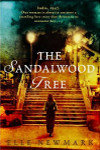
Admittedly it probably helps that I’m interested in India and its many cultures and can speak a bit of Hindi (the book contains a smattering of the language) but I’d hope that the immense richness of detail is undeniable to anyone. Newmark may to a certain point exoticise the country, this makes sense considering the time periods she writes of, but it’s the overall research and the way she describes the places that make the book what it is. The colours of the cover match the story perfectly.
The Sandalwood Tree flips back and forth between 1947 – the time of Partition – and the 1850s, when relations between the British and Indians were understandably bad. It details the events that happened during those times (although the book ends before Partition happens so it’s the lead-up that is examined) but the emphasis is on the lives of the characters and the particular social issues relevant to them. Evie, as an American, finds herself more open-minded than the Brits in her circle and so you get to see a few different points of view. Her own story becomes very much effected by the letters she reads, leading her to find India more homely and enabling her to really consider the impact her husband’s years in service have had on their marriage. Her son, Billy, is a joy in himself, being rather bold and knowledgeable and, being five years old in 1940s India, his own development as a character is particularly interesting.
The letters Evie finds become a second plot in their own right. Even though it is Evie who reads the letters and finds out about the women in them, so much time is given to the letters themselves that it’s easy to forget that. This sort of story has been done before, but because of Newmark’s writing style and the connection she makes between the women and Evie, it is fascinating. I should probably say that Evie’s story is told in the first-person, the 1850’s via the letters and a diary. The various social issues covered due to the two characters love interests make the book very compelling.
I would observe and understand India without India actually touching me.
One of the most interesting elements of the book is the way the domestic squeezes its way into the social, and vice versa.
A second conflict of cultures happens as the back-story to Martin’s plight in the form of the Germans and anyone against them. Consider the following:
He said it bothered him that German sounded so much like the Yiddish of his grandparents; then he shook his head as if he was trying to understand something.
Newmark’s point is poignant, that there was no real difference between Jews and Germans other than religions. Martin’s experiences, when put against the issues surrounding partition add another layer of thought to the book, show in both cases how society can change so quickly when a line is drawn in the middle.
The only thing I took issue with was the phrase “buttoning the curtains down” within the letters written in the 1850’s by British people. I have come to recognise the phrase “button down” through reading American literature, but it’s not something we say in Britain and thus is out of place in an old English letter. But I feel I have demonstrated my feelings overall: this book is pretty near perfect.
The Sandalwood Tree brings many different generations, cultures, religions, nationalities, domestic situations and opinions to its relatively modest 357 pages, and deals with all effectively. Whether the research is spot-on I can only say as much as I know personally, but it definitely comes across as a triumph all round.
The answer to would I recommend this book is a resounding “yes”.
I received this book for review from the author thanks to Pump Up Your Book.
Related Books
None yet
Ella Drake – Jaq’s Harp
Posted 29th March 2011
Category: Reviews Genres: 2010s, Erotic Romance, Fantasy, Science Fiction
1 Comment

Magic beans aren’t just for kids.
Publisher: Carina Press
Pages: 56
Type: Fiction
Age: Adult
ISBN: 978-1-426-89123-6
First Published: 21st February 2011
Date Reviewed: 3rd March 2011
Rating: 3.5/5
Jaq’s sister is dying of a disease that only those who live and work in the sky can cure. Knowing that, as an agent of a covert corporation, she can secret herself up to the floating islands courtesy of her colleague’s beanstalk, Jaq prepares to find the antidote. She may also discover her ex-fiancée in the process.
The set-up for Jaq’s Harp is very good, a blend of science fiction and fairytale, and as before for Silver Bound, Drake successfully creates a world that is fascinating to read about. You are given all the details necessary at any given time to imagine the scene.
The characters are interesting and because of the short page count you get to see how they handle a number of different emotions one after another. Jaq is your kick-ass chick and although you know how Jaq’s mind reels at the sight of her boyfriend, it doesn’t stop her later saving the day. The background story of the characters is given enough time so that you understand their love. I think I would’ve liked to see Jaq take more of a role in the retrieval of the antidote but it didn’t hinder the story.
The inclusion of the fairytale works very well, it’s changed enough to be almost Drake’s own work in its entirety. Having the islanders called Giant Corps is surprisingly original because at times it’s easy to forget the children’s story and so the term nudges your memory.
Once again I find myself saying that I would love to read a story that explores Drake’s world further. The book is apt for the time Jaq’s mission would have taken, it’s only a short mission after all, but it would be great to know that you have more space to really enjoy being in the world created.
The only issue I had was with the romance, not because it’s included, but because its initial placement puts a damper on the pacing. The story begins by throwing you into the situation, racing along as Jaq makes her way towards the enemy and then stops suddenly. It stops so that the heroine can meet her hero, which is fine, but when they start considering whether or not to have sex when they should actually be getting the hell out of there it becomes unrealistic, obvious fantasy genre aside. Romance was to be expected with this book but as Drake shows with a well-timed sex scene at the end, there are better places for it.
To the sex scenes themselves, they are hot. The characters are in love, the details are bold and obvious, the latter more so perhaps than in Silver Bound. The last sex scene ends on a written triumph.
If there’s one single thing I’d like to point out amongst everything else, it’s the inability of the sky-dwellers to look down and the rarity of an earth-dweller looking up. The whole social issue is summed up in that one factor.
If the beanstalk was exciting when conquered once, Jaq’s Harp illustrates that it can be just as exciting when conquered twice.
I received this book for review from Carina Press.
Related Books


Kimberly Derting – Desires Of The Dead
Posted 17th March 2011
Category: Reviews Genres: 2010s, Paranormal, Romance, Thriller
2 Comments

This time it may hit closer to home.
Publisher: Headline
Pages: 355
Type: Fiction
Age: Young Adult
ISBN: 978-0-7553-7896-8
First Published: 15th February 2011
Date Reviewed: 23rd February 2011
Rating: 4/5
Violet knew that ringing 911 when she felt the echo of a body in the shipyard was a risk she had to take. When Sara Priest, an ex-FBI agent contacts her, she realises that it was a mistake to have let the police know something that nobody should. Now she must decide whether to take Sara up on her offer, and to reveal her ability. But there is something else on Violet’s mind. What’s the deal with this new guy, Mike, and his sister?
Desires Of The Dead is the worthy follow-up to last year’s, The Body Finder. In it, Derting packs all the same winning qualities that made the first a success, and takes it up a notch on many levels.
The most obvious difference is the inclusion of the FBI. Whereas Violet’s association with her local police is because of her uncle, Sara Priest enters as a third party, a separate entity. Where The Body Finder was literally about working at ground level, Desires Of The Dead deals more with professional interaction and suggests that in future the series will focus more on things that well befit the crime genre.
The book explores the concept of the family and it’s variations – Violet’s family, a metaphorical family, and this time also the family of the person killed. Family is the basic backbone of the book and whereas before the emphasis was on a person’s mental state, this time it is about how you protect those you love.
Violet has to be one of the best YA heroines of recent years. Continually strong and always equal to her boyfriend, it’s a pleasure to read about her. Jay is also wonderful, and I think it’s fair to say that Derting has a way with characters, which makes them very real.
Jay sat down across from Chelsea and took both of her hands in his. The oversized lunchroom was buzzing with activity, and he practically had to yell to be heard.
“Chelsea, for the love of everything good and holy, please… please stop ruining my friend.”
The romance in the book is never idealistic, and when Violet thinks about Jay she never goes overboard. She thinks about him a lot, but there aren’t paragraphs and paragraphs of it. It’s just so natural. And although Jay is fiercely protective of Violet he gives her space when she needs it.
Before, Derting wrote scenes from the enemy’s point of view, and she does this again in Desires Of The Dead. It’s an interesting device. The reader isn’t so much excited to find out who the person is as they are excited to find out how the conclusion is reached. Because you are already acquainted with the enemy, even if you’re not sure who the enemy actually is, you can enjoy the journey to discovery more because there’s no desire that the author hurry up and tell you. Although the need for speed can be exciting, you often miss interesting details in your rush to finish, and so this isn’t an issue here.
The new elements introduced in this book suggest that next time the difference is going to be quite something, and it appears that from standing on the fence between paranormal and totally realistic (because Violet’s ability is actually rather believable in our world where psychic abilities are acknowledged), Derting is going to jump over and explore the fantastical side. Personally I have little doubt that she won’t keep it just as real as before.
Derting and Violet both know that things cannot stay the same, Derting for the progress of a story, and Violet for the help her ability can bring. The awareness of these things together ensures the development of everything and makes the reader receptive of a third book.
Desires Of The Dead speaks up where others stay silent and proves that a realistic paranormal is possible. The dead have staked a claim on Violet but there’s no reason why you shouldn’t too.
I received this book for review from Headline publishers.
Related Books