




Katharine A Russell – Deed So
Posted 11th March 2011
Category: Reviews Genres: 2010s, Domestic, Historical, Social
2 Comments
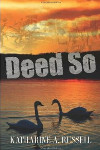
Over the tip of the iceberg but not yet on the ground of the other side…
Publisher: (self-published)
Pages: 428
Type: Fiction
Age: Young Adult
ISBN: 978-1-4537-7503-5
First Published: 2010
Date Reviewed: 8th March 2011
Rating: 3.5/5
In Haddie’s town in Maryland, America, it’s the 1960’s and African Americans are now able to live lives more equal to their European neighbours. But there is still segregation and there are low opinions of the people still called “Negroes”. It is this conflict between equality and low opinion that leads the death of an African American boy to create a furore. The town may be able to get over it but this issue isn’t their “only” problem.
I have to admit that I was skeptical when I received Deed So because discovering it was self-published and then reading the blurb that heralded it as “astonishing” and “gorgeously written” didn’t bode well in my mind. For a while I did indeed have reason to keep comparing the content to what the blurb declared true.
Unfortunately there are a mass of typing errors in the book, including a few which change the meaning of what’s written and thus have to be pondered over. The majority of the book walks along seeming to not go anywhere – although there are subplots they are wrapped up quickly enough and one can wonder where the book is truly heading. The climax is too convenient, the story gets to a point where it’s racing along like nobody’s business and the event is a good length, and then suddenly it ends in a very unsatisfactory manner.
But there is a lot of good in this book that, by the time you do reach the end, has balanced out the bad. One of these good things is that Deed So is very much one of those works where the reader can live the life through the words. Because the plot takes a long while to show it’s true colours you are able to sit back and really explore life in the 1960’s, which if you’re at all interested in historical domestic situations and were not around at the time, is a real treat. Russell does a good job with the descriptions, speaking personally I began the book not really knowing what made the 1960’s what they were – in other words my knowledge of the distinctions between culture, dress, and technology between the 1930’s and 1960’s is a little blurry – but by the end I could say that I was far more knowledgeable and able to conjure up images, albeit if they weren’t completely perfect.
If the strongest overall aspect is the invitation to the reader to immerse themselves, then so close in prominence that it could be argued just as strong, is the social aspect. On the face of it the major issue covered is directly related to the acceptance of African Americans but in fact the issue is broader than this, encompassing social relations as a whole. Whether due to fact or Russell’s creation (this I do not know) the situation provides a good introduction for further contemplation. The town sits in the middle of the two sides of debate – they have accepted blacks into their community, and talk to them as equals, but there is still some segregation upheld, and the past inequality continues to affect the choices of the community in the way that the whites are higher in society. Because Russell gives the reader this quasi-balance and you get to hear each side of the story every time, you come away much more knowledgeable than you would have if only either segregation or complete equality had been spoken of.
In referring to a broader social issue I look to the problems with class and how the family and community at home related to the return of soldiers. One of the subplots involves the complete change a boy undergoes after having been in Vietnam and how he is unable to speak out about it because of the suffocation of an uninformed community and a society unwilling to discuss the issues he has had to face. In addition to this there are also several domestic troubles.
Russell has created a cast of characters bound by family. All her characters belong to families and each family is important in the community and known by all. Yet, whether they acknowledge it or not, every single one of those families have problems of varying natures.
It would be impossible to point to a particular motive Russell may have had to write this book. Like many other writers, no matter whether they use the period to comment on a social or long-term domestic issues, Russell has created a story with her own spin that is thus at once similar yet vastly different. Each story of this nature brings different thoughts to the foreground.
As a reader I feel privileged to be able to have so many viewpoints and opinions in mind on which, if I so chose to do so, would make for a well-debated essay.
Deed So has it’s fair share of technical hitches and could have done with more polish, but it’s safe to say that it’s a pretty decent novel and informer.
I received this book for review from the author thanks to Pump Up Your Book.
Related Books
Ella Drake – Silver Bound
Posted 7th March 2011
Category: Reviews Genres: 2010s, Erotic Romance, Science Fiction, Social, Western
Comments Off on Ella Drake – Silver Bound

Sometimes you might get what you always wanted, but you’ll have to fight for it first.
Publisher: Carina Press (Harlequin)
Pages: 191
Type: Fiction
Age: Adult
ISBN: 978-1-426890-79-6 (only avaliable as an ebook)
First Published: 22nd November 2010
Date Reviewed: 20th February 2011
Rating: 3.5/5
When Jewel attempts to run away from her evil husband, taking their son with her, she’s caught and her memories are wiped. Prepared to become a sexual slave, no one thought that it would be her much-loved ex-boyfriend who would come to claim her as his, the motive being to save her.
This was pushing the boat for me. Even though I didn’t think my venture into Mills & Boon too shabby an experience, it hadn’t been what I thought it would be. I was therefore still lacking in what I’d set out to gain – experience in a genre far removed from what I usually read. The summary of Drake’s Silver Bound found it’s way to me through one of the statuses of the author’s Twitter account, and I knew without a doubt that this was it.
Silver Bound deals with a deprived subject but although Drake uses it for erotic purposes she doesn’t let the storyline sink to such levels as you may imagine. Indeed the space, western, and escape elements are just as important, and it’s obvious that time has been spent just as much on them as the romance.
What Drake does is present the situation but makes it so that the man, Guy, who claims the slave, Jewel, is a lover from her past who regrets their parting and is thus wanting to save her from her predicament. There is actually less sex than you might think because the love Guy has for Jewel does not permit him to use her to his advantage. Guy makes for a very worthy hero.
All that said I can’t really shy away from describing the sex. It’s hot, it’s in a variety of flavours, and it goes back and forth in control depending on Jewel’s recovery of memories at any given time.
Another point of interest is the growth of Jewel, the enslaved woman. Before her enslavement, upon which her memories are wiped, she is a sassy and confident woman despite her horrible situation. After her enslavement, especially when she meets Guy, she begins to regain them so that the story doesn’t remain as much about Guy’s feelings and it becomes a story of two equals. That’s not to say that Jewel’s thoughts are given no time, indeed they are included in all sections of the story.
I couldn’t write about this book and not talk about the mix of living in space and the realm of the cowboy. Silver Bound isn’t so much futuristic as it is fantasy, the people inhabit and use space stations, journey through the universe in “hoppers” and have futuristic technology – but they appear to have lived on their different planets for ever. The western aspect blends into this flawlessly, as Drake explains how the ranchers use the older ways of living – the cowboy ways – to keep their patch of land fresh. Guy can use a technologically advanced weapon, but he’ll just as often bring out the lasso.
The writing is good but there is a sense of the short story in that many times the scene switches suddenly, sometimes it’s very confusing what is happening. The book could have done with a little more development to keep the transitions between sections of the plot smooth.
I can’t say that my comfort zone in romance overall has changed, even if after the third time my boyfriend asked me what I was reading on my phone and the answer came back, sensationalised for maximum effect, “a dirty erotic novel”, he no longer blinked an eye lid, quashed further by my reminder that men have had access to porn for centuries – but having read Silver Bound I feel less daunted by the genre and see that if you choose wisely you don’t have to land yourself with something that is stereotypical or badly written.
Drake drops an original mix into the pot and shows that a combination of genres at opposite ends of the scale can be blended to good effect, even when the least of details in the blend is examined. The universe created could support a vast number of interesting stories of many types – and as a small slice from this massive universe, Silver Bound does not disappoint.
Related Books


Ally Condie – Matched
Posted 11th February 2011
Category: Reviews Genres: 2010s, Romance, Science Fiction
1 Comment

There’s a reason they didn’t keep this poem.
This poem tells you to fight.
Publisher: Razorbill (Penguin)
Pages: 364
Type: Fiction
Age: Young Adult
ISBN: 978-0-141-33305-2
First Published: 30th November 2010
Date Reviewed: 2nd January 2011
Rating: 5/5
It’s not every day I begin a review with a quote; in fact this is a first for me. But I can find no other way to introduce this novel.
Like all other members of her society, at 17 years of age Cassia goes to the city hall to find out who the Officials have paired her with for life. She finds herself matched to her best friend Xander and all her hopes in The Society are fulfilled, thinking those at the top really do know best. But a mistake in the information she is given about Xander leads to another person being matched to her. The Society don’t make mistakes, but is it possible they may have this time? And just how perfect is Cassia’s life, really?
Even with the summary on the back – which is nice and vague – you can’t really guess what the content will be like. What I find so brilliant about the world Condie has created is that it’s unlikely two readers will see it the same way (incidentally, as The Society like probabilities they would probably like this… and there goes another probability). In fact I’m sure I saw it as more visually stunning as Condie planned, but for me that was what worked in my head. Condie’s descriptions – as in the way she uses words – didn’t register at the time of reading but on looking back I realised just how skilled she is.
And yet there is nothing lustrous at all in the world Condie has created, if we are to speak literally. The world is the horrifying product of domination, a world in which a select group of individuals rule almost every aspect of every life – one that could possibly evolve in our own future if we aren’t careful. Condie has made technology very advanced but she hasn’t resorted to all of the usual futuristic elements – there are the odd heralds of our world today and history in the way that humans still run the show. In truth it’s partly this that makes it scary, the implementation of things we tend to agree with, such as recycling, as everything is so planned out. There are no chances, no random occurrences. To me Condie’s creation comes across much like The Sims, the game in which the player controls virtual life. The visuals in that are very cute, colourful, and represent perfection, which is what The Society of Matched are determined to exploit.
Of course with a book of this nature you cannot assume that the characters will be strong, nor can you really expect it, but Condie may surprise you here. Cassia takes a while to start realising how corrupt her world is and thus to a reader she can come across as annoying. It definitely makes you sit back and think because while you can plead her to take chances and run away, you have to remember that to her nothing is unusual. The way in which Cassia comes into her own while still believing certain things may seem difficult to understand, but it’s logical. Although Condie shows how weak The Society really is, she also shows how difficult it can be for a group of people to stand up for themselves when they know that to stay silent will result in an easy life. In this way her book is as much a commentary on our present time than a fly-on-the-wall look at a dystopian world.
I’m rather reluctant to talk about the other characters because a lot of my own enjoyment came from discovering their personalities and desires. I will simply say that both male leads are heroes and that there is little to make you prefer one to the other.
You may be wondering, as I did, how much similarity there is between Matched and the other young adult novels that have been released of late. The answer: a love triangle, and the general idea of a dystopian world. To be honest I’m not sure if I liked the fact that it is the love aspect of life is what’s focused on, I’d have preferred to have seen Cassia struggle for something a little more general, like complete freedom, but love triangles are what sells at the moment, it seems to be the key between a hit and a flop.
Towards the beginning I may have said that you don’t notice how good Condie’s descriptions of locations are while reading, but that’s not the same for the other elements of storytelling. Some lines jump from the page, such as the one I have quoted already. In that particular case it is as much the cause of the structure as the words.
Condie has exceeded my expectations. I could never have imagined such a story, such vivid description, would fill the pages.
Break the rules. Follow Cassia. Trust in Condie. Read this book.
Related Books
Alex Bell – Lex Trent Fighting With Fire
Posted 4th February 2011
Category: Reviews Genres: 2010s, Comedy, Fantasy, Western
1 Comment

Talking foxes, more fire-breathing rabbits and the anti-hero discovering a fear of octopuses. It could only be another Lex Trent book.
Publisher: Headline
Pages: 376
Type: Fiction
Age: Young Adult
ISBN: 978-0-7553-5519-8
First Published: 3rd February 2011
Date Reviewed: 30th January 2011
Rating: 4/5
The Games have been scheduled once again and, once again, Lex has been chosen. But whom will he pick as his companion this time, as he seeks a life-giving sword in the Wild West? The decision is obvious, but Lex and his companion will have to do more than simply spin a couple of pistols and walk beside the tumbleweed. One of the other players is the grandson of a person affiliated with the Trents and having been shunned, the idea of winning the three rounds becomes all the more appealing.
Lex Trent Fighting With Fire continues the same basic format as Lex Trent Versus The Gods but features a lot more events in between the rounds, providing the reader with a chance to get to know the anti-hero even better but also, this time, to see where he can be a bit nicer. That’s not to say that the character improves exactly, because he doesn’t, in fact if anything the more you learn in many respects makes your opinion of him worse, but there are some very good points to him, no matter how well he tries to conceal them, that end up surfacing during the course of the book. This allows for Lex Trent to be ever more awful without alienating the reader.
Money had made them stupid. Lex could have announced himself as Tex Lent and they still wouldn’t have put the pieces together.
Lex’s companion Jesse, is superbly stereotypical as are the other contestants, and this is one of things that makes the book fun to read. Bell exploits stereotypes almost viciously, really making the most of them, and you can’t but be amused even if sometimes in reality it wouldn’t be correct.
More so than the first book, because of the connections between the characters, the other players play a bigger role in the story, at most times being just as much important as Lex and Jesse. The game rounds are more extreme too, whereas in the first book they were very dangerous but more interesting, this time they are more nightmarish and deadly. One round, involving books, is a treat because of the very nature of readers. And Bell includes a far share of libraries.
After all, when a mysterious volcano range suddenly appears on the landscape and may erupt at any moment, what could be more natural than to build a café right there beside it?
The story is slower than Lex Trent Versus The Gods because there is more information in it. The Wild West element is a whole subplot in itself as Lex is doing more than last time; he has two games to win – again the structure and writing style aid in helping the slowness to pass.
Lex Trent Fighting With Fire continues on a theme but succeeds in taking the story further thanks to that theme. In a time when second books are generally fillers it stands out from the crowd with the golden glow of a glowing canary that’s nearing the treasure. And it fits into a sole tradition – it’s own. It is a worthy follow-up and solid piece in a series that is likely to continue.
Related Books
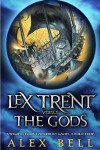


Alex Bell – Lex Trent Versus The Gods
Posted 27th January 2011
Category: Reviews Genres: 2010s, Comedy, Fantasy
2 Comments
An anti-hero with a cleanliness issue plays a divinely-created game lead by a flighty Goddess in a toga.
Publisher: Headline
Pages: 344
Type: Fiction
Age: Young Adult
ISBN: 978-0-7553-5518-0
First Published: 4th February 2010
Date Reviewed: 26th January 2011
Rating: 4/5
Lex likes to make trouble and has a habit of stealing whilst supposedly studying law. Once, when he found himself on the run after an unsuccessful mission, he decided to hide in the church of Lady Luck. This lead to him being enlisted as a competitor in the games, three rounds of challenges organised by the gods. Now, unfortunately for Lex, his boss is his assistant. There’s nothing more Schmidt would like than to give the criminal the what for, but instead they will have to cooperate if they are to win against the odds.
Lex Trent Versus The Gods is an oft-hilarious novel revolving around the tasks set for Lex to complete. There is a touch of Terry Pratchett-like humour in it, especially at the beginning where you may recognise where Bell has got her inspiration from; but the similarity stops there and otherwise the book is unique.
What’s particularly interesting about the story is that the main character is an anti-hero but nevertheless a character you want to read about. Bell’s humour plays a big part in this and she extends it to the group of characters as a whole. Lex is… horrible. He’s not the most awful person by any means, enlivened somewhat by an OCD that ill-fits his “profession” and is thus very funny, but he can at times be uncomfortable to read about. His opposite exists in Schmidt, the lawyer who provides interest because of the oppositeness (and, incidentally, for his opposition) and his dialogue. Of particular note is a scene in which Lex and Schmidt attempt to walk up an ice staircase.
When you have similar themes running through a book, in this case rounds of a game, it can be easy for everything to blend together and for the reader to forget when different events occurred. This is not the case here, where Bell effectively colour codes the rounds and sets them in a variety of locations. Be sure that the game never becomes boring because of these differences and because of the strange goals set.
Generally, authors of fantasy stick with the bog-standard mythical and legendary creatures established in the genre, here and there creating new ones specifically for their own works. Bell partly continues this trend but also diverts her attention to ancient Greek mythology to add a sparkle to the first round of the game. It fits the material perfectly.
“Zoey is – as you say – a ridiculous name for a griffin. I suppose my grandfather thought it was romantic to name a huge, hulking beast after the woman he loved.”
The narrative is fast paced and easy to read. There are a few slower sections where the book can be put down for a while, but the pace means that they don’t last for long. There are also constant climaxes throughout the story owing to the games, and, something I absolutely loved because it’s the thing I don’t like about the fantasy genre – there is no long journey involved. When the scenery changes it’s only for a short while and compared to other books it’s instantaneous. It’s worth reading the book just for the mode of transport.
We always think of Gods as being in the sky. Bell turns this notion on it’s head.
The only thing I wasn’t too sure about was the element of luck, because although it’s completely rational (as Lex is supported by the Goddess of luck) it means that Lex’s tasks are comparatively easy. Not thinking realistically helps, as well as constantly reminding yourself that this is pure fantasy.
Where witches are made the prey for a king’s hunting party while simultaneously still vying for work, and teenagers are turned into fish for trying to trick magicians, you can be sure of a good story. Lex Trent Versus The Gods isn’t perfect, but it’s not far from it, and with a second book on its way I think it’s safe to say that what has been released so far bodes very well for the future.
Related Books


