




Series I’ll Likely Finish; Series I Won’t Be Finishing
Posted 31st October 2016
Category: Chit-Chat Genres: N/A
6 Comments

You’ll relate to this, I’m sure, and I’d love to hear what’s on your own lists. I’ve many book series that technically, in a dubious sense, are on the go. In some cases I have all the books already waiting (in most cases these are the series I’m not so fond of; isn’t that always the way?), others I have half the count, and more others I’d have to purchase. (Having more to purchase/borrow can sometimes itself be a reason to pause reading. It’s the reason I never got around to finishing that series with the boy wizard and man who shall not be named… and now I’ve missed collecting the set in one design.)
Whilst looking at my shelves for an idea of what to photograph in order to have some stock photos ready, I noticed how many unfinished series I had. I picked out a number of them – limited to the last book I’ve finished per series – and split them into two groups.
As I looked at them all neatly stacked on the table, I noticed a pattern that confirms something I’ve known a long time: I love fantasy but don’t make it a priority. I would say fantasy is a favourite genre but it requires a mental investment that I find difficult, a particular attention made more important due to my wish to review, and it keeps me away. I suppose what I’m saying is I love fantasy but find it hard to review, and I don’t know why. It may have something to do with my fear that I’ll miss key concepts, something I’ve got over when it comes to literary fiction and historicals but not yet imaginary worlds. I’m a video game and 90s sci-fi TV show geek who lost her way and thus doesn’t know many references any more.
Series I’ll Likely Finish
Elizabeth Chadwick’s Eleanor of Aquitaine trilogy
I’ve finished book one, The Summer Queen, and have The Winter Crown on the shelf. The first was excellent but there was that pesky factor of having to wait for the next book to be released that meant I lost track. I will get to it – I’m slowly, successfully, making my way through Chadwick’s backlist. And I thought it prudent to wait until she’s published the last book so a marathon can be a possibility.
Lian Hearn’s Tales Of The Otori series
‘Current’ book: Grass For His Pillow. I have the next two (of three) on my shelves. I’ve been reading this series almost as long as I’d been reading His Dark Materials before I finished it earlier this year… about 15 years, now. It’s an investment thing.
Charlaine Harris’s Sookie Stackhouse series
Book 2, Living Dead In Dallas. I have most of this series thanks to a heavy discount that reduced the first ten books – what was published at the time – to the price of one store-bought book. (British readers may be familiar with The Book People.) This isn’t my favourite series thus the time it’s taken so far, but I like it enough to feel fairly confident in saying it will happen.
David (and Leigh!) Eddings’ The Mallorean
Book 2, King Of The Murgos. (There seems to be a pattern with this second book thing; it might be worth exploring at some point.) I pick this series up when I want older fantasy and am happy to read something repetitive. In many ways this series is a rehash of the previous, The Belgariad, that features the same characters. My problem with this ‘reboot’, as it were, is the change in Ce’Nedra and the way that because she’s had a baby she’s been largely left out. I’m making slow progress.
Series I Like Won’t Finish
Lauren Kate’s Fallen quartet
Book 2: Torment. It was a torment finishing the first two books. I went along with my standard ‘second chance’ mode of reading. I could carry on but I can’t say that interests me and negative reviews for negative reviews’ sake – no thanks.
Anna Belfrage’s Scottish time travel series
The Prodigal Son, book three. Akin to Diana Galbadon’s epic series, I read this series for a few tours and had to turn down the next two due to prior commitments.
N K Jemisin’s Inheritance trilogy
Book one, The Hundred Thousand Kingdoms. This book didn’t do it for me but I do plan to try another of Jemisins’ series.
Terry Pratchett’s Discworld
Book seven, Wyrd Sisters. I’m going to continue this series but being realistic there are so many books involved that I doubt I’ll ever read them all. I love Pratchett but need to read him in stages. I very much admire Jessica’s journey and am experiencing the series vicariously through her reviews.
Anyway, question time: which series do you have on the go and which have you given up on?
Rare Saturday Post To Say…
Posted 29th October 2016
Category: The Worm Hole Genres: N/A
9 Comments
I interrupt my regular posting schedule, which does not include Saturdays, to say the following:

I am on the official shadow panel for this year’s Young Writer Of The Year award together Simon Savidge, Kim Forrester, Naomi Frisby, and Eric Karl Anderson. We’ve known for a couple of weeks and can now reveal it. We can’t tell you who is on the shortlist at this point – look out for that announcement next week. I will be reviewing the books over the next month and will likely have some other bits and pieces of news to share here and on Twitter, too.
Annoucement on the official site.
Shan Sa – Empress
Posted 28th October 2016
Category: Reviews Genres: 2000s, Drama, Historical, Political, Social, Spiritual, Translation
2 Comments

Reigning for ten thousand years. It may indeed seem that long…
Publisher: Harper Perennial (HarperCollins)
Pages: 319
Type: Fiction
Age: Adult
ISBN: 978-0-061-14787-6
First Published: 2003; 2006 in English
Date Reviewed: 16th June 2016
Rating: 3/5
Original language: French
Original title: Impératrice (Empress)
Translated by: Adriana Hunter
Wu Ze Tian, as she would become known to history, begins life as the child of a privileged mother and a well-known but commoner father. After spending some years in a convent she is recommended to the Imperial City; a man who once aided her has found her a position as a royal concubine. Ze Tian finds no favour with her husband, the Emperor, but her ability as a horsewoman attracts the attention of his son who comes to desire her. She agrees to be his wife and thus starts a controversial era wherein for the first and only time a woman will rule China as Emperor.
Empress is an epic, fictionalised, account of Empress Wu’s life from her time in the womb and beyond her death. It’s the sort of book to read if the history intrigues you but you want to begin your lessons slowly.
Sa’s character is a difficult one. In Ze Tian you have a woman who was pulled from her life and put in a position that was both a source of envy and a horrible prospect – to be a concubine or wife was a high position in society, but most of the thousands of women kept in the City for the Emperor’s enjoyment would spend their days waiting for acknowledgement in vain. But you also have a woman who, once she gained power, was incredibly ruthless. Sa has balanced it all exceptionally well. For the most part the kindness of Ze Tian is kept to her early years – admittedly a lot shorter, page wise, than her reign – and her tyrannical decisions to said later reign. Sa does allow for moments of goodness and kind thoughts during Ze Tian’s time as emperor, but considering there is little chance at this point of your feeling any sympathy for the monarch, the author keeps it in the region of self-absorption and reflection. Sometimes this reflection just makes the horror worse, but one senses Sa just had to shrug her shoulders.
Ze Tian made a lot of positive changes in her time, even if many were later reverted. She set up a system wherein the regular person could state a grievance that would be listened to, she adjusted exams for hopeful scholars so that commoners could have a shot at governmental roles. She was a role model for women. Sa gives her what positivity she can but is realistic about the tyranny. Of course there’s always the thought in the background, which Sa addresses in the first person narrative – how much of the punishment Ze Tian metes out is due to any evil versus how much does she deem crucial to the success of her status? The narrative revolves around Ze Tian’s thoughts, everything that happens is couched in its relevance to her, how it impacts her, so, again, Sa ensures you’re getting as objective a picture as you can, at least as far as the limits of first-person go. (The book is limited by this narrative choice.)
Jousting with the graphic violence for Most Gratuitous Aspect is the sex. There’s no getting away from sex in this book; the women in the Inner Court had no choice and neither do you – there’s a lot of it, in various guises, sometimes because it’s a reflection of the facts and sometimes because – unfortunately – it seems Sa has run out of ideas. What’s interesting is that you eventually become numb to the idea of incest and old women having sex with consenting-but-under-pressure-to-do-so teenagers because it’s just so prevalent; and it’s interesting that you become numb because there’s a great possibly that that’s something Sa is wanting you to feel – the conquests were acceptable in the situation and so by becoming attuned, study-wise, to it yourself, you stop feeling so nauseated by it and start to see the societal concepts behind it.
The writing is very poetic. The translation reads well and it certainly matches the poetic nature of historical Chinese writings and artwork enough that you can assume it a faithful version. In terms of the writing’s impact on one’s reading, however, the book is very slow and can be a bit too flowery – sometimes it seems as though Sa is exploiting poetry in order to make her story longer than it should be. There is also a lot of info-dumping, Sa likes to go into meticulous, few-pages-long detail about events that could be summarised in a paragraph, and friends supposedly of many years pop up without you having heard of them before. It’s difficult to remember who anyone is in this book, the repetition makes everything so similar. No one is as important as Ze Tian and it shows.
And this is where we come to the main problem with the book – after a point, about two thirds of the way through, once Ze Tian is firmly ensconced on her throne, the novel becomes a series of repetitions. Ze Tian will worry about getting older; someone will suggest another is out to steal the throne; said accused person is condemned to death; Ze Tian is sad because she liked them; someone turns up in the royal bedroom to help the monarch remain young and energetic; that person is taken away; a pilgrimage or other journey happens; Ze Tian dreams of gods and her goodness… over and over again. Undoubtedly there was boredom to the routine of life at court and in the tedious nature of every action, every breath, having to adhere to etiquette… perhaps it is to show that tedium, and the slow decline of the body, but it’s overdone.
You’re never going to feel sorry for Ze Tian. You’re not going to like her and quite frankly it’s a relief to get out of her head. But if you can deal with the ennui I’ve mentioned, or if you’re happy to skip those sections, you might want to flick through Empress. Ze Tian’s reign was an important one, and if you’re at all interested in history your interest will be improved by knowing about her.
Or you could look for articles on the Internet and be just as, if not better, informed.
But I became a symbol of a corrupt woman… Novelists invented a life of debauchery for me, attributing their own fantasies to me.
This may be ironic.
Related Books
Keith Stuart – A Boy Made Of Blocks
Posted 26th October 2016
Category: Reviews Genres: 2010s, Domestic, Social, Spiritual
Comments Off on Keith Stuart – A Boy Made Of Blocks
Gaming. Ability.
Publisher: Sphere (Little, Brown)
Pages: 390
Type: Fiction
Age: Adult
ISBN: 978-0-751-56327-6
First Published: 1st September 2016
Date Reviewed: 24th October 2016
Rating: 5/5
Alex and Jody’s relationship changed forever when Sam was born. Diagnosed with autism, it’s been a difficult journey that Alex hasn’t coped with. Eight years in, now at breaking point, Jody suggests a separation. Alex needs to learn to relate to Sam or leave the family home for good. But as Alex tries to deal with the devastating situation of his marriage, Sam discovers the video game, Minecraft, and a ray of hope shines in.
A Boy Made Of Blocks is a semi-autobiographical novel (excuse the oxymoron), about the relationship and communication in a family affected by autism. It is an excellent work in all ways, being at once a lesson in communication and autism in general taught by someone with first-hand knowledge of parenting a child with autism and a fun story of a very popular game we have in the factual world. And to round it off it’s just a very good, solid, read.
Stuart has a particularly engaging writing style. It flows well, it’s full of emotion without going into any sort of ‘brave’ or ‘inspiring’ territory, well written whilst bereft of anything literary which is absolutely of benefit in this case. You can read the autobiography between the lines of fiction and it’s just a wonderful reading experience.
‘All the standard parenting rules are out of the window,’ continues Matt. ‘Whatever will make this easier for you. The kids can watch movies, play video games and eat crisps for two days, we don’t care. We’ll deal with the fallout when we get back.’
‘Well, I’ve got Sam on Saturday…’
‘Bring him,’ says Matt. ‘Bring whoever you want. I’ll stock the fridge with beer – you can either drink it yourself or give it to the kids.’
It’s also rather funny. Laugh-out-loud only once in a while, it sports a general happiness, joviality, even, that’s down to the other parents’ positive outlook and, increasingly, Alex’s ever-more-optimistic outlook.
Because Alex isn’t always optimistic. In writing him, Stuart is showing very bluntly how people can see the difficulties and not cope with them. Whereas Jody has had to learn how to parent, Alex has used his work life to get away from home and so the book is a lot about the adjustment he must make. It’s far more a case of bad father than any of Sam’s tantrums. Alex must work out a way to communicate with Sam – as Stuart implies, the idea should be to work around problems rather than just say it’s impossible.
Whilst this reviewer cannot comment on the knowledge imparted with any particular expertise, from what she does know, it rings true. The main takeaway in this sense – if you’re looking for a book that presents autism and the parental experience from real knowledge – is that Stuart has a child with autism, of the same age as character Sam. The novel itself makes clear that Sam has high functioning autism so the book corresponds to that particular level of ability and of course it must be remembered that every person is different – one person with autism does not reflect every other person.
For all these reasons it hardly needs to be said – this book is incredibly important.
And due to the variety of subjects and the writing style it has vast appeal. It’s by no means just for those who are interested in or have autism. For example, the information and detailing of Minecraft should prove a literary delight for gamers. On this subject it bears noting that the use of Minecraft will inevitably, unfortunately, mean the book may lose some of its significance within a few/several years. The best time to read it is within that time, most especially if you don’t have experience of the game yourself as there will be lots of resources available to learn from.
(As a brief introduction for those who aren’t familiar, Minecraft is a multi-player game, playable over the internet if the person wants to share their game with others, that involves gathering building materials and making tools in order to create shelters and farms and so forth – all sorts of things really – on a blank/semi-blank landscape canvas. In this book’s case, the building is a vast castle based on the Tower of London. The game’s graphics are retro – in a time when we have rather sophisticated software, Minecraft harks back to 80s/early 90s nostalgia. It’s suitable for a variety of ages.)
The use of Minecraft presents a conflict for this reviewer: it has been noted by many gamers that not all the references in the book are factually correct, and indeed some will be noticeable to non-gamers also, for example Sam and Alex choose to start a game in ‘peaceful’ mode, turning off the monsters because Sam is not comfortable with the idea of them, but then a few pages later to Sam’s dismay monsters arrive anyway. It’s hard to say why there are incorrect references as Stuart plays Minecraft himself and as Games Editor of The Guardian is presumably very well informed. Perhaps it was an attempt to make it easier for people who do not play the game to understand it, but it presents a conundrum: this is an incredibly important book that in all other ways is absolutely superb. To give it less than full marks may be going against the idea that perfect should be perfect, but at the same time the Minecraft references themselves in the grand scheme of things do not seem so vital. (And you know how important research is to me, and that I am a gamer myself.)
So this book gets top points with the caveat that Minecraft players may on occasion feel very frustrated.
There are so many books out there, about autism, mental, and physical health in general, that are written by ‘experts’ with little true experience of the day to day, that A Boy Made Of Blocks shines brightly in its difference. If you want to know more about autism in the context of parenting, read this book. And if you’re looking for a good reading experience that doesn’t necessary fit into any category, this is the book for you. It’s so good it’ll give even the biggest reading slump a run for its money… or crafting tools.
I received this book for review from the publisher.
Related Books
None yet
My Event Report: In Conversation With Dan Richards
Posted 24th October 2016
Category: Events Genres: N/A
4 Comments
© Photo:Gerry Walden/gwpics.com 2016
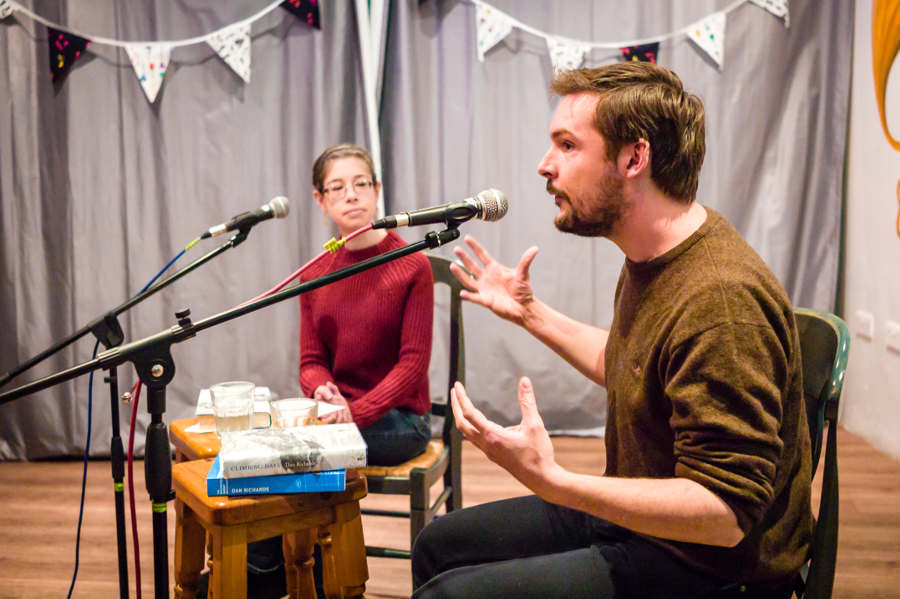
Thursday saw the first In Conversation event here in Southampton, hosted at The Notes Cafe. Dan Richards came down from Bath via Norwich – a very busy day that resulted in a likely miffed cat – and spoke to us about Climbing Days and The Beechwood Airship Interviews: how it was to be a female mountaineer in the early 20th century; the problems with climbing then as opposed to now; being greeted as the great-great-nephew of a climbing legend; interviewing popular artists about their work within their creative spaces.
With me on stage too, this post was never going to be like my other event write ups. It would have looked a little odd for me to have a notebook and pen, not least to be jumping off the stage to gets photographs… of one person and an empty chair, so I mollified myself with the occasional glance to check my live tweeter was indeed tweeting (he was but as we discovered later, he didn’t know about mentions/replies – this is why I was posting tweets the next morning) and rested assured that there was a professional photographer in the house.
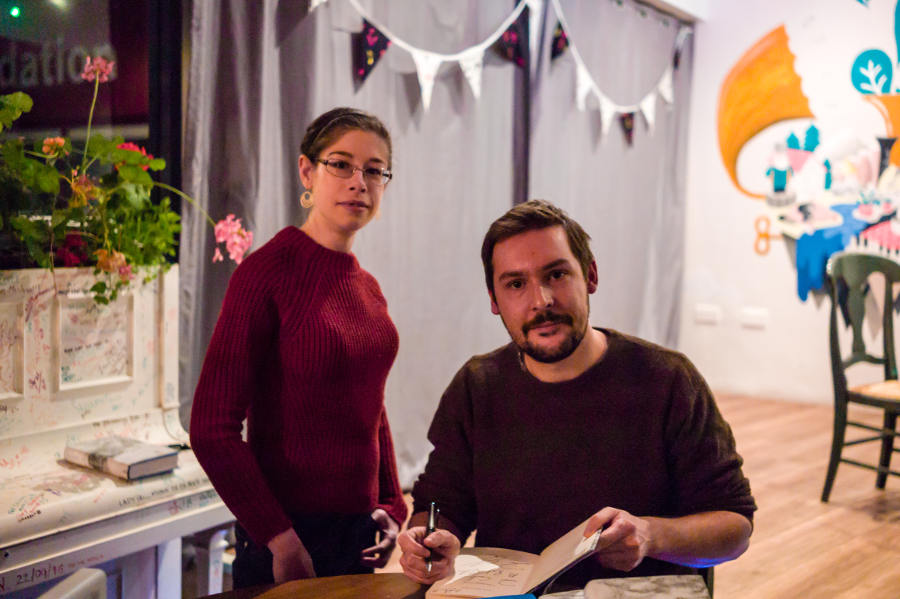
© Photo:Gerry Walden/gwpics.com 2016
Faber sent us some letterpressed prints of Stanley Donwood’s book cover art, signed by both artist and Dan, and we had all three books on sale. It was lovely to see those I’d met before and those I’d met on Twitter; April Munday joined us (we met at last year’s RNA conference) as well as Paul Cheney who I now know, through Dan, and who travelled a fair distance all considered.
It was a lovely evening and we look forward to a second – on Thursday 24th November, Elizabeth Fremantle will be joining us, Facebook event page here. Do come if you can!
What’s the most recent literary event you’ve attended?


