




Random Encounters With Readers
Posted 21st October 2016
Category: Chit-Chat Genres: N/A
5 Comments

Story time.
I think it’s one of the nicest literary pleasures – books, your love of them and another’s love of them, forming a connection even though you don’t know each other. Books are one of those obvious ice-breakers, unless perhaps you’re using an ereader (though that doesn’t stop the possibility, only limits it), as books are something that are visual, an insight into the person you can use to start up a conversation. It lets you form an immediate connection, bypassing small talk (yay!) and given how much we readers often lament the lack of opportunities for bookish conversation in our daily lives, it’s a real boon.
One day I sat down at the bus stop; it was one of those small basic shelters, yet to be updated, all irrelevant outdated poster timetables and little space. Chewing gum on the flip seats. A girl around my age sat on one, deep in her book. I hadn’t encountered someone reading ‘in the wild’ for some time, let alone a reader my age. Etiquette flew out the window as I asked her what she was reading. It was a very brief conversation as she wanted to get back to her book – she was reading Virginia Andrews. That was my introduction to the writing pair. I don’t think I was headed anywhere particularly mundane that morning but the conversation made my day. It must have – here I am remembering it all these years later.
A few months ago at the Curious Arts Festival – I suppose I’m cheating here as it wasn’t long ago – I was attempting to finish Before I Go To Sleep without showing off what I was reading because S J Watson was sitting nearby and I’d made an admittedly oddly specific reference to where I was in the book when I’d asked him to sign it the day before. (Page 425, if you’re wondering – why I thought he’d know what scene that would be I don’t know.) I’m very aware of the pally-pally thing, of that blogger meeting an author thing, silly really. (I once went to a concert with my father and we stood with a group of friendly women we’d been queuing behind. We unfortunately found later we were standing with people who took fandom too far. A few of these experiences later and I’m very keen on the get-item-signed-and-get-going approach.) Anyway, a girl asked if she could share my bench and wondered which Watson I was reading. We had a brief chat about it – she didn’t want to spoil the ending for me and we both had books to read. Her enthusiasm was infectious and although I was already reading as fast as I could at the time, I finished it just that bit sooner because of it.
My last story is more of a sighting. A middle-aged man walking past doing the book equivalent of eyes glued to the screen. I was more than happy to do the swerving – not only was he reading but it was a favourite book of mine. It wouldn’t have been right to stop and say something but how I wanted to. It made me interested in looking for different opinions of the book (this was before blogging) because it was historical fiction about an empress and whilst I was perhaps on the younger side of the target audience, in stereotypical terms he was an outlier. Still in stereotypical terms, however, he looked like a university teacher and thus apt.
These are my stories. I wish I had more but then would encounters have such an impact if they were more numerous?
When did you last meet a reader by chance?
Lewis Carroll – Alice’s Adventures In Wonderland
Posted 19th October 2016
Category: Reviews Genres: 1860s, Fantasy
6 Comments

Curiouser and curiouser.
Publisher: Various
Pages: N/A
Type: Fiction
Age: Children’s
ISBN: N/A
First Published: 1865
Date Reviewed: 21st September 2016
Rating: 4.5/5
When Alice finds herself bored, sitting beside her sister who is reading a book without pictures or conversations, she longs to do something else. Seeing a white rabbit dressed in a waistcoat and holding a pocket watch, she follows him to his rabbit hole and promptly falls down it. At length she finds herself in a room with a tiny door and no way to follow the rabbit through, but there on the table is a bottle with a clear instruction: ‘drink me’.
Alice’s Adventures In Wonderland is a Victorian children’s novel of bizarre fantasy. Ever relevant and deeply ingrained in our popular culture it’s both an important read and a fun one, and it’s good at any age.
Alice is an interesting character. She is in many ways a device, a fictional person Carroll uses to teach his audience various lessons and skills, a young girl who could be said to be a bit silly, oblivious, and perhaps bad tempered for the very fact that it makes the story and lessons more obvious. In Alice we have a very good imperfect person who allows you to see mistakes that could be made, meaning you would learn the cause and effect without, hopefully – I think we can assume Carroll had this in mind – making the same mistake yourself.
As a character otherwise she can be a bit of a bother – ‘irritating’ is too harsh a word – especially as there is no real turning point where she realises what she should be doing or how she should be acting. However this is speaking as an adult and speaking at a time when the Disney film adaptation, with its very polite, perfect, Alice, is more prevalent in popular culture. It’s hard to say for sure whether it’s the product of Alice’s age – alluded to rather than told to us – or perhaps the difference in time period.
It’s fair to say that in our culture where we speak of ‘wonderland’ in terms of something we all know about, the place has become more important than the person. Wonderland is bizarre, it’s the stuff of very strange dreams and far-out imaginings. It’s in part made up of that swords and shields and heroes idea that we have in childhood – and obviously has been a mainstay of childhood for a good couple of centuries at least – partly the dream of animals being able to talk, and also various bits and bobs that you can see Victorian cultural influences from. It’s magical but of the magic that can be more baffling than dreamy. It’s a weird place that is fine to read about, but not a fantasy world you’d want to visit. That’s Narnia’s forte – Wonderland is a little scary.
The writing is simple and the tale fairly short. The text hasn’t aged beyond its few time-specific ideas (that pocket watch, for example) making it completely accessible. For the violent aspects, such as the constant ‘off with his head’ it might be regarded nowadays to be for older children than it was written for but the lessons remain appropriate to the single digit years.
In sum, Alice’s Adventures In Wonderland has something for readers of any age because even when you’re past the target age range there’s a lot to appreciate.
Related Books

The Importance Of The Adaptation
Posted 17th October 2016
Category: Chit-Chat Genres: N/A
7 Comments

I got thinking about this subject whilst in the midst of compiling my thoughts about the way the recent film adaptation of Far From The Madding Crowd used a certain strand of the source material (yet to be posted). I noticed how much more I end up thinking about a book and the story as a whole, and how much more likely I am to write more than one post if there’s a film to be seen. (When I say this I’m meaning film, singular – I’m yet to watch multiple adaptations but it’d be interesting to compare this whole concept when/if – likely when – that happens.
To summarise, watching adaptations – and, I suppose, hearing them on the radio, I’m just not familiar with them – gives you more to think about. It extends your experience of and with the book. It adds or even creates your personal dialogue with it, extending it from the original to other people’s interpretations. You’re able thus to compare and contrast your interpretation with others and see more opinions in action which can help you decide how much impact they might have had on the story or study possibilities. Your journey therefore doesn’t end on the final page. It may be that the interpretation isn’t the author’s (of course sometimes it will be, for example if the author is the script writer) but you’re still deep in the story.
Views are more broadly applied, though they may be limited by feature length. (This is an interesting topic in itself – what gets cut, what’s deemed most important to the director, how does it compare to your own opinions?)
And adaptations are another way of sharing the story with someone else. Whilst you can join readalongs, there’s a more immediate aspect, dare I say it’s more social than reading – you’re seeing exactly the same things, the same interpretation at the same time. You can have a movie night with friends, perhaps share the story by way of film with those who wouldn’t read the book. It might not be quite faithful to the book, but in most cases it will be enough.
The adaptation is often the widely-known version of the story where more will watch that than read the book. (Tara Sparling’s post on how many copies constitute a bestseller makes sobering reading.) Due to adaptation changes it can pay to watch the film so that you know exactly what others are relating to when they speak of it. Unless it’s a highly popular book more people will want to talk film and whilst it’s unfortunate that you can’t always persuade someone to read the book, it’s better than nothing, I think we’d agree.
There is just so much benefit in the adaptation. I find myself down far more research rabbit holes if I’ve a film to watch than if there’s ‘just’ a book and it just broadens the book horizon.
Do you like adaptations? What do they add to your reading?
Some Notes From Babel Literature Festival And YALC
Posted 14th October 2016
Category: Events Genres: N/A
3 Comments

Having attended various events over the summer months, I didn’t want to post about every one and risk making this blog a blog of quotations. Looking back over my notes and photographs, however, I saw the value in writing some of it up and sharing and creating one post for a few events seemed the way to go. Included here are notes from the Babel Literature Festival (a festival normally held on the continent but this year a special one off for London), and YALC – Malorie Blackman’s creation, in its second year, part of the London Film And Comic Convention.
Part of the reason I didn’t post separately should be obvious – there wasn’t enough content, especially once incidental notes had been removed, to make a whole post, but hopefully the notes I’ve included here have been interesting. My photographs? Forget it – apart from the one above, my shots were shocking.
Babel Literature Festival
Xiaolu Guo and Ma Jian
Ma Jian does not speak English – all quotations attributed to him were translated from his Chinese into English by Xiaolu Guo.
- Xiaolu Guo considers Ma Jian the only Chinese writer from her father’s generation she can read, because of the subjects Ma Jian includes. She sees herself and her fellow writer as united in trying to get away from the culture they came from.
- Having left China, she wrote in English because for her there was no feeling that she had to censor herself in that language.
- It was during political conflict, at the time she was confused and feeling nihilistic towards discussion, that she started reading western literature. “I swam in and I lost myself.”
- She wrote her film projects as books to preserve the copyrights.
- She didn’t like the UK at first and had no plans to stay; but she was writing her first story. It was in going to France and feeling isolated, linguistically, because she’d already written in English, that she saw she had to stay. “Forget it. I lost my country, my language – I have to find some comfort in this second language, this adopted country.”
- “I try to communicate with western writers otherwise I have no one.”
- When Ma Jian left his Beijing for Hong Kong, he stopped painting. When he began to write, it was the continuation of his painting.
- He closes off to everything in the UK when he writes so that there’s just his language. (He hasn’t learned English; someone in the audience asked ‘wouldn’t learning English give you the ability to reflect on China compared to England?’ to which Ma Jian replied, “I close the door, but the window is open.”)
- “Only half of a person is kept in translation.”
- “Language is a reflection of a particular time in history.” Language is passive – it’s a record of the history.
- Ma Jian said that in China, before 1949, there was poetic language. Then Mao language was adopted. Then plain language. We have to translate a Chinese book into the modern Chinese, translating Chinese into Chinese. In this way, modern Chinese translations are only half of the text. (On this, Guo said that writing in 1988, it felt the wrong language because she was so used to 1930s books, feudal Chinese.)
Philippe Rahmy talking to Vanni Bianconi
- Philippe Rahmy, who has brittle bones, has used his disease as a tool. He might have been a writer anyway, but…
- He calls himself ‘Ray-Me’ in London as he doesn’t know how his name is pronounced in different places.
- He thinks in German and writes in French.
Chloe Aridjis and Franca Cavagnoli
- Chloe Aridjis: As a translator and author, I have a responsibility to try not to get in congflict with another’s language. There may be a clash between the imaginations; there’s a risk in translation.
- Franca Cavagnoli feels England to be home. When asked, she says she’s Mexican, but being in Mexico feels foreign to her. She speaks English with her father and Spanish with her mother. “My analytical mind works in English.”
Alexander Hemon talking to Maurizia Balmelli
- Alexander Hemon uses Bosnian jokes in English despite knowing it may not work. It won’t have the full impact, he said, but it’ll become a story, acquire a narrative quality. That, to him, was interesting, and he wanted to go into that process of joke to story.
- “I’m greatly interested in translation as a process, a human project.” In translation you lose some and gain some. If everything was translated it’d be the exact same text. To say translation is a loss is to lose the value of experience.
YALC
Malorie Blackman, James Smythe, Eugene Lambert On Sci-Fi
- Blackman: Sci-fi books are books of the scientifically probable and possible. (She loves the idea of possible other realities.
- Smythe: Fantasy is the point where things aren’t possible, that’s the difference. There’s a huge amount of scope for what it could be and what it actually is.
- Lambert: How do you tell stories? You begin by exaggerating.
- Blackman: We talk of social mobility but we’re dismantling the very things that provide it – libraries, for example. To enjoy things costs money.
- Blackman: As a woman I found sci-fi very frustrating, growing up, because the female characters didn’t have much to do.
What’s the best talk you’ve attended, literary or otherwise?
Brief Musings On My Continued Use Of An Editorial Calendar
Posted 12th October 2016
Category: Chit-Chat Genres: N/A
7 Comments
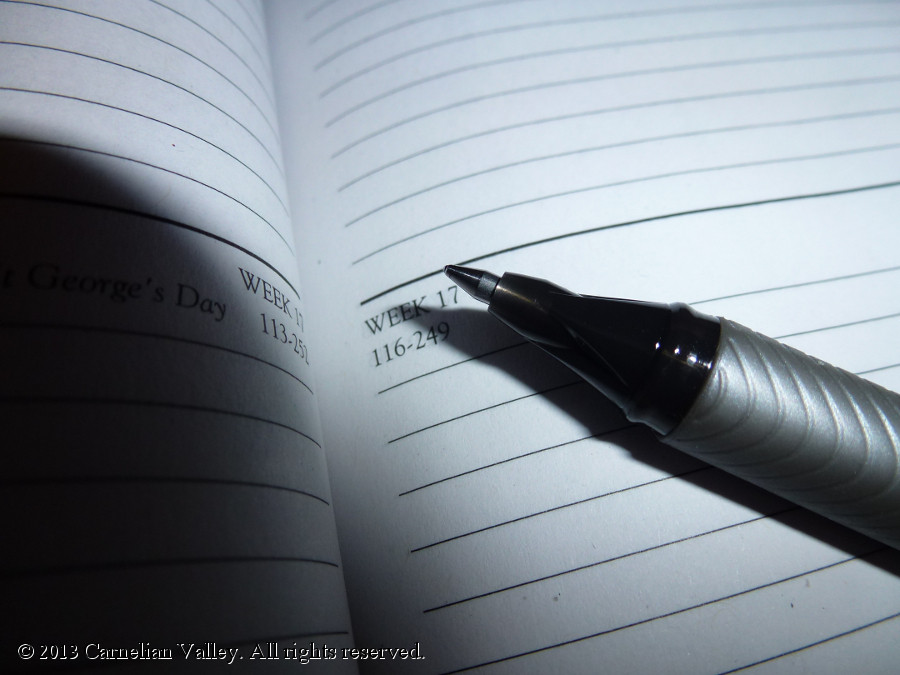
I’ve been using my calendar for five months now, at the time of writing this, and I’ve experienced another learning curve.
It’s very easy when you’re working months in advance to loose track of your writing self, your tasks. Back in May, I had planned posts until mid August, which was pretty amazing to me. So when a writing block hit and I was out of ideas, it was easy and understandable to say, ‘well, I’m planned until August, I don’t actually have to write for a while’. The problem is, if you stop writing and looking for ideas you find yourself still saying you’ve lots of time in late July.
I was still writing reviews; after six years I’ve got a loose plan in place for those – what I like to concentrate on – and it’s much easier to write up something when the ideas are right there, but I was low on all other types of posts. I remembered the importance of a writing schedule – or, in my case, the set block of time for writing a few posts every few days. And the importance of making time to find ideas – if you can schedule that in, as much as it sounds like scheduling day-dreaming time it’s a good thing.
So a break is good but you can’t let a calendar have you thinking you’ve loads of time.
Do you prefer working ahead or are deadlines your thing?


