




Jessie Greengrass – An Account Of The Decline Of The Great Auk, According To One Who Saw It
Posted 21st November 2016
Category: Reviews Genres: 2010s, Commentary, Domestic, Historical, Science Fiction, Short Story Collections, Spiritual
3 Comments

A long title well worth typing out.
Publisher: John Murray (Hachette)
Pages: 179
Type: Fiction
Age: Adult
ISBN: 978-1-473-61085-9
First Published: 30th July 2015
Date Reviewed: 18th November 2016
Rating: 4.5/5
A sailor/explorer tells the story of a species’ extinction; a child wants to go back in time, further than the years spent in a neglectful home; a visit to the zoo reiterates just how little a girl’s father cares.
An Account Of The Decline Of The Great Auk, According To One Who Saw It is an incredible collection of short stories that share basic themes – some, human intervention, others, choice. Spanning from the medieval period to some decades into the future (2050, to be exact), Greengrass’s book is one of beautiful writing and subtle shocks.
The overall reading experience of this book is one of ‘clicks’, or ‘ah ha!’ moments as we often call them. Light bulbs over heads. Greengrass’s general process, the ‘subtle shocks’ referred to, means that after a few stories have been completed you get into the habit of looking closely at the narrative to see what the nub of it all is; even the few unassuming tales in this book have at least a small moment behind them. Sometimes you get answers, a more or less bluntly-spoken meaning. Other times you have to piece it together yourself. The storytelling means that there is always something there to keep you reading; even at those times it seems the story is lengthy (in relative terms) you know that there’s a reason.
And these shocks, these points, that Greengrass includes… they could never be called brilliant, exactly, because they tend to be harrowing, but they do lean towards the exceptional in their telling. A few stories tell of cold climates and the harm done to them so you get those tales of extinction in all their violence; the author spares nothing.
To collect the feathers, there were different ways. We could not take the bodies all the way back across the Atlantic because they would spoil. At first we killed the birds and plucked them, and we tossed the corpses off the cliff and they fell into the sea. The birds looked so much smaller without their feathers on. Then we told ourselves this method took too much of our time.
The title story does this best, containing precisely the sort of information you would think it does. A report of how the Great Auks fell into extinction, which echoes the stories of the sailors of 1840; Greengrass writes from the explorer viewpoint but her thoughts of protection, environmentalism, seep out from the text. The story is full of human destruction, how in exploring and charting we are inevitably, for all our good intensions, bringing harm to places humans had never previously been and, it could be argued, should still stay away from. Echoes of the future abound – will this happen more in time? Greengrass gets to the point, and yet the story is purposefully vague. And full of excuses of the sort seen constantly – it’s not the humans’/this particular group of people’s fault this happened!
Another standout is On Time Travel, in which a child speaks of her longing for the distant past whilst recounting episodes in her dysfunctional family’s life. Rose-tinted glasses abound as the girl explains the benefits of that past time; the reader sees the flaws but then it doesn’t seem to matter when it’s just a dream. It would spoil the effect to discuss anything further, but it’s enough to say that Greengrass’s ending is surprising and incredibly poignant.
Although I am not able to deviate from the set scripts, I do sometimes alter my voice when I speak to the people who call premium phone lines in the thin hope that I will be able to help them. I do this on the occasions when I am for some reason unable to dissociate my mind from my body to the extent that time can pass over my unhindered. On these occasions, my awareness of my existence within the warehouse as unbearable comes in waves; it throbs in my temples and fills my mouth with the taste of sour milk…
Something that may or may not work in the book’s favour depending on what you think of it is Greengrass’s use of the same basic voice and writing style throughout. It’s an incredibly literary style that harks back to Victorian monologues, first-person narratives – her words are not historic, rather it’s a gentle, flowing style, full of beauty. The potential issue then is not in the style itself but in the constancy of it. Some may enjoy the stability of it as well as the way it can suit a person looking back on their life, using adult language to explain their childhood. Others may not find the maturity of the vocabulary matches the ages or personality of the narrators and that that is problematic. It’s very subjective – Greengrass has a lovely style, but does it fit the book as a whole? In regards to the first-person, on occasion the author defers to third. It appears a choice made in order to tell the story in the most expressive way each time and the switching points of view do not seem out of place.
This book warrants your attention but never demands it. It has a lot to say but it can be wistful, both an escape and a work-out for the mind. If you like the sound of the narration you will most likely find it a wonderful reading experience that is difficult to sum up – the way it can leave you speechless has a real-world impact.
An Account Of The Decline Of The Great Auk, According To One Who Saw It is a very fine collection by a very talented and thoughtful writer. One to savour… and potentially scribble all over.
This book is shortlisted for the 2016 Young Writer Of The Year Award. I’m on the Shadow Judging Panel.
Related Books

S J Watson – Before I Go To Sleep
Posted 18th November 2016
Category: Reviews Genres: 2010s, Domestic, Psychological, Thriller
3 Comments
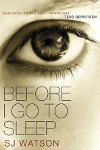
If I should forget before I wake…
Publisher: Black Swan (Random House)
Pages: 356
Type: Fiction
Age: Adult
ISBN: 978-0-552-16413-9
First Published: 28th April 2011
Date Reviewed: 10th November 2016
Rating: 4.5/5
She wakes up in a bed next to a man she does not recognise. The mirror shows a woman much older than she is. It’s been years; Christine discovers she’s had an accident that means every night her memory is erased. She must trust her husband, the man in the bed.
Before I Go To Sleep is a fast-paced psychological thriller that repeats itself intentionally and remains a page turner from start to finish.
Christine is an unreliable narrator of a particular kind – if she could be, she’d be trustworthy. She’s as factually accurate as possible; you have to keep your wits about you. Due to Christine’s role as narrator, and the first-person viewpoint that entails, as the reader you are as in the dark as she is about everything. The only advantage you have is that Watson wants and needs to clue you in more than than he does Christine. The character takes things at face value so whilst it’s fair to say there’s an element of growing together – you and her – your journey is particularly engrossing.
The clue is in the genre; Watson doesn’t provide too many red herrings because he doesn’t need to. The success of this book lies in its ability to make you doubt and dissect everything and indeed you come to form most every possible conclusion out there. There’s a section towards the end where the narrative crawls, almost to a halt, and if you didn’t know otherwise you’d say Watson wrote too much; in actual fact what happens is that, having now exhausted all the possibilities, you’re just waiting to find out which it is.
If you worked it out early, you may be less enthused, though it’s likely you’ll appreciate what Watson has done and the work that went into it. This is perhaps where timing comes in – if you’ve read lots of books that sport the same/similar conclusion you likely won’t feel as compelled. This is the sort of book it pays to mull over after finishing, to look again at what Watson has done, at the editing that must have happened, at the timing, the structure, of it all.
The writing is good. There’s no time for descriptive passages and you wouldn’t remember them anyway. There are plenty of questions posed in the book and all are answered. Only one or two plot points may inspire frowns – situations at the end it would spoil the story to write about – the morality of relatives to patients, that sort of thing, if that makes sense. Are parts convenient? Yes. Does it matter? Not really.
Before I Go To Sleep forces you, at some undisclosed point, to look at a tough subject. Its mainstay is, as Renée Knight said recently, something that works because it’s real and could happen to anyone. It’s scary, it’s shocking, and it’s one heck of a ride.
Related Books

Throwing Books Across The Room
Posted 16th November 2016
Category: Chit-Chat Genres: N/A
10 Comments

Important to note before we begin: I loved the book used in the photograph. I didn’t want to single out a book I’d hated so I chose a less awkward option. Unfortunately trying to get a good photograph of a book in context is difficult to achieve without showing the spine.
Bit of a light-hearted discussion today. I can’t say I’ve ever thrown a book across a room. I know it’s often used as a metaphor but you do see it in action sometimes, if mostly on television or written about in a way that suggests it truly happened. In a way it’s more interesting to discuss because it can be a metaphor. Because it is a physical reaction to a strong emotional reaction.
It’s a reaction related to the times people become exasperated by what they’re reading, a book they aren’t liking for whatever reason – they may well not mind if it gets damaged. This last thing said, it can just be an expression in the moment.
“The only thing worse than hate is indifference.” – Lauren Oliver, Before I Fall. It is better to have that ‘extreme’ reaction than feel apathetic. Throwing a book shows the reader has had a strong reaction; they’ve read the book attentively. They may be taking it to heart.
Does one feel guilt or relief? I know the reason I’d never do it is because I like to keep my books nice. I accept dog-earring happens, grudgingly. (Interestingly, despite the irritation I feel whenever a musician, though especially a non-musician, destroys musical instruments for a music video or so forth, I do not feel an irritation with people throwing books. Maybe it’s because it’s not so extreme. Maybe it’s because a book is far easier, cheaper, to replace. Maybe it’s because there are a plethora – a plethoric plethora? – of books compared to musical instruments in the world.) I can understand the knee-jerk reaction, it’s just not something I’ve real knowledge of.
Ebooks can’t be thrown – are Amazon and Kobo on to something? You can drop a device but if you don’t consider where you are – a sofa or sat against the wall on a hardwood floor? – there will be repercussions.
So I’d like to know whether you’ve ever thrown a book, which book it was, and what it was about it that made you do it? And if you haven’t, would you?
Max Porter – Grief Is The Thing With Feathers
Posted 14th November 2016
Category: Reviews Genres: 2010s, Angst, Commentary, Domestic, Magical Realism, Psychological
5 Comments
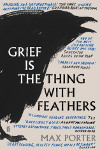
Dealing with sadness (crow).
Publisher: Faber & Faber
Pages: 112
Type: Fiction
Age: Adult
ISBN: 978-0-571-32723-2
First Published: 24th August 2015
Date Reviewed: 9th November 2016
Rating: 4/5
A family in mourning is visited by a crow. Crow brings some havoc with him but he’s also there as Dad gets through the days without his wife – struggling to finish writing his book on Ted Hughes – and as the boys come to terms with life without their mother.
Grief Is The Thing With Feathers is a rather experimental book steeped in literary history. Looking at grief both as a process and in the various guises it takes, it blends prose and poetry together with semi-autobiographical elements – Porter lost his father as a child – to become something very unusual indeed.
There is a lot to this book; it’s difficult to know where to begin. Let’s start with the style: Porter opts to eschew convention, deciding not to choose between poetry, prose, fiction, non-fiction, commentary, study, fully-fledged plot, vignette. His book is the result of a vast mixing pot that is both confusing and compelling. Mind-blowing concepts within the whole compete alongside aspects that are difficult to define. It’s safe to say this book requires a lot of attention.
And a fair bit of knowledge. Whilst the book can just about be read without knowledge of its background subjects, your reading of it will be immensely improved by your having at least a basic idea of the lives and work of those who have influenced Porter. Chief amongst these is the poet Ted Hughes, whose book Crow: From the Life and Songs of the Crow is, not surprisingly, a major factor. Porter’s general interest in Hughes means that any knowledge is useful – and it pays to know about the poet’s relationship with Sylvia Plath.
Porter takes his inspiration for his Crow from Hughes but also from the bird itself. It is the sections written from Crow’s point of view that invite the most bafflement – the sentences are often a mess of words, onomatopoeia-like creations, and a general strangeness pervades. There is the idea of a metaphor – who or what Crow is, and how much he/she/it is related to Hughes’ Crow is a question that spans the entire book. Is this Death? Is this grief itself? Is it, even, Sylvia Plath? And why does Dad see Crow – because it suits Porter or because he’s working on a Hughes commentary?
On the stylistic note, the book uses three narratives – Crow, Dad, and ‘Boys’, the latter of which concerns the two sons but is written from one point of view, potentially to infer that at their young age the boys’ grief could be considered interchangeable, or maybe that their experiences are the same. Sections by the Boys are written in verse and meanings are split over a couple of lines. Much whitespace between narratives as well as lines and sometimes words mean that the book is even shorter than it appears, physically. And in many ways this is a good thing because of the amount of detail and commentary Porter has packed in.
To the stated grief, then; Porter has spared nothing. The book is at its most powerful when it’s examining the forms grief takes and how different people deal with it. Again metaphors and explorations take centre stage, with stereotypes and the idea that one must get over it always lingering nearby.
Take this, the Boys’ reaction to their father calmly coming into their room to tell them their mother has gone:
Where are the fire engines? Where is the
noise and clamour of an event like this?
Where are the strangers going out of their
way to help, screaming, flinging bits of
emergency, glow-in-the-dark equipment
at us to try and settle us and save us?
And this, wherein Dad works through both the metaphorical and literal detritus left in her wake:
She won’t ever use (make-up, turmeric, hairbrush, thesaurus).
She will never finish (Patricia Highsmith novel, peanut butter, lip balm).
And I will never shop for green Virago Classics for her birthday.
I will stop finding her hairs.
I will stop hearing her breathing.
As said, this book requires all your attention. It’s incredibly easy, even with context behind you, to lose your way and it can take work to find yourself again. This is where Porter’s leaving of titbits comes in handy, most noticeably around the middle where comprehension questions, of the English Literature lesson type, are added as part of the narrative.
So Grief Is The Thing With Feathers is hard work but can be very rewarding. But it is also a very unusual beast and fits a specific, niche, category. You have to be happy with the very experimental style.
A difficult book to recommend outright, Porter’s début will intrigue most, delight many, and confuse just as many too and your experience of it won’t necessarily lie in how much you do or don’t know of Porter’s literary interests.
Keep a look out for it, go after it even, and see what you think. It’s quite an experience.
This book is shortlisted for the 2016 Young Writer Of The Year Award. I’m on the Shadow Judging Panel.
Related Books
Andrew McMillan – Physical
Posted 11th November 2016
Category: Reviews Genres: 2010s, Angst, Commentary, LGBT, Romance, Social, Spiritual, Theological
Comments Off on Andrew McMillan – Physical

In all its flaws, in all its beauty.
Publisher: Jonathan Cape (Random House)
Pages: 45
Type: Poetry
Age: Adult
ISBN: 978-0-224-10213-1
First Published: 9th July 2015
Date Reviewed: 1st November 2016
Rating: 4.5/5
Physical is a short collection of poems that’s focused on the male body and sexuality – relationships, encounters, day-to-day life. It uses a specific style to focus attention on a few ideas at any one time. (It is also apparently inspired by poet Thom Gunn – I don’t know enough about his work to comment on this properly; I can only say there is similarity in the themes and the approach to them.)
There are some fantastic passages in this book that have the power to leave you a little stunned in the way of all great poetry (that sort of pause effect this reviewer is coming to love). As it’s short it can be good to read it slowly and it pays to take your time over the lines, to really read into what is being said; McMillan often uses double meanings that are rather clever, a line ending acting also as the start of the next line.
taken allegorically he is beating on himself
until the point at which the inner river of the word grace
runs passed and everything lays down in calm
and walking back across the stream to his possessions
he feels the bruise that is staining his thigh
and he wonders at the strength of one so smooth
One of the stand outs is the very first entry, Jacob With The Angel, which takes a biblical tale, looking at it from both the usual and another angle. It’s a variation full of artistic license and provocation that asks you not to look at the story in another way exactly, but in a way that asks you to consider a potentially different meaning or possibility behind the words. McMillan explains himself outright, saying, “taken literally” then “taken allegorically” – it’s a story exploration of possibilities that makes you admire the thinking behind it.
At the risk of making it seem as though this review only concerns the very first few poems (because an example of style using the third poem follows this paragraph), another stand out is Urination. The whole being just as blunt as its title, this piece looks at discomfort in public situations, childhood memories, having to use the toilet at home when in a relationship. It seems an almost odd choice of subject but McMillan makes it important, stylist choices making it so much more than you’d think it might be. (And to get away from the first poems the multiple-page-spanning-or-is-it middle section of the book is worth reading just for the use of white space.)
In terms of McMillan’s use of pause, white space, to denote meaning and so forth, The Men Are Weeping In The Gym – about power and things that are seen as weaknesses – is one poem that illustrates the method constantly and consistently, so that you can just extract a couple of lines from the rest to show the method in action. For example:
the bicepcurl waiting staring
straight ahead swearing that the wetness
on their cheeks is perspiration
A good use of language, a play on grammar, sentence clauses, and when added to McMillan’s tendency to put words together that aren’t ‘supposed’ to be together but could be – twelveyearold; slowpunctured; shortflightstopover – words that in McMillan’s collection become their own entity, it’s quite something.
Quite something – that’s it in a nutshell. Physical is powerful, stunning, mind-blowing, but not quite perfect – a word which of course has value here because in the context of the collection not being perfect is sometimes the point. The collection repeats itself to interlink, to draw connections between poems, but it also repeats itself literally, subjects that are in reality separate scenes but on the page sound very similar. Is that a problem? The answer is subjective – it really depends on how much you’re enjoying reading about the themes; McMillan’s writing itself never waivers. It’s another reason to take your time.
However you feel, it’s safe to say that McMillan’s book is a valuable addition to the world of poetry. To be taken literally.
This book is shortlisted for the 2016 Young Writer Of The Year Award. I’m on the Shadow Judging Panel.
Related Books
None yet


