





The Young Writer Of The Year Award 2016 Shadow Judges’ Winner
Posted 1st December 2016
Category: Miscellaneous Genres: N/A
Comments Off on The Young Writer Of The Year Award 2016 Shadow Judges’ Winner

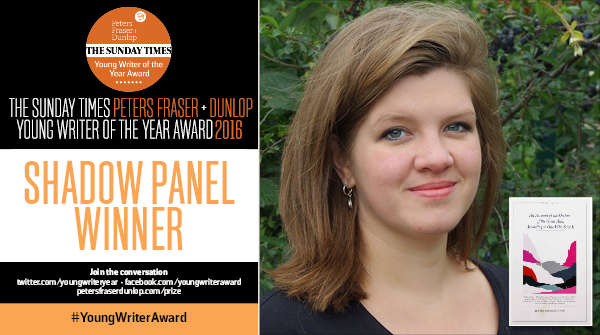
After a couple of hours discussing the four shortlisted books, Eric Karl Anderson, Kim Forrester, Naomi Frisby, Simon Savidge, and I arrived at a winner on Saturday, fuelled by Eric’s fab cake, celebrating Naomi’s birthday. Buzzfeed’s Dan Dalton joined us as chair and kept us on track. It was tough; each of the books is of a high standard, in a similar way. But we got there. Here is our winner:

Jessie Greengrass for her book An Account Of The Decline Of The Great Auk, According To One Who Saw It. There was a lot of talk about the form of the short story in the context of Jessie’s collection. Winter 2058, the title story, and On Time Travel are three of those we all highlighted. We discussed the theme of cold climates that Jessie favours and how well her thoughts corresponded to the backdrop and general situation. We spoke of the writing, how the telling in this book really works.
The official winner will be announced at the award ceremony next week, Thursday 8th December.
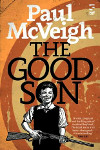
Paul McVeigh – The Good Son
Posted 30th November 2016
Category: Reviews Genres: 2010s, Historical, Political, Social, Spiritual
2 Comments
The Milkybar kid is strong and tough.
Publisher: Salt
Pages: 234
Type: Fiction
Age: Adult
ISBN: 978-1-784-63023-2
First Published: 15th April 2015
Date Reviewed: 29th November 2016
Rating: 3.5/5
Mickey Donnelly lives in Troubled times. Northern Ireland is at war and he can’t go too far from home or he’ll end up on the wrong turf; he has to be careful of the Protestants. Living with the shadow of a new, unwanted, school in front of him he tries to get to grips with girls and with being cool, particularly as the other children believe him to be gay. And there’s always his Da upsetting his Mammy, the parent he loves most.
The Good Son is a book set some time during the 1980s and 90s that looks at the conflict but concentrates on its coming-of-age storyline, blending profound commentary with the ordinary.
It would be quite natural to expect this book to hinge on the conflict but whilst it doesn’t quite do that, there is a fair amount in it that shows how life was, how split the country. McVeigh never shields the reader from the violence and he makes it clear in the way the fighting effects Mickey, physically most often, that he’s going to be blunt. Mickey takes a lot of metaphorical and literal punches, including from his mother. McVeigh also includes raids and the British – English – actions in the conflict, the disturbance of the regular people due to the worry, often founded in truth in the case of this book, that there were weapons and IRA members around.
But McVeigh’s setting acts more as context, as the difficult background information that shows what fuels Mickey’s behaviour. Violent evenings preface run-of-the-mill days in the streets, skipping and playing chase with the neighbours. Neighbours who may be harbouring army members. Just as Mickey’s family could be.
Mickey is ten years old so there are a lot of sudden changes of scene and a lot of talking about things that he doesn’t understand. McVeigh has written the book in the first person in full Belfast dialect; it’s quite unusual especially when joined by everything else and makes the book a little like Marmite – you will likely either love this book or dislike it (‘hate’ is a bit too strong). What’s true across the board is that Mickey comes across clearly, enough that one could speculate some autobiographical elements to his character. And the rendering of a ten year old is perfect in all its minor pomposity and silliness.
The drawbacks to the book rest in the structure, that use of childhood amongst the conflict. It’s that Mickey’s story takes place during one summer and whilst there is an ending the relative shortness of the book means that it’s relatively minor. It’s more ten-year-old character study than story, the voice being superb but the plot – away from the conflict – being pretty average; whether it works for you will rest on how much more you want to hear about the social history rather than the growing up. It’s your evening television series rather than a film destined for the cinema, an apt comparison to make considering the number of then-popular cultural references included (there are enough that one could argue there are too many even if it does show Mickey’s love of television).
The Good Son is good but as is often the case in situations where labels are assigned, there are also not-so-good times. It is best to go in with few expectations so that what works will work very well.
I received this book for review from FMCM Associates.
Related Books
None yet
My Event Report: In Conversation With Elizabeth Fremantle
Posted 28th November 2016
Category: Events Genres: N/A
6 Comments

© Photo:Gerry Walden/gwpics.com 2016
It’s a weird feeling shifting from the role of press to the role of host for an evening. I spent a very good few hours at our latest event but coming home without photos and notes is a strange thing. I’m glad for our photographer and the writer from Southampton University who came to cover the event for us.
Our evening with Elizabeth Fremantle last Thursday was a roaring success. We commandeered the comfy chairs. The majority of seats were taken and more people turned up than we knew were coming; a wonderful surprise.
Elizabeth told us of her journey to publication, her background in fashion writing; her research methods – visit Hardwick Hall! – and all four books which we ended up discussing in reverse chronological order because we got talking about her latest book and it seemed to make more sense to me in that moment than jumping from subject to subject (the books all stand alone but there are links).
This time we recorded it. Fathers who own camcorders are very useful when you discover that your plan to use your DSLR isn’t going to work. You’ll find the video at the end of this post.

© Photo:Gerry Walden/gwpics.com 2016
Many, many thanks to Elizabeth and her friend, Glyn, who also joined us; Rachael from The Edge and Wessex Scene – read her pre-event piece here; and our photographer, Gerry Walden. Having finished it I’m feeling rather odd without promotion to do; I’ve started the planning for January.
Here’s the video, complete with my silly bumbling. I’ve cut the introduction a bit due to microphone issues.
Magda Szubanski – Reckoning
Posted 25th November 2016
Category: Reviews Genres: 2010s, History, LGBT, Memoir, Political, Social
Comments Off on Magda Szubanski – Reckoning

Baa ram ewe.
Publisher: Text Publishing
Pages: 371
Type: Non-Fiction
Age: Adult
ISBN: 978-1-925-24043-6
First Published: 30th September 2013
Date Reviewed: 22nd November 2016
Rating: 4.5/5
British-born, Polish and Scottish rooted, Australian household name Magda Szubanski writes about growing up as the daughter of a man who rebelled against the Nazis – leading him to want the best for his children – finding herself as a comedian after years of academia, working through her sexuality, and the stories of her ancestors.
As the purposefully long heritage-detailed sentence hopefully shows, Reckoning is a book of both Szubanski’s own life, and the life of her Polish relatives living during World War Two. It’s a stunning book that is all the more poignant for the historical information Szubanski includes and it’s a bit of a literary experience to boot.
Szubanski, known best outside Australia for her role as Esme Hoggett in the film Babe as well as Sharon in Kath & Kim, details her life as her family made the move from gloomy Britain to brighter Australia right up until recent professional work. Weather differences, A-grade tennis, convent school. The author sports an open, easy writing style that shows off all her influences. It’s a text full of general cultural and more specific references – films old and new, classical literature – that help to bring clarity to what she says and makes it very readable. Brontë spars with black and white Polish cinema and the book is soaked in philosophical references, the latter in particular owing to Szubanski’s educational choices.
One of the themes is sexuality; in Szubanski’s telling of her life story you see the contention and confusion of a lesbian woman – or, as she puts it, ‘gay gay gay gay gay not gay gay’ – growing up in the 1960s and 1970s, the way Szubanski came to understand her feelings and the changes in society’s views. It’s a constant element that looks right back to childhood and right up to her coming out during which she details what was going on in her head, the confusion, her discomfort and later embrace of terminology. Another theme is Szubanski’s weight, as she talks openly about the way her size has often corresponded to the goings on in her life and also the way she has and is happy with her weight, indeed feels more like herself. Szubanski’s career in comedy lends the book a certain slant; the way the humour is written, opinions conveyed.
The book is also harrowing. One of the most important aspects of it is the look at the German occupation of Poland. Szubanski’s Polish heritage and in particular her father’s life, means that her work is full of information of the sort that is often forgotten.
We arranged to meet up again and I rejoined my family. As we shuffled through the cemetery, something caught my eye. A long line of wonky headstones, uniform and yet misaligned.
‘What does it say? Who are they?’ I asked Uncle Andrzej.
‘Girl scouts,’ he replied. ‘Among the first to be killed by the Nazis. Enemies of the Reich. This is how they frighten people. Killing girl scouts.’
Szubanski’s telling of the occupation and her father’s role in the Polish resistance is hard-hitting and superbly told. She leaves out nothing; there is a lot of shocking violence in this book that puts the spotlight on things that get lost in amongst the publication of the larger scale happenings. The killing of children, the choice to kill or be killed, the constant acting required of young people delivering anti-German information. To see this solely as a memoir of a modern day icon would be a mistake.
‘…a very evil man put this number on me.’
‘Why?’
‘Because he wanted to kill me.’
‘Why?’
‘Because I am a Jew.’
I didn’t really understand what a Jew was. Or why anyone would want to kill such a nice lady. Was she related to the Little Jewish boy Dad was always going on about?
‘I am telling you this, Magda, because it must never happen again.’
I nodded. I felt bad that this had happened to the nice woman. And I agreed it should never happen again. And I remember now – as I looked up, the other women all held out their arms and showed me their numbers.
At least on the face of it, Reckoning is bound to appeal more to Australian readers and those outside Australia who are familiar and interested in its popular culture, but if there’s one memoir you should read this year regardless of whether or not you know the author, it’s this one.
I received this book for review from FMCM Associates.
Related Books
None yet
A Person Who Writes In Books
Posted 23rd November 2016
Category: Chit-Chat Genres: N/A
7 Comments
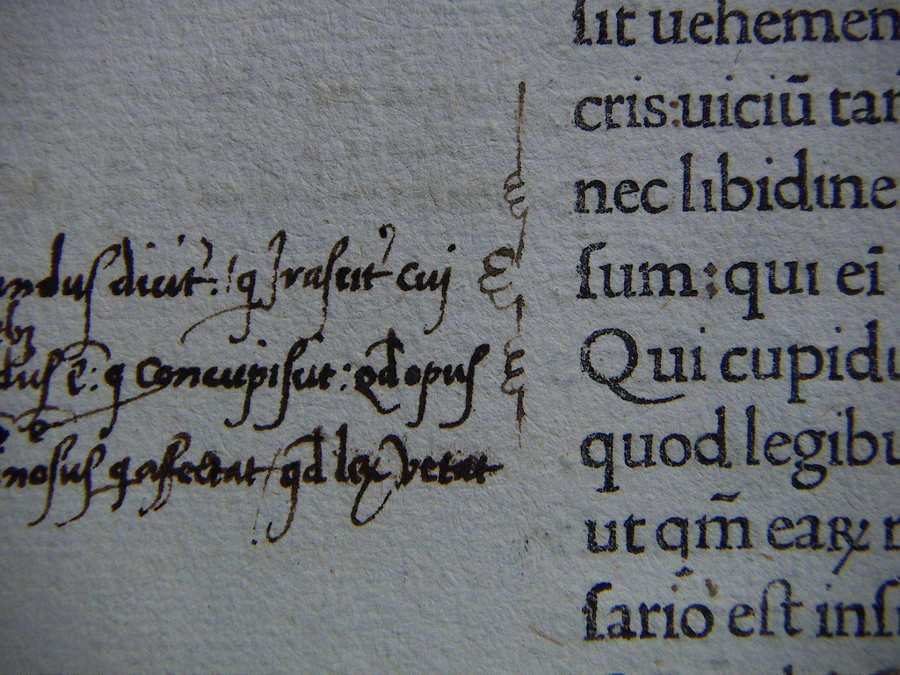
This photo of 1479 marginalia was taken by Philobiblon.
This post is brought to you by a 360 degree reversal in the reading mode of its writer. If you follow me on Twitter you may have seen a tweet I posted a couple of weeks ago about my sudden and compelling urge to write in the book I was reading… by the next day I’d posted another tweet to say I’d gone and done it. I’ve since made notes in two books.
I say ‘sudden compelling urge’ because I have had sudden writing urges before but they’ve never been quite compelling enough for me to actually pick up a pencil – it’s got to be erasable – and change my stance. The strength of it was a bit silly really but then I suppose it was the opposite of how I usually feel.
Others write in books. Many of my classmates at school scrawled all over their poetry books. I did too because I had to but even back then, during the time I wasn’t reading for pleasure, I felt books were… sacred. Not to be sullied. Interestingly I have no problem with other people writing in their books; I believe it’s each to their own, but me and mine? No chance.
The reason I never wanted to was because I’m always worried that a re-read would be dominated by my past thoughts and whilst on the whole that’s no bad thing – interesting, almost, because you’d have definite comparisons there between then and now as opposed to having to remember what you thought – I can be easily distracted, that attention span thing, and I know that when I’ve come across underlined or highlighted text when going through photocopied book extracts while essay planning, I get stuck on those sections that the person before me deemed important. And I always think that while they may be important sections, they might not be in my specific context or – god forbid – I might end up taking a bit more from the source material or friend’s notes than I meant to.
A friend once photocopied a chapter of a book for me that our lecturer had photocopied for her. My friend was effectively presenting me with source material only she had. I felt uncomfortable anyway because I knew that if I used it I’d potentially be writing about things that previously only she could have, but her highlighting had me worried – I didn’t want her own planning to weave its way into mine. Like my reviewing process – read others’ reviews after I’ve written my own – I worried some of her work would creep into mine no matter how much I was aware of the possibility. Once you’ve crossed that border, even if you don’t actually use someone else’s work whether by accident or on purpose… just that worry that you will and the lengths you’ll go to to ensure you don’t can be exhausting and can negatively affect your own work.
Back to writing in books myself – I chose a pencil. I wrote in the whitespace. Emboldened, I progressed to underlining lines, sectioning paragraphs I liked, scribbling everywhere. Once I started I figured I’d write whenever I wanted. In a soft pencil. Very lightly.
Afterwards I was regretful. I’d crossed the line. I could erase the markings but knew it’d be difficult and anyway, it would scuff the pages. This feeling remained for a few hours. The next day, reading a new book, I came to a place where I knew I had to write everything or I wouldn’t be able to continue reading. I did it again.
Here’s the thing – these two books? Two of the shortlisted titles I’m reading as a shadow judge. I suppose it’s different; it certainly feels so. I feel a greater sense of needing to get it right, to remember all my thoughts, to understand the nuances of the texts.
And it’s just easier to have my thoughts – all of them – to hand. I like to make copious notes when reading. I use notebooks, and once I’ve written the review I tend to leave the rest of the notes behind where at some point, when the notebook’s used up, they’ll end up in the shredder. I rarely keep my notes, precisely because I don’t have a place to keep them. I’ve considered a commonplace book but the idea of trying to categorise multi-category notes is daunting. Some books I read are lucky; I store their notes on the computer. Others are lost forever if the thoughts don’t make it into my review, and that’s most of them because if I included them there would be “ah ha!” and “excellent!” and all sorts of other notes and copyright-infringing amounts of text that even I wouldn’t read.
Will I continue? I really don’t know. But I guess under the surface I am a writer in books, or, as I said on Twitter, I’m a Person Who Writes In Books. And I’m not sure if I’ll ever feel comfortable with that but then it’s a lot better than it could be.
I could be using a biro.
Do you write in books?


