




Sue Gee – Trio
Posted 27th May 2016
Category: Reviews Genres: 2010s, Domestic, Historical, LGBT, Music, Spiritual
2 Comments
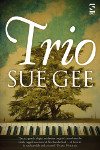
The healing powers of music.
Publisher: Salt
Pages: 308
Type: Fiction
Age: Adult
ISBN: 978-1-784-63061-4
First Published: 16th May 2016
Date Reviewed: 23rd May 2016
Rating: 4/5
Margaret dies early in the marriage; Steven is devastated but knows he must keep going. One day his colleague at school invites him to a concert and though Steven has no knowledge of music he enjoys it, and comes to enjoy the company of his colleague’s childhood friend. His loss will always be with him but in Margot and her music he sees light ahead.
Trio is a book set in the couple of years prior to the Second World War that looks at sadness, tragedy, and the way we deal with it. A beautiful work of literary fiction, it’s full of originality and sports a lovely uniqueness.
And then the gas masks came. In every classroom, throughout the lunch hour, came the struggle to fit the things on, the coughing and heaving at the rubbery smell, the helpless laughter as the trunks were waved about; the trumpeting.
‘Look at you, Hindmarsh!’
‘Look at yourself, Potts. You look prehistoric.’
‘All right, boys, that’s enough.’
Gee’s been writing for years and it shows. Her writing style is rather like a script; the author includes description in the third person but will then switch to dialogue in a way that means you hear a lot more about the situation in a sort of faux first person. Many of the descriptions of thoughts turn out similarly. It won’t be to everyone’s tastes but it is something that everyone is likely to appreciate, at the very least. It’s a literary dialogue, at once between the author and her characters – rendering them in a realistic fashion – and also between the author and the reader, both a breaking of the fourth wall and a hiding behind it. It means that every single character who speaks – every pupil in Steven’s class who gets a mention – stays in mind as though they were all main characters.
Sadness informs most every part of this book. It’s everywhere but Gee never lets it burden the text itself, meaning that whilst this book may be triggering if you’ve recently lost a loved one, it’s not a book you’ll need to avoid for long. But whilst not burdening the text, Gee never covers up, showing how sadness carries on, lingers far longer than our speaking of it shows. In this way she demonstrates how that point wherein society says ‘okay, enough moping now’ shouldn’t be taken as wholly as we often do – everyone suffers losses and it’s okay to refer to it in the future.
There are various tragedies: Steven’s loss of Margaret, a person’s ‘loss’ of the friend they are in love with (twice over in this case), the way a rebuff of affections can lead to awful conclusions. Many of the losses are connected but few are vocalised. Gee uses a bit of mystery in order to explain certain emotions – they aren’t mysteries you need to work out as it’s pretty clear who is who and what is what, it’s that the emotions need to be hidden between the characters because of a feeling of shame or worry that is down to their situation, their relation to one another, and the time in which they are living.
The book is fantastic right up until the last couple of dozen pages. Everything ebbs along and you’re ready for the inevitable start of the war and in seeing where it takes the characters and then suddenly you’re pulled forward to our present day. There is no conclusion to Steven and his friends’ stories, instead you move on to the latter years of Steven and Margot’s son, a person you’d not met. Why this was done is not clear – presumably it was so that we could learn the outcome of everyone’s lives, but this is small compensation; the information could have been provided in an epilogue or, because there’s really only one character you ‘need’ to hear about, communicated naturally at the end.
As for the musical episodes they are mainly good, if a bit overwritten. Steven’s lack of knowledge means that Gee goes into a lot of detail, romanticising the sounds and effects of music; when it’s part of the subtext it’s glorious. The trio of the title don’t quite make the book what it is – that’s Steven’s role – but they play their part; it’s more that they’re the ones through whom people are connected.
Trio is difficult to put down. It’s a gorgeous escape back in time that for all its – needed – sadness, is gripping. The end does come out of left field but the overall product is wonderful.
I received this book for review from the publisher.
Related Books
None yet
Amy Liptrot – The Outrun
Posted 23rd May 2016
Category: Reviews Genres: 2010s, Angst, History, Memoir, Nature, Spiritual
3 Comments

Running to rather than from.
Publisher: Canongate
Pages: 278
Type: Non-Fiction
Age: Adult
ISBN: 978-1-782-11547-2
First Published: 31st December 2015
Date Reviewed: 25th April 2016
Rating: 4/5
Understanding she has become dependent on alcohol and that despite earlier thoughts it’s not making her feel better, rather it’s making her feel worse, Amy Liptrot enrolls at a treatment centre and then decides to move back home to Orkney from London to see if bettering her location can help her recover from her addiction. In moving back she becomes in tune with nature, enjoying all the things she’d left, helping her father on the farm, taking long coastal walks, and helping the RSPB in their research.
The Outrun is part memoir, part nature book, that Liptrot wrote whilst back in Orkney. It’s got a lovely atmosphere to it and it’s full of information both historical and natural, about addiction and the journey to sobriety with all its struggles.
The first thing you notice is that Liptrot can really write. Whilst writing was therapeutic for her in her time of upheaval, in its publication it could be said to have become therapeutic for the reader too. There’s nothing particular about it – one can’t say she uses big or small words or the work is peppered with such and such – it’s more the general feel of it. The book’s written atmosphere is shaped in part by its theme – flocks of birds, windy but beautiful days, talk of old stones and cliffs and everything of the sort the Brontës would have championed, which of course play a big role – as it is by Liptrot’s sheer raw talent. The text ebbs and flows, never gaining a momentum it could lose, and at many points you’d think you were reading an award-winning novel.
This said there’s a great deal of repetition in the book. Writing for herself, it makes sense that there would be rambling and repetition, but as a publication the book could’ve done with being a bit shorter, more linear (it’s very easy to become confused as to where you are in time). The self-absorbed feel to the book is more a case of this repetition than Liptrot’s feelings, or at least it certainly seems that way. (Some self-absorption is of course par for the course.) For this repetition the book can be easy to put down and difficult to resume.
To the subjects, then, and as said, the nature writing is lovely. In many ways this book seems more about the nature and history of Orkney than Liptrot’s addiction which, given what I’ve said about self-absorption, works in its favour, though by no means does the recovery take a back seat. Liptrot is adept at blending her personal life with the nature of Orkney; they become one and the same when she can find a way to speak in metaphors, but equally there are times when it all just seems so natural to blend them together. Liptrot’s focus is on the wildlife of the islands, specifically the birds – there is less on farming than you might expect though she does talk at length about methods and the journey from bog-standard farming to organic. (Any lamb you happen to buy from the north of Britain may well have come from Liptrot’s family farm.)
The hill is studded with craters from when it was used by the Royal Navy for target practice in the Second World War and test shells were fired from ships onto the island. The holes are filled with rainwater in the winter and range from the size of a paddling pool to that of a jacuzzi. It is said that one bomb came further south than intended and just missed a farmer’s wife but killed her cow. After the war, a sailor from one of the launch ships
could not believe their target island had been inhabited.
In focus, too, is astronomy. Perhaps inevitably given the location, Liptrot becomes a connoisseur of the night sky, speaking of stars, the planets, and also cloud formations and the Northern Lights. And then there’s the Neolithic history all over the isles: Skara Brae, a settlement of stone-built homes under the earth to protect from the harsh weather, ancient tombs, standing stones. Tragedies at sea, wherein ships crash against the cliffs, result in their own historic stories and findings. There is so much to this book, something for most people, and because of Liptrot’s determination to make her book as informative as it is personal, you learn a lot.
Lately I’ve noticed a gradual reprogramming. In the past when I was under stress, my first impulse was to drink, to get into the pub or the off-license. A house-moving day years ago once ended a month-long attempt at sobriety. Now, sometimes, I’m not just fighting against these urges but have developed new ones. Even back in the summer, set free after a frustrating day in the RSPB office, my first thought was sometimes not a pint but ‘Get in the sea’. Swimming shakes out my tension and provides refreshment and change. I am finding new priorities and pleasures for my free time. I’ve known this was possible but it takes a while for emotions to catch up with intellect. I am getting stronger.
I wanted to focus on the wider aspects before dealing with the alcohol side of the book. Liptrot details her time as an alcoholic with a fierce openness; she discusses parties and a break-up that haunts her for years, and also an attack, sexual encounters, and other incredibly personal details. There’s a picking apart of right and wrong, missteps, but never any self-pity beyond a few what ifs. This isn’t to say that any other way of speaking is wrong, it isn’t, but Liptrot’s manner means her book may interest people who might not be otherwise interested. The recovery is spoken of in detail, too, so this could be considered both a self-help aid without the negative associations often levied on self-help books, and a book with a wealth of information for those who want to know what it’s like. The book may well aid another’s recovery as well as help a person who knows someone with addiction develop more empathy and an understanding to help them assist and show support.
The Outrun is an impressive work in many ways for many reasons, its beauty slipping out from every crevice. It may lose its way textually at times but never errs in its wonder.
I received this book at the Wellcome Book Prize blogger’s brunch.
Related Books

Mavis Cheek – Dog Days
Posted 20th May 2016
Category: Reviews Genres: 1990s, Chick-Lit, Comedy, Domestic
Comments Off on Mavis Cheek – Dog Days

Separating for the kid.
Publisher: Ipso Books
Pages: 193
Type: Fiction
Age: Adult
ISBN: N/A
First Published: 1990
Date Reviewed: 4th May 2016
Rating: 4/5
Pat is leaving Gordon, buying a new home, getting a dog for her daughter who has said if they must lose Daddy she wants a dog, and starting life afresh. She should have done it years ago – she should have never married him. Love isn’t on the cards; Pat has no intentions of another relationship, she’s just looking forward to being herself again.
Dog Days is at once a light and easy-going story, and an honest look at the breakdown of a marriage, a person’s resurfacing after divorce into the person they used to be. At times very blunt, Cheek’s book is one that delves into things that are difficult to talk about whilst nevertheless remaining breezy. The Times has said ‘Mavis Cheek seems to have cracked the conundrum of how to write decent novels with popular appeal’, and that’s a good way to sum it up.
Rachel gave me my pass through life. She was, anyway, the only reason I was in this situation.
Cheek is open about the problems that can come with having children – whilst it’s obvious to the reader and to Pat herself that Rachel’s birth did not exactly change Gordon (more that it allowed her to see who he was), it was in having Rachel that Pat felt bound to her then boyfriend and so an accidental pregnancy led to her life going quite a different way than planned. Gordon was not the one for Pat – he’s stingy, having plenty of money but never treating his wife nor his daughter, and only cares about himself. He turns on the charm when he wants to manipulate his daughter to get what he wants.
But equally, as much as Cheek is honest about the affect of children and the way a person should think beforehand as to whether they truly do want to be a parent, she is open about how much happiness they can bring. Rachel doesn’t cause Pat to be exuberant, it’s more a case that Rachel’s intelligence continues to baffle her mother, in a good way, and the girl, older than her years it seems to her mother, is a good companion. Whilst Pat would not have stayed with Gordon if it weren’t for Rachel, nevertheless Rachel is obviously a good factor in Pat’s life.
More than children, Cheek just speaks of relationships. When asked by her solicitor, Pat struggles to find a tidy reason for getting a divorce; this is where Cheek’s exploration of resentment and sadness comes in. Pat can’t sum up her reason in a sentence. She can’t say she was abused, or that Gordon cheated, and so begins a long, excellent, section wherein she narrates various episodes in her life that show why she wants to leave her husband. Cheek shows how it isn’t always cut and dried, and that listing reasons doesn’t always work.
Amongst this exploration is some humour. It’s the sort of easy joviality that keeps the pace steady and the pages turning on the occasions when what you’re reading about is quite bleak. A lot of it revolves around Pat’s distaste for dogs and her slow journey towards becoming a dog person:
Eventually, with considerable effort on my part, we selected the weakest and wettest of mongrels in the pound. Rachel wanted the racy little cross between a Jack Russell and a something (a very something), but it had far too many of Gordon’s traits for my liking. Small and wiry with bright snapping eyes; a prominent, urgent profile and – I could sense – totally selfish motives behind its cocky, winning ways. I had lived with one like that for too long in its human form to burden myself with another, albeit four-legged and linked to me in animal slavery. Whereas the wet-looking mongrel had not an ounce of spunk left in it.
Brian, the dog of the title, doesn’t really do much, he’s no Scooby Do or Lassie – the title is more about the time itself, those days. Brian’s the subtle presence, there for Rachel, there for Pat once she thaws a bit towards him, and a menace once or twice when Pat’s too sure he’s the right dull dog for her.
The main thing to bare in mind is Pat’s illogical misunderstanding which spans a good few chapters. There comes a point when Pat mistakes someone for being in a relationship and it gets a bit grating because it’s blatantly obvious that they aren’t and therefore comes across as a lengthening device. Once cleared up, Pat notes it should have occurred to her, but that doesn’t atone for the frustration.
This aside, Dog Days is a funny, half-escapist, half-brutal-with-good-reason read. It’s honest, it’s realistic, and yet its status as an easy page-turning book never wavers.
I received this book for review on behalf of the publisher.
Related Books
None yet
V H Leslie – Bodies Of Water
Posted 16th May 2016
Category: Reviews Genres: 2010s, Historical, LGBT, Paranormal, Science, Social
2 Comments
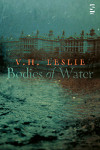
Not just a siren’s call.
Publisher: Salt
Pages: 130
Type: Fiction
Age: Adult
ISBN: 978-1-784-63071-3
First Published: 15th May 2016
Date Reviewed: 3rd May 2016
Rating: 4/5
Following a sad breakup, Kirsten moves into an apartment building situated beside the Thames, which used to be a wing of a Victorian hospital. Drawn by the location, she starts to unpack but is relieved to find she’s not the sole resident of the renovated block. Then there’s Evelyn, rescuer of fallen women in the late 1800s, who has been sent by her father to a hospital for the Water Cure. She’s haunted by the loss in her life of her former lover, a woman she rescued, and hopeful that her stay can help her.
Bodies Of Water is a paranormal, gothic, novella that looks at the way water has had an effect on lives through the decades. It’s a dual plotline work that doesn’t go the way of many others, making it more unique (there are no revelations of connections between the characters).
Leslie has compiled a few concepts and it works very well. The book studies the treatment of women in the Victorian times, contrasting it slightly with the present day. The author works from the diagnosis of hysteria, that Victorian concept of a particularly feminine illness often associated with what we’d now consider the repressed sexuality of women. Leslie never says what caused Evelyn’s hysteria directly – in a way it’s up to the reader to decide – but this works in the book’s favour, allowing for more thought as much as it ushers you to concentrate on the bigger picture. Because whilst Evelyn seems fine, her stay at the hospital speaks of the wider issue.
It’s the basis behind Evelyn’s calling that Leslie wants you to focus on; Evelyn works for the Rescue Society, going out into the streets to aid prostitutes, hoping to save them from the abuse many suffer, from sexually transmitted infections. She likes the idea of bringing the women to a better, higher life, though through the chapters we see her realising that this cannot always happen – in the case of Evelyn’s lover, Milly, for example, Evelyn can’t get away from the fact she’s got Milly a set of rooms but no society to mix in, and that their relationship may be about love on her own side, but Milly may see it as just more of the same.
It’s Milly’s death that gives the study its backbone; Milly is one of many women who have taken their lives, fallen into the Thames, so that whilst Kirsten, who comes to see the paranormal in her leaky ceiling and in the drenched woman on the river bank, is more a bystander, learning about what happened at the scene abstractly, Evelyn’s direct relationship with the river allows a more poignant mode of thought. And as the Victorian character comes to understand the finer details of the hospital and suffers a setback, so her thoughts take quite a shape:
As for lust, it seemed to be the curse of every man. The Rescue Society would have no fallen women to rescue if men could only control what was between their legs. Evelyn had read in her father’s medical journals that hysterectomies and clitoridectomies were often performed to cure women of the very condition Dr Porter had diagnosed Evelyn with. They were so ready with the scalpel, these medical men, to cut and slice, yet no one had thought that castration was the logical solution to venereal disease.
A running point through the book is this plight of women to be heard and to gain freedom; Virginia Woolf’s thought of a room of one’s own is given space, her demise compared to that of the many fallen women ending their lives in the river. There are echoes of Kate Chopin’s The Awakening, too. Kirsten’s introduction to the relative reality of what’s going on is in the form of drawings of bodies being pulled out, doctor’s knives at the ready. Because how else were women to be understood?
Leslie’s study is a good one, just a little short. There is some confusion in the story that would not be there if the plot had been teased out more, given more time between revelations. Everything happens a bit too quickly and questions are left unanswered. In terms of the text there are patches of proofreading errors that are noticeable and add to the confusion on occasion.
But all in all Bodies Of Water is a solid article. It’s well-researched and it puts a different spin on a well-used format. It’s got enough of the history that intrigues many people without treading the same path. Recommended.
I received this book for review from the publisher.
Related Books
None yet
Alex Pheby – Playthings
Posted 9th May 2016
Category: Reviews Genres: 2010s, Historical, Psychological, Social
2 Comments
Nothing is as it seems/everything is as it seems.
Publisher: Galley Beggar Press
Pages: 235
Type: Fiction
Age: Adult
ISBN: 978-1-910-29647-9
First Published: 5th November 2015
Date Reviewed: 22nd April 2016
Rating: 4/5
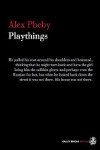
Judge Daniel Paul Schreber can’t find his wife. She’s gone, and the cook doesn’t seem worried enough. On running outside, he sees his daughter returning home; she urges him to go back in, but he doesn’t, and when others find him they say they’ll take him to his Court. When he wakes up he’s in a sanatorium.
Playthings is a fiction book based on part of the life of a 19th to early 20th century German judge, diagnosed with paranoia Schizophrenia, who wrote a memoir in the hope it would allow him to leave the sanatorium he was living in. It’s a rather unique book that gives all its time to Schreber and what was going on in his mind, based on reports and the memoir, and is quite something.
Pheby throws you into the story without explaining anything, which has the effect of leaving you as confused as his character about what is going on. It’s a great beginning that enables the author to demonstrate Schizophrenia without description, without having to say anything about it, the ultimate of the concept of show rather than tell. And it carries on throughout, meaning that on one hand you understand what Schreber is going through – you’re in his head, via third person, after all – whilst simultaneously questioning everything. It’s the unreliable narrative at its extreme.
So you feel for this man from the get go because whilst you may not understand him at his core, you’ve been with him from the start and he is what you know. You sympathise with his confusion. There is seemingly no malice in him and so you’re comfortable in your discomfort and want him to prevail. That’s important to note, I think – you’ll feel at a loss at the start but you gradually get used to it and any hope you may have had that Pheby would give you a clear answer at some point fades away because you just don’t need it.
Unfortunately what the thrown-into-the-story factor also means is that you’ve no context in which to ‘get’ what’s going on. This book is Pheby’s fictional attempt to continue Schreber’s memoir, to give life to the times of illness that Schreber did not write about; the story reads very much as a continuation and so whilst you may be happy with that, you are just as likely to feel you lack the context, history, information, to truly appreciate it. There is information enough about Schreber online, and likely if you’re interested in the book you’ll have a basic idea anyway, but it does mean you can’t expect to pick this book up at random. It requires research in a way fiction often does not.
It’s worth doing your research. Not only does Pheby look deeply into the way mental illness was viewed and treated at the turn of the century, which is reason enough to read it, he looks at Schizophrenia itself meaning that albeit historical, there is a lot to learn about the illness from this book. He looks into the progression, at where Schreber’s Schizophrenia may have begun (there are a few opinions on this; Pheby’s opinion is of events in Schreber’s childhood and he looks to Schreber’s family’s dynamics for evidence, which are of course fictionalised somewhat here but the factual base is there), at how it affects a person, and by the excellently crafted confusion he includes, he shows how reality and fantasy can be mixed up.
In this book repetition is intentional. If you think you’ve already read that line, heard that simile, you have – one of the features of Schreber’s illness is that he will think he is somewhere and then later think he’s there again and so on. There are conflicts in this book that would be called devices in other books and that simply isn’t the case here – here it’s just truth and illness. Schreber goes on for a very long time about his wife, showing us in turn – once we’ve realised how much time has or has not passed – that his perception of time is rudimentary at best. And so yours will be too – are we on a memory of last week or moments ago or are we in the present? You must work it out.
That isn’t to say you have to be perfect at identifying everything; on this note each chapter starts with a sentence or two which details what the chapter is about – this helps you figure out your impression of events but doesn’t cure you of confusion, leaving out enough that you can draw a line between fantasy and reality but not to be let off the hook. Your job as the reader is to be in Schreber’s head. The sentences have the effect of making the book seem a bit theatrical in the literal sense and bring an additional atmosphere to it.
“There are things I do not allow myself to think of.”
There is a lot of tragedy in this book. Schreber’s father had a few accidents and as he had been very strict and into routine for his children – he’s rather akin to The Sound Of Music’s Captain von Trapp – this has a profound effect on the children and the working of the household in general. Schreber’s illness was characterised by the feeling that he must be good for God, and here, in this book, at least, we witness the emergence of one of the factors of this complete willingness to please – Schreber’s belief that God was turning him into a woman. It may not be obvious from the text of the novel, but this was not a transgender issue, rather an anxiety, a paranoia about what God wanted from him. Whilst at first confused, the character later takes comfort in pretending to be his mother, in assuming her role. He comes to believe he needs to be a woman to do what God wants.
Of Schreber’s father’s authoritarian manner of parenting, some people have used the term ‘psychological fascism’ to describe the way Schreber thinks – to describe the thoughts he has that you come to understand are the result of his father’s demeanour. It fits. There is no reasoning in himself; Schreber is his own dictator in many ways.
Of tragedy, and in terms of the above quotation, however, perhaps the most effecting part of the book occurs in the penultimate pages. We see the ultimate reason for Schreber and his wife’s adoption of a child, and of a girl at that, in a time when heirs were boys. You know the basics for a while but Pheby goes right to the heart of the matter, speaking plainly of multiple miscarriages and two stillbirths that caused the couple a lot of pain; in particular we see Schreber’s pain which given his illness is honest and could be considered graphic – not in a dirty way but in the way devastation can cause things that are understandable but are things we don’t like to talk about. If everything else is somewhere on the scale of confusion, then this episode is clear, transparent.
He sees himself shouting like a God to his stillborn children, animating them, but them refusing to move.
Playthings is a fantastic book. It boasts a particular individuality that’s not just in its subject matter but in its handling. It’s well written, clear in its confusion; it’s one you won’t forget any time soon. You do need to do your research, be awake so that you catch every detail, and willing to start and end in the midst of a longer tale, but make time for some preliminary reading and get to reading this book. You’ll know a lot more about many things by the time you’ve finished and there are a variety of reasons to enjoy it.
I received this book at the Wellcome Book Prize blogger’s brunch.
Related Books
None yet


