





Nicholas Royle and David Gledhill – In Camera
Posted 6th May 2016
Category: Reviews Genres: 2010s, Art, Commentary, Historical, Political
Comments Off on Nicholas Royle and David Gledhill – In Camera
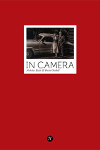
Watched, photographed, painted.
Publisher: Negative Press
Pages: 40
Type: Fiction
Age: Adult
ISBN: 978-0-957-38283-1
First Published: 10th May 2016
Date Reviewed: 23rd April 2016
Rating: 4.5/5
Taken by her father’s instruction that she may hold his camera but never click the shutter, an East German girl living at the time of the Cold War cannot quite ignore her inclination to disobey.
In Camera is a short-story-length historical art book that pairs fiction with oil paintings. Gledhill found a photo album from the time of the Cold War, decided to create oil paintings from it, and asked Royle to compose fiction around his work. It is very much a concept book and a lovely one.
The story is told in a series of vignettes, different episodes in the girl’s life, moving in a linear fashion except for a few times when we move to a more modern time, perhaps this present day, for added context and to tie up the various tales. There is only one name given in this book – the father’s – everyone else is afforded but an initial. This helps to keep each vignette short and nicely presented – most scenes happen in the space of one page and there is a painting to accompany each. It also suits the time period, the initials conforming to the idea of filing, tracking, shorthand, secret synonyms.
It’s all about surveillance in the Cold War, but it’s subtle. This is a book wherein there is a lot packed into a mere handful of pages, much to learn and discover lying under the surface. Again, it suits. The camera at the centre of the story means that the girl is effectively taking records of things that we can assume could be used as evidence; it’s an innocent pastime with an uncanny significance. Spying is the name of the day – presuming the father knows about the photography, which we can expect as she appears young and doesn’t understand that there’s a film inside to show that someone’s been using the camera, he doesn’t so much as mention it – one could say the borrowing is condoned.
Everything layered is rounded off by the simple day-to-day of the girl’s life, her games with her brother and her life as an adult wherein the camera is in full use. We hear about the modern efforts to find out what was noted about people, gaining knowledge – the reader gaining knowledge – from another perspective.
The only thing not in the book’s favour is the size of the prints of the paintings; they are often very small and because of Gledhill’s photographic-like talent, end up looking more like actual photographs than paintings, which makes sense in a way but does negatively impact the point of them. This said, on the size of the paintings the publisher says something worth baring in mind: when it came to designing the book I wanted to make it subversive and circular, for the paintings to appear almost as photographs again, to add to the idea that things are not often as they seem.
In Camera is a wonderfully imagined piece of writing, and size aside, the paintings are lovely. If you like the idea of combining art and literature, you’ll like this book. If you like books with many layers, subtle stories that appear simple but have much more behind them, you’ll like this book. A lot.
I received this book for review from the publisher.
Edited later in the day to add the note about the publisher’s design.
Related Books

Elizabeth Gaskell – Cranford
Posted 27th April 2016
Category: Reviews Genres: 1850s, Comedy, Commentary, Social
5 Comments
No man’s land, gender form.
Publisher: N/A
Pages: N/A
Type: Fiction
Age: Adult
ISBN: N/A
First Published: 1851-1853
Date Reviewed: 8th April 2016
Rating: 3.5/5
Our narrator – whose name we will learn in time (this is no Du Maurier) – takes trips to the town of Cranford periodically and informs us of the goings on. Most of the residents are women – men tend to disappear – and a certain propriety functions. You’ve people like Deborah – faithful to the works of Samuel Johnson – and you’ve the richest woman, Mrs Jamieson, who struggles somewhat to retain feelings of wealth in a town where money never grows on trees.
Cranford is a novella, one of three that looks at the fictional town; it deals with many different subjects. Akin to a long-running soap opera in terms of its lack of action and overall excitement, the book is more an escape and ripe for pleasant Sunday afternoons.
This said there are two ‘sides’ to Cranford. Certainly the surface dressing and the majority of the content is frivolous – we could well imagine people in Gaskell’s time sitting down to the most recent chapter (the work was first published as a serial) but there is a second side akin to Gaskell’s work in North And South. It may take a while for the side – the social commentary – to become apparent but to put it simply, the book includes a small-scale study of poverty. One can assume Gaskell was wanting more contemplation for her readers, in fact one could assume she was wanting to say something without jeopardising their interest – she looks at poverty in general and how other people work to help each other, whilst simultaneously never implying anyone lacks money. Needless to say the book can be read in a variety of ways; Gaskell seems to want you take away what you will.
Away from this there’s little to comment on in depth. The book is all about its humour – every now and then you may laugh out loud but the emphasis is on subtlety. Here, again, Gaskell doesn’t want to alienate her serial readers – the characters are women and that’s great, but we’ll have some fun at the expense of them on occasion. The male characters, likely deliberately, are all good guys, men that can match the women in wit and personality and thus stay in town.
The writing is strictly okay; you can see why, perhaps, Gaskell is not considered on a level with her friends Charlotte Brontë and Charles Dickens, but it does the job.
That this review is so short should clue you in to what you can expect from Cranford – fun, yes, and escapism, but a lot of average moments and a sense of convenience. Reading the book is like watching Neighbours, just without the divorces and deaths. It’s something to read whilst you’re deciding what to read.
Related Books

Sarah Ladipo Manyika – Like A Mule Bringing Ice Cream To The Sun
Posted 30th March 2016
Category: Reviews Genres: 2010s, Books About Books, Spiritual
3 Comments

Slow and steady wins the race, but what if you’ve got a purposefully fast car?
Publisher: Cassava Republic Press
Pages: 178
Type: Fiction
Age: Adult
ISBN: 978-1-911-11504-5
First Published: 1st April 2016
Date Reviewed: 14th March 2015
Rating: 4.5/5
Morayo is a book-loving English Literature Professor. Originally from Nigeria, her life has taken her around the world before she finds her place in San Francisco – she thinks often of returning to Africa but feels it wouldn’t be right. At 75 years old she’s retired and loves spending time reading, darting around in her Porche, visiting friends at their coffee shops, and walking about the city. But recently she’s had letters from the DMV about incidents she thinks are minor, and on the same day she gets another of the letters calling her for a test, she falls over.
Like A Mule Bringing Ice Cream To The Sun is a beautifully written novella about the changes that come with age and the process towards acceptance when things become difficult. It looks mainly at Morayo but her acquaintances and the strangers she meets during the book are also given time.
It’s a lovely work. In a way similar to Emma Healey’s approach towards the later years in Elizabeth Is Missing, Manyika deals with her subject gently but effectively. She presents Morayo as someone who may or may not be losing her memory – you’re in the same boat as the character herself as to whether you know if it’s happening or not – and someone who has yet to realise that perhaps she needs more help. A very independent person, Morayo is confused about the sudden need for a wheelchair, for example, and does not adhere to the idea that her car must be sold, at least she’d like one more ride first. We have more ‘confusion’ to deal with upon meeting characters like Dawud, a man who seems to patronise Morayo, this older woman who will look through his flowers, rarely buying though she ‘was one of those that preferred the organic place down the street’.
To a slightly lesser degree than independence is included a study of Morayo’s sexuality. She may be old but she looks at pleasure with fondness, remembering moments from her life, relationships, and writing about her feelings. Rather than the stereotype of the older angry neighbour rapping on doors, Morayo listens to the rhythmic knocks on the walls with interest. Age and sexuality is viewed neutrally, Manyika simply saying that it happens rather than discussing it, reminding us it’s normal and that sexual pleasure is not confined to the younger years.
Brought into the book by both Morayo’s presence and the inclusion of another character – an African American who visits the care home to see his wife – there is consideration of race, of living as a black person. Morayo muses on the way a person says she looks awesome in her wrappa, in her multi-coloured clothes, and that whilst it’s a nice compliment, she’d just blend into the crowd in Nigeria. Reggie, the man who visits his wife, contemplates his being married to a white woman, thinking – aside from the way she is no longer herself and that he isn’t keen on the way the staff dole her up with cosmetics when she never used so much in her competent days – about the way her children disowned her for marrying a black man. He thinks of the way he had to stop seeing a girl because her father called him a coolie.
In addition to the subjects at hand we have other stories – the story of Sunshine, who Morayo describes as Chinese but seems to be Indian (the lack of confirmation isn’t an oversight), and the conflict between housekeeping and motherhood, and the desire to work. We have the story of Dawud and his sister, Amirah.
It’s a good book. And it’s a good book about good books. Morayo’s love for reading comes into play often and Manyika knows that going into detail is best in this case:
As you will see, I no longer organize my books alphabetically, or arrange them by color of spine, which was what I used to do. Now the books are arranged according to which characters I believe ought to be talking to each other. That’s why Heart of Darkness is next to Le Regard du Roi and Wide Saragossa Sea sits directly above Jane Eyre. The latter used to sit next to each other but then I thought it best to redress the old colonial imbalance and give Rhys the upper hand – upper shelf.
There are several of those moments. There’s a sad one too, one that book lovers will sympathise with, that demonstrates the vast difference between readers and non-readers.
If there’s any downside to the book it’s that it’s perhaps too short; whilst the ending as far as Morayo is concerned is pointedly ambiguous – it suggests something bitter-sweet without confirming it – we don’t find out what happens to the other characters.
Like A Mule Bringing Ice Cream To The Sun is a novella to look out for. The content, the approach to every situation, the writing, make reading it an afternoon very well spent.
I received this book for review from the FMCM Associates.
Related Books


Elizabeth Chadwick – Shields Of Pride
Posted 23rd March 2016
Category: Reviews Genres: 1990s, Angst, Domestic, Historical, Political, Romance, Social
2 Comments

And prejudice.
Publisher: Sphere (Little, Brown)
Pages: 361
Type: Fiction
Age: Adult
ISBN: 978-0-751-54027-7
First Published: 1994; re-printed and edited 2007
Date Reviewed: 7th March 2016
Rating: 3/5
Joscelin’s been a mercenary for years but when he gets in a fight with a man who accuses him of trying to carry off his wife, things start to change. The man, now dead, leaves a widow and child and they will need taking care of. And in the background is the conflict between Joscelin and his half-brothers – Joscelin is the child of his father’s other woman – and the fight between the king and his son.
Shields Of Pride is one of Chadwick’s earlier novels, recently reprinted, that deals with completely fictional characters. It’s a fair book but far outmatched by some of her others.
The history is as strong as always; Chadwick’s knack for throwing the reader back in time is just as good here as elsewhere. The details ensure an almost film-like, immersed quality, and the two main characters are stunning. Particularly Joscelin. Chadwick’s hero is fully medieval. Unlike some of her books wherein the hero is a historical dream, inevitably very similar to her other historical dream heroes, and sometimes a little too modern in sensibility, Joscelin is simply a medieval man. He’ll fight to the death, no holds barred and in anger, then kiss his wife who, similarly unaffected by any misplaced modernity, doesn’t comment on the fight and happily follows him to bed. If it feels like the book lacks any nicety, it’s for good reason.
Not so good is the plot. One could say there isn’t a plot, just a scene, a man who takes to wife the woman whose husband he killed, and their resulting average life together; indeed if that were it it would be fine – and it is for a good chunk of pages. What happens, then, is that the story begins to drag and continues to drag until the end. Unnecessary minor conflicts are conveniently added to, it can only be assumed, lengthen it. (The book would have made a lovely novella.) Fights happen then life happens then fight happens and rinse, repeat; you can see the conflicts coming a mile off. Each battle is meticulously detailed but as you know who is going to win you could skip them if you wanted to. It’s hard to say there’s a climax because the end of the book is a lot weaker than the middle.
Amongst this is the family set-up: Joscelin is the lauded, loved, out-of-wedlock oldest son whose father treats his wife and younger sons badly. The initial introduction works – you’re introduced to the hurt wife who had to live in the footsteps of the other woman (who lived with them) and the official heirs who are constantly criticised because their mother was married out of duty and isn’t loved. The thing here is that these people are rightly angry and it’s well established that they have reason, but as the book carries on they are written more and more as crazy bad guys who are too hateful and as much as one might agree that they shouldn’t blame the messenger for the faults of the sender it all becomes a bit too hubble bubble toil and trouble, and a bit too good versus evil. Add to this the young-skinny-woman and older-large-woman divide and the release date shows.
Where Shields Of Pride works, then, is in the afore-mentioned factual hero and the history. It works as a generally upbeat, escapist read, that doesn’t demand anything of you, but shouldn’t be picked instead of others.
Related Books



Chigozie Obioma – The Fishermen
Posted 9th March 2016
Category: Reviews Genres: 2010s, Commentary, Domestic, Political, Psychological, Social
2 Comments

Taking ‘do as I say’ to the extreme.
Publisher: One (Pushkin Press)
Pages: 293
Type: Fiction
Age: Adult
ISBN: 978-0-957-54885-5
First Published: 11th February 2015 (in translation); 26th February 2015
Date Reviewed: 3rd March 2016
Rating: 3.5/5
Together with his four elder brothers, Ben starts going to the river to fish, secretly, because the town views the previously-worshipped waters with suspicion. The boys are caught by a neighbour, whipped by their father, but the real trouble with creeping out alone is yet to come. One day the madman Abulu, considered religious by some, happens upon the brothers and tells them that one will kill another.
The Fishermen is a book that incorporates folklore, old customs, and 1990s Nigerian social and religious culture into its tale of tragedy. A literary venture, it takes its time on one particular element, bolstered by a background of politics, fundamental Christianity, and the kind of child discipline we now call too much.
Dealing with the writing style first because it’s the first thing to make its mark, Obioma favours a detailed, sometimes overly-wordy, almost studious style that nevertheless has the power to wow on occasion. He likes ‘big’ words, beautiful sentences, and his young narrator, Ben, is just the right side of well-spoken rather than appearing too old for his years. Obioma narrates in a way similar to the spoken narration you often find in Victorian adaptations, films – that slow, wistful narration most common to women. There’s an oral tradition feel to it, poetic, storyteller. It could certainly be called too much – it’s one of those styles you’ll likely either love or hate. Obioma is entirely unapologetic; he wants a well-written book, old fashioned – understandably more 90s than nowadays – and he will have one. (You do have to remember the setting when considering the style, the time and the place.)
It’s not completely well-written but whether that’s down to Obioma or the editing process is hard to say. Certainly the myriad uses of ‘in’ instead of ‘on’, of ‘on’ instead of ‘at’ and so on, are at odds with the rest of the text, suggesting an oversight or perhaps a slight discord between our literature professor and the publisher’s editors. Whatever the reason, the constant misuse is distracting and means keeping your mind on the story is difficult.
There is a disconnect of sorts between Ben and the reader; where Obioma is so focused on the way he writes his tale – the words, the genres, the background – Ben, his brothers and other family are not so detailed. They are detailed – they’re not one-dimensional at all – but there’s no pressing reason, no feeling of the need to care, which is a problem when the story involves a lot of tragedy. And it’s hard to get to grips with the family – the way the father metes out punishment, the mother quick to manipulate and throw her children under the proverbial bus, are perhaps more difficult to read than the author hoped.
Not much goes on in the book – this sounds too ironic to be true so I’ll explain: the book is a series of tragic events with some politics in the background, but not much beyond that. This isn’t a failing in itself, many books are similar, it just means that The Fishermen is more about the sum than the parts. The book is not as interesting to read as it is to contemplate after the fact, when you’re able to put everything together and see that Obioma’s goal has been to provide an overall meaning, a message, even.
Superstition or prophecy? Obioma presents the possibility of both and asks you to form your own conclusion. What was it that made things happen as they did and can and should religious ideas take precedent? Obioma looks at the psychological factors ruling his characters’ choices, the way one thing said by a person considered mad has a knock-on effect. And as much as the characters are Christian, the author shows that mythology and old ways can still creep into life, that we can move on to new ideas but those old ones will remain ingrained for a time.
A note on one of the tragedies – this book deals with under-age crime in a way that may make you uncomfortable. This is actually a reason to read it rather than not because it opens you to the situation and says more by its inclusion than Obioma could say without it – more than he could say just in words. It’s viewed through a similar lens as the rest of the book: it happens, whether it’s right or wrong is irrelevant here.
Overall, then, The Fishermen is a good book, but doesn’t quite keep the promise of the first pages. It does make for some interesting contemplation but the contemplation is fairly short-lived. Take it as a look at 90s Nigeria, its politics and its culture and society and you’ll be best off.
Related Books
None yet


