





Marian Keyes – The Break
Posted 1st June 2018
Category: Reviews Genres: 2010s, Angst, Chick-Lit, Commentary, Domestic, Political, Spiritual
Comments Off on Marian Keyes – The Break
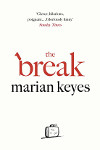
The paperback version of this book was released yesterday.
I can’t get used to living without you by my side… God knows got to make it on my own.
Publisher: Michael Joseph (Penguin)
Pages: 658
Type: Fiction
Age: Adult
ISBN: 978-1-405-91875-6
First Published: 7th September 2017
Date Reviewed: 1st June 2018
Rating: 4/5
Amy has been married to Hugh for years. They have one daughter together, and they have Amy’s daughter from a previous marriage and a niece whose parents have never wanted her. Life isn’t perfect but they do okay and are fairly happy. But since Hugh’s father died, and then his best friend too, Hugh hasn’t been coping and one day he tells Amy that he needs to take a break from their marriage for six months, to go to South East Asia, live it up for a bit, and then return. It’s devastating news, but as her family remind her, it means Amy’s on a break too.
The Break is Keyes’ fifteenth full length novel and a whopper of a book. Standing at just over 650 pages (paperback, in shops as of yesterday) it is a fairly big reading commitment to make, but a heck of a good one.
Strictly speaking, the length of the book is too much – there is a lot of description that could easily have been edited out and parts of the story are drawn out too much – but the quality of the reading experience never waivers. It almost goes without saying after all this time, but Keyes’ is very good at taking a very ordinary situation and getting to the heart of the matter without it feeling so; whilst perhaps not as obviously funny as previous novels, the book sports that same light-hearted, easy reading, atmosphere as always, whilst digging deep into issues.
The first is of course the set up of the book. Devoting a great many pages to the consequences of not only Amy’s life during the break, but also spending a lot of time on the aftermath when Hugh returns, means that Keyes’ can spend a lot of time looking at the problems that outside of fiction we often want to sweep under the carpet for the sake of not looking to sentimental or depressive, bad company. This isn’t new, per se – Keyes’ This Charming Man, for example, dealt with even heavier issues very well several years ago – but the length of the book allows it to progress at a good pace; there will likely come a point where you wonder if the author ought not get to the ending already and whenever that occurs for you you’ll soon realise from the text the good reason. It’s a fair device that doesn’t often work – Keyes’ is a rare expert.
Whilst the main topic of the book is important but not, as said above, as heavy as others, there is an element of the plot that takes the story to a completely different level. Particularly in the context of the very recent Irish vote to repeal the eighth amendment, this book is incredibly timely; and in the context of its release in paperback yesterday, it’s worth picking up for the topic alone. Keyes’ explores the impact of an unwanted pregnancy on a teenager living in Ireland. The author looks at the legalities surrounding the wish for an abortion, the way the medical aspects must be attended to, the threat of prison if pills are discovered when packages enter customs from abroad, and the need and subsequent hassle and trauma of travelling to England for an abortion. Keyes does not hold back – whilst she never refers to herself the views are there prominently – and she puts forth the reality of the situation for women very well. The author also looks at the problems surrounding the public voicing of a pro-choice opinion in Ireland.
The characters are pretty great; there’s quite a lot of diversity and the plot points that arise due to the diversity round the book off well. Characters are well written and presented and a lot of time is given to the family element, where a whole other range of diversities rears its head in the family dynamics.
With such a set-up as a break, the ending of the book was always going to divide opinion, no matter which way it went. This is surely a big part of why Keyes spends so long working towards the conclusion; no matter whether you agree with the way she concludes Amy’s tale, you can at least rest assured that Keyes has provided a fully-fledged reasoning for it that works for the character’s happiness. Following this ending is a short epilogue that moves the action forward several years so that the children’s lives – whilst not the main aspect, they are a constant part of the story – can also be concluded.
The Break is a fun way to spend a chunk of your reading time – it offers an easy read but with ample things to take away, and most importantly it keeps you thinking and considering whilst you’re reading; a very good thing.
I received this book for review.
Related Books
Manu Joseph – Miss Laila, Armed And Dangerous
Posted 16th May 2018
Category: Reviews Genres: 2010s, Commentary, Political, Social, Thriller
Comments Off on Manu Joseph – Miss Laila, Armed And Dangerous
Or is she?
Publisher: Myriad Editions
Pages: 211
Type: Fiction
Age: Adult
ISBN: 978-1-912-40810-8
First Published: 19th September 2017
Date Reviewed: 16th May 2018
Rating: 3.5/5
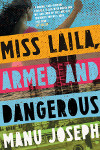
The day Hindu nationalists win the elections, a building collapses; Akhila arrives as teams are trying to find survivors and she offers to crawl through a tunnel to help a man who is still alive. The man is muttering about a person on his way to commit a terror attack. A member of the two groups chasing the man and the girl sat in the passenger seat next to him, Mukundan isn’t sure what they’re doing is right, and is sure there’s a better way of extracting the girl, but his boss bids him to wait.
Miss Laila, Armed And Dangerous is a work of fiction which switches back and forth between a number of narratives as the author seeks to explore social injustice in its various forms.
This is a book that is at once an easy read, an uncomfortable read, and a hard-hitting read that requires your attention. Joseph’s use of satire and general slight humour often lures you into thinking it’s a fun novel. That may be part of the point – Joseph gets his thoughts across through via an easy writing style that’s nevertheless full of report-like phrasing.
Sometimes, the style and structure makes the book hard to follow – Joseph, a journalist away from his novel writing, has chosen to write his book in a similar style, and adds to it many different points of view. As an example, you might think that Akhila Iyer, the medical student and social media prankster who targets people in or close to the political sphere, will be moonlighting as this Miss Laila, and it takes a while for Joseph to get to Miss Laila herself wherein you have to get your head around the fact they are two different people.
Joseph’s major commentary apart from the controversies surrounding Mukundan’s story is the difference between rich and poor, high caste and low caste, Hindu and Muslim, and in the context of politics, and due to the basis of fact underlining the book. There is lots to consider here, with Joseph’s bold dialogue looking at both past and near present, holding nothing back. One person named outright is the author Arundhati Roy, who Joseph speaks of in the context of the female author’s visit to the house of a very wealthy person and her views about how much money this person had compared to those nearby; Joseph takes his Akhila Iyer to Roy’s own apartment building where she conducts an interview with a woman who says similarly of Roy’s house. (Whether this is truth or fiction this reviewer cannot say.)
So, to the narratives, you have the man trapped inside a fallen building. You have the narrative of Akhila Iyer, often told in the chapters focused on Professor Vaid as her own narrative is taken up by the collapsed building; occasionally you hear from Akhila about her family, the mother that was often away helping other people as an activist, leaving her daughter to grow up without her. (A lot of Joseph’s commentary is about activism and the way it can simply just switch people’s situations until another wave of activism is required, the once powerful becoming the powerless and then powerful again.) You have the narrative of Mukundan, who tails Laila and Jamal, and the narrative Laila’s sister tells of the days before Laila left with Jamal. And you have the narrative of election winner, Damodarhabi.
A revelation comes towards the end that may lessen the impact of what you’ve read. It’s a good idea going into this book, to consider that the non-linear timeline might expand.
Miss Laila, Armed And Dangerous is a difficult book to make a call on. Some of it is excellent – compelling points, good writing – but it does come across more as an essay or piece of reporting rather than a story or study.
I received this book for review.
Related Books
None yet
Yaa Gyasi – Homegoing
Posted 14th May 2018
Category: Reviews Genres: 2010s, Commentary, Historical, Political, Social, Spiritual
3 Comments
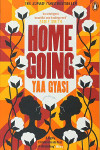
Homegoing was on the British Book Award shortlist for the Debut Book of the Year 2018.
History is not always confined.
Publisher: Penguin
Pages: 298
Type: Fiction
Age: Adult
ISBN: 978-0-241-97523-7
First Published: 7th June 2016
Date Reviewed: 14th May 2018
Rating: 5/5
Effia’s mother tells her to keep the beginning of her menstruation a secret. It’s long been known that Effia would marry the man next in line to be Chief but Baaba has something else in mind and Effia is traded in marriage to the white governor of the Castle. As she moves away with James, Baaba tells her daughter that she is not related to her and that her mother abandoned them. As Effia’s new life begins, her unknown half-sister is taken prisoner, held with hundreds of other women, about to be sold into slavery overseas. The sisters’ situations will reverberate down the ages.
Homegoing is a superb mainly-historical novel that starts in 1700s Ghana and continues into our present century. Spanning many generations, it spends a number of pages on each character in turn, nevertheless retaining the sense that it is a novel of one story.
Gyasi has created something rather remarkable. Within moments she sucks you into the story, her use of history in all contexts – the writing of it, the knowledge included, the bringing to life – starts it off, and then her masterful characterisation ensures you don’t let go. In terms of the history, there’s a fair amount of information that often gets looked over, as well as the horrors that continue.
The writing is wonderfully descriptive and Gyasi creates the perfect balance of narrative and dialogue. It flows very well; indeed the only negative aspect of the book is the use of ‘off of’, the only thing that stunts the flow.
But at its heart, beyond the subject matter that we’ll go on to in a minute, is that characterisation. There are few books in which multiple narratives are considered to be equally fine. Gyasi’s is one of those few. No matter how invested you are in any one story (which read almost as vignettes despite the time they span; there are no complete endings within a character’s chapter, the only closure is in the descendant’s chapter) you never once feel that sense of loss so often caused by other multi-narrative novels. Would it be nice if there was more of each character’s story? Of course. But the novel does not suffer for the lack of it. The progression is natural and easy to follow; Gyasi includes hints early on and you soon get used to the flicking back and forth between bloodlines. If you do fall behind – and you will when it comes to working out which generation you’re on to – there’s a family tree in the opening pages.
As it’s pretty obvious from the start – or at least from the moment you realise how Gyasi has plotted the book – that somewhere it’s highly likely the two bloodlines will meet in some way, it’s pertinent here to say that the book isn’t predictable on that count. This isn’t your usual ‘and magic happened and they found out who each other was’. There is indeed ‘magic’ in the book – to use the phrase that people down the ages start to refer to traditional spirituality as – and yes there is a meeting of the bloodlines, but there are no unbelieveable discoveries.
On the subject of symbolism is Gyasi’s use of fire and water, with fire particularly pronounced because water is more obviously associated with the beginning. It’s a gentle, weaving sort of symbolism, that takes you through the various generations, creating an impact – the history of a people on their descendants – as well as a sort of coming-of-age, cycling, taking back ownership.
Apart from symbolism, Gyasi explores the slave trade, particularly, as said, in terms of the beginnings and early impact in Ghana. She explores the affects of the difference between the Northern and Southern states and the impact of Southern laws on free men of the North. She explores segregation, the concept of passing, and tensions and social and political problems still occurring today. These explorations are interlaced with the chapters so that black history in America as a whole is explored in depth. Again, Gyasi’s writing makes everything flow together, showing how they are both separate subjects and part of a whole, and as with everything else the author does it with aplomb.
Homegoing is the sort of novel that stays with you, that you want to return to. In the second to last chapter, Marjorie is asked by her teacher if she feels the book she is reading inside of her. I think we all know that feeling, the one that makes reading so worth it.
You may well find it in this book.
I received this book for review.
Related Books
Charlotte Smith – Emmeline
Posted 13th April 2018
Category: Reviews Genres: 1780s, Angst, Commentary, Drama, Romance, Social
1 Comment

Previous posts refer to the author as Charlotte Turner Smith. For this review I have left out the middle name, matching the original edition of the book.
How my poor heart aches with every step you take.
Publisher: N/A
Pages: N/A
Type: Fiction
Age: Adult
ISBN: N/A
First Published: 1788
Date Reviewed: 13th April 2018
Rating: 3.5/5
When orphaned Emmeline’s nursemaid dies, she moves away from the castle she called home. Her rich uncle, who has paid for her upkeep but not bothered to visit her, finally arrives with his son, Delamere, who becomes instantly infatuated with her. Angry at this, the uncle and aunt try to keep Emmeline away from him – and Emmeline would be happy if he did stay away – but he follows her in her travels and harasses her for marriage. All Emmeline wants is to return to her castle, perhaps with her new friends, but her choices are not her own.
Despite the fact of Emmeline‘s success when published and the great historical value it presents to us today, in the context of the here and now the things it includes are difficult; whilst what it shows could be said to show further evidence of why society has changed in the way it treats women, the scenes and characters in the book, particularly when added to the stereotypical fainting, literary devices, and padding, make for a book that is difficult to read.
Chief in this is the role a good half of the male characters play; Emmeline’s beauty – her personality is of little consequence to most – creates, at the instant of meeting, an obsession in the minds of many she meets and the vast majority go on to pursue her in earnest. What we would now consider harassment, narcissism, and emotional abuse, are major features of this book, with Emmeline and her friends travelling extensively in their quest to outrun various suitors, an effort which nevertheless fails to endear her to her uncle; it takes a long time for Lord Montreville to see Delamere’s entitlement and childish temper tantrums, which involve hitting his head against walls.
So the problem isn’t so much that it happens, because in fact it shows well the issue of Emmeline being controlled by her uncle; the issue is the way Emmeline’s friends handle it and how Smith – perhaps because her goal is to illustrate a woman’s lack of choice rather than any sort of commentary on how things are reached – often writes without commentary on it, leaving Emmeline to truly fend for herself. The times when the author is blunt, and these do increase about halfway through, make the novel palatable again, with Emmeline granted authorial leave to stop painting and singing for Delamere, things that give him the idea she likes him, that it seems the author has instructed her to do.
‘The regard she was sensible of for Delamere did not make her blind to his faults; and she saw, with pain, that the ungovernable violence of his temper frequently obscured all his good qualities, and gave his character an appearance of ferocity, which offered no very flattering prospect to whosoever should be his wife.’
And, later:
“His love, too ardent perhaps to last, will decline; while the inconveniences of a narrow fortune will encrease [sic]; and I, who shall be the cause of these conveniences, shall also be the victim.”
On the subject of a women’s choice to live how she wishes, comparisons can be made between Smith and Mrs Stafford. Smith’s husband lost them a lot of money and the author ended up living in jail with him for a time before they separated; Mrs Stafford, mother of a few children, spends more time with Emmeline than she does her husband but her life is necessarily entangled with his so that his lack of care for his family and career of gambling away his money means she must go back to him and try and work things out. In life, Smith left her husband, and died ill and with little money. In fiction her friendships enable her to have a happier, healthier, wealthier family despite him. Even Mary Wollstonecraft, who otherwise hated the book, liked Mrs Stafford.
Otherwise, Emmeline fits every stereotype of novels from the period. If a woman does not carry smelling salts she is very much out of luck, for a great deal of fainting and, on some occasions, actual dying, occurs for relatively minor reasons such as the appearance of one’s lover, the realisation that a person isn’t the golden perfect child they were molded to be and, in what is a particularly unsatisfying literary device, the jealousy of one for another who is also obsessed with a lady no longer available.
One unfortunate drawback to the usage of characters from the 1780s with extreme personality traits is that the hero of the book isn’t all that much of a hero. In comparison to others he is a knight in shining armour, and Smith uses him as a device in order to insert poetry that history tells us was more her sort of thing, but he himself can get quite angry on occasion, jealous, and, whilst historically considered the right thing to do, his enforcement of a woman’s estrangement from her lover when few relatives seem to care – including the woman’s husband – means that he doesn’t come across nearly as well as he perhaps should… particularly as Smith resorts to deus ex machina to continually put him in Emmeline’s path… which, given the rest of the novel, effectively becomes a pursuit.
Smith does acknowledge this:
‘…who seemed providentially to have been thrown in her way on purpose to elucidate her history.’
The lead-up to the ending promises a great future for Emmeline but Smith draws out the last few chapters with filler material before tying everything up very quickly in the last few pages. After almost 500 turns, or 500 swipes of the screen, it’s a big disappointment.
Given the way this review darts back and forth between saying that things are bad and then that they make sense and are good, you’d be forgiven for thinking that the reviewer – referring to herself in a fashion she has come to find synonymous with 1700s and 1800s writing – is utterly confused as to the merit of this book. But – and this might be an ‘alas!’ – she is not. Seen entirely in the context of its history, society at the time, and the life of the author, Emmeline is quite a feat. Thus, seen as a subject of study for whichever element it is chosen, it is rather good even if, as its declining fame aptly shows, it’s far from the best. But in terms of the reading experience for escape or pleasure, it is not a good one and the general, public, success of the novel is long gone.
Related Books
None yet
Philip Pullman – La Belle Sauvage
Posted 22nd January 2018
Category: Reviews Genres: 2010s, Adventure, Commentary, Fantasy, Spiritual, Theological
2 Comments

Genesis.
Publisher: David Fickling (Penguin)
Pages: 544
Type: Fiction
Age: Young Adult
ISBN: 978-0-385-60441-3
First Published: 19th October 2017
Date Reviewed: 22nd January 2018
Rating: 3.5/5
The first months of Lyra Belacqua’s life: when not at school, Malcolm works at his parents’ pub, regularly visits the convent across the river, and paddles down the water in his canoe. One evening, the pub is visited by three men who politely decline the invitation to dine in the main room instead of the more private one they chose upon entering. Malcolm overhears snippets of conversation, and over the next few days it starts to come together. Baby. Prophecy. The Magisterium. Meanwhile Dr Hannah Relf is studying the Bodleian Library’s Alethiometer, using it to gain answers to questions that a secret group of people have hired her to find.
La Belle Sauvage is the first book of The Book Of Dust, the decades-awaited follow up trilogy to His Dark Materials. It serves as a prequel. Written in a way that’s similar to the Young Adult tone of the ’90s books but with enough nods to those readers who have since grown up, it’s (likely) accessible to new readers but certainly best read by those who’ve read the originals.
Looking at the book in isolation, it’s mostly solid. The writing is good, there’s some scary content, and whilst the second half is monotonous it remains a page turner. Possibly due to the fact that Pullman long ago established his aim, the use of religious fervour in this book is even stronger than before. Here Pullman constructs a system that mirrors many religious and political methods in history, his League of Saint Alexander creating snitches of children in order to flush out any hints of rebellion and scare people into submission. There’s a lot of background detail provided but it’s in order to further express how awful the rulers are rather than a case of infodump.
Malcolm’s a believable hero if not particularly compelling, and his counterpart – who I won’t name because it takes a while for them to be identified – is a fair match, even better, perhaps, despite having little to do. Hannah Relf is okay. One of the villains is only there to ramp up the horror and disappears with his own sets of unanswered questions. But in more important news, if you’re looking for Lyra, you’ll be disappointed, and this is where the long wait and the present come into conflict – Lyra remains a speechless baby throughout.
Is it a fair book? Yes, but when the set up of Lyra as a resident of Jordan College was established in Northern Lights, enough back story was provided. We know where Lyra’s going to end up so the worries in La Belle Sauvage aren’t of any import. And it’s difficult to say that the horrors in His Dark Materials are not somewhat damaged in impact by this new book – one can’t help but think that the people of Lyra’s world might have been on the look out for the Magisterium’s next move and thus not been quite so shocked by the happenings in the north ten years later.
There’s also the world-building. There’s not much of it – presumably because it’s expected that readers are well-versed in Lyra’s Oxford – but what is included doesn’t ring true. In the course of the book we see Malcolm collecting disposable nappies and baby formula, which is at odds with the old-fashioned steam-punk that defined Lyra’s world before.
In sum, this book, isolated from its literary context, is a good enough read. Even the monotony isn’t enough to hold it back. But in the context of history it’s an average and rather jarring addition that would’ve been better as a short story.
Related Books


