





Charlotte Perkins Gilman – Herland
Posted 26th July 2017
Category: Reviews Genres: 1910s, Commentary, Philosophy, Science Fiction, Social
Comments Off on Charlotte Perkins Gilman – Herland

This is a difficult book to write about!
Publisher: Various
Pages: N/A
Type: Fiction
Age: Adult
ISBN: N/A
First Published: 1915
Date Reviewed: 12th February 2017
Rating: N/A (Historical value is significant but it’s not the best book out there)
Van and his friends are exploring new regions and during their travels they are told of a land bereft of men. Highly intrigued, they make for that country for different reasons. Terry thinks he’ll conquer the ladies, Jeff thinks it all sounds marvellous, and Van is simply interested. It might not turn out as they expect, particularly for Terry.
Herland is a science fiction utopia novella – a sociological text – that looks at what might happen if men were not around. Understandably based around early 20th century American society – and a lot of academia – there is much to recommend it today both in terms of the history of feminism and eternally relevant concepts. There is also a lot to be said for reading it in our modern day where, in our further cultural and scientific progress, some of the concepts are more poignant and relevant than they were in Gilman’s day.
Herland asks many questions under the umbrella subject of womanhood. What is a woman? What is femininity and how much is nature versus nurture? How much should motherhood (back then almost an inevitability) impact upon a woman’s life?
Gilman’s narrator is a man, Van, and he is joined by two others. In the trio, the author makes use of different personalities in order to be able to fully explore her ideas in the context of her fictional world as well as to pull it apart both in favour of it and not so. Van is somewhere on the middle of a scale; he’s critical of both his friends who in turn represent viewpoints at the extremes, one of them loving Herland a lot. Jeff doesn’t take long to align himself with the country, indeed he is presented, once the trio get there, as a major ally of it. Gilman, through narrator Van, questions the wisdom of falling completely for the female-only society, always leaning towards equality for both genders. Jeff takes Herland in his stride and as the novel continues you can see Gilman’s questions – is Jeff’s a complete submission, his almost ‘mummy’s boy’ approach a good one?
Then there’s Terry. Granted, Terry goes through a cycle of changes that’s in favour of Gilman’s ideas – which I’ll get to in a moment – but on the whole in Terry you have a ‘man’s man’ who thinks all the women will love him and submit to him. Gilman wants you to see that both Terry’s and Jeff’s views are problematic – Van, too – to various extents.
Terry’s change, from ‘man’s world’ to a bit more ‘woman’s and man’s world’ is never completed – Gilman does make him more amenable for a time but it’s in her continued decision to not change him completely (she shatters his good progression to major effect) that you can see her thought that equality is best – and in fact Gilman uses him to show the increasing realisation that women can do just as good a job in traditionally male work. It’s a slow development but there is a distinctive span of time between Terry’s reckoning that the female-only country will be ‘savage’ and his statement in which he terms the people ‘highly civilised ladies’.
On the question of what femininity is, there is much. Gilman builds it up, as she does her exploration of ‘people’, speaking of Terry’s description of ‘real women’ (those in his society) and using character development to say the following through Van:
This led me very promptly to the conviction that those ‘feminine charms’ we are so fond of are not feminine at all, but mere reflected masculinity – developed to please us because they had to please us, and in no way essential to the real fulfilment of their great process.
Gilman looks at the differences between Herland women and American women, the way Herland’s are the equivalent of American men. She doesn’t go too far into the idea that Terry, Jeff, and Van should do the housework, too, but the point is made: a woman doesn’t have to conform to societal expectations to be a woman.
Where Gilman looks most critically at her creation is on the subject of motherhood. She uses the real world expectation in her fictional one, taking it to the extreme so that becoming a mother is the absolute be all and end all of life, it’s just that they happen to live full lives otherwise. (She has by this stage built up your imagination of the world enough that you can see the patriarchy and western concept of manhood aligning perfectly with this taken-to-the-extreme concept of motherhood.)
The country revolves around motherhood. It’s the highest, best thing, a woman – a person – can live for; it’s a religion. It’s both a clever criticism of the west and a criticism of itself:
“The only thing they can think of about a man is Fatherhood!” said Terry in high scorn. “Fatherhood! As if a man was always wanting to be a father!”
Motherhood is where the novella meets its biggest present day opposition. The basic history of the land is science fiction – it might even disappoint you because Gilman takes a giant definite leap towards fantasy, away from real world concepts. Herland women started experiencing immaculate conceptions and this reproduction produces only females. The contention today is in the continual effect of that propagation (because it’s now natural) – in order to not become overwhelmed by overpopulation, the highest people in Herland decreed that some women must ‘suppress the urge’ to reproduce and leave it to a select number of chosen women. Some women are so favoured they have more than one child.
The criticism itself comes in where Gilman places what we would now call a cheeky child outside of the circle of those chosen to later be mothers. If you combine this concept with Herland’s success at eradicating disease, illness, harm, it’s not the happiest picture, despite that this eradication of suffering is for the benefit of everyone in the land.
(The interesting thing about the views of children, in general, displayed here is Gilman’s view of how the west treats them: ‘no Herland children ever met the overbearing rudeness we so commonly show to children’.)
So disability and mental illness become suspect, too. Gilman does not speak of it outright – the illnesses she mentions read as cold and flu – but it creates unease, particularly in the context of today. It’s much like the situation surrounding Bertha Mason in Jane Eyre – you have to consider where prejudice as we view it meets what were average societal thoughts back then and come to your own conclusion.
Gilman says little directly about race. Terry calls the people who reside next to Herland ‘savages’ but given his character in general, in the context of the book it’s hard to say that this is Gilman’s view. Gilman’s Herland could be ethnically mixed; again it’s down to the reader. (I will note here that the question of the author’s views on race are answered in the next book. Since I wouldn’t recommend reading the next book I’d propose you read essays about her instead.)
Herland is an enjoyable read on an entertainment level, at least in terms of being entertained by history and barriers being broken, but it’s not something to read to escape daily life. It demands you think – that is it’s very purpose – and it’s a book you’d be hard pressed not to take a thousand notes on. It has its faults, it has its dated aspects, but it is a triumph in terms of progressive thinking. The only thing really amiss is the ending – the book finishes almost mid movement, but there’s a sequel that continues where the flying machine takes off.
Related Books


On Book Haul Posts
Posted 24th July 2017
Category: Chit-Chat Genres: N/A
3 Comments

…Or what I refer to here as Latest Acquisitions posts.
I haven’t written an acquisitions post recently. It isn’t because I’ve not received/bought/borrowed any books – I have had fewer books enter my home but enough to warrant a post. It’s because the knowledge that they are easy posts, and the considerations as to how and when to create them, got me thinking I should write less of them.
That ‘worry’… I’ve been about it in some shape or form for ages, then Holly posted her own thoughts which in turn were inspired by Ariel Bisett’s video. I thought I’d take a leaf from their book and write down the thoughts I’ve kept to myself. Primarily my thoughts concern the ‘why’ of book hauls, but also revolve around the form the posts take.
I create my latest acquisition posts because I like to highlight books I’ve received, knowing it’ll take me a while, sometimes forever, to get to them all. I do it because it gives me a chance to flag up a new release I’m not set to review until after the publishing date. I do it to share my excitement and my reasons for saying ‘yes’ to a request or buying a book. (In the second case – buying – it allows me to share my journey, if there was one, to buying it.) And I like posts that include lots of books.
On a less personal note, book haul posts are easy. Yes, they are easy (generally) for me to write (on occasions when I’ve accepted a book for review not knowing too much about it I feel the lack of good background information) but also easy to read. As much as long posts are great, sometimes people just don’t have the time to read them so a mix of long and short posts hopefully helps mean more time for both. I don’t think it’s a coincidence that short posts see more comments, and it’s entirely understandable. (Reviews are excluded of course – in my experience they are effected, comments wise, by whether or not the blog reader has read the book.)
Two of my considerations are length and time:
- The balance between a short, easy, post, and something of value is something that in the case of hauls I’m still working on.
- Time – how often to post; how many books in each post (which may affect post frequency); how many are too many.
And always lingering at the back of my mind – when dealing with review requests, does this constitute showing off?
I’ve acquired many books since my last haul post but due to pulling back a little on review copies for the time being, I’ve been reviewing them pretty swiftly… which is another thought – I don’t like posting about a new book twice in quick succession unless I’ve lots (and lots) to say about it.
Though I should probably write another acquisitions post soon, leaving out books I’ve since reviewed – that’s another factor. Wait too long and calling a book ‘new’ is no longer true.
The amount I’ve written here… I guess this post has been a long time coming!
What do you think about book hauls and their value?
Contemplating My Favourite Genre(s)
Posted 21st July 2017
Category: Chit-Chat Genres: N/A
4 Comments

I’ve the urge to read some books that have been on my backlist. Specifically I’ve been wanting to read historical fiction of the fantasy variety, mostly time travel and time slip; in the case of the books I’ve had on my shelves, it’s primarily time slip.
I’ve been wanting to do this since I briefly picked up The House On The Strand some time ago. It occurred to me earlier this week as I sat with Susanna Kearsley’s The Shadowy Horses, that I might have been wrong all this time that historical fiction and fantasy fiction are my favourite genres. It’s far simpler – I like both put together.
Historical fantasy is a genre I always feel comfortable with in that particular way of sitting down to read and feeling the need to relax back into the chair and not do anything else for a good few hours. Even if I don’t think the book’s great, as I ultimately found with the Kearsley, the feeling remains. Historical fantasy speaks to my passion for history and my longing to be back in time, the part of me that loves visiting castles and old houses. It’s like coming home.
And I think it’s more like coming home than reading a good classic can be. I’m surprised to find that my joy in reading classics is pipped to the post by historical fantasy.
I don’t mind a romance, but only when it works. Could The Shadowy Horses have done without the romance? I’d say so, yes. Could Nicola Cornick’s The Phantom Tree? Yes. But I think Cornick’s previous, House Of Shadows, would have been a little less without the progression of a relationship.
Historical fantasy is a genre I don’t own many books in. It does take a bit to get it right and where it’s something I don’t read too often (and whenever I do read it I have to stop myself reading too much) I don’t often actively seek new books.
I should. I have only the Du Maurier, that I stopped reading because there were other books I had to read that I knew I’d abandon if I didn’t stop; Kearsley’s Season Of Storms and The Firebird; Barbara Erskine’s Sleeper’s Castle – my current read. Unless there is time travel/slip in a book that I do not know about, that’s my lot. Everything else – not much – has been read.
I think I need to get better at identifying what I like the most and making it more of a priority, both in terms of reading and when at the bookshop/library/when reading requests.
Has your favourite genre changed over the years?
Tove Jansson – Letters From Klara
Posted 19th July 2017
Category: Reviews Genres: 1990s, Short Story Collections, Spiritual, Translation
Comments Off on Tove Jansson – Letters From Klara
To quote Moominland Midwinter: ‘One has to discover everything for oneself. And get over it all alone.’
Publisher: Sort Of Books
Pages: 129
Type: Fiction
Age: Adult
ISBN: 978-1-908-74561-3
First Published: 1991; 1st June 2017 in English
Date Reviewed: 19th July 2017
Rating: 4/5
Original language: Swedish
Original title: Brev Från Klara Och Andra Berättelser (Letters From Klara And Other Stories)
Translated by: Thomas Teal
Letters From Klara is a collection of short stories that are very subtle in their points. The creator of Moomins, Jansson is quoted as saying, “I love the short story concentrated and united around a single idea. There must be nothing unnecessary in it. One must be able to hold the tale enclosed in one’s hand”, and she stays true to form in this collection. What this means is that some of the stories may strike the reader as missing something – Jansson holding on so much to minimalism that it can be difficult to see exactly what she wants to say, but there are others that are profound. Those more average in their storytelling still make for a good read.
There are thirteen stories here and most are confined to a handful of pages. Standouts include the title story, entirely epistolary, in which a person’s first letter (so far as the story is concerned) sets out how someone else should become less critical and then goes on to show that perhaps it’s the letter writer’s own traits, projected; another is The Train Trip, wherein a man who very much admired an old classmate meets him and discovers his admiration pails in comparison; and Party Games in which a group of what we might now call ‘frenemies’ in school meet up again as adults, having changed little. A variety of themes, as subtle, often, as the overall reasons for the stories, rounds it off well – who one is, one’s place in the family (often too burdensome!) and other groups and communities, how one relates to others.
Something not covered in the stories listed above is the oft-used theme of art. An artist herself – in fact Jansson saw the art as more important – a few of the stories look at different types of artist, and the different reasons, ways, and places for drawing and painting. An isolated, prison-like place where a young adult nevertheless cannot escape the idea of home; a classroom of budding artists where one person stands out for seeming to misunderstand the concept of friendship and closeness, later revealed to be part of something else about him.
As a translation the book reads well, in fact it’s difficult to note anything particular about it simply because Teal has done such a good job. He’s kept it steeped in time and place and the tone and word choices, feels very right, an echo of many English-language counterparts, if you will, dialect from a few decades ago and matching the phrasing of an older generation.
This is a book to read at a pace that feels comfortable to you – there’s the feeling that Jansson, whilst of course having a reason to write and a desire for you to know certain things, has left the reading experience itself open to choice.
Letters From Klara shows off Jansson’s ability beyond children’s literature, just as deserving of accolades.
I received this book for review.
Related Books
None yet
Hay Festival 2017: Samanta Schweblin, Hari Kunzri, And Ann Goldstein
Posted 17th July 2017
Category: Events Genres: N/A
1 Comment
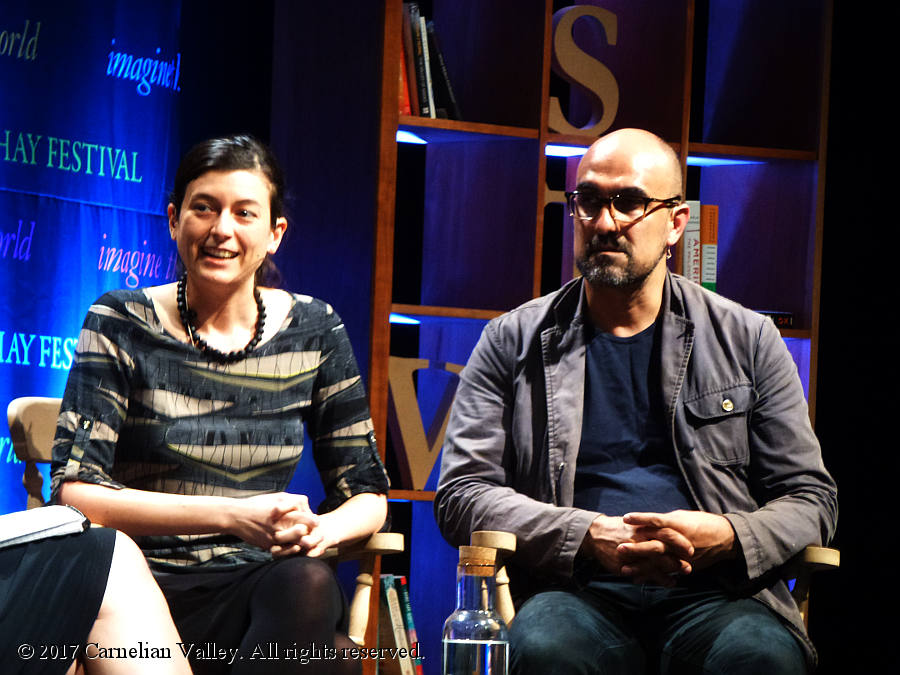
On the afternoon of the first Saturday, Hari Kunzri and Samanta Schweblin, together with a translator for the latter, gathered on stage with Claire Armistead.
I’d read Schweblin’s book but Kunzri was new to me; his book is about collectors and cultural appropriation, quite different to Schweblin’s look at chemical agriculture but perhaps with a similarity in the way both books care about countries.
Schweblin said that the ‘rescue distance’ of her book (which is the Argentinian title of it) was something she invented rather than anything she knew of people doing. (She likes the English title, Fever Dream, but believes it’s disadvantaged by the suggestion that the dream is more prominent than the worries of the mother for her child. Of the ‘dream’, she said, “I think it’s real… it could be a dream… I would like to play with both up to the end of the book, about the ties that bind us”.)
Armistead asked about the worms in the book. “I was playing with the idea of chemicals,” said Schwebin, “because she [the main character] gets poisoned… the point of your fingers start to feel like worms.” She said the physical effects of the chemicals are very real. The author later said that the novel has not changed anything in the country.
Schweblin likes to put words in the reader’s head that aren’t on the page, words one must figure out and that make you want to asked questions. “I feel I’m a short story teller. Tension is so important.”
Kunzri became interested in the idea of the haunting quality of music. Haunting is both a metaphor and not, he said. It’s an experience and you can never forget the distance in time – static, for example. He spoke of the early days of recording when audio was physical – vibrations created discs. His story is partly about how white people used black music. “I’m interested in who gets forgotten and who gets remembered.”

Photo © 2017, Sam J Peat.
There was much for Elena Ferrante’s translator, Ann Goldstein, to talk about with Daniel Hahn. To use a common phrase the stage was a full, if small, house.
Goldstein recently quit her job as a copywriter after 45 years; though it was not stated, one can assume this was in part due to Ferrante’s success overseas. She did not learn Italian until her mid 30s; her speaking skills are not as good as her written skills. She goes to Italy a couple of times a year and is always translating something. The job role itself was an accident; a book had been sent to her newspaper editor and she read the book and liked the idea of working on it. The finished result was published in the New Yorker.
On the subjects of problems when translating Italian to English, Goldstein noted gender; the syntax is more flexible in Italian. Her feeling is that Italian is a musical language and hard to capture. Sometimes English has to fill in, she said, and Italian has suffixes that can change a whole meaning so you have to be careful. You can never find a word that will have all the same nuances, or syllables. You have to decide what is most important. Hahn summed it up: it’s never as simple as changing words for other words, and different people privilege different things.
“If I haven’t read the book [prior to translating]… I’m typing and reading at the same time and that is exciting,” Goldstein said later. The first time round you miss things. When Hahn pointed out, in regards to translation decisions, that a person may have no idea what might happen in later books, Goldstein replied that that is true in her case. She couldn’t get ahead of herself in the story. The later books hadn’t yet been published – in any language – for her to be able to know what would happen.
The translator had to go through editors to get information about Ferrante’s translations. She still does, even now. Hahn noted that Ferrante has said she trusts Goldstein and Goldstein said she had read a translation of one book but not the Neapolitan novels. ‘I thought it was important for [Ferrante] to have a voice, a public voice, in English. So many people liked her books, even if I couldn’t speak for her, I could speak as someone who knew them.’ This is why she goes to festivals.
In the USA, 30% of published books are translations; that hasn’t changed. But that lack of change is good when there are more books being published overall. In the last 15 years, the UK sold 5.5 million books and a very good percentage were translations.


