

Samantha Sotto – A Dream Of Trees
Posted 6th November 2019
Category: Reviews Genres: 2010s, Commentary, Fantasy, Psychological, Social, Spiritual
2 Comments

“A dream is not reality, but who’s to say which is which?” – Lewis Carroll, Through The Looking-Glass (quoted by Sotto).
Publisher: (self published)
Pages: 326
Type: Fiction
Age: Adult
ISBN: 978-1-081-78019-7
First Published: 30th July 2019
Date Reviewed: 4th November 2019
Rating: 5/5
Aiden sits down in his hotel room’s chair and waits to die. Instead, the door opens and a Japanese woman walks in. She tells him she’s here to take him to his ‘rooms’, places he must visit before his soul can pass on. It’s unbelieveable, but he starts to trust her as she tells him to look over to the chair where his double sits; he has left his body. Meanwhile, the lady, Shiori, knows how incredible it all seems – she’s not sure why she is in the position she is and longs for the short periods of time she gets to spend in a greenhouse; rather that than these visits to those who are dying. But for now it is Aiden she has come to see and she must get him through however many doors will exist for him to pass through.
A Dream Of Trees is an exceptional book about what could happen between life and death and how we treat each other when times are hard. Somewhere between fantasy and magical realism, the novel offers an experience you will not easily forget.
This book is stunning. In a move away from time traveling and road trips, for her third novel Sotto has turned to a subject that is very moving and ever relate-able, with threads particularly relevant to our present day, her choices for the various characters and scenes up-to-the-minute. The writing is a delight, word choice and general detailing very effective. There are a number of proof-reading errors but – and this is, to me, all credit to the strength of the book – they don’t matter. Sotto’s story and her message are strong enough that it withstands them.
The novel transcends beliefs in regards to religion and faith. Concerned with the in-between and unfinished business, questions and thoughts aligned with religious ideas feature but are part of the wider spiritual whole, for example at least one person questions whether Shiori is an angel. There is a look at the afterlife in the sense of people waiting for others.
The characterisation is very good but regardless this is more of a theme-led book. The characters’ purpose is to look at questions we have and troubles that occur in our world. Situations such as a person who has suffered from poor treatment from peers, the ripple of impact years later, and the realisation of the perpetrator that what went on affected their victim far more than they thought. So in exploring the life/death moment, the novel revolves around the idea of unfinished business – having or not having it and how that might affect a soul going forward. It covers accidents, murder, and natural causes of death. It covers acceptance, disbelief, and simple incomprehension.
And around it all is the mystery of Shiori, of who she is and why she has such a job of leading souls. The narrative is open to predictions – you’ll likely have your own idea of what or who she is but there are many possibilities and no matter whether or not you were on the right track does not make a difference to your experience; when it comes to the answer it’s a surprise, a powerful one. At the same time there is the diary of days passed without an understanding of what’s going on that adds to the mystery whilst, ironically, adding to your own understanding. Sotto puts our relationships with each other as paramount, showing how important love and forgiveness are.
A Dream Of Trees is… well, it’s hard to say exactly how brilliant this book is; it is a book for everyone. I would pick your moment carefully – this may not (or may in fact be) the right time if you’re in a bad place – but I would most certainly recommend it. It’s an important subject and set of considerations.
Related Books


Speaking to Samantha Sotto about Before Ever After, Love & Gravity, and A Dream Of Trees (spoilers included)
Tune in as Charlie Place and Samantha Sotto discuss characters that join you in your car in the midst of a traffic jam, time travelling with Issac Newton, switching from your fully researched work in progress to a story that needs to be told, and… chickens?
If you’re unable to use the media player above, this page has various other options for listening.
The 2019 Young Writer Of The Year Shortlist
Posted 4th November 2019
Category: Chit-Chat Genres: N/A
1 Comment
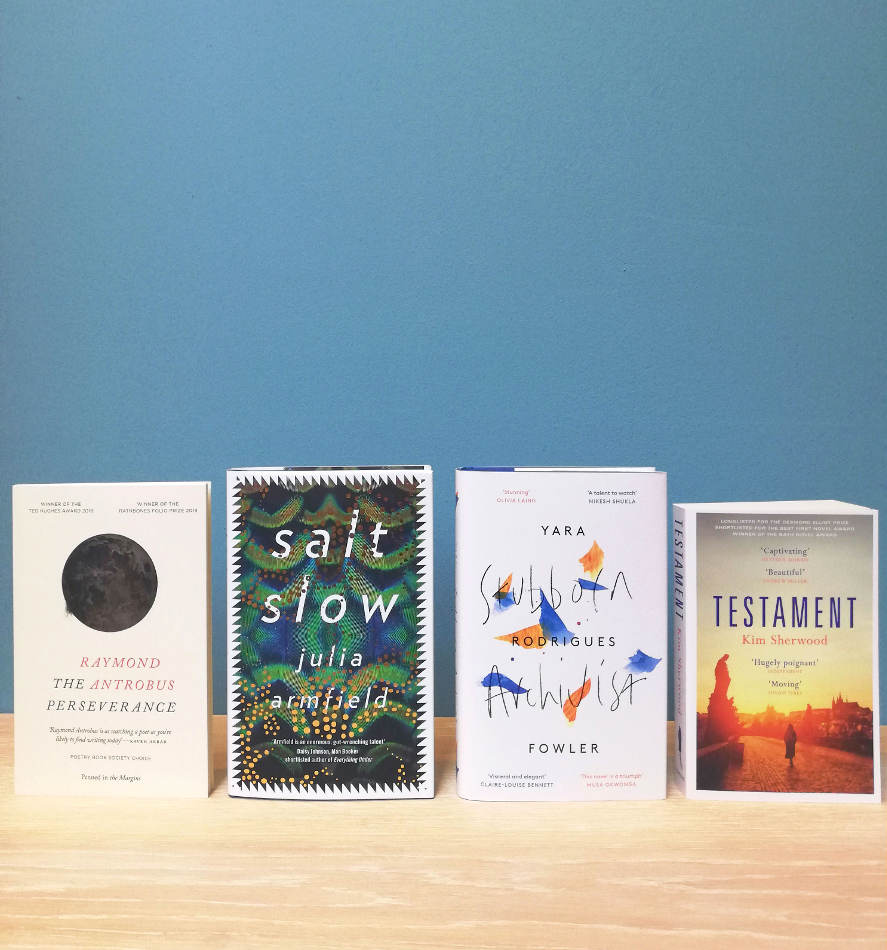
To me, now, it wouldn’t feel like November without this. The shortlist was announced yesterday following a record number of submissions – over 100 books were sent in this year. Awarded to a writer under the age of 35, the prize was won last year by Adam Weymouth for Kings Of The Yukon, a non-fiction narrative. He was joined on the shortlist by Imogen Hermes Gowar, Fiona Mozley, and Laura Freeman. The award was won in 2017 by Sally Rooney, 2016 by Max Porter, and 2015 by Sara Howe.
This year’s authors are Raymond Antrobus for the poetry collection The Perseverance, which won the Rathbones Folio Prize earlier this year; Julia Armfield for short story collection Salt Slow (one of her stories won The White Review Short Story Prize last year); Yara Rodrigues Fowler for the novel Stubborn Archivist, a Desmond Elliott Prize longlister; and Kim Sherwood for the novel Testament which has won the Bath Novel Award. This year’s winner will be announced on 5th December.
Due to the number of submissions this year, there are five judges – alongside The Sunday Times’ Andrew Holgate are Kate Clanchy, Victoria Hislop, Gonzalo C Garcia, and Nick Rennison.
This year’s shadow panel of bloggers are Anne Cater, David Harris, Linda Hill, Clare Reynolds, and Phoebe Williams. Each year’s shadow panel have so far awarded a different author than the one who won officially so it’ll be interesting to see if this year’s group do the same. Perhaps I’m biased – okay, I am – but I do look forward most to the bloggers’ choices.
I’m particularly happy to see Antrobus on the shortlist; whilst I’m yet to read his collection in full I’ve read examples from it and read a fair amount about the poet’s work and background, which I mentioned in the post linked above about his Rathbones Folio win.
Have you read any of the books? What’s your opinion on the shortlist?
October 2019 Reading Round Up
Posted 1st November 2019
Category: Round-Ups Genres: N/A
5 Comments
Breakthrough – I’ve read more this month than I have in a relatively long time. Adding to the month’s list one by one has been an excellent motivation and the fact that there was re-reading to do helped.
All books are works of fiction.
The Books
Jane Austen: Sanditon – When a carriage accident befalls the Parkers, they are taken in by the Heywoods and when better, they return to their seaside resort of Sanditon with the eldest Heywood daughter, Charlotte. I’ve read this twice now and it was just as good the second time, the promise of what could have been both wonderful to read and understandably a little sad as well.
Meike Ziervogel: The Photographer – To Agatha’s dismay, daughter Trude falls in love with a local photographer; when Agatha finds out the couple are listening to an anti-Nazi radio station she sees her chance to save her daughter by going to the police about Albert. A very well-written tale of the German experience of the war and its aftermath.
Naomi Hamill: How To Be A Kosovan Bride – Two young women prepare to marry as Kosovo looks to the future; one will find herself in a traditional marriage, the other, believed to not have been a virgin is returned to her parent’s house but finds freedom in her new status. A stunning look Kosovo post-war, its birth as a new nation, and the mixing of tradition, culture, and outside influences.

Nicola Cornick: House Of Shadows – Receiving a phone call from her frightened niece, Holly leaves home for the holiday house she owns with her brother, and when Ben doesn’t just turn up as everyone says he will, Holly takes up a meeting he had scheduled with an antiques expert who has the mirror that matches Ben’s reputed pearl. A timeslip novel that goes back to the 1600s and 1800s, this book is super – always compelling, well-paced, and just a joy to read.

Orlando Ortega-Medina: Jerusalem Ablaze – A boy sees a homeless man and envy takes him from onlooker to problem; a woman discovers a dead body following a storm and feels a sense of possession over it; a priest in training follows a prostitute to a bedroom not knowing the darkness that lies in front of him. The book is a collection of short stories, dark, sinister, and exquisite.
Samantha Sotto: A Dream Of Trees – As Aiden waits to die he is joined in his hotel room by a stranger, a lady who wants to help him by taking him to his ‘rooms’ in the period between life and death. It’s incredibly hard to sum up this book in one sentence, not least because there is so much mystery involved – it is an incredible and very moving fantasy/magical realism story of souls and unfinished business told with an immense amount of heart.
Sara Ramsey: Heiress Without A Cause – Lady Madeleine is a spinster and, bored of her role in society, has taken to acting in a theatre in a low-class area of London; when Ferguson, the owner of the area in which the theatre stands, recognises her he suggests she pretends to be his mistress to lessen any scandal that would occur if she were found out. The basic premise of this book is good and the characters are fairly well developed but the story is pretty thin which means there’s a lot of manufactured threads, repetition, and overuse of the idea that Ferguson is going to end up like his father.

Virginia Woolf: Mrs Dalloway – On the day it is to happen, Clarissa plans the finishing touches to her dinner party, musing about her life as she goes; the book also looks at the life of her old friend Peter and a couple whose day will make an impression on Clarissa later. I appreciated this but didn’t feel I ‘got’ it. A good book, just not for me.
Of the new books, my favourite was A Dream Of Trees. It’ll be on my best of list for the year, quite possibly along with a re-read or two – I’ll have to see where re-reads fit in the year round up.
November will involve a few more re-reads and potentially the completion of The Secret Commonwealth – I must admit I put it aside after 80-odd pages as this young woman just doesn’t seem like Lyra to me and I’m disappointed with the direction Pullman’s taken with this sequel as it just doesn’t line up with what Lyra was to do when she came back to Oxford at the end of The Amber Spyglass. So we’ll see. If I get to all the other books on my list, I’ll go back to it.
How was your reading October? (And I know a few of you are taking part in R.I.P – how is that going?
On My Present Re-Reading And Discoveries Therein
Posted 30th October 2019
Category: Chit-Chat Genres: N/A
2 Comments

Over the last month I’ve been being doing a fair amount of re-reading. I’ve re-read various books before but never in quick succession as I am now. It’s been a pleasure.
I’ve found re-reading to be quicker than the first read even when reading the book in full, not skipping anything just because you’ve read it before. I think it’s a ‘thing’ anyway, but it’s perhaps been intensified due to my relative generally slower reading speed; I’m re-reading these books faster than I normally would read, which is both obvious and a big motivation, and it doesn’t seem to be necessarily reflective of how I read them – I’m faster whether I’m reading a chapter at a time or spending the whole evening with the book.
It’s definitely true that you notice more when re-reading; it’s a well-known concept applicable to all kinds of things but is nevertheless still surprising when it happens. Without needing to concentrate so much on what’s happening (or on character development in cases where plot is less important) – and even if you often notice ‘small things’ anyway – it’s surprising how much you miss the first time. I’ve found this to be the case no matter whether notes from the previous reading of the book were detailed or not. And if the lifelong interests of academics of an author and/or their work is anything to go by, the more times you re-read the more you pick up. I can’t help but wonder whether there’s a line of sorts for each book (because it couldn’t be applied equally across the board) where to go over it, to re-read more than that number, would finally present nothing new. It’s an interesting thing to consider, partly because I suspect that the answer is that no, there isn’t a line, or that if there is, it would indeed take a great many re-reads. More likely, I think, is the chance that there will always be something new to find, just that the somethings will become less and less interesting, less relevant, and at some point understandably too minor to bother with.
I think it’s also true that you notice more during a re-read regardless of when you first read the book. No matter when it was you, will remember more as you go along, the only difference being the amount you remember, the time it takes you to remember whilst re-reading, and the clarity of your memories.
Reading with hindsight allows you to see more of the writing process. You know where such and such a thread is heading so you can enjoy the journey the author takes to get there, not unlike the way the author must have found it when writing. Likewise, you’re more aware of author context and/or background context in the book.
I found I enjoyed the books even more. And it does help to know in advance that you’ll most definitely enjoy reading it/them, it lessens any tendencies to browse before choosing. Whilst any twists will not be new – you’re not going to get quite the same experience – coming back to a book you loved ensures an easy, happy, read.
What benefits do you find in re-reading?
Meike Ziervogel – The Photographer + Podcast Link
Posted 28th October 2019
Category: Reviews Genres: 2010s, Domestic, Historical, Political
Comments Off on Meike Ziervogel – The Photographer + Podcast Link
Launched today: click here for The Worm Hole Podcast episode 1, with time-slip author Nicola Cornick. If you’d prefer to listen using a mobile app, SoundCloud is available on the Google Play store and the Apple App Store. Finally, if you have social media and would be willing to share the link, that would be awesome, and thank you.
And now for today’s blog post:
The other side of the war.
Publisher: Salt
Pages: 169
Type: Fiction
Age: Adult
ISBN: 978-1-784-63114-7
First Published: 15th May 2017
Date Reviewed: 27th October 2019
Rating: 4/5
Trude meets Albert when she and her friend are out together; Albert is a photographer for hire and Trude suggests he take a photo of her and her friend in exchange for a kiss. Thus begins their relationship. But Trude’s mother, Agatha, isn’t happy about this – Trude has always been a problem – and when she discovers something about the couple that will have an affect on Albert in the Nazi German regime, she makes a decision.
The Photographer is a story of the war in regards to those in Germany who had the chance to (mostly) get away.
In some ways, The Photographer is more of an easy read compared to Ziervogel’s past novellas. In contrast to those books, the narrative is relatively simple. There is less mental energy needed when assessing the characters as a reader. And the book is more generally literary than Magda and Kauthar in particular. However this only accounts for the accessibility of the novella – the issues involved are still just as hard-hitting as ever.
In Agatha’s awful, catastrophic, choice that she doesn’t seem to think through properly – or does she? The German people at the time did not know what we know since – there is a lot to take in and process. History shows us that snitching on someone you knew could have far-reaching consequences beyond that single person; Agatha never considers that the police could have also come for her as a close relative, nor that those she was under the impression her going to the police would protect could have been just as equally impacted as Albert, and so her choices hit you far more than they do her.
For all that happens – and thank god, Agatha, that Albert is lucky – once Agatha’s snitching becomes apparent, there is a relative lack of fallout. This is where reader subjectivity comes into play, strongly – you may find that Trude and Albert’s reactions are fine and appropriate given all contexts, but you may also wonder how Agatha manages not to end up in a very bad position. Both subjective thoughts are equally valid – how valid each one is to you personally depends on your interpretation of the book and what you bring to the novella. It is incredibly interesting that Ziervogel has written it in the way she has and begs a deeper study – if you have the time to read the book more slowly you may well appreciate it more. Certainly there is a lot to be said for both the desired and necessary codependency and the needs for survival between the characters as the book goes on; everyone needs each other, and Ziervogel’s melding of these two states is an interesting aspect of the book, with Trude ready to forgive her mother because she loves her, and Agatha needing her daughter.
Ziervogel’s descriptions and general placement of the characters as a sample of Nazi German people is brilliant. Again hindsight comes into play – you may never get used to the nonchalance displayed, by Trude in particular, but it’s crucial to learn. This is a family of very lucky people in general, with Ziervogel perhaps positioning them as she does in order to look at the country in a way we don’t often look at it – in relative terms the family do well for themselves, they get past the war fairly well, but around them, and in front and behind, is devastation.
So you get to see the regular everyday life – the shopping, the fashion, the going for coffees, the usual life. And you get to see the journey across the country, running from the Allies, who are rarely discussed, again allowing the focus to be on the family. And then the life that comes after. You get a superb feel for how Germany was and a sobering up from the result of displacement and taking refuge.
Albert’s time captive isn’t a main thread of the book but his memories, which he discusses with Trude, show brilliantly the extreme underside of an already-known bad aspect of history. Son Peter’s childhood and growth as a person provides a bit of general relativity as well as instances of the wars’ effects.
The Photographer deals with less-considered aspects of the Second World War in a way that brings both the horror and the living situation to the fore, leaving you with no doubt as to the affects. It is well worth your time.
I have met the author and attended a few of her events.
Related Books