




N K Jemisin – The Hundred Thousand Kingdoms
Posted 7th February 2014
Category: Reviews Genres: 2010s, Domestic, Fantasy, Political, Romance, Social, Spiritual, Theological
8 Comments
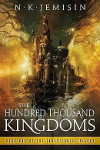
Where Gods walk amongst us.
Publisher: Orbit Books
Pages: 234
Type: Fiction
Age: Adult
ISBN: 978-1-909039-45-2
First Published: 1st January 2010
Date Reviewed: 4th February 2014
Rating: 3/5
Yeine, happily living in Darr, was commanded to ‘return’ to her maternal family’s palace in Sky to become one of three heirs to the kingdom and the world. As she learns what her role is to be, she’s given a proposition by the earth-bound gods that may not save her but will save her homeland.
The Hundred Thousand Kingdoms is a book that sports a different sort of fantasy but is unfortunately rather confusing, static, and badly written.
The world itself, or, rather, the possibilities for it, are wonderful and promising but Jemisin only goes so far in the building of it, and albeit that detailing the palace is understandable (the story is almost exclusively located there) it does make it hard for the reader to really see Yeine’s plight and her reasons for her actions.
The writing is often confusing. There is a constant switch between Yeine’s usual narration and her inner thoughts and torment, and there are times when she looks back at the day just passed in order to tell you something she forgot to tell you earlier. Whilst the style lends the book an individuality and Yeine a distinct voice, it also hints at a lack of planning, or, at least, the look of such. And at the end of the day the look of poor planning has the same result as an actual lack of planning.
The constant ‘switch’ in narration is a pity because it becomes apparent later on in the book that there was a real reason for it. The problem is, of course, that it is too little too late. What could have been an interesting exploration of Yeine’s sense of self is simply left to hindsight. It means that the switch may indeed work for the remainder of the book but that this doesn’t atone for the confusion of what came before.
The book lacks a true focus – is Yeine concerned about the gods, her homeland, or does she simply want to find out the truth of her mother? Yeine’s mother’s life may be intriguing but it is no match, story-wise, for what is happening at that present moment, to what is happening to the world and the gods, and Jemisin’s increasing focus on it moves away from the fantastical possibilities brought forth by the premise. Nor would Yeine’s mother’s life have a true bearing on Yeine in the future as Jemisin’s focus changes once again towards the very end.
Where the book does shine is in the variation of fantasy it employs. This is no high-fantasy travelling-the-world tale of dragons and witches, and whilst those are not bad elements and whilst the book could have spent more time away from the palace, it is good to have this difference. The city of Sky is at once realistic and utterly imagined. In Yeine’s land women rule (even if Yeine is not written convincingly in that way). There is a lot of unnecessary violence and bizarre thoughts but this does fit the genre. The problem is that Jemisin does not provide any reasons for the reader to care about anyone.
The Hundred Thousand Kingdoms had potential but much of that is lost. It’s possible Jemisin may detail more of the world in later books but without having much of an idea about anything beyond the palace already, not least the knowledge of what the hundred thousand kingdoms are, you may decide it’s not worth finding out.
Related Books
None yet
Tom Kizzia – Pilgrim’s Wilderness
Posted 8th November 2013
Category: Reviews Genres: 2010s, Angst, Domestic, Law, Political, Psychological, Social, Theological
2 Comments
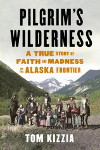
When God is no longer that man in the sky but the father of a family that has no choice but to follow him.
Publisher: Crown Publishing (Random House)
Pages: 296
Type: Non-Fiction
Age: Adult
ISBN: 978-0-307-58782-4
First Published: 16th July 2013
Date Reviewed: 30th October 2013
Rating: 4/5
Tom Kizzia recounts the story of the ‘Pilgrim’ family who appeared at first to be naïve wannabe pioneers in rural Alaska, but later proved to be problematic to the National Park Service, the local residents of McCarthy, and a group of people with a horrific secret.
Pilgrim’s Wilderness is the generally well-paced and well-written tale of a family that was not all what they seemed to be. Including tales of what came before McCarthy, and his own then-present reporting of the Pilgrims for the newspapers, Kizzia creates a strong and shocking story, reminding you that appearances can be deceptive.
Kizzia’s approach to the work is one of the biggest, if not the biggest, recommendations for it. Kizzia’s approach is both biased and highly objective. And whereas a bias can often detract from unpersonal non-fiction, here it is necessarily apt. The actions of Bob Hale (‘Papa Pilgrim’) warrant an incredible and understandable bias against him, and it is to Kizzia’s credit that he, the writer, stays away from slandering. Kizzia could not help but be biased, it would be intolerable any other way, and it is interesting that it may take the reader a while to realise why.
This is because for a long while the issues are all to do with land ownership and the way many dislike governmental take overs of land in the name of preservation. Kizzia is fair here, telling the reader why the Pilgrims had a good claim, and why the National Park Service had a right to feel irritated. He includes the various thoughts of the long-term residents of McCarthy. But the reader who is still on this section, if they haven’t realised where the Pilgrim’s tale is headed, may see Kizzia’s bias as unfair – it will all depend on which side of the debate (parkland or private property) they fall. Kizzia includes, one can assume, the whole debate, but he is bias towards the National Park Service whilst giving the Pilgrims’ opinions plenty of time.
Depending on how much prior information the reader has, it may only be after other details of the Pilgrims’ lives begin trickling into the narrative that Kizzia’s viewpoint can be truly appreciated. Providing all sides and quoting everyone when your story has a darkness to follow is admirable, and for all Papa Pilgrim and others’ thoughts on Kizzia’s reporting, he has strayed from the traditional picture of the entertainment-creating out-for-himself journalist.
Quotations are another element that should be noted. Kizzia’s book is full of the words of others; his sources are identified, his commentary backed up, and his views of people as objective as possible when possible. Crucially, he includes the words of the Pilgrim children, and rather than just telling the reader that they changed, he often writes in a way that almost hands the narrative over to them. It is obvious from the specifics of the writing style that Kizzia went straight to the primary sources whenever he could.
By now it will come as no surprise to say that the darkness in the tale is one of abuse. Whilst Papa Pilgrim based his life and rulings, in his mind, on a literal reading of the Bible, this was a man who acted in every way but the way his God wanted. Kizzia does not gloss over facts.
Referring once more to Kizzia’s style, the author has made a brilliant contrast, showing that whilst the Pilgrims did not live a truly Christian life (at least not so long as their father was controlling them) there are other families of similar appearance who do. When the Pilgrim children finally saw freedom it was in the form of a family who were not so different. The Buckinghams wore (and presumably still wear) the same sorts of clothes, share the same deference to gender roles, put God first, live in a cabin, and promote the virtuous way of life – but they are as different to Papa Pilgrim and his views as chalk and cheese. It is perhaps surprising to hear that the Pilgrim children did not escape their father to be introduced to the mainstream way of life but simply to a positive version of their own, and yet it feels very appropriate. These children were so far from twenty-first century life with its television, video gaming, sexual liberation, and shopping, that there is no saying how they would have faired, but the Buckinghams’ similar (but true) focus on God enabled them to stay true to who they had become. In any other book, the Buckinghams may have been regarded as a worry, given the Pilgrims’ background, but Kizzia shows that just because people do not meet expectations, that they share a visual similarity to problematic cases, it does not mean they are the same.
There are but a few places where Kizzia’s work is brought below masterpiece level. There is a lot of superfluous information in the book, of other people’s pasts and of Alaska, that could have been edited out to keep the pace of the narrative going – especially when those people play only a bit-part. There is a constant switch back and forth between eras of the Pilgrim family’s movements that becomes confusing to follow. And there is the unfortunate story of Kizzia’s wife who died from cancer. Sally’s life is of course important to discuss, but the tale of a law-abiding beloved wife who died of cancer included in the story of a lying, cheating, sexual and domestic abuser who raped his children and had no connection to Sally, is out of place. A memoir would be wonderful.
But, as suggested by this review, the work is, as a whole, an excellent one. Kizzia has given a long-lasting voice (as opposed to disposable daily news) to the children and wife of Bob Hale, as well as a voice to McCarthy. His handling of the subject matter and his approach to it are superb and it is safe to say that this book is one that won’t leave you any time soon.
Pilgrim’s Wilderness suggests reflection, asks for empathy, and relates triumph in the face of adversity. It is a difficult book to read, but it is a story that begs to be heard.
I received this book for review from Crown Publishers.
Related Books
None yet.
Kieran Shields – The Truth Of All Things
Posted 3rd July 2013
Category: Reviews Genres: 2010s, Historical, Mystery, Theological
2 Comments
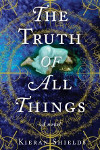
Far more sinister than bubble bubble toil and trouble.
Publisher: Broadway (Random House)
Pages: 401
Type: Fiction
Age: Adult
ISBN: 978-0-307-72029-0
First Published: 2011
Date Reviewed: 2nd July 2013
Rating: 3.5/5
It’s late 1880s Portland, Maine, and a witchcraft fanatic has murdered a prostitute. No one has any idea why and if it weren’t for Grey and his outlandish plans for fingerprint taking and other evidence collecting, it might have been a lot harder to discover. There appears to be a connection to the Salem witch trials, but also to native Indians and a potential link with a pagan group in the town. It’ll be up to Archie Lean, Grey, Lean’s friend Steig and Steig’s niece Helen, to work out what happened and bring the killer to justice.
The Truth Of All Things is a historical mystery based on fanaticism – a nice town setting with some gruesome murders and a narrative that is both plot and character driven. This mixture can keep you reading even during the slow moments.
Shields has created a good cast of characters. It’s obvious from the text that time is to be spent on them as a group in future – whilst the plot may end sufficiently, the situation of the characters is such that even if it wasn’t now the case that a second book is out, the stage is set for a continuation. This doesn’t mean they are particularly developed however, as the bias is towards the plot.
Of particular note is Helen and Shields’s writing of her. Not only is it good to have a woman included in the investigation, Shields makes her role fairly sized and also includes slight social context. Helen is both a product of her time (she doesn’t speak out when the men worry about how she’ll react to bad news) and someone who is pushing for change in that she wants to play her part. This is improved by her status as a mother, albeit that she is a widow and therefore has no one but her uncle to answer to.
Grey’s part is also worth considering as he is partly native Indian. Although he lives in a time where he has some respect, there are occasions where he is discriminated against and, like the crafty detective he is, he uses this to his advantage, lurking in the shadows so that he and Lean get two perspectives of a scene. Indeed whilst it is slight, Shields book provides a commentary of the society in general. It’s there, but it never takes over the story. But nor is it so minute as to not be noticed.
The history (the 1600s Salem witch trials rather than the 1800s setting of the book) is used to good effect. It is of course important to the story itself, yet Shields never allows it to take over here, bringing in other factors to influence the crimes. When reported, however, there is a lot of detail provided. The issue is that sometimes it could be considered info-dumping. It’s far from a major negative, especially as it’s confined to dialogue, but it is noticeable, namely because it slows the dialogue down to a halt. The 1800s history is all that you’d expect from such a setting, that is to say if you like reading about the period at all, you will like Shields’ Portland.
The dialogue can be grating at times. Shields includes a lot of banter between the characters, and much of this happens during odd moments. It also isn’t very successful as it’s based on the characters’ natures which, given that this is a first book of a series and there is a whole thread dedicated to murders, isn’t something that one can appreciate as the characters are not known yet. There is the sense that the reader ought to know them already.
The book picks up pace around the three-quarters mark, gaining momentum and showing off what Shields can do when not bogged down by detailing. He pulls the wool over your eyes to success. You do need to keep your wits about you as most of the minor cast are referred to at this time, all at once.
The Truth Of All Things isn’t bad. It’s a good début and good enough that you might want to check out the next book. But you won’t be waiting impatiently for it.
I received this book for review from Crown Publishers.
Related Books

Anna Belfrage – The Prodigal Son
Posted 28th June 2013
Category: Reviews Genres: 2010s, Domestic, Fantasy, Historical, Political, Romance, Social, Theological
2 Comments
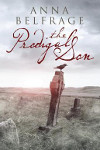
You can definitely have too much of a good thing, and it’s intended that this sentence refers to sex.
Publisher: (self-published)
Pages: 368
Type: Fiction
Age: Adult
ISBN: 978-1-780-88574-2
First Published: 1st June 2013
Date Reviewed: 27th June 2013
Rating: 3/5
Alex and Matthew are back at Hillview but as the family grows and tries to enjoy life, soldiers keep visiting to investigate Matthew’s aiding of Presbyterian ministers. It’s true that Matthew is helping, but he cannot give up his faith and friends, no matter what Alex says. And with his son/nephew Ian spending much of his time at Hillview, issues with Luke might come to a head again.
The Prodigal Son is the third book in the Graham saga, but whereas Like Chaff In The Wind was rather good and suggested that this goodness would only get better, a backwards step has been taken. Whilst both the previous books (A Rip In The Veil was the first) suffered from editing errors, a lot of violence, and a bad use of language, unfortunately here these issues have doubled.
The most obvious of these is the writing. There are many editing errors, but more to the point the language Belfrage uses darts back and forth between an over-the-top Scottish dialect, historical language, some sort of nineteenth-century speech, and 21st century phrasing. Whilst the 21st century phrasing works, because Alex is from our present day – and the phrasing works for the children, too, as children emulate their parents – the rest makes the book disjointed. There is also a continual issue with people being relegated to things by the usage of the word ‘that’ when referring to them, in the particular way that absolutely needs to be ‘who’ in order for the sentence to work. Though the good thing is that there are very few questions ending in ‘no?’ this time around.
Undeniably, considering it forms the book’s basis, the best aspect of the previous books was the time travelling, the scene change between Stuart Scotland and 21st century Britain. There is no time travelling in this book and it is a shame because it was the most compelling aspect of the series. In relation to this there is but one short instance of Alex remembering her fatherless son, Issac, who decided to remain in the 21st century, and despite the fact that Alex doesn’t love Issac as much as she ‘should’, it is hard to accept that she wouldn’t be thinking of him, especially considering she often brings her father, Magnus, into conversations. There is a particular episode in this book that unfortunately underlines just how important to its success it is for Alex to remember Issac, as Alex becomes incredibly emotional towards another of her children. Alex may not have had the best ‘start’ with Issac, may even have resented his existence, but she would remember him from time to time.
The episode that causes intense emotion may divide readers. Just as it seems something very interesting is about to happen Belfrage makes a decision that can only be called convenient.
And it is convenient due to the next point that needs to be made. There is no true plot to this book. It is repetitious from start to finish – soldiers come to interrogate, Alex and Matthew have sex, Alex stops talking to Matthew, over and over again. The final resolution is minor. It’s nice that the story stays on the farm and that the family isn’t apart for any length of time, because the previous books already covered separation, but there is really not much going on apart from what has just been listed. If not for the repetition the state of the plot wouldn’t be so bad because of the character development (to be discussed shortly).
Sex scenes can be a wonderful addition to a book, they can contribute to character development and signify the love the couple shares, but here there are far too many of them. The scenes are all very similar, down to the phrasing. It’s wonderful to know that after nine years Alex and Matthew are still in love and lust but Belfrage infers that perfectly well in the dialogue, having the curtains open every night lessens the impact.
Again there is a lot of violence. In some ways just as extreme as before, in some ways less, but it’s the number of scenes that makes it difficult. Indeed it’s realistic, the law and justice were not at all like they are today, but when blended with the rest of the repetition it just becomes another filler element.
Thankfully the book has great characters, good enough to rise above the dialogue. Naturally, considering the amount of sex and the absence of contraception (and Belfrage does make the necessary point that the couple wants each other so much that timing sex would never happen) there are a lot of children in the book. Each child is very different and flourishes whenever the focus is upon them. And Belfrage continues to develop the historical characters in the manner you would expect considering their exposure to a time traveller. This is where the 21st century language comes into its own, where ‘okay’, Matthew’s understanding of the concept of reality TV, and children saying “so, too!” are brilliant additions. The family is a lot of fun and Ian’s story a fine idea.
Included in this time travelling influence is the strict level of hygiene Alex employs that works well except in times when people with or exposed to consumption are around and the woman doesn’t bat an eyelid. Baths are taken, vegetables are eaten, and people survive what are now easily fixable ailments thanks to her knowledge. And Alex’s education is in full swing here, the knowledge Belfrage referred to before is displayed in its glory.
And it must be said that Belfrage has made good use of the history. That she has researched her book is obvious, anyone familiar with the history will be delighted with the references, and those who aren’t familiar can rest assured that they can believe the information Belfrage gives them.
The Prodigal Son does not keep the promise made at the end of Like Chaff In The Wind, could do with another edit, and its filler-like feel is further cemented by the intriguing premise of the next book (suggested by the last pages). However the character development is good, the history fine, and it is hard not to like the set-up. If you have been enjoying the series you will likely want to read it, though it wouldn’t be too detrimental to skip it in favour of the fourth.
I received this book for review from the author for Historical Fiction Virtual Author Tours.
Related Books
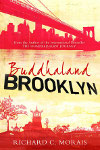
Richard C Morais – Buddhaland Brooklyn
Posted 10th June 2013
Category: Reviews Genres: 2010s, Philosophy, Social, Spiritual, Theological
2 Comments
When worlds collide.
Publisher: Alma Books
Pages: 275
Type: Fiction
Age: Adult
ISBN: 978-1-846-88241-8
First Published: 2012
Date Reviewed: 7th June 2013
Rating: 4/5
Japanese Reverend Oda was sent to the monastery as a child by his parents. The action saves his life and he comes to enjoy living in the temple. But the temple is moving on, modernising, and where there are now western Buddhists there is the requirement for a competent priest to move to America. The temple believes Oda is that person, but Oda feels very differently. And working with and teaching westerners who have not grasped the teachings may prove difficult.
Buddhaland Brookyn is a peaceful book, in its words, about cultural clashes and how they influence the working together of a group of people who must be a team. It demonstrates how, with more thought, people can overcome their differences and work together. Morais offers a poignant character in the person of Oda.
Yet it must be pointed out immediately that Morais’s Buddhism here is not at all the sort you are likely expecting, and this is true no matter how much or how little you know of the religion. Reverend Oda smokes and has sex, eats meat and drinks alcohol, and his fellow priests go shopping on the high street for golfing clothes. It is indeed best that the potential reader knows this beforehand so that they can decide whether or not it would work for them. This is in part because it means that so many of the cultural differences that would ‘usually’ occur in such a situation, are not here. (It should be noted that Morais says, in the acknowledgements, “My novel should in no way be considered a serious religious work…”.)
Yet the absence of the expected Buddhist tenets does allow for Morais to concentrate on the less general areas of conflict that might have occurred. Instead of dealing with, for example, the decadence of his American congregation, Oda must teach them that their faith is a little misplaced (for example believing that prayer helped a company survive). This is where the heart of the book lies, in the transitions that need to be made by the congregation, as well as the understanding Oda must develop of his adopted land.
Oda is at the heart of the book – his change as a person is the most important. This may seem odd considering that it should be the western believers changing in order to be true Buddhists, but Morais made the right choice. As mentioned, Morais’s Oda is a wonderful character, and it’s evident that the writer has spent a lot of time getting him ‘right’. And the flow of the story, the way it has the capacity to draw you in for countless minutes before you realise just how many pages you’ve read, is a very good thing. It ought to be said, however, that this does mean the secondary characters are not as developed and a lot of their inclusion is down to the easily-identifiable stereotypes they provide (Morais is not being prejudice, he uses stereotypes to make the conflicts simple to understand).
The book ends quietly, there is no great statement or revelation. It should be noted that depending on the reader’s feelings about Buddhism, or, more so, religion in general, they might find the compromises made – in light of what happens in reality – disappointing. Yet the book’s story and voice, and the feeling that it could have been a memoir, keep it relevant and engrossing.
This Brooklyn presents a very different Buddhism, but for what it is the book is a success.
I received this book for review from Alma Books.
Edited on 11th June to reflect the information later provided of Morais’s long-time interest in Buddhism.
Related Books
None yet


