

B N Peacock – A Tainted Dawn
Posted 6th February 2013
Category: Reviews Genres: 2010s, Historical, Social
4 Comments
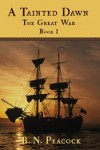
A rocky dawn.
Publisher: Fireship Press
Pages: 339
Type: Fiction
Age: Adult
ISBN: 978-1-61179-212-6
First Published: 2012
Date Reviewed: 5th February 2013
Rating: 0.5/5
Edward’s father is dead and the boy wants respect; when his family scorn him he signs on as a ship-man, finding no respect there either. Jemmy, the fiddler, runs away from home. Louis wants France to be better off. This all takes place around the time of the French Revolution and slavery.
A Tainted Dawn is, unfortunately, for all the history in it, a rather bad book. The writing is poor and the novel is full of spelling and grammatical errors. It would appear that no editing was performed. There is little in the way of plot, the author focusing on characters; this would usually be fine but in this case the story is very confusing due to the writing and it is incredibly difficult to know whether people are coming or going. There is nothing to recommend the characters to the reader and despite the abundance of description in the book, scant time is given to the protagonists’ own.
Peacock uses “big words” when they are not needed. It does infer that the author wanted to create an epic, which is fair, but it does not work. Sentences such as “All three went their separate ways, but all three retained the memory of others”, and phrases such as “Edward perversely inventoried the paintings” are prime examples of the problems with the text.
The issue with all of this, beyond the idea of “big words”, is that it is evident Peacock knows her history well and wants to impart her knowledge to the reader. Evidence comes in the form of info-dumping, where long paragraphs or even pages are taken up by descriptions of people or situations that are not warranted in the book but would be rather useful otherwise. It is no use knowing all about a character you are not going to encounter in more than one scene, for example, yet the historical information provided in the description might be of use to a student. Doubtless Peacock loves all her characters, but that doesn’t mean the reader will accept them similarly without a proper introduction to them, and there is far too much telling (no showing). There are also peculiar descriptions such as “she had skin the colour of chocolate richly laced with cream” for a mulatto (mixed-race) woman.
There are a few occasions where Peacock succeeds and may captivate the reader, unfortunately these are short-lived, being followed by puzzling plot points. There is also too much emphasis on bullying and punishment – though believable in reality, in this book it does not work.
The backdrop is the French Revolution – but there is not nearly enough time given to it, indeed although the characters think about it and live in a changing world they are so removed in other ways that it would be easy enough to allocate them to a completely different era. Instead of worrying about war they worry about their family tree, one even goes so far as to travel to the Caribbean before jumping ship, literally, and going home due to a dream they had about their father being arrested. The connection between the three characters is tenuous at best.
Peacock knows her history and her wish to teach readers is commendable. But it must be said that her teachings are better suited to non-fiction and would likely be rather compelling if presented in that manner. As it is, A Tainted Dawn is confusing, rushed, and includes too many incomprehensible episodes. A naval enthusiast may enjoy the sailing, but it’s likely leisurely readers will not find it smooth.
I received this book for review from Historical Fiction Virtual Author Tours.
Related Books


Susan Cain – Quiet
Posted 4th February 2013
Category: Reviews Genres: 2010s, Science, Social
13 Comments

For too long we’ve been silent about being silent.
Publisher: Broadway (Random House)
Pages: 266
Type: Non-Fiction
Age: Adult
ISBN: 978-0-307-35215-6
First Published: 2012
Date Reviewed: 29th January 2013
Rating: 4.5/5
Cain explores the history of personality and details experiments and social situations to tell her readers why introverts are important and why they’ve been relegated to second-class citizen status.
Quiet is a rather good, often provocative book that seeks to change the way the world works. Drawing on her personal experience and research, Cain has compiled a thorough document that is both an explanation and a manual for change.
The word personality didn’t exist in English until the eighteenth century, and the idea of “having a good personality” was not widespread until the twentieth.
Cain begins by explaining how there hasn’t always been this conscious split in the western culture, between those who are quiet and those who are louder. It is very interesting, however she doesn’t allow the facts of this to be the focus of her book, in other words her aim is not to go back to the days when to be quiet was preferred, rather it is to create a balance in society where both extroverts and introverts are valued equally. The focus is the overall way in which society has come to value the traits of extroverts, for example that teamwork and the insistence that prospective employees have people skills has caused a skew, leaving introverts at a loss, literally, and favouring a sector of society that, Cain says (and uses evidence to back up) accounts for at the most two thirds of the population.
If we assume that quiet and loud people have roughly the same number of good (and bad) ideas, then we should worry if the louder and more forceful people always carry the day.
Cain highlights the fact that introverts are often better off working alone as opposed to in teams, that team-building days and brainstorming sessions can make it appear as if they have nothing to contribute. Indeed one of Cain’s hopes is that society will not be so obsessed in future with open-plan offices. And in case anyone is reading the book and thinking that she is wrong in her suggestions, Cain spends a chapter looking at other cultures (as opposed to the US) and how they value introversion more. She looks at how Chinese Americans function in American schools and the way they feel they must adapt – and, of course, how they feel America is does it wrong sometimes. This is not to say that some white Americans don’t feel this way, but in highlighting an obviously different cultural group Cain is able to enforce her point.
A big part of the book, even if it is only most obvious at the end, is Cain’s wish to impart teaching ideas and methods for parents to better support their children. For example, Cain describes the extreme of extroverted parents who seek medication for their child, not understanding why the child is quiet. She suggests how classrooms could work better and speaks of how school is so important to get right, how teachers should stop including on report cards the wish that a child would speak more. This is an understandable part of the book but due to its focus on children it could be off-putting for the childless reader or simply just a reader looking for something more adult-orientated. It’s true that a great deal of the book looks at adults, but there isn’t the same dedication in those parts as there is this latter section.
However the main area of the book that is an issue is the bias. Although it is obvious that this book will be quite subjective, the way in which Cain pushes for the rights of introverts can be rather strong, even for the introverted reader. Cain does a great job of being balanced and talks of how both personality types are important, but there are occasions where she becomes a bit of a preacher and denigrates extroverts. If this book was targeted only to introverts that wouldn’t be so much of a problem, it would be more of a book for “bigging up” a reader, but as it is plain that the author plans for anyone to find it accessible, these moments of sudden power are not appropriate.
As Americans moved into cities, working with strangers was needed.
The prospective reader may be interested to know that besides the obvious focus on the artistically inclined – the writer who holes themselves up in their study – there is a great deal of time spent on famous figures in technology, science (this beyond those conducting experiments), and politics. Thus the book would appeal to people who look up to the various leaders in computing, and there is time spent documenting the lead up to black freedom.
Quiet is quiet by nature, but the book has its loud moments. It may not always be objective but at least the intentions of the author make understandable, if not quite acceptable. The few quizzes in the book allow those on the fence to find out who they are in the context of the material. It’s true that there is some repetition in the book, phrases and ideas repeated more than a couple of times, but overall the product is a success. The book will appeal to anyone who considers themselves, well, quiet, shunned by their peers and interested in changes. It will also appeal to teachers looking for insight, and also extroverts – as long as the bias doesn’t put them off (this is the reason the bias is such an issue, because this sort of book needs to be accessible to all). Will it change the world? Who knows? But it might just change a life or two.
I received this book for review from Crown Publishers.
Related Books


Beatrice Colin – The Luminous Life Of Lilly Aphrodite
Posted 23rd January 2013
Category: Reviews Genres: 2000s, Domestic, Historical, LGBT, Political, Romance, Social
3 Comments

Because the cinema is always an escape, no matter how bad the world outside.
Publisher: John Murray (Hodder & Stoughton)
Pages: 400
Type: Fiction
Age: Adult
ISBN: 978-1-848-54031-6
First Published: 24th July 2008
Date Reviewed: 16th January 2013
Rating: 4/5
Lilly Nelly Aphrodite was sent to an orphanage after a failed adoption, and in the first years of the 20th century, living in such a place is bleak. She loves the nun who runs the orphanage, however, and makes friends with Hanne, who brought her (Hanne’s) siblings to the door following the suicide of their mother. But the orphanage will not always be around and life is destined to lose its peacefulness. And in war-torn Germany, it’s hard to get by when you have no relations to help you.
The Luminous Life Of Lilly Aphrodite (titled The Glimmer Palace in America) is the story of a girl’s struggle to live a good life and break free of the stigma of her background. Not quite the luminous life you might expect (more on this in a moment) it manages to not only show how awful the First and Second World Wars were but also puts them in the context of life in Germany. Some of the main characters are Jewish, which gives Colin the opportunity to explore the strife of Jews in a first-hand manner. The inclusion of the film industry allows her to show how life went on despite major social problems, and how the government exploited the media for their own gain.
To be sure this book isn’t, for the most part, about film, despite what the summary and title (both British and American) suggest. Lilly does become an actress but she must make it through several hardships first. Indeed one could consider the title to be ironic, looking at the realities of the backgrounds of film stars who have not come from wealthy families, and the way that Lilly’s early life is the very opposite of happy and luminous. What Lilly’s life is, however, is incredibly interesting, both as a work of fiction and for the factual content it offers the reader. In a world where the villain is not given a voice, Colin’s focus on Germany, and on its citizens, is poignant.
There is a lot of sexual content in the book; there are affairs and the odd sex scene, but what is put in the spotlight is the way adults reacted to children. Colin never implies that paedophilia was widespread, but she does imply that it happened a lot – in other words she never glosses over it. The author tells of street corners and girls dressed as women. Lilly’s friend, Hanne, enables Colin to look further, as Hanne becomes a prostitute and performer at a seedy bar. Where Lilly demonstrates liberation and bettering oneself, Hanne demonstrates what happens when people are neglected and left to fend for themselves. Colin deals with this well and never casts any character as bad unless necessary. It should be noted that there is also a lot of love, both platonic and romantic, and not all of it is mutual or appreciated. Yet behind all this is the fact of the war and the way it made sex more prominent, taboo preferences no longer hidden, and meetings for payment rife.
Given that the book focuses on Lilly’s early life, there is in fact little overall about the German film industry. For the most part, the industry is confined to the first page of each chapter and Colin accounts film premieres, the relationships between stars, and the reaction of people to the extras on screen that they recognise and denigrate for appearing in propaganda. Whilst these events relate to Lilly few times, they provide plenty of new voices to aid Colin in the description of war-torn and then Nazi Germany.
And war-torn Germany was as awful if not worse than other countries. Colin describes the starving, the effect of disease on an already weakened population, and the lengths desperate people go to obtain food. All this is contrasted with wealth, as Colin not only details the lives of those who had no reason to worry about inflation or hunger, but has some of her characters be part of that set also to the effect that the reader, who has just witnessed utter poverty, is thrown with Lilly into a world of expensive toiletries and plentiful amenities. Not only does it give you something to think about, it exposes the corruption and has the ability to truly impact the reader on the average person’s behalf.
The book may be about Lilly in name, premise, and angle, but really it is the story of a nation. It could have used more detailing about the film industry and not been quite so convenient at times, but it cannot be said that it fails to make an impact. The Luminous Life Of Lilly Aphrodite is not so much about Lilly but about anyone of the time. And it is that that makes it a winner.
Related Books



Zadie Smith – NW
Posted 16th January 2013
Category: Reviews Genres: 2010s, Domestic, Experimental, Political, Social
6 Comments

When you look with your eyes, everything seems nice. But if you look twice you can see it’s all lies1.
Publisher: Hamish Hamilton (Penguin)
Pages: 292
Type: Fiction
Age: Adult
ISBN: 978-0-2411-4414-5
First Published: 27th August 2012
Date Reviewed: 29th December 2012
Rating: 5/5
Leah opened the door to the desperate girl seeking money for a taxi to the hospital. Later she found out the girl was not who she seemed to be. It’s just another mistake in a long line of mistakes and disappointments for Leah, who has a good relationship with her French husband but many issues that she has not spoken about to anyone. Then there is Natalie, or Keisha, Leah’s best friend who seems to have a perfect life and a great job. And there is Felix who plans to be married and works at a garage. The characters’ stories may not always be connected, but for one element: London.
NW is a particularly experimental novel that explores the plight of those in the less wealthy suburbs of London; the ways in which they live, the ways they are stuck in their current lives, and the ways in which they try to move up in the world. The storytelling is split into three sections – experimental, regular storytelling, and a series of vignettes. Each section roughly focuses on a different character to present an overall visual of urban London.
The busy complicated writing of the experimental section mirrors the madness of London. For example there is one chapter in which Smith includes lines of songs in the middle of a description of a market, incorporating too a description of the individual people. Any confusion caused by the experimental writing (for example a lack of speech marks) is offset by the sheer artistry of the work – a chapter where words are used to form a tree, a visual painted with words, or the chapter called 37 that is about that number and is located on page 37. The vignettes, the latter section, demonstrate that one doesn’t have to include everything to create an effective and fully-described story, especially considering Smith titles each with a summary. So it is the case that just when you think the whole book is going to be ambiguous, because the experimentation goes on for a long tine, Smith turns to traditional storytelling. Indeed it could be argued that the length of the first section is a test for the reader, to see whether they trust Smith enough to go along with it, before the regular narrative takes shape in part two.
Owing to the different characters, the book does not have a linear narrative, and indeed the stories do not connect as much as the reader might assume they would do. The novel is more of a look at London and its people; the relationship between Natalie and Leah being an exercise in comparisons to show the effects of choices on a life, the different effects that “going up in the world” and staying where you were born can both have the same impact, as well as the impacts you would more commonly associate with the other – a switching of life happenings if you will.
Thus the book involves expectations. Expectations of parents for their children, unvoiced expectations, and those we place on ourselves. And what happens when expectations are met but do not satisfy? – Smith provides answers through the choices of her characters.
The story is mostly concerned with the successors of immigrants, Leah being the sole “main character” of white descent. This gives Smith the scope to view events from many angles and to highlight, if in subtext rather than words, the ordinariness of the life of the second generation.
On the way back from the chain supermarket where they shop, though it closed down the local grocer and pays slave wages, with new bags though they should take old bags, leaving with broccoli from Kenya and tomatoes from Chile and unfair coffee and sugary crap and the wrong newspaper.
You would expect such a book as the one described to be somewhat cheerless and to a certain extent that is exactly what NW is. But then the pressures of life are bound to be greater for many in a place which such a focus and determination as London has. NW shows how it can be for those living in a capital when they don’t quite fit the publicised demographic, and in doing so demonstrates how even those who want to change their status can find it difficult. Smith shows a glimpse of the way out, providing an alternative even if it is difficult or impossible to get there. Indeed it is this impossibility that makes the book poignant and at once both timeless and grounded in current affairs.
It may be different, it may be odd, it may present the important in new and sometimes baffling ways, but that is the way Smith chose to say what she wanted to say and as an overall product it works very well.
1 “LDN” by Lily Allen.
Related Books

Jesse Blackadder – The Raven’s Heart
Posted 12th December 2012
Category: Reviews Genres: 2010s, Domestic, Historical, LGBT, Political, Romance, Social
5 Comments

Nothing but the castle.
Publisher: Bywater Books
Pages: 454
Type: Fiction
Age: Adult
ISBN: 978-1-61294-027-4
First Published: September 2012
Date Reviewed: 10th December 2012
Rating: 4.5/5
Please note that this book is the fictionalised story of the author’s family and therefore there are a lot of references to “Blackadder” that will not necessarily refer to the author herself.
Alison Blackadder, instructed by her father to become invaluable to Mary Queen of Scots with the aim of retaining Blackadder castle, begins a life of deception. Having been brought up as a boy in order to mask her from the family’s enemies, Alison finds it easy to be Mary’s eyes and ears in the city, as well as the sovereign’s guard when Mary wants to see the city for herself. Whilst Mary is unattainable, Alison finds herself attracted to other people, however for all her desires one remains the most important – to stay in the Queen’s favour until the castle is regained.
The Raven’s Heart is a grand epic that combines history, politics, and romance, accompanied throughout by a lot of suspense. Indeed the suspense rarely lets go of the narrative; the story speeds along in no time. And considering that almost the entirety of Mary Queen of Scot’s time in her homeland is included, that is a very fine thing.
The epic nature is very much apparent in the storytelling. The beginning of the book focuses on love – Alison’s feelings for the Queen, and the later relationship with one of the maids – creating a sweeping romance, mini plot points arising where Alison’s sexuality causes religion and taboo subjects to enter the fray. But as the book moves on and decisive blows are struck (literally, if you consider the use of execution in those times), romance takes a step back to allow politics, domestic situations, and social history to stake a claim. In other words, the events that do not relate to Blackadder Castle are from popular record and therefore the author lets the dynastic history take over. This in itself is rather wonderful when you consider that the author set out to tell the tale of her ancestors (albeit somewhat fictionalised to fill in the gaps) and means that both the Blackadder tale and the story of Mary Queen of Scots are given ample time; thereby creating a book that is very broad in appeal. The author wants to tell her family’s story, but she never forgets the period of which she is writing and the interest her contemporaries have in it.
Nevertheless, for all the book moves swiftly, it must be said that at times it can seem a bit like a bullet-pointed list. Whilst there is nothing that feels overly quick or lacking in detail, the reader may wonder why the narrative moves quite so fast, even if it’s obvious that Blackadder has made a conscious effort to strip away any text that is unnecessary. Yet the author does look at some events, both fictional and factual, in great detail, and it should be said that the speed and change of scenes and time are a big part of why the book keeps its suspense. Whether the written structure is complimentary or not will likely depend on the reader.
Regardless of the fact the book incorporates romance, attention should be brought to the way sexuality has been approached. Looking at the surface, so to speak – the reference to same-gender relationships on the book’s cover – it must be said that Blackadder’s use of a cross-dressing bisexual woman provides a fantastic contrast to the violent aspects of male perversion present in the novel. The author shows to good effect the difference between harmless same-sex relationships, and perversion. Given that same-sex relationships and bisexuality are often still linked with perversion today, Blackadder demonstrates the marked difference that surely makes the cause for acceptance easy to see. And most interestingly, in choosing these subjects as well as the references to the liberal court of France, the author openly displays the fact that such ways of living have always been a part of humanity. In so doing Blackadder makes use of the opportunity presented to comment on the way different people responded.
The character of Alison, a woman more aligned with manhood, also allows Blackadder the chance to comment somewhat on gender as a whole, and to study the way in which society’s restrictions on what makes a man or woman creates expectations of how people should act. For example, Alison, having lived as a boy all her life, finds talking in a lower register and walking with a wider gait comes more naturally than the dainty traits of the stereotypical woman, and is able to make a decision as to which traits she would like to adopt from her days as a lady-in-waiting.
Unfortunately, with all the events that have been included, the book does start to loosen its grip on suspense before the end. Depending on how invested the reader is in the story of the castle, this may happen when that thread is tied, partly because it can be a surprise, otherwise the natural winding down of the narrative whilst aiming to detail the rest of the reign inevitably slows everything down. In the case of the castle, the story has finished, and thus the continuation of the narrative, albeit necessary to the dynastic tale, shines less brightly. There is also a short period of personification that whilst aligning with the thoughts of the main character, can feel a little convenient and forced.
However the few negatives are relatively minor. Finding anything really off-putting is rather difficult and it has to be said that Blackadder has done a fabulous job of not only introducing her family to the world, but in providing an accessible account of Mary’s reign. There are times when artistic liberties have been taken with the history, but it is easy enough to discover the reality.
The Raven’s Heart is an extraordinary tale of society, politics, love, and one woman’s aim to get back the heritage that ought to have been hers. It will delight the literary interests of a myriad of readers, and perhaps most of all it warrants that the name Blackadder should no longer be confined to a British television series.
I received this book for review from Historical Fiction Virtual Book Tours.
Related Books