





Kay Kenyon – A Thousand Perfect Things
Posted 19th March 2014
Category: Reviews Genres: 2010s, Fantasy, Historical, Political, Romance, Social
4 Comments

An alternative to the British occupation of India.
Publisher: Premier Digital Publishing
Pages: 312
Type: Fiction
Age: Adult
ISBN: 978-1-624-67096-1
First Published: 27th August 2013
Date Reviewed: 17th March 2014
Rating: 3/5
In 1800s Londinium, those with power want to use the bridge that spans from their land to Bharata so that they can control the inferior continent and destroy the magic that has made its way from the east. Astoria wants to go to Bharata, too, but for a very different reason. Having been schooled in botany by her grandfather, and with no possibility of marriage ahead of her due to disability, she wants to find the legendary golden lotus, complete the herbarium, and find acclaim. But in a world where men rule, this will be difficult, and as the Bharati people begin to rebel against foreign rule, everything is subject to change.
A Thousand Perfect Things is a book with an interesting premise and thematic concept, but one that doesn’t always deliver.
The most obvious issue is the writing. The narrative, and more so the dialogue, are full of modern phrasing and Americanisms, meaning that the story reads as though not enough research was conducted. American ways of speaking such as ‘in back’ and ‘also was’, where Britons, and most definitely the Victorian middle classes, would say ‘in the back’ and ‘was also’, are jarring.
Along with the writing comes the transliterations of Hindi words. This isn’t an issue as such, but there are some well-known words, even to people otherwise unfamiliar with the language, that are written in a confusing form, such as ‘rani’ being written as ‘ranee’. Some of these words are actually more correct – that is to say that in Hindi the spelling is ‘raanii’ – but it does tend to be written as ‘rani’. Words like ‘pyaari’ become confusing when spelt ‘piari’, and again whilst the former is not completely correct, it is as correct as it could be without making words too long. There is a lot of Hindi which is then always translated, suggesting the dialogue is more a language lesson than part of the story.
There are some characters that aren’t developed enough, or are inserted into the story suddenly, that for the lack of information about them are hard to care for. These tend to be the characters who are killed off, but it is sad that they can be so easily forgotten.
Kenyon has included enough factual information about both England and India to make the story appealing as a historical, but the best part is undeniably her focus on the British occupation of India. In Kenyon’s Londinium and Bharata, Indians travel easily to London and vice versa, making, if not for equality (because after all, the English built the bridge for their own gain) then a good prelude to the later action. This is because Kenyon has, by way of historical fantasy, written the occupation in the way we might wish it had happened – namely that the English didn’t gain much control and were pushed back, the Indians retaining control of what was theirs. (Comparisons can be drawn between Kenyon’s story and the Sepoy Rebellion, however Kenyon’s action is on a larger scale.) In A Thousand Perfect Things, Kenyon shows how the cultural exchange, even if largely a one-way import of English to India, could be of interest to the receiving country, but that that should have been where it ended. The author sticks to history enough to make her point obvious – she has the English seeing the Indians as inferior, and takes a sharp look at the entitlement to discipline the English felt they had – and then changes the continuation and conclusion.
Through Tori, Kenyon shows how cultures can work more in harmony if given the chance, and whilst it’s the case that Tori’s change and views of Bharata are fanciful and sometimes a little condescending, they fit the idea of magic and the exotic fantasy that Kenyon uses. In some ways the exoticism is over the top, but it works as an extra study into how the Victorians saw India.
It should be noted that although the book begins with Tori being interested only in science, there is some romance in the book, and less time spent on science as the story continues. In regards to this romance, by itself it is an interesting element. First there is the sad fact that a woman with a relatively minor condition (at least we would view Tori’s club foot as such today as it is easily treated) has been told she’ll never marry. She is essentially a second-class person. The prejudice of Victorian society is matched by the second, happier, fact that by not having any thoughts of marriage, Tori is free from the limitations placed on married women. She may not be allowed to be a female Faraday, but she could devote herself to a scientific path nevertheless. It is these factors that make the romance one to watch – who will accept Tori; how will a romance impact her studies? The answer to these questions, and your reception of them, will depend on your reading preferences and whether you’re after a romantic thread. It must be said that Tori’s wish for a sexual awakening does appear out of the blue, but either way you feel about the romance you will likely appreciate the way that difference was not as much of a problem as Tori’s family believed.
The book has issues, but it also has an excellent theme, a very different idea in the design of the world, and a section on travelling that never becomes boring.
There may have been A Thousand Perfect Things for the people of Bharata to find, but in this story the better things help to overturn history and the book is finer for it.
I received this book for review from the publisher.
Related Books
None yet
M J Rose – The Collector Of Dying Breaths
Posted 14th March 2014
Category: Reviews Genres: 2010s, Domestic, Historical, Mystery, Paranormal, Romance
2 Comments
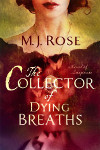
In hopes that the last breath isn’t the last at all…
Publisher: Simon & Schuster
Pages: 307
Type: Fiction
Age: Adult
ISBN: 978-1-451-62153-2
First Published: 8th April 2014
Date Reviewed: 14th March 2014
Rating: 3.5/5
In 1500s France, an apothecary’s apprentice is saved by Catherine de Medici and becomes one of her favourites, providing her with perfumes, potions, and poisons. He is happy in his position but his ultimate goal is to put into practise the theories of his old friend who believed life could be reborn. In present-day France, Jac looks at continuing the work of her brother Robbie, who died of a mysterious illness. History and modernity come together and Jac knows she is taking on the past. She also knows about her brother’s belief that her hallucinations are windows into days long gone, but she doesn’t know just how far it goes.
The Collector Of Dying Breaths is a dual-story book that uses history to good effect but to mixed results.
The story is predictable but it in a way that doesn’t spoil it too much – there is nothing that suggests the answers shouldn’t have been easy to guess. What may prove difficult, however, is the notion of dying breaths that the book rests on. Superstitions and theories about magic and the unknown where rife in the 1500s, but it can be hard to believe that anyone nowadays would consider the possibility that a breath captured in a bottle could recreate life. Whilst the theory is of course fine as a fantasy element, there is not enough of the genre overall to aid in the suspension of what is realistic required by the reader and so the resolution of the story may not be as compelling as it is supposed to be.
This is also true of the way the two time periods are woven together. Because Jac’s ‘ability’ is known from the start, the conclusion of this theme may not seem as interesting. However the biggest issue with the way the periods connect is one of belief, similar to that of the experiments. The past lives idea works by itself, but the way it is dealt with by the characters is overdone – and this is because the main character switches back and forth between being strong and weak, knowledgeable and naïve in odd ways, that make the answers unsatisfying.
Part of the issue has to do with the writing style. There is a lot of telling involved, in fact Jac remains undeveloped for a fair amount of time. Information about her is suddenly included as though you’ve walked in during the middle of a conversation, and facts are dropped randomly that it’s hard not to feel should’ve been stated within the first few pages. Where there is a lot of unnecessary information about historical people and perfumes (more than is needed for this story of perfumers) the book could do with more information on Jac, shown. Nationalities are also difficult to discern and the historical language, whilst generally good, does veer towards the 21st century on occasion.
The history itself is believable and well written. Catherine de Medici is portrayed in a somewhat bad light that might be worse than reality but is far from awful, and you can see where the author has filled gaps in history and used certain factors as a springboard into fiction. The author has no qualms about showing the dark side of court and how quickly an enemy or simply a person of higher standing would be quietly removed.
There are sex scenes in both eras, fairly graphic and in the case of the 1500s showing the religious hypocrisy apparent. One of the contemporary scenes provides a moment of contemplation for the character that seems to be a way for the author to explore a trend and is a little out of place overall, but otherwise, especially where the historical chapters are concerned, the scenes work.
Due to the predictability and sudden switches in thoughts early on, it is hard to get a handle on the story and difficult to say you really know the characters and care about them – the story can be confusing. That said, the history is interesting and accurate enough, and the mystical aspects appealing if not used to full effect.
The Collector Of Dying Breaths is unlikely to make your best of list, but it isn’t bad and the history is informative.
I received this book for review from for Historical Fiction Virtual Book Tours.
Related Books
None yet
Heather Walsh – The Drake Equation
Posted 5th March 2014
Category: Reviews Genres: 2010s, Political, Romance, Social
2 Comments

Love, work, and the environment.
Publisher: (self-published)
Pages: 208
Type: Fiction
Age: Adult
ISBN: 978-1-492-29531-0
First Published: 31st April 2013
Date Reviewed: 21st February 2014
Rating: 3.5/5
Emily works at GeoForce, a charity that wishes to rid the planet of SUVs. She’s very forthright in her opinions and quick to dismiss from an argument anyone who thinks differently – until she meets Robert. Robert works for a car manufacturer and his political views are at odds with hers; Emily’s beliefs ensure a massive debate. But Robert isn’t deterred, and he’s not as ‘bad’ as Emily thinks.
The Drake Equation is a book full of politics (the amount may take some getting used to) and difficult characters, but also with a romance that is in the main well-written, and believable thanks to the amount of effort the author puts into the build up.
Let’s deal with the negative first. The book needs a lot of editing. There are unnecessary dialogue tags when there are only two people in the conversation, odd turns of phrase, and mistakes such as the couple walking out of a shop in a strange manner because they continued out the door still holding the same hands they had shaken. These sorts of problems can jolt you from the text momentarily but they are not major issues overall. What is an issue is Emily’s lack of time spent actually working when contrasted with her strong views and a later promotion up the charity’s ladder (albeit that the lack of work is considered by the character at that time).
Then there are aspects that many may find negative but which cannot be called issues in themselves. Emily will be difficult for many readers to like, and even readers who agree with her views about fuel-hungry cars may find her too much – but it is evident that you’re not necessarily supposed to like the character. In regards to GeoForce there are a vast number of conflicting thoughts, statements, and actions. A prime example is the charity’s working with McDonalds wherein the latter provides the former with drink for the public at the rally. Whilst McDonalds may be improving, it’s not the sort of company you would expect an environmental group to align with. Depending on the reader, aspects of this sort will likely be met with confusion, or the thought that the charity may work on one issue at a time. A lesser divide will be caused by the employees’ mocking of the people they cold call for donations.
As the book progresses, the author gets better at showing how the characters are a good fit despite their differing views. (This is not to say she is ever bad at it, but it of course only becomes apparent as you read on and come to know the characters yourself.) Debates and other conversations do go on for a long time, however this means that all the groundwork for the relationship has been done by the time they are a couple – thereafter Walsh can just get on with the scenes without needing any big purpose for them. It means she can write purely character-driven scenes and the relationship becomes extremely believable. The author shows how, views aside, the characters are similar and well-matched. Even if their views are different, their strength of belief and ability to converse on these beliefs are equal.
In the same way, sudden conversational changes work because of Walsh’s dedication to detailing Emily’s beliefs. Where a sudden change is generally jarring in a book, Emily’s switch to her topic of choice aligns with her personality. Emily is arrogant, narrow-minded, and selfish, and because Walsh has shown you all this, her writing decisions work beautifully. You may not like Emily but it is impossible to say that Walsh hasn’t written her well.
As the book reaches its conclusion, readers may be divided as to whether or not the ending is equal to the rest of the story. Walsh’s decisions on Emily’s growth as a person will likely please some and annoy others, and the book could have done with more time spent on the time just before the change, as it is rather sudden. Similarly, a suitable conclusion to the conflict in the relationship is reached but not every one may believe in the result. But given that, either way Walsh was swayed to write, some readers were always likely to have been disappointed.
The Drake Equation looks at opposites and shows that when the difference is big enough, the situation may circle back around to the effect that there are more similarities than would be supposed. It takes the romance genre and moulds it into its own creation; it digs deeper into the general idea of a good match.
It has its flaws and it won’t satisfy everyone, but in The Drake Equation many may find what they’ve been looking for in a romance.
I received this book for review from the author.
Related Books
None yet.
Aimee Bender – An Invisible Sign Of My Own
Posted 21st February 2014
Category: Reviews Genres: 2000s, Angst, Commentary, Domestic, Psychological, Romance, Social
4 Comments

Bizarre – but then that’s life.
Publisher: Windmill Books (Random House)
Pages: 242
Type: Fiction
Age: Adult
ISBN: 978-0-099-55852-1
First Published: 2000
Date Reviewed: 17th February 2014
Rating: 4/5
Mona’s childhood came to an effective end when her father became ill. Holidays ceased to occur, her father stopped being interested in anything, and Mona coped by becoming a quitter. Successful and talented, she slowly quit everything she was good at before she became too successful or happy. Passionate about maths, the one interest she didn’t give up, she is given a teaching job despite a lack of formal qualifications, and comes to love the job, but her coping method isn’t quite usual, even amongst those who are also unusual.
An Invisible Sign Of My Own is a focused take on life and all its idiosyncrasies. Further than the superstition mentioned in the blurb, the book studies obsessive compulsiveness and depression. It is, at its heart, a look at two groups of people who are often one and the same – those who cope in unique ways, and those who live in ways that aren’t the norm.
The book is at once very positive and negative. It looks at idiosyncrasies and dark issues in the same bizarre way as Bender’s later work, The Particular Sadness Of Lemon Cake, whilst having a foundation of pure despair. This is not the book to read whilst you are upset yourself, indeed whilst the conclusion may show a sort of conquering of depression, the atmosphere of the story and characters are dark enough to be almost too easy to relate to if you’re having a bad day. This is of course as much a drawback as a triumph. Bender’s choice of idiosyncrasies may for the most part be unrealistic, as much as the word can be used when dealing with the subject, but if anything this helps the reader emphasise and/or understand more. By having that distance between reader and book – the distance of the distinct behaviours – the content is more welcoming, because anyone who has experienced depression, OCD, and/or the sort of tragedies in the book, is going to find it easier to see it from a fly-on-the-wall perspective. The pain may be the same, but the difference in delivery means that you’re not going to feel targeted and at the mercy of an author whose other characters dislike what they see in those who aren’t coping.
The story, in which no quotation marks are used, is somewhat predictable, but it is obvious that this is part of the idea. In order to understand Mona as the author wishes you too, you have to see where the book is headed. Mona is at once the main character and one of many. She may be the narrator but the story focuses on, for example, the plight of a child whose parent is dying of cancer, just as much. What Bender shows, via the subtext, is how important it is that society in general truly recognises that people cope with pain and despair in different ways and that when those ways do not fit the norm, or what is expected, these people are still looked after. An Invisible Sign Of My Own isn’t about leaving people to fend for themselves (so long as the issues are known), indeed it is very much the opposite, and due to that it forces you to look beyond appearances. In the case of the child of the parent with cancer you have a child that looks for cancer – indeed almost hopes for cancer – in everyone she meets due to her undisclosed feeling of detachment, whose idea of numbers in nature is morbid, naïve, and dangerous, and who, for her young age, suggests things such as suicide as though they were something to do when bored. This is a girl too young to really realise what she is saying whilst knowing exactly what is happening. Other children, albeit not faced with terminal illness, show how naïvety about subjects they don’t yet understand have disastrous consequences. And Bender lets the disaster happen, to shock, to teach, to illustrate just how important care and education are.
An Invisible Sign Of My Own is at once easy and difficult to read. It’s strangeness can at times bely its message, suggesting that Bender just wrote a lot of madness without anything in particular to say, or worse, that she thinks it is okay. It’s tough getting to the heart of it, and likely often times you’ll wonder what in the world you’re reading. It may be barmy but that’s the surface dressing; it’s worth reading to get a glimpse of lives that don’t tick boxes, and there is plenty relevance in its content to fit our lives in the non-fictional world, too.
Related Books
Sarah Mayberry – Her Best Worst Mistake
Posted 14th February 2014
Category: Reviews Genres: 2010s, Romance
Comments Off on Sarah Mayberry – Her Best Worst Mistake
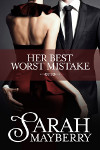
The best friend’s ex.
Publisher: (self-published)
Pages: 146
Type: Fiction
Age: Adult
ISBN: 978-0-987-31600-4
First Published: 3rd May 2012
Date Reviewed: 3rd June 2013
Rating: 3.5/5
Elizabeth realised she and Martin weren’t a good fit, and cancelled their upcoming wedding. Best friend Violet should be happy, after all she loathes the boring man, but she can’t get him out of her thoughts. And if something happens between them, how will she tell Elizabeth?
Her Best Worst Mistake is technically a sequel to Mayberry’s Hot Blazing Nights (published by Harlequin), but can be read as a stand-alone. A short book, there is relatively little action (pun not intended) and it is an easy read.
However. The book contains a multitude of problems. The most obvious one is that this ‘British’ setting and the ‘British’ characters are actually American. In other words it appears that the (Australian) author has done no research. Yes, ‘elevator’ is matched by ‘lift’ many times, as is ‘cell’ and the neutral ‘phone’, but the simple usage of American terms (including ‘high school’ in dialogue when Brits go to ‘secondary school’ and ‘sixth form’ or ‘college’) does the writing a great disservice. A British reader or anyone who knows British terms will likely feel distanced. There are times when it is okay, for example ‘apartment’ instead of ‘flat’, as the former has worked its way into British language, but the lack of care is far too obvious. This is unfortunately matched by numerous spelling and typing errors proofreading should have picked up.
Aside from this, the book is okay. It is incredibly steamy – that’s the only way to describe it, as ‘hot’ doesn’t inspire the same idea – and there are many sex scenes. The novella is practically erotic romance, and the development of the relationship happens mostly lying down. Mayberry writes good sex scenes that generally lack those words and situations that some readers might find uncomfortable (though a special mention should be made for the scene involving fruit). Whether the relationship works or not will depend on the reader – whether they’re okay with people taking on the ex-partners of friends, whether they like the characters, whether they are okay with a girl saying she’s been tested for STDs without anyone mentioning the man (six year relationship or not), and so on.
Being a novella, there’s not much time for the resolution to take place, and the reader may feel cheated by Elizabeth’s response if they were hoping for a long scene (no matter if they wish for Elizabeth to be angry or unmoved). The vast majority of the book takes place in settings where sex is known to occur. That said, there are mini storylines regarding Violet’s feelings of inferiority, as well as the tensions faced by Martin, who works for Elizabeth’s grandfather, that aren’t bad. The characters are likeable enough, though as much of the plot revolves around the bedroom and Violet’s worries about Elizabeth, there is not all that much to get to know about them beyond the basics. This means some of the characters’ interests and dislikes may be confusing.
Her Best Worst Mistake is a very apt title as it will sate the opinions of those who like it and those who do not. Recommended with caution as to high expectations, it is a fair offering but unfortunately also an example of how important research is even when you’re writing about a widely-known theme (romance) and the present day.
Related Books
None yet.


