

Ai Mi – Under The Hawthorn Tree
Posted 18th July 2014
Category: Reviews Genres: 2000s, Angst, Historical, Political, Romance, Social, Translation
3 Comments
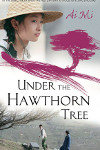
First love – a time to worry.
Publisher: Virago
Pages: 352
Type: Fiction
Age: Adult
ISBN: 978-1-844-08703-7
First Published: 2007
Date Reviewed: 18th July 2014
Rating: 3/5
Original language: Mandarin Chinese
Original title: 山楂树之恋 (Shan Zha Shu Zhi Lian – Hawthorn Tree)
Translated by: Anna Holmwood
Jingqiu’s family has been written off as the lowest of the lowest. Landowners, in the time of Mao they are hated. Jingqiu works hard to provide for her mother and sister and sees her future as one of inevitable manual labour. She would hope to return one day. On a field trip, as a writer for the new school textbooks, she meets Old Third, the so-called foster brother of her teacher’s family. He’s obviously not as poor as Jingqiu – there would be issues if they became more than friends.
Under The Hawthorn Tree is a book that starts very well and offers much to those interested in the history, but slowly descends into what is to all intents and purposes stupidity.
The stupidity can be found in Jingqiu’s choices. She is a fair enough character and works more than is healthy so that her family has money, but she declines all offers of support and legitimate ways to get around her situation. The love interest, Old Third, has much to offer and asks for nothing in return; he wishes Jingqiu out of danger. Jingqiu rejects his money and puts her life on the line working in factories that use poison and taking on heavy lifting duties that could kill her. Perhaps it is meant to be endearing, but instead it comes across as silly and selfish. It’s a miracle the character survives at all.
Some, only some, of Jingqiu’s concerns are valid. She worries about being seen with Old Third in a society that will reject her if they believe she’s lost her virginity out of wedlock. She worries about her family’s already low status. But by and large her worries don’t hold water. There are the constant musings on what people are referring to (metaphors and innuendo). Jingqiu’s innocence is believable up to a point, but it’s hard to believe that by 25 she still dismisses those happy to clarify matters and to be the only person (seemingly, at least) in her home town who has not learned anything. Personal experience doesn’t enlighten her, either. Sex itself is one of the few things that is discussed openly in the city, at least enough that everyone knows a good amount, everyone except Jingqiu.
Jingqiu’s love isn’t believable. She goes through some motions, and perhaps it is down to the lack of knowledge, but it’s hard to phantom that one day she won’t fall in love for real and relegate Old Third to a crush. Old Third loves her, that is certain, by Mi does not present the love on Jingqiu’s side very well.
The writing is hit and miss, however because we’re talking of a translation, it’s hard to say for definite whether or not the repetitive words and juvenile phrasing is down to the author or the translator’s choices. (The translator is Anna Holmwood.) It is safe to say that the translation needed editing, because you’d expect errors in the original text to have received some sort of mention, if just to clear the translator’s name.
What’s good about the book is the pace – it’s quick and easy to read – and the history. Beyond the silliness there is a lot of interesting information, and it’s localised to Jingqiu’s community. You can learn much from this first-hand account, albeit fictional, and its status as a best-seller (it was adapted for the screen, too) goes some way towards informing you about how much you should believe. Jingqiu may not be devoted to Mao but she refers to the rules and texts enough that you see how people were affected.
As an insight into the history it’s not bad, but you shouldn’t pick up Under The Hawthorn Tree expecting to be wowed. If you are, all well and good, but most likely you’ll be happy to move on.
Related Books
None yet
John Green – The Fault In Our Stars
Posted 7th July 2014
Category: Reviews Genres: 2010s, Angst, Romance, Social, Spiritual
14 Comments
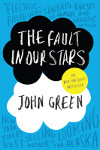
There is life in cancer.
Publisher: Penguin
Pages: 311
Type: Fiction
Age: Young Adult
ISBN: 978-0-141-34563-5
First Published: 10th January 2012
Date Reviewed: 30th June 2014
Rating: 5/5
Hazel has cancer. She’s not likely to ever be in remission but she’s able to live a fuller life than she had with illness so far. At the support group her mother insists she goes to she meets Augustus, someone who matches her in wit and thought. He’s lost a leg but is in remission, and although things will always be difficult, the two teens begin to fall in love.
The Fault In Our Stars is every bit as good as you’ve heard. Green’s writing is very unique and rather excellent, no matter that he has a few novels already under his belt. The book moves far away from the idea of pity, allowing you to see reality.
Green writes teenagers very well and the dialogue seems true to life. There has been no attempt to make the book beautiful – this is no literary feat and frankly it would suffer if it was. To be sure it’s a particular type of writing (this reviewer took a good few pages to get used to it even though she liked it), and it may not appeal to everyone. This is perhaps the only possible issue – where everything is so fresh and specific the book may put readers off by it’s technical nature.
Putting that aside, however, the characters are fantastic. These are teens of a particular personality. They use ‘big’ words, often to excess, and there are so many subjects covered as metaphors and evidence for otherwise simple conversations, it’s unlikely you will know all of them. The sheer life implied by the way the characters act just goes to emphasise how awful it is that we have these diseases that kill. They are simply two fictional people, but they represent a great many more, real, people.
The metaphors are many. A particularly prominent concept throughout is of cigarettes and the potential to kill. Augustus disgusts Hazel when he takes a cigarette from his pocket, but he explains the theory behind his action, that something that kills, stripped of the power to kill by his failure to light it, is not a threat. There are semi-subtextual ideas, such as Hazel’s naming transition, changing what she calls her boyfriend, and there is the controversial scene in Anne Frank’s house in which the teenagers cause a stir.
There is, as you may expect, a lot of humour. You are meant to laugh. You are meant to have a good time. You are not meant to pity, but you are of course meant to feel. There is the sadness – of course there is, you may say, but the point here is that because it’s balanced by the humour and normality, it is all the more powerful.
A special mention must be made of the novel Hazel loves, that she passes on to Augustus. It forms a big part of Green’s book and contains a great many concepts and metaphors. Does it signal what will later happen in the book? The scenes with the author of this book within a book remind you that sometimes life sucks, and it can continue to suck even when it’s already reached the lowest of lows.
Metaphors, concepts, themes. These, apart from the C word, are what The Fault In Our Stars is about. Green wants you to get to the heart of the matter and knows that often, subtlety is the best way. The book gets you thinking, analysing as though it is literature set for class discussion, and will leave you considering it for days.
Both a fast read and a slow burner, The Fault In Our Stars will change you by way of making you think. It’s not out to change the way you approach disease (or even, it could be said, disability). At least not obviously.
Think. Consider. Laugh. Cry. There is a fault in the stars, but it isn’t Green’s book.
Related Books
Laini Taylor – Daughter Of Smoke And Bone
Posted 6th June 2014
Category: Reviews Genres: 2010s, Angst, Fantasy, Political, Romance
5 Comments
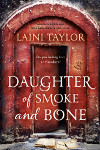
Will anyone tell her what’s going on?
Publisher: Hodder (Hachette)
Pages: 418
Type: Fiction
Age: Adult
ISBN: 978-0-091-94924-2
First Published: 27th September 2011
Date Reviewed: 5th June 2014
Rating: 4/5
Karou lives with chimeras, but she’s human and knows that there’s a story to be told, if only her friends would tell it to her. They won’t. Instead Karou has to keep running errands all over the world, using portals to collect teeth from various countries for yet another story she’s not allowed to know. She does get to make wishes, a small benefit when you consider she only gets the slight ones like making people itch. She’d much rather know how to fly. She’s at university now and pretty frustrated with her lack of knowledge. Surely it’s time she learned the truth?
Daughter Of Smoke And Bone is a low-fantasy tale, the start of a trilogy, that is often engrossing and promises much for the series as a whole.
Taylor makes sure her world is amply populated with interesting characters. She explores the world – our world – a fair amount. Karou visits many places in her time, using doors to move from her newest residence in Prague (she moves a lot and asks for languages for her birthday) and illustrating just how routine such a ‘dream’ of fast travel can be. The routine, coupled with Karou’s otherwise usual life does a good job of both stunning you and keeping you down to earth. Travelling is downright boring for Karou at times, and you come to emphasise with her from the start due to her approach. All this to say that Taylor is very good at making the awesome average, and rather than being a drawback it’s an interesting and absorbing concept. It makes Karou feel real, which is always a good thing.
This is a book to set up a trilogy but it’s complete in itself aside from the open threads at the end. Given it’s a trilogy, you might be surprised by how much happens. And it’s just fun. Daughter Of Smoke And Bone is exciting to read, it lets you escape into another world, it drenches you in culture even if only for moments at a time, it has wars and wings and… well, Karou doesn’t know yet, so it’d be unfair to tell you first.
Many people have written favourably of the twist – it’s a fair twist. How much you like it, however, will depend on the amount of YA and which types of YA you’ve consumed over the past few years. The twist is similar to those of other books so it’s likely you’ll predict it early on. This said, the evidence so far (as in this far into the series) indicates that Taylor is going to treat the trope differently.
This difference, the maturity and overall respect of reader’s intelligence, is the overall takeaway that will end this review. Beyond the general appreciation you’ll have of Daughter Of Smoke And Bone, you’ll appreciate the handling of the themes. Taylor has taken a genre and a handful of tropes that many people like, that half of those people have felt lacking in execution elsewhere. She’s taken them and she’s written something that matches what they were wanting. Daughter Of Smoke And Bone is quite possibly the YA fantasy romance that you’ve been looking for. If you’re jaded, give the tropes one more chance, here.
Before this review repeats its repetitiveness let’s leave it there. This is a good book. You’ll like it.
Related Books
Noelle Adams – Married For Christmas
Posted 30th May 2014
Category: Reviews Genres: 2010s, Domestic, Romance, Social, Spiritual, Theological
6 Comments

Charlie asks a question: Is it out of line, so to speak, to post reviews of books set during a holiday on another day? (I read this last week, hence the review now.)
To have and to hold, in convenience.
Publisher: (self-published)
Pages: 141
Type: Fiction
Age: Adult
ISBN: 978-1-492-76514-1
First Published: 30th November 2013
Date Reviewed: 24th May 2014
Rating: 2.5/5
Jessica is going to propose to her childhood friend, Daniel. She loves him, and although he doesn’t love her that’s neither here nor there – this marriage will not be about love. Jessica wants a family but has never met the right man, and Daniel needs a wife if he’s to be selected as the next pastor of his home town’s church. Jessica’s adamant that love is not important, and Daniel says he can never love another as he loved his deceased wife. So the set-up is perfect… surely.
Married For Christmas is a short tale about the first month of marriage between two friends who both see an advantage in getting married. The characters are Christian but there are a few detailed sex scenes so, as the author points out, this isn’t a book for those looking to read a ‘fade to black’ and/or typical Christian romance.
The book begins well, and at first the characters are good – well developed, and showing much potential. Many readers have said it would’ve been nice to have read a few chapters from Daniel’s point of view and this reviewer would agree. Daniel is a solid, very good, character throughout, whereas Jessica changes somewhat, and not in a ‘regular’ way, but in that way that suggests the author really wanted to write about someone else. You have to be wary of Jessica, in this sense, and know that she will quite possibly get on your nerves.
Jessica’s thoughts about her past are consumed by the idea that men don’t like her, no one has been in love with her, and that she was never going to find anyone. However, as becomes apparent, there have been men who liked her. And, whilst it’s perfectly okay that Jessica has limited her pool of available men by discounting anyone who doesn’t share her religion, it does make the constant refrain unbelievable, even when considering insecurities and quietness. Men who liked her but were turned down because they weren’t Presbyterian nevertheless count as men who liked her. With her limits and the limited-by-design scope of her social life, the ‘no one likes me’ track doesn’t work.
The book could do with an overhaul. Missing words, poor grammar, and strange statements mar what would otherwise be fairly good writing.
What’s good is Daniel. Daniel remains a good guy throughout the book despite Jessica’s belief to the contrary. The change he undergoes is well-written and even if it’s predictable, it brings forth the sweet romantic element that was sorely needed. The sex scenes are written well and there are a fair number of them. They are detailed and verge towards erotic fiction at times, however this is somewhat influenced by the mixing of genres and they are less graphic when considered away from that context.
Married For Christmas is cute, but being upset about the marriage you planned working out as planned doesn’t invite empathy, especially when the marriage is only 4 weeks old. Similarly, the annoyance at the help offered (understandable somewhat out of the context of a close community, not understandable in it) doesn’t ring true given the amount of thought Jessica would’ve given to being a pastor’s wife. Strictly alright.
Related Books
None yet
Shannon Stacey – Love A Little Sideways
Posted 4th April 2014
Category: Reviews Genres: 2010s, Domestic, Romance
1 Comment

Sideways (verb): dating your best friend’s sister even though it’s wrong.
Publisher: Carina Press (Harlequin)
Pages: 353
Type: Fiction
Age: Adult
ISBN: 978-0-373-00225-2
First Published: 26th November 2013
Date Reviewed: 28th March 2014
Rating: 3/5
Liz is moving back to Whitford after (finally) splitting up with her boyfriend and realising she was missing out on all the fun being so far from her family. However as she nears the town her car skids and hits a tree, and although she’s not injured those nearby are convinced it’s an emergency. So they call the police, and to the scene arrives Chief Drew Miller – the man Liz spent time with at the last Kowalski wedding…
Love A Little Sideways is the seventh book in Stacey’s Kowalski series and the last to focus on a member of the family itself. Focusing on a female Kowalski rather than a male, the book has a different feel to it from the first page. This could easily have made for a strong and more interesting book, given that no matter how fun the other books are there is inevitably repetition – however the final bow from the Kowalski clan isn’t as fluid as it could have been.
The major issue with the book is one of the two conflicts, which this reviewer hates to call ‘the first’ due to how debatable the ‘second’ issue is. This conflict is that of the best friend’s sister. Drew is the best friend of Liz’s brother, and a vast amount of time is spent, not just by Drew and Liz but by practically every one of Liz’s family members, worrying about this ‘problem’. It is understandable that the reality of a romantic relationship, a relationship that is far easier to break than that of blood (in most cases), would be cause for thought, yet this understandable reason isn’t the book’s focus. The ‘problem’ with Drew and Liz is simply that Liz is Mitch’s sister. And apparently there is a ‘code’, one of those school-aged agreement ideas.
Liz and Drew are adults, in fact Liz is 30 and Drew is a little older – yet this best friend’s sister issue keeps getting in the way as if someone is threatening to tell Mum and get everyone grounded. Later on, when Mitch inevitably finds out, he deals with the issue as a little child – and Drew responds in a complimentary fashion. Of course this ‘conflict’ gets solved in the end, but it is totally unbelievable and likely to simply evoke a ‘so?…’ on the part of the reader.
Next is an issue far more mature and completely believable – the difference in life choices. Drew is single because he wants children whilst his ex-wife didn’t. He’s now on the lookout for a woman who feels the same as he does about padding feet. Liz is at the start of a new life, and is at the beginning stages of working out whether she’s happy in Whitford working at the diner, whether she wants children, or whether she wants to go and get a degree. Drew definitely wants to stay in Whitford and procreate; Liz may want to move to the city and start a business like her brothers. Of course a conflict of interests can work, and people make compromises and allowances so that they can live with the person they love whilst also living the life they want as an individual, so that isn’t an issue. What is is the relative, and, by the end of the book, complete, marginalisation of Liz’s wants and dreams. Part of the problem is that the characters have little chemistry. When measured against the other couples in the series, the romance is even more suspect. But the biggest problem is that whilst Liz gets a few cries of “what about what I want?” the book leans firmly on the side of Drew, and because the books are founded in family, this is inevitably cemented.
That’s not to say that the basis in family is bad, it isn’t, and it’s been a reasonable feature of the books – indeed you need to be open to the idea of ‘living in each other’s pockets’ and traditional gender roles to enjoy these books – but there is using the idea of family to make a book ‘warm and fuzzy’ and using it to override the thoughts of someone who may prefer a child-free life. Liz’s opinions of her own destiny are simply not valued enough by anyone and so Liz’s future is effectively decided upon by her lover and family. It is also resolved far too quickly.
Speaking of the chemistry it’s a pity that Liz’s suggestion that Drew simply wants a woman to breed for him comes across as true. That Drew loves Liz seems a nice convenience. Likely if Drew’s single-mindedness on the issue wasn’t such a big element of their relationship the relationship would read better, but as it’s the case that it is, it’s all too easy to believe that a few months down the line when the couple are married and Liz has finally had time to work out what she wants in life, a swift divorce will follow.
Aside from this the book could do with another copy edit. There are awkward phrases, plot development issues, and scenes such as Liz and Drew having a shower, Liz’s long hair not being combed afterwards, sex and sleep ensuing, and no mention of time-consuming tangles and impossible bed-hair in the morning. (These things are noticeable when you have long hair.) Despite the entirety of the family being at the camp and despite the fact that Liz is renting her house from her sister-in-law, Lauren gets one small mention and no admission into any other scenes or any lines of dialogue whatsoever. It is as though the heroine from two books ago doesn’t exist. Terry and Evan only get a small look in, but as they don’t have a book to themselves this feels ‘right’. And, whilst it’s not an editing issue, Mitch saying he often doesn’t listen to his wife puts a damper on the fabulous chemistry in his own book.
Where Love A Little Sideways does work is in the family factor, as is to be expected. The family may be around a bit too much and you may get to hear the same old information about everyone as the book seeks to welcome readers who haven’t read about the Kowalskis before, but overall it works. Liz is distant enough in her role of the half-stranger and Drew in his role of friend to make the book interesting in a unique way compared to the past six, and the book is a fine comfort read.
But the conflicts do unfortunately place it firmly in the middle of the scale.
Returning to a great family and location, but making one reconsider the values, Love A Little Sideways may be worth reading if you’ve read the other books in the series but as an introduction it’s unlikely to foster interest.
Related Books