





S J Watson – Before I Go To Sleep
Posted 18th November 2016
Category: Reviews Genres: 2010s, Domestic, Psychological, Thriller
3 Comments
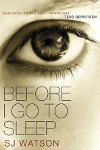
If I should forget before I wake…
Publisher: Black Swan (Random House)
Pages: 356
Type: Fiction
Age: Adult
ISBN: 978-0-552-16413-9
First Published: 28th April 2011
Date Reviewed: 10th November 2016
Rating: 4.5/5
She wakes up in a bed next to a man she does not recognise. The mirror shows a woman much older than she is. It’s been years; Christine discovers she’s had an accident that means every night her memory is erased. She must trust her husband, the man in the bed.
Before I Go To Sleep is a fast-paced psychological thriller that repeats itself intentionally and remains a page turner from start to finish.
Christine is an unreliable narrator of a particular kind – if she could be, she’d be trustworthy. She’s as factually accurate as possible; you have to keep your wits about you. Due to Christine’s role as narrator, and the first-person viewpoint that entails, as the reader you are as in the dark as she is about everything. The only advantage you have is that Watson wants and needs to clue you in more than than he does Christine. The character takes things at face value so whilst it’s fair to say there’s an element of growing together – you and her – your journey is particularly engrossing.
The clue is in the genre; Watson doesn’t provide too many red herrings because he doesn’t need to. The success of this book lies in its ability to make you doubt and dissect everything and indeed you come to form most every possible conclusion out there. There’s a section towards the end where the narrative crawls, almost to a halt, and if you didn’t know otherwise you’d say Watson wrote too much; in actual fact what happens is that, having now exhausted all the possibilities, you’re just waiting to find out which it is.
If you worked it out early, you may be less enthused, though it’s likely you’ll appreciate what Watson has done and the work that went into it. This is perhaps where timing comes in – if you’ve read lots of books that sport the same/similar conclusion you likely won’t feel as compelled. This is the sort of book it pays to mull over after finishing, to look again at what Watson has done, at the editing that must have happened, at the timing, the structure, of it all.
The writing is good. There’s no time for descriptive passages and you wouldn’t remember them anyway. There are plenty of questions posed in the book and all are answered. Only one or two plot points may inspire frowns – situations at the end it would spoil the story to write about – the morality of relatives to patients, that sort of thing, if that makes sense. Are parts convenient? Yes. Does it matter? Not really.
Before I Go To Sleep forces you, at some undisclosed point, to look at a tough subject. Its mainstay is, as Renée Knight said recently, something that works because it’s real and could happen to anyone. It’s scary, it’s shocking, and it’s one heck of a ride.
Related Books

Max Porter – Grief Is The Thing With Feathers
Posted 14th November 2016
Category: Reviews Genres: 2010s, Angst, Commentary, Domestic, Magical Realism, Psychological
5 Comments
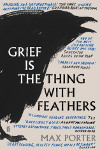
Dealing with sadness (crow).
Publisher: Faber & Faber
Pages: 112
Type: Fiction
Age: Adult
ISBN: 978-0-571-32723-2
First Published: 24th August 2015
Date Reviewed: 9th November 2016
Rating: 4/5
A family in mourning is visited by a crow. Crow brings some havoc with him but he’s also there as Dad gets through the days without his wife – struggling to finish writing his book on Ted Hughes – and as the boys come to terms with life without their mother.
Grief Is The Thing With Feathers is a rather experimental book steeped in literary history. Looking at grief both as a process and in the various guises it takes, it blends prose and poetry together with semi-autobiographical elements – Porter lost his father as a child – to become something very unusual indeed.
There is a lot to this book; it’s difficult to know where to begin. Let’s start with the style: Porter opts to eschew convention, deciding not to choose between poetry, prose, fiction, non-fiction, commentary, study, fully-fledged plot, vignette. His book is the result of a vast mixing pot that is both confusing and compelling. Mind-blowing concepts within the whole compete alongside aspects that are difficult to define. It’s safe to say this book requires a lot of attention.
And a fair bit of knowledge. Whilst the book can just about be read without knowledge of its background subjects, your reading of it will be immensely improved by your having at least a basic idea of the lives and work of those who have influenced Porter. Chief amongst these is the poet Ted Hughes, whose book Crow: From the Life and Songs of the Crow is, not surprisingly, a major factor. Porter’s general interest in Hughes means that any knowledge is useful – and it pays to know about the poet’s relationship with Sylvia Plath.
Porter takes his inspiration for his Crow from Hughes but also from the bird itself. It is the sections written from Crow’s point of view that invite the most bafflement – the sentences are often a mess of words, onomatopoeia-like creations, and a general strangeness pervades. There is the idea of a metaphor – who or what Crow is, and how much he/she/it is related to Hughes’ Crow is a question that spans the entire book. Is this Death? Is this grief itself? Is it, even, Sylvia Plath? And why does Dad see Crow – because it suits Porter or because he’s working on a Hughes commentary?
On the stylistic note, the book uses three narratives – Crow, Dad, and ‘Boys’, the latter of which concerns the two sons but is written from one point of view, potentially to infer that at their young age the boys’ grief could be considered interchangeable, or maybe that their experiences are the same. Sections by the Boys are written in verse and meanings are split over a couple of lines. Much whitespace between narratives as well as lines and sometimes words mean that the book is even shorter than it appears, physically. And in many ways this is a good thing because of the amount of detail and commentary Porter has packed in.
To the stated grief, then; Porter has spared nothing. The book is at its most powerful when it’s examining the forms grief takes and how different people deal with it. Again metaphors and explorations take centre stage, with stereotypes and the idea that one must get over it always lingering nearby.
Take this, the Boys’ reaction to their father calmly coming into their room to tell them their mother has gone:
Where are the fire engines? Where is the
noise and clamour of an event like this?
Where are the strangers going out of their
way to help, screaming, flinging bits of
emergency, glow-in-the-dark equipment
at us to try and settle us and save us?
And this, wherein Dad works through both the metaphorical and literal detritus left in her wake:
She won’t ever use (make-up, turmeric, hairbrush, thesaurus).
She will never finish (Patricia Highsmith novel, peanut butter, lip balm).
And I will never shop for green Virago Classics for her birthday.
I will stop finding her hairs.
I will stop hearing her breathing.
As said, this book requires all your attention. It’s incredibly easy, even with context behind you, to lose your way and it can take work to find yourself again. This is where Porter’s leaving of titbits comes in handy, most noticeably around the middle where comprehension questions, of the English Literature lesson type, are added as part of the narrative.
So Grief Is The Thing With Feathers is hard work but can be very rewarding. But it is also a very unusual beast and fits a specific, niche, category. You have to be happy with the very experimental style.
A difficult book to recommend outright, Porter’s début will intrigue most, delight many, and confuse just as many too and your experience of it won’t necessarily lie in how much you do or don’t know of Porter’s literary interests.
Keep a look out for it, go after it even, and see what you think. It’s quite an experience.
This book is shortlisted for the 2016 Young Writer Of The Year Award. I’m on the Shadow Judging Panel.
Related Books
Louisa Young – The Heroes’ Welcome
Posted 4th November 2016
Category: Reviews Genres: 2010s, Angst, Commentary, Domestic, Historical, Psychological, Social
2 Comments

We’ll meet again.
Publisher: Borough Press (HarperCollins)
Pages: 322
Type: Fiction
Age: Adult
ISBN: 978-0-007-36147-2
First Published: 22nd May 2014
Date Reviewed: 16th August 2016
Rating: 3.5/5
Riley returned from WWI a changed man, half his jaw missing. Surgery made up for some of it; Nadine still wants to marry him though her family worry about his prospects – it doesn’t seem to matter to employers that he served his country when he’s disfigured and thus deemed a discomforting presence. Riley’s worried about how Nadine will view him and in turn Nadine is worried about Riley’s depression; she doesn’t care that his looks have changed. Then there’s Peter and Julia – Peter served with Riley and came back physically unharmed but the war has taken its toll on his mind. Julia, in an attempt to reach him, experimented with cosmetics and has damaged her skin. Will either couple return to how they were?
The Heroes’ Welcome is the sequel to Young’s previous book, My Dear, I Wanted To Tell You. This fact is not noted; fortunately the book works as a standalone or at least it seems to – readers of the first book say it does matter, that you need to read them in order. The Heroes’ Welcome is a fair look at disability in the context of the war, it just doesn’t have much of a plot or character development going on.
On that word, ‘fair’, it’s fair to say the book goes a good way towards showing social issues and personal rehabilitation but doesn’t go quite as far as one might hope. It shows PTSD and the effects of the disorder on families – one of those topics that doesn’t get looked at much – but the main bulk of the development in this way is confined to a few pages. Young knew about the hospitals and healing through the work of her aunt (I discovered this after having read the book) which means that when the subject is concentrated it’s special. In those few pages is a wonderful overview of what you’re already starting to understand, the juxtaposition of society saying, ‘welcome back and thank you for your service!’ and ‘I’m not sure you can do this work and anyway you’ll scare people – no job for you’. It both harks back to the post-war days and illustrates what is unfortunately still the case today.
The writing is pretty good. It flows well and in the main rings true, however there are some anachronisms – ‘epically’, ‘those ones’, and the rather odd ‘losable’, for example. Young slots a first person thought narrative into the third person narration which makes the text choppy at times. Phrasing can be vague.
Young was inspired by the work of another writer who used Homer in conjunction with the events of WWI, showing how related the ancient text is to the later war. It’s interesting but the sense of fascination and seeming originality in Young’s book is marred by this fact of copying – something only divulged in the afterword, after you’ve finished it. And if you haven’t read Homer or don’t know the stories well, it may be a problem. It may be best to read Homer or to get your knowledge of The Iliad down to pat first… which given the nature and length of that text…
In sum, The Heroes’ Welcome sports nice language, good ideas, and isn’t a bad read, but there’s not much going on and for all the promise in the veterans’ stories, the book is lacking in substance. The ending is a bit of a rushed, convenient, job. The book would work best as further reading, say if you’ve completed Anna Hope’s Wake and want something that looks at the war in a similar light. It’s not, as the quotation on the cover says, the book to read about the war if you’re only ever going to read a single one.
Related Books

Linda Stift – The Empress And The Cake
Posted 30th September 2016
Category: Reviews Genres: 2000s, Historical, Psychological, Thriller, Translation
Comments Off on Linda Stift – The Empress And The Cake

There’s no way out. There’s every way out.
Publisher: Peirene Press
Pages: 172
Type: Fiction
Age: Adult
ISBN: 978-1-908-67030-4
First Published: 2007; 30th September 2016 in English
Date Reviewed: 20th September 2016
Rating: 5/5
Original language: German
Original title: Stierhunger (Bulimia)
Translated by: Jamie Bulloch
A young woman is approached by an older woman, asked if she’d share a cake because the cake is too large for one person. The older woman’s clothes are very old fashioned, from the 1800s, and her companion is similarly dressed. Though she avoids rich foods, the young woman agrees to take half the cake; after the purchase the older woman suggests sharing first her own half. The young woman finds she cannot say ‘no’, and whilst she believes it was her choice, it sets a precedent for the future.
The Empress And The Cake is an Austrian novella about three women of different generations who are connected. It’s got a bizarre, strange, atmosphere, a lot of history, looks at mental and physical health, and sports a brilliant uniqueness.
There are four major characters in this book, three in the present and one in the past. The present-day characters are our unnamed narrator, Frau Hohenembs, and the latter’s friend/servant, Ida. The fourth is the Empress Elisabeth of Austria, of the mid to late 1800s. Elisabeth is included via descriptions written by a friend – we view these scenes as reflections – and her presence in the novella is to show the basic ideas behind Stift’s drawing of Frau Hohenembs and Ida and thus the connection she has created between the factual Empress and the fictional characters.
This reviewer would recommend doing a bit of research into the personality and life of the Empress prior to starting the book. The book’s meaning won’t be lost without it but some knowledge of her will really enhance your reading experience and allow you to figure out what might happen, which when you consider the fact the Empress is likely well-known in Austria and this is an Austrian book, just makes sense. Elisabeth’s story is quite fascinating; she was reluctantly married to an Emperor who adored her and spent her time away from the court she disliked, often travelling incognito. Her mother-in-law practically removed her from her children’s lives and she was assassinated by a man who wanted to assassinate a royal and hadn’t been able to get close to his first choice, nor his second.
Part of the connection between the characters and something that is a major theme is an obsession with slimness, which in the unnamed heroine’s case is a disorder, bulimia. The book gets into very graphic detail at times so that Stift can show the way bulimia affects a person. It is a very frank portrayal, Stift’s character telling herself, or us, how this will be her last vomiting session, how she’s going to stop weighing herself so much – she’ll weigh herself several times a day instead of a dozen, for example (a difference the reader sees as inconsequential) – how she’ll start eating more again, only for her to revert almost instantly. The heroine is bound by her disorder but does not see it – she views herself as in control of it. And her increased contact with Frau Hohenembs furthers her it. (What’s interesting here is that the way the passage of time is shown in the book, the rough slowness that can be attributed to Stift’s detailing and repetition of the regular makes it seem as though more time passes between decisions than it truly does.)
Similarly she views herself as in control of her visitations to Frau Hohenembs’ apartment, and in control of the choice to go out, which happens often, with said lady and her servant; the truth is different. Not quite so different is her lack of control of her eating disorder, but a big part of the psycho-thriller aspect of the novella is the dwindling nature of personal agency. This is where the plot thread of cocaine comes in; the drug is not referenced directly for some time and we do not know whether the heroine and Ida take the drug, but there’s a vagueness, an ambiguity, in the story, that lets you imagine what is most likely. What, for example, was in that cake? Stift does not say either way – just sugar, or something more addictive? – that’s up to you to decide. (Does sugar itself perhaps reflect the addiction?)
Empress Elisabeth wanted to be very slim, and favoured being stitched into her clothes. Whilst the present-day fictional part of the story does not go this far, the factual forms a sort of backbone. Frau Hohenembs’s obsession with Elisabeth (does she think she is her or want to emulate her?) never wavers, and as such the heroine falls into line behind her. This thread is not resolved neatly, but then it doesn’t need to be. It’s the connection that Stift wants to show rather than any reason d’etre.
On the gruesome front it should be noted there are visits to a ‘specimen’ museum. These, as well as the vomiting scenes, if the reader finds them difficult, can be skipped because the importance in them lies in the sentiment rather than the scenes themselves – so long as you’ve the cause in mind, flicking past shouldn’t be a problem.
In regards to the translation, it reads well. Jamie Bulloch seems to have opted for a balance between literal word meaning and flow; there are some German words you may want to look up but the rough meaning is there in the text.
It’s hard to say exactly why The Empress And The Cake is so good. It has something to do with the complexity, the number of ideas in it, and the amount of thought that’s gone into it, but enough to say it’s excellent. It’s bizarre, random, and totally unique, and it makes you think, so much.
I received this book for review from the publisher.
Related Books
None yet
Pamela Hartshorne – House Of Shadows
Posted 26th August 2016
Category: Reviews Genres: 2010s, Commentary, Drama, Fantasy, Historical, Mystery, Psychological, Romance
3 Comments

Cast your mind back 400 years…
Publisher: Pan Macmillan
Pages: 466
Type: Fiction
Age: Adult
ISBN: 978-1-447-24958-0
First Published: 3rd December 2015
Date Reviewed: 22nd June 2016
Rating: 3.5/5
Kate wakes up in hospital. She’s had a fall but can’t remember anything about it or even who she is. Everyone calls her ‘Kate’ but it doesn’t feel right… she finds ‘Isabel’ more fitting. She can work an Ipad and recognise things in the hospital but is surprised by people’s clothing and the absence of Tudor items. Her relatives don’t seem too nice and there’s that malicious voice she heard when semi-conscious that said she should have died…
House Of Shadows is a modern day/Elizabethan time-slip in which a woman recovers from amnesia with the wrong memories, memories that nonetheless match up somewhat to her present situation. Author Julie Cohen, quoted on the back cover, called it a cross between Vertigo and Rebecca and whilst I can’t comment on the first reference, there are definite parallels with the latter.
Hartshorne has created a fair premise and the book succeeds in whisking you into that delicious time-slip experience. Kate has memories rather than dreams or travels so it’s not quite as ‘involved’ as some, but Hartshorne includes the memories as scenes so that the effect is the same as any other. The history is luscious, the romance well set up and believable, and it’s got that same big old house thing going on as Susanna Kearsley’s Mariana, only here the house isn’t a neutral element, instead it’s almost a character in its own right.
Hartshorne plays with the idea of ghosts, pitting the concept of spirits against possession but taking a less definitive route to most – Kate’s son can see there’s something not quite ‘Mummy’ about the woman presented as his mother, as can Kate’s devoted dog – but still it’s not quite your usual idea of possession; there’s just something unique about it that’s as difficult to put a finger on as the reader as it is difficult for Kate to put her finger on her memories. But it’s a lovely aspect.
One of the themes in the book is the treatment of people and the concept of privilege. Much like E Lockhart in We Were Liars, Hartshorne studies the way class divisions still rule in society, particularly in the upper echelons. Angie, Kate’s friend, helps out in every way she can, running errands for the family and helping out with the estate’s visitor system, without any real acknowledgement. She doesn’t have a defined role and isn’t considered important because she’s a commoner (she’s also of Polish decent), and Hartshorne spends various moments throughout the novel looking at the difference between the family needing her insomuch as there would be some chaos were she to leave, versus the family’s view of her which is completely coloured by her class status. Then there is the general hatred of anything other than complete heterosexuality and a major hatred for disability, interestingly also shared by said disliked Angie. The lord of the manor cannot be disabled and he can’t be gay. The lord cannot be a lady and the lord must uphold all the traditions that have never and must never be deviated from. (Whilst race isn’t commented on, one assumes the family keeps a draw full of smelling salts in case they happen to encounter any non-white tourists.)
There are a few problems with this book and one of them (two, it could be said) is major: Hartshorne gives away the mystery in the first couple of pages. First you understand that there’s hatred around Kate and then a few pages after that the major twist shines brightly and as the twists in both the modern storyline and Elizabethan storyline are exactly the same – you realise that straight away, too – you don’t have much in the way of a reveal to look forward to. It’s not clear whether Hartshorne meant for this to happen – it could easily be said that it’s a case of the author wanting to provide intrigue, a hint, and happening to go too far. Instead of hints you get answers.
This means that your interest in the book changes from wanting to know what’s happened to wanting to witness the journey Kate takes to get there, but, and likely mostly due to that fact of the answer being provided so early on, this does not work. Hartshorne’s use of amnesia is a good idea in theory and it means that you start to look forward to Kate uncovering what you, unfortunately, already know, but as the book goes on the amnesia becomes more of a plot device.
The amnesia becomes a device and then it turns into something akin to a deus ex machina move – by a quarter of the way through you know not just the major twists but have figured out everything that isn’t solely minor, but the amnesia remains a device. The answers are staring Kate and Isabel in the face, the answer is glaringly obvious, and you have to ask yourself could anyone be so, so stupid?
These plot and character problems are joined by poor proof reading and weird writing choices – made up verbs and words ending with -ly when there are perfectly useful words already in existence (‘studiedly’, for instance). Plot points and information are repeated in a way that’s either down to a disbelief in reader memory or a major editing error (it’s not to do with Kate’s memory). The book could’ve done with a heavier editing hand and a few more drafts.
You may well enjoy House Of Shadows if your interest in reading it is to experience a time-slip or to look at social division but if you want anything beyond that, you’re going to want to read something else. It’s fun enough as a story, and easy to go back to – it’s quite like the situation I found with Amy Snow, wherein it may not be great when looked at as a whole but it’s a very fun experience nonetheless.
Related Books


