





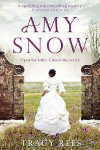
Tracy Rees – Amy Snow
Posted 9th October 2015
Category: Reviews Genres: 2010s, Angst, Domestic, Historical, Romance, Social, Spiritual
Comments Off on Tracy Rees – Amy Snow
Guided to change.
Publisher: Quercus
Pages: 551
Type: Fiction
Age: Adult
ISBN: 978-1-784-29145-7
First Published: 9th April 2015
Date Reviewed: 8th October 2015
Rating: 4/5
Aurelia, heiress to her parents’ fortune, finds a baby in the snow and takes her home. Her parents are furious but they love their daughter and give in to her pleas to keep the child. And so the girl grows up amongst the servants in the kitchen and later with Aurelia as a companion. Later, Aurelia becomes sick and goes travelling whilst she still can, stating she’ll be a few months but remaining away for longer. Upon her death Amy is thrown out of the house with the ten pounds left to her. Only it’s not ten pounds, it’s more, and Aurelia is sending her on a journey from beyond the grave.
Amy Snow is a long historically-rich story of self-discovery and friendship. Written with close attention to detail it is as much about the Victorian period as it is the mystery.
Because, truly, the mystery isn’t much of one. The story is simple and the answers very predictable but this was the intention – Amy works out the most likely scenario long before she learns it officially; this leaves her able to contemplate what happened otherwise. You could call this a cosy mystery – the answer is not imperative, though of course you want to know it, and the pacing is slow. But that is the beauty of the book.
Why? Because it’s not the mystery you want to read this book for, it’s its atmosphere. Amy Snow is a blending of Jane Eyre and any work of Austen. It is a classic Victorian novel written in the 21st century. It’s not perfect – there are some anachronisms, for example – but this book is the book for any reader who has looked at their finished collection of 19th century British novels and wished those authors were still writing today. It’s quite the feat.
So it’s a slow novel, full of waiting around and going to balls and dressing up. It’s got your evil Lady and your awesome elder who defies convention. It’s got your respectable gentleman suitor and your average shopkeeper’s son suitor. It’s got letters and calling cards and upstairs downstairs and your walking around looking at bonnets in the window and exclaiming at their beauty. Rees has worked hard to get it right. Yes there are anachronisms and even more exclamation marks than the Victorians used (this is something you get used to as you settle down into it) but by and large the writing style fits beautifully. It’s obvious that Rees has spent time working through the differences between modern and Victorian speech, and it lets you get pulled back in time. Amy Snow is not as confident as Elizabeth Bennet and whilst she is in a not dissimilar situation to Miss Eyre she spends too much time on herself; but she can be placed beside these two heroines with ease as far as feelings go.
Before I leave off from the writing I want to show you an example of Rees’ metaphors. She favours a certain sort of style that is quite fun, however much it becomes noticeable later on for its repeated use:
He proceeds to grill Mr Garland as thoroughly as a fish for his views about the railway.
The mystery in this book takes second place to Amy’s self-discovery. Aurelia’s treasure hunt, as it were, is important and ought to be followed, but Amy’s journey towards acceptance and who she wants to be takes centre stage. Amy’s journey whilst journeying is of course set apart from Aurelia. It comes with the baggage of knowing she wasn’t wanted by anyone but her friend and is something Aurelia knew but would never understand completely due to their difference in station. Amy struggles with her sudden fortune. At home with the relatively wealthy but down-to-earth family who accept that she would prefer to wear more modest dresses, she finds it difficult adjusting to her next situation which requires her to mix with the upper echelons and dress accordingly. Rees’ novel is somewhat the Cinderella story but unlike Cinderella, Amy can’t simply abandon her past. She has to learn for herself that Aurelia, by giving her riches, is giving her a choice – she can live as a virtual Lady; she can be amongst the gentry; she could become a servant. Aurelia was a Lady who wanted to be independent, see the world, speak to those lower than her, but could do none of those things precisely because she was a Lady. In Amy she posthumously lives her dream.
The self-discovery is where the main flaw of the book lies, one I must discuss if I’m to be objective. (This book left me in raptures, I loved it and it’s joined my all-time favourites, but I can’t deny there are flaws.) A lot of Amy Snow is composed of naval-gazing. Amy thinks a great deal, she over-thinks, re-hashes, and whilst it’s very realistic and happens to the best of us when in a situation where we have to choose and aren’t sure, or have had a sudden change that we’re adjusting to, it doesn’t work in a book. It becomes boring, as do her moans that she doesn’t want to keep following Aurelia’s treasure hunt. If you’re enjoying the rest of what the book does, it’s not going to be enough to make you abandon it, but it does affect it.
Apart from the anachronisms and exclamation marks there are sentences that use American grammar. As the spelling is American it can be assumed the erroneous grammar is not accidental, though of course it should be.
There are some very convenient second meetings where people Amy leaves behind just happen to turn up where she travels to – absolutely understandable when she’s mixing in high society and it’s a high society person she sees as they tended to stick together across the country, but less believable when it’s your average Joe. In this way you’ll need to put on your Rochester’s-voice-echoes-all-these-miles-away hat – is it lovely or just deus ex machina?
Lastly, there are many proof reading errors, distinct from the copy editing problems.
Amy Snow is a trip to the classics section of the bookshop. It’s a dream of a book for anyone who wants their Victorian-setting 21st century novels to be wonderful. It has the sort of epic story vibes, romanticism, that tend to make half of all readers swoon and the other half label it sappy. It’s both phenomenal and flawed.
This reviewer read the epic story and swooned just as she did when she read Brontë; her opinion on whether or not one should read this book is of course going to be ‘yes’ and for that reason she’s going to suggest you decide for yourself.
Related Books
None yet
Speaking to Tracey Rees about Amy Snow, Florence Grace, The Hourglass, Darling Blue, and The House At Silvermoor (spoilers included)
Charlie and Tracy Rees discuss Richard, Judy, Dickens, Austen, and Brontë – not all at once – coffee houses in Victorian times, landslides and hourglasses, changes to the Yorkshire mines in the late 1800s to early 1900s, and the inclusion of the average person in historical fiction.
If you’re unable to use the media player above, this page has various other options for listening.
Robert Merle – The Brethren
Posted 23rd September 2015
Category: Reviews Genres: 1970s, Domestic, Historical, Political, Theological, Translation
4 Comments

All for one and one for… sort of.
Publisher: Pushkin Press
Pages: 402
Type: Fiction
Age: Adult
ISBN: 978-1-782-27123-9
First Published: 1977
Date Reviewed: 21st September 2015
Rating: 3.5/5
Original language: French
Original title: Fortune de France (Fortune Of France)
Translated by: T Jefferson Kline
Pierre was born in a time of war. Some time before his birth, his father, Jean de Siorac, made a pact with Jean de Sauveterre; whilst the Siorac family grew in number, de Sauveterre stayed with them, sharing leadership duties. The war is as much about land and rulings as it is about religion: as Calvin states his ideas reform begins to sweep across France and the people of Mespech begin to join them.
The Brethren is historical fiction, the start of a series that suggests the rest will be epic. A fairly long story, it focuses on Pierre’s childhood and the background of the family. Heralded a modern Dumas, though not quite the same, Merle looks at those who were both at odds with and in favour of the crown.
This book requires a fair amount of attention, composed as it is of battles both factual and not so, other pieces of information, and a number of characters. You’re forgiven for confusing people on occasion – Merle tends to include descriptions with his references and dialogues (for example Colondre’s lack of speech, Coligny’s battle experience). Though technically repetitive it never seems so as it’s helpful. The story is very well set in its era with the benefits of hindsight the author can include. The women are occasionally allowed to be involved in battle (to an extent) and Jean de Siorac’s understanding of health and hygiene is ahead of its time. (As far as the latter is concerned, it’s interesting to note the way what we would now consider common sense is discussed as an unhealthy obsession. Needless to say, however, the good hygiene pays off!)
This book sports action but it’s mostly related third-hand as I’ll be discussing shortly. The story therefore deals more with the domestic side of the sixteenth century – Pierre’s upbringing, the effect of reform on a divided household, childbirth and wet-nursing, and relations between masters and their servants. The family at Mespech have a good relationship with their tenants – they don’t offer in the way of money but there is a relative equality and no one goes hungry. This element, the relationship between the well-off and not so, is perhaps the strongest element of the book.
And there is humour. Some of it must be seen in its historical context to work, for example the woman who always talks of being ‘forced’ into having intercourse, who is always the brunt of laughter because everyone knows she went willingly, enjoyed herself over the course of fifteen times, and uses the notion of being forced to mitigate the problems that would accompany infidelity. Such comedy wouldn’t work nowadays, would be awful. Whether or not Merle’s humour here is comfortable enough for the reader is something else, of course.
The characters are okay – the men developed, a pun that’s intended because the women, as much as they can talk and banter with the men and as much as they don’t have to stay in the kitchen, are somewhat reduced to body parts – again, explained in a moment. Due to the way the story is narrated by a child rather than any of the adults there is not quite enough development for you to feel particularly strongly but then this is the start of a series.
Amongst all the goodness, then, are a fair few problems. The first is the way so much of the book is non-fictional. Historical fiction often deals with fact but Merle has included information as though he were writing a text book, whole swaths of historical information which is often background context rather than anything that affects the characters directly. This means the book is semi-non-fictional and begs the question of how smaller the page count could have been without it.
Merle is absolutely obsessed with breasts. Almost every time a woman is mentioned, so too are her breasts as well as, often, her size. (Most older women are very large, most young very thin.) The female characters are mostly servants of the household but one would not be remiss in believing they’re also there to serve lusts. There are two scenes wherein all heads turn, all gazes fix, upon the firm buxom wet-nurse who takes out her beautiful white breasts during dinner to suckle the lucky little babe the men wish they could replace. Talk of heads enveloped by chests almost forms a theme. Doubtless the male characters would not gawk so much if Merle wasn’t forcing them to do so.
There’s distance between narrator and reader. Where Pierre narrates what happens to his father, third-hand, there is distance and the story is perhaps not as interesting as it could’ve been if, say, these adventures had happened to Pierre himself. This looks set to change in book two, but for this, book one, it’s very much the case.
Finally, exclusive to the English translation, is the language. Merle wrote his story in a sort of sixteenth century French which may sound hard going and potentially off-putting but that’s the way it is. The translator has written the English version in modern English, a little on the Victorian side; what you’re getting is one person’s interpretation more so than you would usually. The lack of comparable sixteenth century English may entice some readers but those wanting to read Merle may find the English drier and less thrilling than the French.
The Brethren has a lot going for it but also a fair amount that’s not in its favour. It is quite fascinating, the modernity of the characters is capable of winning you over, and most importantly it will make you want to continue to book two; but it is best noted that it’s far from flawless and has the ability to disappoint in places.
I received this book for review from the publisher.
Related Books
None yet
Amy Stewart – Girl Waits With Gun
Posted 16th September 2015
Category: Reviews Genres: 2010s, Crime, Domestic, Historical, Social
2 Comments

Taking on a rich lout.
Publisher: Houghton Mifflin Harcourt
Pages: 416
Type: Fiction
Age: Adult
ISBN: 978-0-544-40991-0
First Published: 1st September 2015
Date Reviewed: 15th September 2015
Rating: 3/5
1914: Constance and her sisters were riding their buggy when a car hit them. The owner, the manager of a silk factory, is unwilling to pay the damages and soon the girls find themselves being harassed by his group of thugs. The law courts and detectives aren’t interested and there’s little the police can do until a threat is put into action.
Girl Waits With Gun is an historical novel loosely based on true characters. Constance Kopp and her sisters are people history has forgotten. Presumably the beginning of a series, the book focuses on the sisters’ lives before Constance became a deputy.
Though there is of course a lot of almost forced helplessness, warranted for the time, the book goes a long way in showing the way women could on occasion take control of their destinies. Constance, Norma, and Fleurette are quite fearless and whilst Fleurette is flighty, Norma’s seriousness and Constance’s common sense add up to a good team. That it’s based on truth only makes it better. The social elements are well shown – the frustration of not being listened to compounded by a villain who won’t give up. Stewart talks you through the process of the courts and all the things that wouldn’t happen today.
Great is the application of humour. There are some very funny scenes, particularly near the start, that beg to be highlighted. The domestic/social issue Stewart has added, the fate of unwed mothers, holds much promise and is a good feature, as is the way she moves the sisters from the emotional and social isolation their mother’s worries left them living in to a more open environment. (In this respect, aside from Constance’s later role as deputy sheriff, Fleurette is served best, her extroversion suddenly given full reign and her desires to be the centre of attention taking to the stage, almost literally.) The sisters have been written very well; they read as real as they obviously were and interesting enough that you’ll likely want to do some research.
The book is evidently the introduction for a series; there is a lot of information in it. This means all the ground work is set and in all likelihood the next books will be thrilling, but it also means that Girl Waits With Gun is missing the necessary grip it needed in order to keep the suspense up and the plot moving forward at a steady pace. The thrill, the mystery and suspense that should have accompanied the constant threats of Kaufman’s men is not here; instead we have a general lack of the feeling of danger – staying at home, not being watched over enough – and a pacing that’s frustratingly slow.
A lot of the problem is that Stewart has focused this book on the before – the events before Constance Kopp became a deputy sheriff – and has thus had to create most of the back story. There is a lot of detailing and telling, little showing. There is a lot of repetition, odd grammar choices and anachronisms. Had the book been reduced by half it wouldn’t be so noticeable, nor would the plot meander so much.
If you like learning about the era and about women who broke the mould, you may enjoy Girl Waits With Gun, but know that the title relates more to later events, at least as far as exceptions of action go. It’s a fair story but most will want to wait until book two.
I received this book for review from Historical Fiction Virtual Book Tours.
Related Books
None yet
Judy Chicurel – If I Knew You Were Going To Be This Beautiful, I Never Would Have Let You Go
Posted 9th September 2015
Category: Reviews Genres: 2010s, Angst, Domestic, Historical, Social, Spiritual
Comments Off on Judy Chicurel – If I Knew You Were Going To Be This Beautiful, I Never Would Have Let You Go

Hot summers, long titles, and all that life throws at you.
Publisher: Tinder Press (Headline)
Pages: 326
Type: Fiction
Age: Adult
ISBN: 978-1-472-22168-1
First Published: 30th October 2014
Date Reviewed: 7th September 2015
Rating: 4/5
It’s 1972 and Katie has lived in Elephant Beach on Long Island all her life. It’s nothing special, but it’s home for her and her friends. The prospects aren’t great unless you’ve the money and status to bag a better education, and most people end up at the local college. Getting high is pretty much assumed, cigarettes are smoked by everyone, and everyone’s got secrets.
If I Knew You Were Going To Be This Beautiful, I Never Would Have Let You Go is a book somewhere between a novel and short story collection, that looks at life in a fictional town in the 70s and life at the time for those coming of age.
There is a basic plot running through this book but it’s best viewed as a series of vignettes, indeed if you focus on the idea of a novel having a plot and a main character, you’re going to be disappointed. The stories are mainly set over one summer, with breaks for memories and considerations and reports of the future, and whilst you hear everything from Katie she’s no more important than anyone else. Katie may be the one whose thoughts you know and whose future you’re more invested in by virtue of intimacy, but Chicurel has worked on the whole. It would be fair to say that this book straddles contexts – a book for book’s sake, nostalgia, and a bit of a study.
Not a study as in get your pen and paper and write an essay, more a look at the issues of the time. These are teens still getting to grips with who they are, working through that time between childhood and adulthood and, for many of them, they’re trying to work through the poor hand life has given them, though they don’t always recognise it as such. The drugs keep them living life happy and although the future is discussed, told to us by Katie, everyone is living for the ‘now’. It’s best to. They know they’ve few prospects and that’ll be hard getting out, getting away, though there are possibilities. Many will die young through their various abuses. What all these teens do have, though, is friendship. Lots of it, lots of loyalty. There is a bit of a contrast with the kids from ‘the Dunes’. Chicurel shows us the privileged, the teenagers that turn to hippie living, throwaway boyfriends of less privileged backgrounds and protests for things they don’t have knowledge of, teenagers that were always going to end up as rich as their parents and do.
A new thought occurred to me, that women had all this drama, all this waiting and hoping and crying over things we’d been told, raised on, warned about, these monumental milestones that ended up lasting only minutes in our lives and were never, ever as wonderful or horrible as you thought they would be.
In a way it can seem like there’s a lot going on here, but it works in context. Suicides, overdoses; what we would now call ‘care in the community’; secret abortions where names must not be exchanged (the quote above is from such a scene); running away for a better life to never find it; PTSD. Everything is handled well and with respect in every way.
The affect of the Vietnamese war on mental health is the thread that continues from start to finish. A couple of the characters are veterans and dealing with scars, physical, mental, emotional. Not only does Chicurel detail these changed lives, she shows well how people back home might try but can’t quite understand what would have happened. The veterans, both young, behave in ways unconsidered and the easiest way to show you how the teens are incapable of understanding is to say that Katie fancies Luke something rotten, dreams about their lives together, but thinks trying to get him to notice her will work. You see that Luke doesn’t care but it’s not because he doesn’t like Katie, it’s because he’s got little left.
And there is a smigin of a theme of identity, of finding one’s place. Katie was adopted and wonders about her birth mother – what she’s doing, if she misses her child. The title of the book relates to this.
There are chances gained in this book, but not too many. To make everything work out in the end for everyone would be to negate the very real circumstances the book is grounded in.
I think it’s worth stating that there is a lot of swearing in this book and a lot of very casual ‘yeah, man’ language. I’m stating this, particularly the swearing, because it should be seen in context. Chicurel isn’t aiming to shock or offend, rather she’s setting the book in its era, in its place.
If I Knew You Were Going To Be This Beautiful, I Never Would Have Let You Go. gives you something to think about. There’s nothing we can change now, of course, but it makes you think about similar circumstances nowadays and how the way things are, the privilege, the support, hasn’t really changed all that much and should have. It may not have an ending as such and it may be but a set of memories, but it’s a good read. As much as it isn’t a happy book, it is full of sunshine and friendship. That others would dismiss the friendship and say that it’s a bad place be damned.
I received this book for review from the publisher.
Related Books
None yet.
Horace Walpole – The Castle Of Otranto
Posted 7th September 2015
Category: Reviews Genres: 1760s, Comedy, Domestic, Historical, Paranormal
3 Comments

J K Rowling would like the moving pictures.
Publisher: N/A (I read Project Gutenberg’s edition)
Pages: N/A
Type: Fiction
Age: Adult
ISBN: N/A
First Published: 1764
Date Reviewed: 1st September 2015
Rating: 3/5
In the Medieval period Manfred, Prince of Otranto, arranges a marriage between his sickly son, Conrad, and the lady Isabella. On the day, Conrad is killed by a giant helmet, leaving Manfred with no heir, and an heir he must have if his line is to continue ruling and the prophecy that Otranto be returned to its rightful owner overruled. But Manfred’s new plan of marrying Isabella himself is to be upset by the arrival of a peasant and a ghost or two.
The Castle Of Otranto is a novella in the style of Shakespeare. It’s prose but high in drama; its value lies mostly in its Shakespearian context.
This is because there’s really not much to The Castle Of Otranto and albeit that this was the first gothic book ever written, it pales in comparison to most others. There are paranormal elements, not scary enough likely even for readers of the time, and these elements are never explained, they just happen and Walpole finishes his tale without explaining the whys and hows. The book is incredibly dramatic, there are info-dumps, and the story is minor. Not all that much happens, at least in the context of what we’d call action today, or even what Austen would call action, and a lot of the dialogue is composed of rambling.
What does work, then, is the imitation of Shakespeare. The Castle Of Otranto is to all intents and purposes a prose version of a Shakespeare play if Shakespeare had written about a man called Manfred who wants to keep his castle. The style is very Elizabethan – the first edition had Walpole pretending he was simply the translator of an old text – and the drama far more akin to Shakespeare than any fainting ladies of the Georgian period. The dialogue is full of thys and forsooths… actually it may not include a forsooth, but that word is a good one to use because I think everyone can imagine the period commonly associated with it.
The value of Walpole’s work lies in theatre – this book would make a great performance on the stage of the Globe. Otherwise, however, there is not much to be taken from it; I’d recommend it only to those with a prior interest who want to study drama and/or 1700s literature. There are veiled references to Henry VIII, there’s silliness, and there are many convenient relationships that have most certainly been planned. This book is contrived; it’s meant to be.
The Castle Of Otranto is fun but wearing. Read it if you love The Bard, pass on it otherwise.
Related Books
None yet


