





Anna Hope – Wake
Posted 12th August 2015
Category: Reviews Genres: 2010s, Angst, Historical, Psychological, Romance, Social
2 Comments

Don’t know where, don’t know when.
Publisher: Doubleday (Random House)
Pages: 315
Type: Fiction
Age: Adult
ISBN: 978-0-857-52194-1
First Published: 2014
Date Reviewed: 11th August 2015
Rating: 5/5
Hettie dances for a living. Giving up the job in Woolworths her mother was happy for, she has taken work dancing with men, only getting paid if chosen to partner. When she meets Ed, it seems things might finally be going her way. Evelyn works in pensions, assessing claims for veterans of the First World War and dealing with the lowered pay that the men will not accept. Her brother is always too happy, far happier than other men who served. Ada lost her son to the war but can’t quite believe it; she’s been in limbo for a few years now whilst her husband sits forgotten. In amongst these three tales is woven the homecoming of the Unknown Soldier and the situations of those who aid his journey.
Wake is stupendous. It’s full of character, emotion, the excellent results of research; this book is just wonderful.
In fact it’s the sort of book you wish would be adapted for film; the characters leap from the page – they are very real and the writing is such that you can picture it all well. There isn’t really much of your conventional plot, instead the novel is about the spiritual/psychological, post-war journey of the three characters, the way they deal with the after effects of the war.
The use of the three definitions of ‘wake’ speak of the book’s whole as you might expect. The characters are waking from a metaphorical slumber: Hettie from her situation at home, her strict mother and now silent brother; Evelyn from the drudgery of the everyday; Ada from her limbo. We witness the funeral and effects of the funeral, which could be termed the ‘wake’ of the Unknown Soldier. And we are seeing what’s happening as a consequence of the war, in the wake of the war. It is a rather powerful combination and the way it’s all done so that it takes studying to really see it, is rather stunning, too.
It’s this, the combination of the three definitions, that makes the book what it is. There is just so much to take in, to savour, despite the story taking place over only five days. Emotion is the be all here, and whilst the characters are each important, the culmination of the book, the homecoming of the unknown soldier is just as important if not more so in some ways. It’s the way Hope links the homecoming to the characters, the way she demonstrates to her readers, most likely people who did not witness the event and were not alive at the time, what an effect it could have; you will feel like you were there. It’s fair to say she shows the event from the point of view of those who organised it – what it was created to represent. The body could represent a person another had lost, the lost person who hadn’t been found. People could, likely often quite reasonably, believe it was the body of a loved one. It’s this symbolism that Hope delves into with such aplomb, and the emotion she stirs up… well, similarly to what I’ve said above, you can picture it in your mind, it’s as vivid as a film and as powerful as any visual could be. If you’ve ever wondered what this time was like, this book will show you, and as my repeated use of the word should intimate, it really is all about ‘show’ – there is no telling here even though there are details aplenty.
Back to the characters then; that well-known situation where you tend to prefer one character’s narrative to another? – Hope tackles that to good effect. You may still prefer one of the three but it has less of an impact because the author is constantly switching back and forth, never lingering too long; she’s spends time fairly. She also gives you reason to enjoy each narrative and to really get under the skin of Hettie, Evelyn, and Ada. She keeps them apart, narratively, so you can focus on them.
Hettie, who introduces us to old-fashioned dance halls and the PTSD from the viewpoint of the sister of the man; Evelyn who has been as involved as she could be in the war, lost a finger and rebelled against bad parents in a similar place as Hettie, the sister, but closer to her brother; Ada, parent, sometimes wife, who is seeing her dead son everywhere and can’t accept the loss without information. The thread of PTSD, as seen and experienced by the various characters, is rather valuable in its way. Of course not everyone will recover, but the author shows the glimmer of hope.
The writing? Gorgeous. Succinct but never lacking. Every word valuable whilst not important – it’s the whole that’s important but the pieces make it so.
It is difficult to do Wake justice; one just wants to say ‘read this book!’ but of course that would be an injustice. Suffice to say that if you want to learn about the aftermath of WWI, you should read this book. It may be fiction but the facts are everywhere. If you want to learn more about the time period in general, you should read this book. If you want to learn about women’s roles in society, the way they were reversed after a war which saw woman move from the home, you should read this book. If you want to read something powerful, vivid beyond your imagination, and unique in the way it deals with the subject, you should read this book.
Just read this book. There; I said it.
Related Books

Mary Ann Shaffers and Annie Barrows – The Guernsey Literary And Potato Peel Pie Society
Posted 15th June 2015
Category: Reviews Genres: 2000s, Books About Books, Historical, Political, Social, Spiritual
4 Comments

Turnips, books, and occupation.
Publisher: Bloomsbury
Pages: 238
Type: Fiction
Age: Adult
ISBN: 978-1-408-81026-2
First Published: 29th July 2008
Date Reviewed: 14th June 2015
Rating: 5/5
Juliet is stuck. Her last book did well but she’s having trouble finding a new topic to write about. She begins to receive letters from a man in Guernsey who bought a book she’d sold to a second-hand shop. Dawsey introduces her to his life and friends, the story of their makeshift book club, and wartime Guernsey. It’s hers for the taking.
The Guernsey Literary And Potato Peel Pie Society is a wonderful little book that has earned its place in every bookshop. (Is there a reader who hasn’t encountered it somewhere?) Jolly, fun, but balanced by the solemnity of World War II, it provides both a great escape and an excellent history lesson about a place mainland classes forget.
The book is told through letters, telegrams, and a couple of diary entries. The correspondents are many but it’s not difficult to keep track of who’s who – the only reason you’ll fail is if you worry about it. The authors have given each character a unique voice and personalities shine through the text. You will know these people extremely well by the time you’ve finished. You’ll know more about them than you would if the book had been told in usual prose. The writers are open, unrestricted as they are by thoughts of anyone else reading the letters than their intended (fictional) friend. Given the nature of letters between friends, the book is not bogged down by detail. You form your image of the characters naturally, without the usual ‘my hair is… my eyes are…’ and it takes the pressure off; you never have to wonder if you’re picturing them correctly.
This is a story within a story. It’s about the composition of a potential new work of fiction or non-fiction inside a larger tale. It’s as much about Guernsey as Juliet’s personal journey through life, about the beginnings of a new way of life, and like Daphne Du Maurier’s Rebecca it’s also about someone who is no longer there (though for entirely different reasons). You get the wishes, the relationships, and the mundane day-to-day. The troubles, the fun, the history.
And history is inevitably important to this book. Shaffers (for we can assume it’s her1) spends a lot of time on the German occupation of Guernsey, ensuring the fiction she writes weaves around it convincingly. She shows the hard times, the evacuations, the punishments, the food scarcity, but she also shows the humanity of the German officers, reminding her readers that there was a fair amount of ease, some respect between the occupied and occupiers. The name of the book, quirky as it is, links into the rationing and shows people trying to make the best of a bad situation.
So, not surprisingly, this is also a book about books. Books bring Juliet and the islanders together and there are explorations of reading groups and passages and, on a general scale, what reading means, the place it has in our lives. Literature carries the story along.
In truth any review I wrote could not do this book justice. It is hard to put into words how great an experience it is. If the characters see Guernsey as home, see those who arrive as coming home, then reading the story is like coming home. You are welcomed with open arms. The characters could be real, the authors the fictional people.
The Guernsey Literary And Potato Peel Pie Society is exquisite. It’s an escape, it’s a laugh, it’s a lesson. There’s a reason it’s everywhere and has been for some time. Let yourself be drawn to the characters, let them whisk you to their post-war Guernsey.
1 Shaffers wrote the majority – Barrows, her niece, took over when her aunt was too ill to carry on.
Related Books

Eloisa James – Duchess By Night
Posted 13th May 2015
Category: Reviews Genres: 2000s, Domestic, Historical, Romance, Social
1 Comment

Infiltrating male society.
Publisher: Avon (HarperCollins)
Pages: 366
Type: Fiction
Age: Adult
ISBN: 978-0-061-24557-2
First Published: 1st January 2007
Date Reviewed: 12th May 2015
Rating: 4.5/5
Isidore is tired of waiting for her husband to turn up and after ten long years the suggestion of Lord Strange’s illicit house is most compelling. Harriet, widowed Duchess of Berrow and sometimes unofficial judge, agrees to play a male so that the plan can go ahead without a hitch – Isidore will have a friend with her, it just won’t be known. Harriet would like to find love but Strange’s party isn’t the place, or is it?
Duchess By Night is a great book that’s only downside is its ending.
James is on top form. The writing is very readable, the humour laugh-out-loud. The book begins on a fun note, the drunken judge whose role Harriet has taken over and a fancy dress party at which Jemma lends her a stuffed goose as a prop, and it sustains it for a rather long time.
The characters are fun. Not everyone is developed particularly well but due to the nature of the book that doesn’t matter so much. Harriet loves being a man and this shows, she takes to her role like a bird to flight and the freedom allows the story to be more involved with the male side of life. Harriet is also allowed to be a man by those who know, making polite society have less of a stake (if it ever did in this series!) This said, Harriet’s character is a little fluid, most obviously at the end which I’ll be discussing later.
Strange is best once he’s figured out Harriet is really a woman. It’s then that he comes into his own as does the romance. He’s not bad otherwise but he’s not presented as particularly eligible, and by this I don’t mean the house parties. He doesn’t read as eligible because in truth he sounds a little too old and distant; it’s after the reveal you get the sense he’s Harriet’s age and a good match for her. As such, overall he’s a rather different hero to those in Desperate Duchesses and An Affair Before Christmas, less defined, not as well written. Related to difference but not writing, as he would say, he’s a libertine, so the sex scenes are a bit different. This is not a bad thing.
There is Eugenia, wonderful literal child of fiction. Strange’s eight year old daughter is into science and maths and she’s marvellous to read about. Though kept away from the parties she’s mature enough to provide fun (and accurate) commentaries on adult songs. Her scenes are ones to look forward to. Although the book is a romance, everything else in it is just as good to read about.
There is a lot of bias against same-sex relationships as might be expected in a book set in this era. It is entirely in context and nothing is remarked upon out of it – these are 1700s thoughts, no more. The era does lend itself to an interesting semi subtext, however – Lord Strange rather fancies effeminate ‘Harry’, so what does that say of his sexual preferences? It was always going to be beyond the scope of the book to explore, but it’s interesting to speculate whether or not Strange is bisexual, or if he somehow sensed Harriet’s true identity before he really knew. It is also interesting to look at the way there is a lot of freedom in Strange’s house for affairs and casual sex – but not between two people of the same sex. Duchess By Night is almost a mini study at times.
I should mention Isidore here because it’s important – whilst Duchess By Night is Harriet’s book, the premise sets up the next, Isidore’s own book. This means that Isidore’s musings and hopes of luring her husband home play an important part. As someone there by choice but not there to ‘partake’, Isidore provides both balance to the house and a reminder of the differences in society.
The book takes a while to get to the romance but that’s okay – Harriet’s exploits are something you won’t look forward to ending. James makes up for the time Strange is confused by way of a several pages long reveal and sex scene in the latter section. It could be argued this book is the steamiest so far, though due to Harriet’s relative inexperience and Strange’s insistence it could also be argued it’s the least comfortable. James spends time making her characters take their time but keeps the balance between closed and open doors – this is to say there aren’t numerous sex scenes – barring the first they are short and a lot of the content is alluded to rather than written out. The story rests very much on the general attraction and compatibility, even if it doesn’t always read as though the compatibility is complete enough.
This book would get the top rating from me if it were not for the end. Duchess By Night is excellent right until the last 30 or so pages when it turns to mush. An illness and plight for no reason – presumably James meant to further deepen feelings but it wasn’t necessary. The very end is a gooey, sickly sweet mess in which there are sudden pointless arguments and sentimental conversations. Most notably Harriet’s personality does a 180 and it’s stated she won’t be wearing male clothing any more even though the book had shown she would. Soon after this it appears she does don breeches irregularly, but not for the freedom. In sum, the ending doesn’t fit the rest of the book and the characters aren’t the Lord Strange and Harriet we’ve come to know.
Duchess By Night is a blast; it’s an absolute riot. You’re likely to enjoy its successes even if you do have to rewrite the conclusion yourself.
Related Books


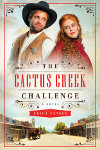
Erica Vetsch – The Cactus Creek Challenge
Posted 4th May 2015
Category: Reviews Genres: 2010s, Angst, Domestic, Historical, Inspirational fiction, Romance, Social, Western
2 Comments
Guns, outlaws, and women included.
Publisher: Shiloh Run Press (Barbour Publishing)
Pages: 309
Type: Fiction
Age: Adult
ISBN: 978-1-630-58927-1
First Published: 1st July 2015
Date Reviewed: 3rd May 2015
Rating: 3/5
Schoolteacher Cassie loves sheriff Ben, but Ben still sees her as a child. When they are paired together, tasked with doing each other’s jobs, both are confidant they can rise to the challenge. Then there is new resident, baker Jenny, a widow with a past she’s not divulging, who is paired with another widow, stable owner Carl. Whoever does their temporary job best wins money for a certain sector or the town but it’s likely they’ll win each other, too.
The Cactus Creek Challenge is an inspirational (Christian) western romance that focuses on domestic and social relations.
The story is simple and mostly predictable but that’s no bad thing; it leaves Vetsch able to look at her other themes. There are two romances. The reader is likely to vastly prefer one to the other due to how much more natural it is. The slow burn of Carl and Jenny’s relationship is rather special and it’s written very well. The addition of Amanda, Jenny’s child, only adds to it. Yes, Amanda is included a lot and almost too talkative (in the way of info-dumping) but the relationship and development of the new family is rather lovely.
Cassie and Ben, on the other hand, is a relationship that’s more forced. There is a nice passage in which Ben realises Cassie has grown up but otherwise their relationship isn’t so believable. It’s hard to see why Cassie likes Ben, particularly when we’re told they are like siblings but never shown any true evidence of it or any friendship. The relationship rests on what we’re told, that Cassie loves Ben but she’s always moaning at him, that Ben now likes Cassie (that nice passage) but it doesn’t really blossom.
Carl and Jenny are the stand outs in this book; both work hard to do the other’s job and to understand life from that point of view. Carl’s efforts to bring Amanda out of her shell and his love for her are written brilliantly; he is a very endearing character. Jenny worries about her past but Vetsch keeps it from becoming frustrating – there is no constant pushing away as there can be in other books.
One of the problems with this book is that Cassie is a bit of a mismatch. Vetsch presents a woman who was a tomboy in her youth, a woman who loves the idea of being sheriff for a month, and who shows promise to the reader as such – and then has Cassie prettifying the jail in a way that makes no sense and bares no relation to the set-up. This second Cassie does not comprehend why Ben is angry she’s added curtains and crockery and cushions to the jail, does not understand why it’s inappropriate to have a tea party there with all the ladies of the town, whilst simultaneously wanting to be the sheriff.
In the main the story reads well, but there are a few issues. Foremost is the way two of the characters kill a kidnapper – they are worried about the child which is understandable, but there is no mention of any remorse or prayers to God, which in the context of the Christian background is difficult. The body is pulled back home and will be planted in the ground; no prayers, nothing. The man is shot and anything else is simply ignored by the text.
Otherwise religion is included well. There is one time wherein an entire hymn is included, which is a bit much and lessens the effect, but otherwise faith lingers in the background, naturally informing the character’s lives. The romantic scenes show well how a book can be perfectly steamy without the characters ever adjourning to the bedroom. Carl and Jenny’s scenes stand out as their scenes do in general, but there are some lovely moments between Cassie and Ben near the end.
Throughout the book you know there’s a fair chance of a particular event occurring – it’s something that is reported as a possibility in line with Jenny’s leaving her old home. It’s something that’s almost expected as an element. However when it comes down to it Vetsch decides to use the concept itself but place it in an entirely irrelevant context, an unimportant plot device sort of context, that could be considered frustrating due to how successful and meaningful the alternative would have been. It’s a case of close but no cigar – not bad, per se, but the alternative was so remarked upon that it does feel as though the story’s going down the wrong path.
There are continuity errors, for example a character says that a person should follow them outside and moments later the second character leaves by themselves with no mention of changing the plan. Chairs are pulled out, never to be referred to again. Part of the story is made up of accident after accident after accident. Lastly there is a great amount of info-dumping and the text is overwritten (excursions that are simply to introduce someone to the reader rather than having an actual raison d’etre).
The writing itself is strictly okay. Here again there is too much description (to paraphrase, there are lots of sentences akin to ‘he took the chair from the desk and sat on the seat’), factually inaccurate statements and anachronisms.
The Cactus Creek Challenge isn’t as refined as, say, A Bride’s Portrait Of Dodge City, Kansas, but it’s generally well set in its era and the twist of women doing the men’s work is as fulfilling as you might have hoped upon reading the blurb. It’s also a fair choice for those looking for faith in their fiction without it being a theme. It’s not going to ‘wow’ you, but you may find yourself lingering over it all the same.
I received this book for review from the publisher.
Related Books

Nancy Bilyeau – The Tapestry
Posted 24th April 2015
Category: Reviews Genres: 2010s, Historical, Political, Social, Spiritual, Theological
1 Comment

Youth must have some dalliance1.
Publisher: Touchstone (Simon & Schuster)
Pages: 380
Type: Fiction
Age: Adult
ISBN: 978-1-476-75637-0
First Published: 24th March 2015
Date Reviewed: 23rd April 2015
Rating: 3.5/5
Joanna Stafford, ex-novice of Dartford Priory has been summoned to London but when she gets there she’s led away by someone who wishes her harm. She doesn’t know who he is and is unable to find out but finding protection she stays, meeting Thomas Culpepper and later her relative, Catherine Howard. Joanna just want to live her life, but she’s a way to go before she can.
The Tapestry is the third and last book in Bilyeau’s series on Joanna. It is well written and, as always, wonderfully blended with the true history, though perhaps not as strong as the previous books.
To the writing then: it is lovely. There are no two ways about it; Bilyeau’s work makes for a good read. There are your odd phrases and words that are a little too colloquial but not glaring when considering the fact the story could hardly be written in Middle English, and Bilyeau continues to evoke the Tudor period in a very natural way; you never feel you’re being taught.
The book is slow to start, in fact the story on the whole is a lot slower than the previous. There is far less action this time around and there isn’t one definitive plotline – this isn’t all about a tapestry. It is nice in that it aids the wrapping up of the series but it does mean there are times you can easily put the book down. Given the content of the story, Joanna comes across as weaker than before though this really is more of a ‘comes across as’ rather than a reality. Sometimes the character seems to take a while to realise what will likely seem obvious to you and this is something that is difficult to either defend or criticise. On one hand Bilyeau is writing about popular history and it’s very likely the reader will know the history prior to reading, ergo you know a certain person is going to become queen number five. On the other hand you’ve got to remember that Joanna Stafford (and so, in this respect, any real person who might have been a semi or regular stranger to the court) would not have known any of it so it makes sense she would take a while to catch on. Hindsight is everything. Joanna does over-think things sometimes; it is fair to say it’s down to the reader to let things unfold as they will.
The best aspect of the novel is one shared with The Crown and The Chalice: the blending of fact and fiction. On top form as always, Bilyeau fills gaps, sometimes to an astounding degree; it’s almost cheeky the length the author goes to but it’s cheeky in a very good way. The blending is exceptional – if you’re not familiar with the series, what Bilyeau essentially does is write her fictional characters into the factual history in a way they can be added and removed without leaving a mark. And this time around, Bilyeau has aimed higher than ever, using our scant knowledge of Catherine Howard’s life to construct one possibility of who the girl was. Joanna does not change anything at a fundamental level; Bilyeau rewrites without rewriting. (This can mean that some subplots seem irrelevant and confusing for a while as Bilyeau seeks to keep the timeline in check and provide background context. The major reasons for the sub-plots become evident in time.)
There is but one element that brings the novel down a couple of rungs. Grammar issues, changing names, and missing words feature throughout the book; the text isn’t always fluid and it can be difficult to stay focused, to not be jolted from the story. The writing itself remains lovely, which is testament to Bilyeau’s talent, but the book does suffer quite a bit from the errors.
The Tapestry takes someone who is surely beloved of many Tudor fiction fans and gives her story, her journey, a firm ending. It is slow (but steady) and does have its drawbacks but it’s a fair end to the series and, no matter how many times you may have read about the history of Catherine Howard, it manages to make you feel as frustrated or sorrowful or angry as you likely did when you first found out about the situation. And that is quite the boon.
1 Line from Pastime With Good Company by Henry VIII.
I received this book for review from the author.
Related Books


Speaking to Nancy Bilyeau about the Joanna Stafford trilogy, The Blue, and Dreamland (spoilers included)
Charlie Place and Nancy Bilyeau discuss the lifestyle of Dissolution-era nuns, using a website’s ‘contact me’ form to great success, there being more relics than there were items, using your family’s name in your work, and the grand amusement parks and luxury hotels of New York’s past.
If you’re unable to use the media player above, this page has various other options for listening.


