




Ben Fergusson – The Spring Of Kasper Meier
Posted 17th June 2016
Category: Reviews Genres: 2010s, Historical, LGBT, Political, Social, Thriller
1 Comment

Blow a kiss, fire a gun.
Publisher: Abacus (Little, Brown)
Pages: 386
Type: Fiction
Age: Adult
ISBN: 978-0-349-13976-0
First Published: 15th April 2014 in translation; 17th June 2015
Date Reviewed: 15th March 2016
Rating: 3/5
In the year following the end of WWII, the rubble of ruined buildings sprawls across the streets of Berlin. Kasper, a black market trader, is not acquainted with any rubble women until one day he is stopped by one who wants him to find a pilot. She won’t say why but to Kasper it’s clear there’s some sort of underground factor to it.
The Spring Of Kasper Meier is a thriller that looks at a certain aspect of the aftermath of war. It’s categorised under the thriller genre, but doesn’t quite match it.
This is a novel wherein the vast majority of the book doesn’t do anything to recommend itself but the last 50 pages are excellent. It’s a case of the reader having no real idea as to what’s happening, and that’s not good here. There’s no suspense until those last pages start and it just feels like a lost chance. Nine out of ten times you don’t have a clue what’s happening or why you’re reading about a person and even if you manage to figure some of it out the raison d’etre will likely still evade you. It’s the lack of any clues that is the problem.
The writing doesn’t help. There’s a decided lack of commas which means clauses run together so you have to work out what the sentence is saying. Of facial expressions there are too many in each piece of dialogue – speaking then smiling then speaking then surprised then speaking and laughing, that sort of thing. All tell, no show.
The history’s good. That’s the one plus side of the telling – you get a good picture of the period. One of the themes is sexuality, in this case being gay in 40s Europe. It’s dealt with well – there’s commentary when needed but otherwise Fergusson just gets on with it. As the majority of the characters and certainly the main characters are German, there is more time spent on Kasper’s romantic history than, for example, the plight of the Jews. Women also get a look in, though mostly it’s in the form of Kasper’s friendship with Eva.
Like other recent writers of the occupation of Germany by the allied forces, Fergusson doesn’t shy from showing the realities of German life and the way that not all those in the allied forces were good. He shows the horror of it, reminding us that regular people faired the same way everywhere.
The Spring Of Kasper Meier, then, is a book of good history, but otherwise isn’t so great. If you’re able to figure out – or guess correctly – what’s happening early on, you may enjoy it more, but most will want to keep it on the to-be-read pile for a while longer.
I received this book at the Young Writer of the Year award blogger event.
Related Books
None yet
Sue Gee – Trio
Posted 27th May 2016
Category: Reviews Genres: 2010s, Domestic, Historical, LGBT, Music, Spiritual
2 Comments
The healing powers of music.
Publisher: Salt
Pages: 308
Type: Fiction
Age: Adult
ISBN: 978-1-784-63061-4
First Published: 16th May 2016
Date Reviewed: 23rd May 2016
Rating: 4/5
Margaret dies early in the marriage; Steven is devastated but knows he must keep going. One day his colleague at school invites him to a concert and though Steven has no knowledge of music he enjoys it, and comes to enjoy the company of his colleague’s childhood friend. His loss will always be with him but in Margot and her music he sees light ahead.
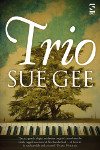
Trio is a book set in the couple of years prior to the Second World War that looks at sadness, tragedy, and the way we deal with it. A beautiful work of literary fiction, it’s full of originality and sports a lovely uniqueness.
And then the gas masks came. In every classroom, throughout the lunch hour, came the struggle to fit the things on, the coughing and heaving at the rubbery smell, the helpless laughter as the trunks were waved about; the trumpeting.
‘Look at you, Hindmarsh!’
‘Look at yourself, Potts. You look prehistoric.’
‘All right, boys, that’s enough.’
Gee’s been writing for years and it shows. Her writing style is rather like a script; the author includes description in the third person but will then switch to dialogue in a way that means you hear a lot more about the situation in a sort of faux first person. Many of the descriptions of thoughts turn out similarly. It won’t be to everyone’s tastes but it is something that everyone is likely to appreciate, at the very least. It’s a literary dialogue, at once between the author and her characters – rendering them in a realistic fashion – and also between the author and the reader, both a breaking of the fourth wall and a hiding behind it. It means that every single character who speaks – every pupil in Steven’s class who gets a mention – stays in mind as though they were all main characters.
Sadness informs most every part of this book. It’s everywhere but Gee never lets it burden the text itself, meaning that whilst this book may be triggering if you’ve recently lost a loved one, it’s not a book you’ll need to avoid for long. But whilst not burdening the text, Gee never covers up, showing how sadness carries on, lingers far longer than our speaking of it shows. In this way she demonstrates how that point wherein society says ‘okay, enough moping now’ shouldn’t be taken as wholly as we often do – everyone suffers losses and it’s okay to refer to it in the future.
There are various tragedies: Steven’s loss of Margaret, a person’s ‘loss’ of the friend they are in love with (twice over in this case), the way a rebuff of affections can lead to awful conclusions. Many of the losses are connected but few are vocalised. Gee uses a bit of mystery in order to explain certain emotions – they aren’t mysteries you need to work out as it’s pretty clear who is who and what is what, it’s that the emotions need to be hidden between the characters because of a feeling of shame or worry that is down to their situation, their relation to one another, and the time in which they are living.
The book is fantastic right up until the last couple of dozen pages. Everything ebbs along and you’re ready for the inevitable start of the war and in seeing where it takes the characters and then suddenly you’re pulled forward to our present day. There is no conclusion to Steven and his friends’ stories, instead you move on to the latter years of Steven and Margot’s son, a person you’d not met. Why this was done is not clear – presumably it was so that we could learn the outcome of everyone’s lives, but this is small compensation; the information could have been provided in an epilogue or, because there’s really only one character you ‘need’ to hear about, communicated naturally at the end.
As for the musical episodes they are mainly good, if a bit overwritten. Steven’s lack of knowledge means that Gee goes into a lot of detail, romanticising the sounds and effects of music; when it’s part of the subtext it’s glorious. The trio of the title don’t quite make the book what it is – that’s Steven’s role – but they play their part; it’s more that they’re the ones through whom people are connected.
Trio is difficult to put down. It’s a gorgeous escape back in time that for all its – needed – sadness, is gripping. The end does come out of left field but the overall product is wonderful.
I received this book for review from the publisher.
Related Books
None yet
V H Leslie – Bodies Of Water
Posted 16th May 2016
Category: Reviews Genres: 2010s, Historical, LGBT, Paranormal, Science, Social
2 Comments
Not just a siren’s call.
Publisher: Salt
Pages: 130
Type: Fiction
Age: Adult
ISBN: 978-1-784-63071-3
First Published: 15th May 2016
Date Reviewed: 3rd May 2016
Rating: 4/5
Following a sad breakup, Kirsten moves into an apartment building situated beside the Thames, which used to be a wing of a Victorian hospital. Drawn by the location, she starts to unpack but is relieved to find she’s not the sole resident of the renovated block. Then there’s Evelyn, rescuer of fallen women in the late 1800s, who has been sent by her father to a hospital for the Water Cure. She’s haunted by the loss in her life of her former lover, a woman she rescued, and hopeful that her stay can help her.
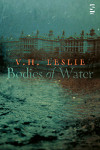
Bodies Of Water is a paranormal, gothic, novella that looks at the way water has had an effect on lives through the decades. It’s a dual plotline work that doesn’t go the way of many others, making it more unique (there are no revelations of connections between the characters).
Leslie has compiled a few concepts and it works very well. The book studies the treatment of women in the Victorian times, contrasting it slightly with the present day. The author works from the diagnosis of hysteria, that Victorian concept of a particularly feminine illness often associated with what we’d now consider the repressed sexuality of women. Leslie never says what caused Evelyn’s hysteria directly – in a way it’s up to the reader to decide – but this works in the book’s favour, allowing for more thought as much as it ushers you to concentrate on the bigger picture. Because whilst Evelyn seems fine, her stay at the hospital speaks of the wider issue.
It’s the basis behind Evelyn’s calling that Leslie wants you to focus on; Evelyn works for the Rescue Society, going out into the streets to aid prostitutes, hoping to save them from the abuse many suffer, from sexually transmitted infections. She likes the idea of bringing the women to a better, higher life, though through the chapters we see her realising that this cannot always happen – in the case of Evelyn’s lover, Milly, for example, Evelyn can’t get away from the fact she’s got Milly a set of rooms but no society to mix in, and that their relationship may be about love on her own side, but Milly may see it as just more of the same.
It’s Milly’s death that gives the study its backbone; Milly is one of many women who have taken their lives, fallen into the Thames, so that whilst Kirsten, who comes to see the paranormal in her leaky ceiling and in the drenched woman on the river bank, is more a bystander, learning about what happened at the scene abstractly, Evelyn’s direct relationship with the river allows a more poignant mode of thought. And as the Victorian character comes to understand the finer details of the hospital and suffers a setback, so her thoughts take quite a shape:
As for lust, it seemed to be the curse of every man. The Rescue Society would have no fallen women to rescue if men could only control what was between their legs. Evelyn had read in her father’s medical journals that hysterectomies and clitoridectomies were often performed to cure women of the very condition Dr Porter had diagnosed Evelyn with. They were so ready with the scalpel, these medical men, to cut and slice, yet no one had thought that castration was the logical solution to venereal disease.
A running point through the book is this plight of women to be heard and to gain freedom; Virginia Woolf’s thought of a room of one’s own is given space, her demise compared to that of the many fallen women ending their lives in the river. There are echoes of Kate Chopin’s The Awakening, too. Kirsten’s introduction to the relative reality of what’s going on is in the form of drawings of bodies being pulled out, doctor’s knives at the ready. Because how else were women to be understood?
Leslie’s study is a good one, just a little short. There is some confusion in the story that would not be there if the plot had been teased out more, given more time between revelations. Everything happens a bit too quickly and questions are left unanswered. In terms of the text there are patches of proofreading errors that are noticeable and add to the confusion on occasion.
But all in all Bodies Of Water is a solid article. It’s well-researched and it puts a different spin on a well-used format. It’s got enough of the history that intrigues many people without treading the same path. Recommended.
I received this book for review from the publisher.
Related Books
None yet
Alex Pheby – Playthings
Posted 9th May 2016
Category: Reviews Genres: 2010s, Historical, Psychological, Social
2 Comments
Nothing is as it seems/everything is as it seems.
Publisher: Galley Beggar Press
Pages: 235
Type: Fiction
Age: Adult
ISBN: 978-1-910-29647-9
First Published: 5th November 2015
Date Reviewed: 22nd April 2016
Rating: 4/5
Judge Daniel Paul Schreber can’t find his wife. She’s gone, and the cook doesn’t seem worried enough. On running outside, he sees his daughter returning home; she urges him to go back in, but he doesn’t, and when others find him they say they’ll take him to his Court. When he wakes up he’s in a sanatorium.
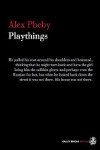
Playthings is a fiction book based on part of the life of a 19th to early 20th century German judge, diagnosed with paranoia Schizophrenia, who wrote a memoir in the hope it would allow him to leave the sanatorium he was living in. It’s a rather unique book that gives all its time to Schreber and what was going on in his mind, based on reports and the memoir, and is quite something.
Pheby throws you into the story without explaining anything, which has the effect of leaving you as confused as his character about what is going on. It’s a great beginning that enables the author to demonstrate Schizophrenia without description, without having to say anything about it, the ultimate of the concept of show rather than tell. And it carries on throughout, meaning that on one hand you understand what Schreber is going through – you’re in his head, via third person, after all – whilst simultaneously questioning everything. It’s the unreliable narrative at its extreme.
So you feel for this man from the get go because whilst you may not understand him at his core, you’ve been with him from the start and he is what you know. You sympathise with his confusion. There is seemingly no malice in him and so you’re comfortable in your discomfort and want him to prevail. That’s important to note, I think – you’ll feel at a loss at the start but you gradually get used to it and any hope you may have had that Pheby would give you a clear answer at some point fades away because you just don’t need it.
Unfortunately what the thrown-into-the-story factor also means is that you’ve no context in which to ‘get’ what’s going on. This book is Pheby’s fictional attempt to continue Schreber’s memoir, to give life to the times of illness that Schreber did not write about; the story reads very much as a continuation and so whilst you may be happy with that, you are just as likely to feel you lack the context, history, information, to truly appreciate it. There is information enough about Schreber online, and likely if you’re interested in the book you’ll have a basic idea anyway, but it does mean you can’t expect to pick this book up at random. It requires research in a way fiction often does not.
It’s worth doing your research. Not only does Pheby look deeply into the way mental illness was viewed and treated at the turn of the century, which is reason enough to read it, he looks at Schizophrenia itself meaning that albeit historical, there is a lot to learn about the illness from this book. He looks into the progression, at where Schreber’s Schizophrenia may have begun (there are a few opinions on this; Pheby’s opinion is of events in Schreber’s childhood and he looks to Schreber’s family’s dynamics for evidence, which are of course fictionalised somewhat here but the factual base is there), at how it affects a person, and by the excellently crafted confusion he includes, he shows how reality and fantasy can be mixed up.
In this book repetition is intentional. If you think you’ve already read that line, heard that simile, you have – one of the features of Schreber’s illness is that he will think he is somewhere and then later think he’s there again and so on. There are conflicts in this book that would be called devices in other books and that simply isn’t the case here – here it’s just truth and illness. Schreber goes on for a very long time about his wife, showing us in turn – once we’ve realised how much time has or has not passed – that his perception of time is rudimentary at best. And so yours will be too – are we on a memory of last week or moments ago or are we in the present? You must work it out.
That isn’t to say you have to be perfect at identifying everything; on this note each chapter starts with a sentence or two which details what the chapter is about – this helps you figure out your impression of events but doesn’t cure you of confusion, leaving out enough that you can draw a line between fantasy and reality but not to be let off the hook. Your job as the reader is to be in Schreber’s head. The sentences have the effect of making the book seem a bit theatrical in the literal sense and bring an additional atmosphere to it.
“There are things I do not allow myself to think of.”
There is a lot of tragedy in this book. Schreber’s father had a few accidents and as he had been very strict and into routine for his children – he’s rather akin to The Sound Of Music’s Captain von Trapp – this has a profound effect on the children and the working of the household in general. Schreber’s illness was characterised by the feeling that he must be good for God, and here, in this book, at least, we witness the emergence of one of the factors of this complete willingness to please – Schreber’s belief that God was turning him into a woman. It may not be obvious from the text of the novel, but this was not a transgender issue, rather an anxiety, a paranoia about what God wanted from him. Whilst at first confused, the character later takes comfort in pretending to be his mother, in assuming her role. He comes to believe he needs to be a woman to do what God wants.
Of Schreber’s father’s authoritarian manner of parenting, some people have used the term ‘psychological fascism’ to describe the way Schreber thinks – to describe the thoughts he has that you come to understand are the result of his father’s demeanour. It fits. There is no reasoning in himself; Schreber is his own dictator in many ways.
Of tragedy, and in terms of the above quotation, however, perhaps the most effecting part of the book occurs in the penultimate pages. We see the ultimate reason for Schreber and his wife’s adoption of a child, and of a girl at that, in a time when heirs were boys. You know the basics for a while but Pheby goes right to the heart of the matter, speaking plainly of multiple miscarriages and two stillbirths that caused the couple a lot of pain; in particular we see Schreber’s pain which given his illness is honest and could be considered graphic – not in a dirty way but in the way devastation can cause things that are understandable but are things we don’t like to talk about. If everything else is somewhere on the scale of confusion, then this episode is clear, transparent.
He sees himself shouting like a God to his stillborn children, animating them, but them refusing to move.
Playthings is a fantastic book. It boasts a particular individuality that’s not just in its subject matter but in its handling. It’s well written, clear in its confusion; it’s one you won’t forget any time soon. You do need to do your research, be awake so that you catch every detail, and willing to start and end in the midst of a longer tale, but make time for some preliminary reading and get to reading this book. You’ll know a lot more about many things by the time you’ve finished and there are a variety of reasons to enjoy it.
I received this book at the Wellcome Book Prize blogger’s brunch.
Related Books
None yet
Nicholas Royle and David Gledhill – In Camera
Posted 6th May 2016
Category: Reviews Genres: 2010s, Art, Commentary, Historical, Political
Comments Off on Nicholas Royle and David Gledhill – In Camera
Watched, photographed, painted.
Publisher: Negative Press
Pages: 40
Type: Fiction
Age: Adult
ISBN: 978-0-957-38283-1
First Published: 10th May 2016
Date Reviewed: 23rd April 2016
Rating: 4.5/5
Taken by her father’s instruction that she may hold his camera but never click the shutter, an East German girl living at the time of the Cold War cannot quite ignore her inclination to disobey.
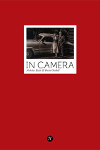
In Camera is a short-story-length historical art book that pairs fiction with oil paintings. Gledhill found a photo album from the time of the Cold War, decided to create oil paintings from it, and asked Royle to compose fiction around his work. It is very much a concept book and a lovely one.
The story is told in a series of vignettes, different episodes in the girl’s life, moving in a linear fashion except for a few times when we move to a more modern time, perhaps this present day, for added context and to tie up the various tales. There is only one name given in this book – the father’s – everyone else is afforded but an initial. This helps to keep each vignette short and nicely presented – most scenes happen in the space of one page and there is a painting to accompany each. It also suits the time period, the initials conforming to the idea of filing, tracking, shorthand, secret synonyms.
It’s all about surveillance in the Cold War, but it’s subtle. This is a book wherein there is a lot packed into a mere handful of pages, much to learn and discover lying under the surface. Again, it suits. The camera at the centre of the story means that the girl is effectively taking records of things that we can assume could be used as evidence; it’s an innocent pastime with an uncanny significance. Spying is the name of the day – presuming the father knows about the photography, which we can expect as she appears young and doesn’t understand that there’s a film inside to show that someone’s been using the camera, he doesn’t so much as mention it – one could say the borrowing is condoned.
Everything layered is rounded off by the simple day-to-day of the girl’s life, her games with her brother and her life as an adult wherein the camera is in full use. We hear about the modern efforts to find out what was noted about people, gaining knowledge – the reader gaining knowledge – from another perspective.
The only thing not in the book’s favour is the size of the prints of the paintings; they are often very small and because of Gledhill’s photographic-like talent, end up looking more like actual photographs than paintings, which makes sense in a way but does negatively impact the point of them. This said, on the size of the paintings the publisher says something worth baring in mind: when it came to designing the book I wanted to make it subversive and circular, for the paintings to appear almost as photographs again, to add to the idea that things are not often as they seem.
In Camera is a wonderfully imagined piece of writing, and size aside, the paintings are lovely. If you like the idea of combining art and literature, you’ll like this book. If you like books with many layers, subtle stories that appear simple but have much more behind them, you’ll like this book. A lot.
I received this book for review from the publisher.
Edited later in the day to add the note about the publisher’s design.
Related Books


