




Laura Navarre – By Royal Command
Posted 7th November 2012
Category: Reviews Genres: 2010s, Domestic, Historical, Political, Romance, Social
2 Comments

Can obeying the king lead to happiness?
Publisher: Carina Press (Harlequin)
Pages: 284
Type: Fiction
Age: Adult
ISBN: 978-1-4268-9400-8
First Published: 2nd July 2012
Date Reviewed: 4th November 2012
Rating: 4.5/5
Katrin was trapped in a wretched marriage, a match made in the interests of her uncle, the king. Now her husband has died, Ethelred wants to make another match for her in order to suit his interests, but Katrin does not want to be sold again and tries to resist. She can’t resist her uncle’s sword-theyn, however, albeit that he is much lower in status than her. If her uncle finds out it may be their undoing, however Katrin may find the outcome better than she’d thought to hope.
Whilst the official blurb of this book gives a lot more insight into the narrative, having, as it does, two heroes, it seemed a good idea to provide only the basics here in case this is your introduction to the book.
Navarre’s Anglo-Saxon tale is in a similar league to the famous Elizabeth Chadwick, featuring sweeping romances, politics, and a cast of believable characters. Navarre’s heroine may seem weaker, but she fits the time. In fact there is a balance within Katrin; she is strong in personality and aims to be as active in domestic society as possible, but she realises where it is better to step back and be meek in order to save her skin. Navarre aptly portrays the men of the time, in fact the first hero, Eomond, is a particularly alpha hero, being incredibly domineering though obviously enthralled by Katrin. It might take the reader some getting used to, this strong woman who will bow down when the pressures of her era take over, but Navarre always keeps her heroine steady – Katrin will always find certain situations difficult and won’t change her personality or feelings at any time. She recognises danger and takes the safest route, and when she knows she can be bold she will be. There is development in the way that Katrin decides to act, namely that she will throw caution to the wind after a time spent assessing the situation, and the way that Navarre makes the development of Raphael match that of Katrin is wonderful.
As said, Eomond is a rather strong character. At times the reader might wonder where the story is headed due to the way he treats Katrin, but Navarre balances it out via his love and his frustrations at his low situation in life. It is interesting, due to Eomond’s character, that the later Raphael is so different. The better match Katrin finds in him seems to demonstrate the difference between the woman naïve about love, and the woman who knows what she wants. Where the heroes are strong but likeable, the author deftly illustrates the fact that Katrin is rather lucky – the other men in her life are not as caring, and indeed King Ethelred himself makes for difficult reading.
It must be noted that Navarre has taken artistic liberties with the history she uses. The good thing is that this is discussed at the back of the book. Anyone who finds Ethelred hard to bear can take note that Navarre made him that way (and it’s nice that whilst the fictional Ethelred is rather horrid, he’s not nearly as misaligned as Gregory’s Anne Boleyn). That said, the basic period has been adhered to, and the interested reader will find that the politics and basic society of the day mirror Navarre’s portrayal.
The romance(s) are well written and mostly devoid of discomfort (the odd phrase may sound over-much, it’s up to the reader to decide how much historic-sounding phrasing they are okay with). Navarre does not always draw the curtains around the bed; when described the scenes are such that they add to the story. For surely scenes where the sex is accompanied by a burgeoning sense of emotional realisation can only develop the narrative further. What is interesting is the way, given the characters Navarre created herself, the strict Christianity is woven into the romance. Rather than simply relegating ideas of pleasure to prostitution and mistresses, and pro-creational intercourse to a marriage, Navarre demonstrates how the church viewed such concepts and how the people sought to align with them – or not, as sometimes happens, which in itself provides a good insight into how early Christianity could hinder relationships when adhered to.
The writing is generally good. There are a couple of occasions when words sound a bit off, for example near the beginning characters say “I say” and “look here” as though they’ve just stepped out of a wardrobe, chain mail is called ring mail, and there is perhaps a bit too much effort made to make the dialogue historic, but these do not detract from the overall experience. Accents remind you of the native lands of the characters as well as the fact that the story started in Scotland, and there is ample medieval phrasing that does work. Katrin has a tendency to think to herself a lot, which sometimes feels strange after all the third-person narrative, but it suits the story to have the insight it provides and offers a real chance for the reader to see what went on in the mind of a strong medieval woman. And it gives evidence and reasoning for the way Katrin acts where dialogue and regular narration does not suffice.
By Royal Command is a stunning epic that spans a long enough period of time for the reader to feel they’ve learned something, without being so long that gaps are present. Whilst being incredibly serious in its illustration of life the book glitters with fantastical romantic elements and plenty of emotion. And whilst having romance at its heart, it doesn’t shy away from the difficulties of the day in terms of gender, political marriage, and sexual relations, as well as showing well how these same elements affected both men and women. In Navarre’s case, men especially, which makes the social history all the more poignant.
History, fictional but fine characters, and a good dose of true politics. By Royal Command rivals the best.
Related Books

Hélène Grémillon – The Confidant
Posted 3rd October 2012
Category: Reviews Genres: 2010s, Angst, Domestic, Historical, Political, Social, Translation
5 Comments

What happens when no one is telling the truth about how they feel?
Publisher: Gallic Books
Pages: 253
Type: Fiction
Age: Adult
ISBN: 978-1-908313-29-4
First Published: 12th September 2012
Date Reviewed: 30th September 2012
Rating: 4.5/5
Original language: French
Original title: Le Confident (The Confidant)
Translated by: Alison Anderson
Upon the death of her mother, editor Camille starts receiving letters from a sender who only gives his first name. Believing the letters to be a clever method of mailing a novel, Camille does not realise for a while that the correspondence relates to her own life. The story of lovers split by outside events and other people, of babies conceived for questionable reasons, and of the hatred of everyone for everyone else, does not register as real until Camille finds proof of its relevance. The meaning of the words is catastrophic, and it seems the sender is the only one who knew the truth. Until now.
The Confidant, translated from the French by Alison Anderson, is a story about how selfishness, and misplaced belief and love, can become so twisted around each other that they leave truth to be confined to the mind – never spoken, with dire consequences. Set against the backdrop of the German invasion of France during World War 2, the factual history included weaves its way into the narrative to create situations that further destroy the humanity of the characters.
And like all stories with a similar narrative – in the way that it feels, the atmosphere, the confusion – it may be difficult to enjoy the book in the usual sense. In regards to the characters, it is difficult to be impressed by a group consisting of a sexual pervert, an obsessed and allegedly dangerous childless woman, and a younger woman who appears to lie to everyone. These aspects take a while to become apparent, but they may be difficult to comprehend when they do. What is interesting, however, is the way one may question their opinion of Camille as the book continues.
The book is told using a series of letters – all sent by Louis but formed of both his words and the words of others – as well as the thoughts of Camille as she comes to the end of each instalment of the story. The formatting is a little unorthodox, the use of a typeface generally spurned by the publishing industry, but it has the interesting affect of not only ensuring the reader knows who they are listening to but of actually adding to the atmosphere; Camille, is incoherent at times, her world a confusion to herself. Indeed the first couple of pages are so peculiar in their written style that you could easily believe Anderson’s translation poor, were it not for the elegance of the rest of the book.
The book is actually rather short, due to both page count and the easy-to-read nature of the text. But Grémillon makes the most of what she has – everything included is important, there are no “filler” events and there is no feeling that the book would have been better served by additions. The narrative gets right into the action, Camille provides a brief but sufficient background, and whilst Louis rushes on occasion it is not a drawback. It is a very welcome style in a world where books continue unnecessarily.
One ought not to feel disappointed by the predictability of the tale, indeed if you read the blurb you will know a lot, and the reason is that Grémillon wishes to explore her topics with a reader who will know, confidently, what she is talking about.
And if the most obvious theme is cause and affect, then the major theme is surrogacy (this comes to light as the major theme in part due to the acknowledgements in the back of the book). Being infertile in the 1930s and 1940s was of course nothing like it is today with all the advancements we have made both technologically and socially. Grémillon shows how society placed such a role in the expected life of a woman, and how it could affect those women who did not live up to the standard set. Due to the narrative structure, and the way in which the author divulges the characters’ beliefs and thoughts, the suggested routes to happiness are laid bare, often with the consequence of creating burdensome personalities. Grémillon portrays the historical infertile woman in the extreme – which creates some of the gross horror in the book – as well as discussing surrogacy in more simple terms. And to a great extent her discussion is relevant today, highlighting the issues that can surround a woman who agrees to carry a child for another without the experience of knowing how such an occasion will make them feel.
It is impossible to retain the same opinions one had at the beginning of the novel once the end has been reached, such is the fine decision Grémillon made to explain the story from different angles. The book does require diligent attention but it rewards with clarity and confirmation. And in addition it also provides a basic knowledge of the lives of the French in German-occupied Paris, which describes in subtext, if not always via direct experience (of the characters), the martial law of the time.
When I try to understand the reasons behind the whole tragedy, I always come to the same conclusion: if Annie had not been passionate about painting, none of this would ever have happened. I am as certain of this as are those who maintain that if Hitler had not failed his entrance exam to art school the world would have been a better place.
It may not be easy to like what happens in The Confidant but that is not the point and Grémillon is not worried if you feel that way. What matters is the subject at hand, the details imparted, and in that the book has surely succeeded in its conquest.
The Confidant was originally written in French, and was translated into English by Alison Anderson.
I received this book for review from ED Public Relations.
Related Books

Robin Shulman – Eat The City
Posted 28th September 2012
Category: Reviews Genres: 2010s, Domestic, Food, History, Social
6 Comments

Are you sure farming is rural?
Publisher: Crown (Random House)
Pages: 301
Type: Non-Fiction
Age: Adult
ISBN: 978-0-307-71905-8
First Published: 2012
Date Reviewed: 17th September 2012
Rating: 4/5
Shulman presents the often deceptively small groups of people who defy the notion of modern urbanisation to grow and produce their own food in the heart of New York City. Covering both traditional gardening and industrial manufacture, Shulman illustrates how history has moved from one extreme to the other and back again, showing that whilst such production may seem shocking to those who live unknowingly amongst it, it is actually part of how New York City first came into being.
Eat The City is a rather in-depth look at those who produce food, both en masse and in small quantities. It spans a range of tastes and traditions, including both solids and liquids. Each food in question is given its own section as Shulman recounts visits to the individuals who make it and refers back to historical records to detail how things used to be done. But far from the historical parts being all about the economic and culinary history, Shulman also looks into family history to explain how those she visits and interviews are culturally linked to the foods they produce.
And for the most part such a method of storytelling works well; the present flows into the past and back again and one feels that they know the individuals assessed as well as Shulman herself. Indeed it is only when right in the midst of the book that the method feels a little overused and you start to wonder whether more time ought to have been spent on the present, regardless of the fact that Shulman aptly describes the manufacturing and growing process. Yet this is more a case of retaining interest than writing style as the book requires the history – it is simply that having the book split into sections and the same method of writing being employed each time becomes wearing. For this reason the book can favour a dip-in approach so that the report doesn’t become heavy. The presence of the history fits Shulman’s aim – present-day is incredibly intriguing, but the context and reasoning even more so.
There is a good mix of vegetables and animals accounted for. The first half of the book favours natural, unaltered, produce, with the second half full of industrial manufacture and traditional methods that have been tainted by modernity, for example fishing. Shulman’s section on fishing is a particularly favourable addition because the entirety of it highlights the dangers of the practise. Whilst you are shown that it is possible to farm organically and safely in the city, fishing has inevitably been literally tainted by the chemicals that are dumped into the surrounding waters. For an overall subject that presents hardship and hard work but with resounding success, the section on fishing is difficult to read because of the knowledge Shulman brings to the table. And it is all the more harrowing given that whilst many poor people are fishing for mercury-filled fish, there are others who have the money to eat well but are unknowingly feeding themselves and their family poison.
Shulman brings the era of Atlantic slavery into the section on sugar, detailing not just the history but how the work has been passed down so that even now the successors of the African slaves grow cane. The difference being, of course, that their gardens are the result of choice. This is just one instance of immigration adding to the workings of the city, as detailed too are the Arab Jewish wines and Caribbean vegetable growers. Shulman’s book is a fantastic look at how a city is shaped by everyone who lives there, be they natives, invaders, or otherwise, and how it is impossible to separate such cultures when everything has become mixed together to become one mass society and way of life.
It must be said that the book is not apologetic. If the beginning sections invite the interest of vegetarians then the latter ones will put them off, and there are interviews on both sides of the GM debate. There are inclusions from newspaper articles on political decisions and overturning when the common man did not meet the specifications of those on high, as well as the disagreements within neighbours of those who wanted land for food and those who opposed it. And there is the ever-imposing divide between man and machine, the foodie and the real estate company, as well as the man and the Industrial Revolution. Because food production, even today, is considered backwards when urbanisation is forwards.
There is not really much to be said in disagreement to the way the book has been written. To be sure there are too many lists, wherein Shulman provides all the different elements of a particular system and the number of commas is at least a dozen over several lines, and there is the instance of a misquotation of Apollo 17 moon walker Eugene Cernan as having said “man oh Manischewitz” when he simply said “Manischewitz”, but these are meticulous points.
If ever there was an interesting tale to be told about a place that appears to be the height of urbanity, then this is it. For the European who can only view the city via Friends, the film The Devil Wears Prada, and Google’s Streetview, New York is perhaps the ultimate in urban business areas with a few residential neighbours thrown in. Indeed whilst what Shulman says may shock the average American citizen (and that in itself is a supposition) the impact will likely be greater on the onlooker.
Eat The City is a unique and inspiring exploration of an idyllic way of life, both surviving and being newly imported into a place that is not assumed to be appropriate for it. It does this whilst including a host of people who are from different walks of life and who have different goals. The traditionalist, the hobbyist, the entrepreneur and the capitalist – Shulman brings them all together as one movement: the everyday citizen, be he rich or poor, who just wants to have a hand in the way his food is produced and bring back production to a local level.
I received this book for review from the Crown Publishing Group.
Related Books

J R Crook – Sleeping Patterns
Posted 24th September 2012
Category: Reviews Genres: 2010s, Domestic, Experimental, Psychological, Romance
7 Comments
Wherever the story ends…
Publisher: Legend Press
Pages: 106
Type: Fiction
Age: Adult
ISBN: 978-1-908775-52-8
First Published: 2012
Date Reviewed: 19th September 2012
Rating: 5/5
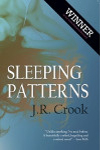
Annelie Strandli (Grethe to her friends) presents to the reader a fictional story written by her friend, who is dead. Annelie is herself included in the story, a story of a girl who meets a boy, which in turn contains another story. It seems she took a while to work it all out, but might the reader understand it quicker? The basic plot is that Annelie meets Berry and Annelie wants to read Berry’s work, and he in turn is unhappy that she has a boyfriend.
Many novels have been called unique and powerful, and described as containing incredible depths. If such a number of novels is categorised as a group then Crook’s short work is destined to join it. And yet it can’t, because what Crook has written here is truly different; it is the structure of the plot, the layers of meaning that aren’t contained in the pages and that must be experienced afterwards, that are so individual. What is especially intriguing about the relationship between the text, the reader, and what is implied rather than spoken, is the way in which you can spend a long time, whilst reading, wondering whether or not you will be able to work it out, and a lot more time wondering if for all the reading you have done in the past you might be completely stupid. This being before you work it out. Was such a thing considered by Crook? This in itself is pause for thought because either way the conclusion yields more discussion, of both the text and what the overall purpose is.
Indeed if the summary of the plot, if plot is the word, sounds intriguing, then the structure is all the more so. The reader must start at the dedication page; whereas it is fine to bypass dedication pages in general, in this case to bypass would be to make a mistake. This is because the dedication tells you that Crook is dead, however he is not – it is he who sent this reviewer a copy of the book. And due to the many layers of story, if Crook is not dead and there are already a good few layers of repetition already, then the possibilities are endless and the book may even have a higher level than the reader themselves – in other words the reader may in fact be yet another layer of the story, who knows? Once you’re past the dedication page there is one other element of intrigue and then you start reading the story itself – starting at chapter 5. You don’t need to worry about getting chronological order wrong however, it’s easy enough to keep up. And whilst you could read the chapters in order, there is no bonus to doing so, you might even miss something.
There is a story within a story within a story, possibly with another story before all of that. The reader ought to find it out for themselves. The most inner story, however, is appealing in the way that it is written; Crook is a very good writer yet suddenly this inner story has sections where the plot is written very simply, almost dull in places, juxtaposed with other sections that are more highbrow. Luckily for the reader, apart from the subtext the book is very easy to follow.
The story – whichever story that is – has a romantic basis, subtle so that it will appeal to all, whilst having emotion pouring from it. And the story – this time the obvious one of Crook being the writer of the book – transcends fiction, making the author fictitious as a character himself and Annelie, presented by Crook as fictional, real.
There is a connection between all the stories. At the heart of everything, the author presents himself in the story (the one Annelie presents) as a fly-on-the-wall. But is he? And if Annelie is supposedly real is this non-fiction of sorts? Are we looking into real lives or fictional ones? And why is the author written as dead? We can take what Berry says as fact, but of the rest there is no knowing.
These are questions you will ask yourself, and whilst this reviewer has answers gathered from reading Sleeping Patterns, they could always be wrong and other readers will likely have other questions in addition.
It is impossible to explain this book further without giving the entirety away. Sleeping Patterns requires all of your attention but it will give as good as it gets. If you are looking to be awed and inspired, to be challenged intellectually, and to find love in a different way, this is the one.
I received this book for review from the author.
Related Books
Kate Morton – The House At Riverton
Posted 5th September 2012
Category: Reviews Genres: 2000s, Domestic, Historical, Mystery, Romance, Social
4 Comments
What the elders want the elders will get, but it will come at a cost.
Publisher: Pan Macmillan
Pages: 591
Type: Fiction
Age: Adult
ISBN: 978-0-330-44844-4
First Published: 2006
Date Reviewed: 27th August 2012
Rating: 3.5/5
At 98, Grace is approached by a film-maker who is creating a movie about the murder mystery surrounding the house she, Grace, used to work at. What the world doesn’t know, however, is the truth; and this Grace has kept to herself her entire life. Only now, facing inevitable death, does she decide to create some cassette tapes for her grandson explaining everything, including what really happened on the night a famous poet killed himself at the lake.
The House At Riverton is a long look at the early decades of the 20th century and how society came to dictate lives in such a way that people made drastic choices they wouldn’t nowadays. The book could have easily been cut by about 300 pages – the back story, whilst fascinating, especially for those with a particular interest in the era, is unnecessary, and it takes three quarters of the book for the story to actually begin. The build-up is for the most part predictable and thus all the extra details surrounding it are irrelevant. It’s nice to get an idea of what went on in the characters’ heads (so far as Grace can determine) but what would otherwise have been a big reveal is, of course, not there.
However this doesn’t mean that the book is a failure, indeed even if it required heavy editing, the superfluous content does illustrate well the life and society of the time. If you’re a reader looking for a thrilling mystery you won’t find it here – this is a book for people who enjoy period dramas and the sorts of incidences that were considered monumental back then but would be a non-issue today. Family structure is discussed, such as marriage in order to produce heirs to keep hold of property. And seeing as the book follows the lives of a couple of generations of the same family, Morton also details, through the characters themselves, how change occurred as the children of the 1910s became the adults of the 1920s and began to challenge the strict rules imposed upon them by their elders. Both these issues, woven together, cause the most conflict in the family, as well as the streak of feminism and want for equality that comes as second nature to one of the young women, Hannah.
It would be fair to say that although the characters are well written, their purpose is to enable Morton to put her point across and to explain history and society, and so whilst the reader knows them enough they are not the sort to commit to memory in a fond manner.
It should be noted that The House At Riverton isn’t all that much of a romance story and that the mystery aspect of the book is hampered by the fact that the reader knows the basics, even if the true mystery does remain a secret. Yet, in these two factors there does remain some interest – the romantic threads form more of the commentary on society, and as there are a few of them Morton is able to look at the issue as a whole in detail. The veils over the classes are pulled down and Morton shows the reader that the relationship between upstairs society and downstairs subservience was a lot more complicated than either section would have admitted, maybe than they would have known. The romances also highlight the need for loyalty that is often inherent in us. The true mystery is what the film-maker, Ursula, is after, but only Grace knows it, and the reader is only party to it from being inside Grace’s head; thus the ending is good, as it ties everything together and the reader being given all the ingredients to work out what would happen next. Indeed the reader may know more than the characters, even after those happenings happened.
The House At Riverton is too long for what it sets out to accomplish, and the real thrill takes a while to get going; it is recommended thus as a good resource for gaining knowledge of past society and exploring the class system inherent in the day.
Related Books


