

Jeanne Ray – Calling Invisible Women
Posted 13th May 2013
Category: Reviews Genres: 2010s, Comedy, Domestic, Fantasy, Political, Social
6 Comments
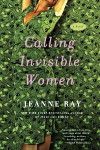
No longer on the shelf.
Publisher: Broadway (Random House)
Pages: 246
Type: Fiction
Age: Adult
ISBN: 978-0-307-39506-1
First Published: 2012
Date Reviewed: 28th April 2013
Rating: 2/5
At fifty-four years old, Clover feels invisible as a woman. One day she wakes up and it’s no longer a feeling – she is literally invisible. Going unnoticed by her family, she discovers a group of women like her and starts attending meetings. The other women have worked out what’s gone wrong, but is there a way to fix it?
Calling Invisible Women is a book that starts brilliantly and has a fantastic premise, but rapidly falls to what’s most comfortable in a way that provides a negative impact. The premise, or at least the supposed premise, of a middle-aged woman feeling invisible, is fresh. The possible metaphor of literal invisibility standing in for the invisibility of middle-aged women in a society that values youth and beauty, is promising and had a lot of potential, but sadly Ray does not take the opportunity presented.
What is good in Calling Invisible Women is the laugh-out-loud humour of the first half, the fine writing, and of course the social issues referred to. But that is where it stops. In Clover there is a character who feels invisible but has done everything that will insure she’ll remain so; a woman who simply does not fit her time period. If this book had been released in the mid-twentieth century, understanding Clover would be easier.
A typical example is Clover’s relationship with her daughter. Ray’s descriptions and the dialogue show Evie to be a self-absorbed person who cares not a jot for others unless she needs something. When Evie needs clothes, Clover describes how she’ll be giving her daughter, who is 20 and hasn’t realised her mother is invisible, the money for these clothes. If Clover spoke of how she should stop and how she lets her family walk all over her, it would be okay, but she doesn’t. There is also a situation where Clover and Gilda stop their grown-up sons making their own life choices, and when Clover tells her women’s group what happened “The group let out a moan, the collective heartbreak of all suburban mothers.” Given the subject at hand, Ray affectively wipes out a great number of potential readers from her audience as well as providing an out-dated social commentary on something that is widely considered an individual’s choice.
After the initial set-up, wherein one could suppose the women have become invisible because of society and the way they themselves feel, Ray places the actual reason outside of the women’s jurisdiction in order to conduct a commentary of another subject. It means that the strength of the premise is destroyed, even if the commentary itself is an interesting one. This happens later also, in a minor way, by Clover’s changing thoughts about her family. This is a family who fails to notice that their mother and wife has become invisible, despite the fact that Clover continues a sexual relationship with her husband and affectively flies around in clothes, headless. There is also the fact that Clover’s issues really needed to be at the forefront.
For its premise this book needed strength and empowerment. The ending is little more than a summary and the action happens too late in the day. Calling Invisible Women could have been incredible, a friend to women entering middle-age and a lesson for those who are younger or who simply forget such women. Unfortunately, it is not and whilst it may be one thing to have an un-likeable character, it is another to have one who is nonsensical for no given reason.
I received this book for review from Crown Publishers.
Related Books


David Eddings – King Of The Murgos
Posted 12th October 2012
Category: Reviews Genres: 1980s, Comedy, Fantasy
1 Comment

The search continues, and this time they’re heading east.
Publisher: Corgi (Random House)
Pages: 436
Type: Fiction
Age: Young Adult
ISBN: 978-0-552-14803-0
First Published: 1988
Date Reviewed: 26th September 2012
Rating: 3.5/5
Garion, his wife Ce’Nedra, and their friends, are still on the journey to find baby Prince Geran who was kidnapped by Zandramas. Fate unknown but destiny acknowledged, the company enter the land of the Murgos on the next step of their trek across the world. It will take them back to the Ulgos and land them in danger with the sacrificing Grolims, but there will be one or two surprises also.
Eddings’s story here is more of the same, which is a very good thing if you like his work in general but likely off-putting if you are looking for difference. There is, as always, the continuation of self-indulgent humour, coincidences that take away all worry that people will not survive a battle, and the unfortunate tendency to present murder followed by yet more humour. And whilst the latter can and often does work in television and other works of fiction, sadly in the case of Garion and company it can feel a little insensitive. Indeed of the humour one must find it particularly enjoyable for it to not become ingratiating, given that it is used in every book in exactly the same manner.
And yet in many ways this book surpasses the previous, Guardians Of The West, and the entire first series, The Belgariad. There is far less info-dumping – where Eddings has always included an entire battle strategy multiple times in one book, here he simply includes a few sentences or paragraphs, meaning that the afore-mentioned lack of worry that the reader has, considering the battles never end in tears, is less of an issue; it’s easier to accept the lack of true thrills when there isn’t any unnecessary logistical planning beforehand. The story features fewer instances of characters suddenly appearing to save the day, and more interesting conversation and revealing background context.
But the additional angles linked to battles and complications can be a disappointment. Indeed complications are never really complications – a ship is wrecked, magic heals, a holy fire is put out and the accused is easily let off. Magic and coercion are obviously going to be used, this is a fantasy book, but it does make conclusions more unbelievable than they would be otherwise.
Eddings has a view on women, but what is it is anyone’s guess. On the one hand we have an author who creates strong women who have no qualms about raising an army and leading it, but on the other we have a group of male characters that worry about their womenfolk seeing the bodies of slaughtered people. A woman will go into battle and kill, but her male friends will still worry about how “the ladies” might get upset over less than that. And in these series it could be argued that the women are far stronger than the men. One could say that Eddings was writing before gender equality became such a big issue, but this book was only released, if one may make a reference to popular culture, a few years before Girl Power entered the 90s. In addition to this there is the constant usage of “yes dear” both as a term of endearment and irritation and given the quasi-medieval yet futuristic landscape of the world Eddings created, it doesn’t sit right.
But for all this there is one striking element in this book that is not as apparent, if indeed it exists, in the others. This is the way Garion and Eriond react towards those who kill violently for no good reason. They, Garion and Eriond, have their values but these are never thrown at the reader, resting steadily with the characters. The reader is a mere observer; there is no lesson in morality, which is just as well because on one occasion there is quite a lot of violent retaliation. What is striking, then, is the way Eddings allows the feelings of the characters to pour onto the page – the way that whilst they will kill without thought when need arises, they see the difference between needs-must and glorified hatred, but their thoughts of action are in most cases given a lecture by the older members of their party.
For the most part, King Of The Murgos is surely a better work than any of the previous, but as it comes to a close the incidences that suggest otherwise rear their ugly heads all at once. One certainly needs to appreciate Eddings’s style considerably in order to find the book a spectacular success, but such appreciation is not required for simple enjoyment. There are a lot of issues with the book, but it is still a solid example of fun fantasy fiction that will appeal to various age groups and both genders.
Related Books

Dodie Smith – I Capture The Castle
Posted 24th August 2012
Category: Reviews Genres: 1940s, Books About Books, Comedy, Domestic, Romance, Social
3 Comments

The continuation of 1800s novels.
Publisher: N/A (but I’d wager Vintage’s a good one)
Pages: N/A
Type: Fiction
Age: Young Adult
ISBN: N/A (Vintage’s is 978-0-099-46087-9)
First Published: 1949
Date Reviewed: 16th August 2012
Rating: 5/5
Cassandra lives with her family in a house adjoining a ruinous castle. From having a fair amount of money they have become poor, and it doesn’t look like Mr Mortmain will start writing again anytime soon – despite his wife spending time outside in the nude in order to commune with nature. But then the Cottons arrive, American brothers who have just inherited the estate the castle stands on. And far from being angry about the unpaid rent they’re positively entranced by what they’ve found.
I Capture The Castle is a rather quirky novel about relationships and the power of money. It presents itself initially as relaxing and intriguing, but as soon as it gets a hold of you it branches off, showing deeper colours, just like the women’s dresses after they decide to dye them into new life. What’s particularly appealing about the book is that it is heavily influenced by Victorian literature, both obviously and subtly. There are worded references to Jane Austen and the Brontës, but further than that the book’s story itself feels like it could have been written by, say Austen. Indeed it can be so easy at times to snuggle down, knowing that you’re reading the work of an admirer, that when Smith diverts from the era of chasteness it’s rather a shock. It would not be wrong to say that I Capture The Castle is Austen without the limitation of Victorian etiquette.
I am not so sure I should like the facts of life, but I have got over the bitter disappointment I felt when I first heard about them, and one obviously has to try them sooner or later.
And the book truly strikes a chord. Told from Cassandra’s point of view, via her diary, often she will say something that is so compelling and always considered by ourselves, but rarely shared, such as her ruminations over the idea of her sister wanting a wedding rather than a marriage.
“As we’ll never be able to stop her turning on the Early Victorian charm, we ought to accentuate it.”
Referring back to the Victorian influence, it is apt to discuss the characters. Rose, for example, is paramount in Smith’s dedication of her work to Victorian literature; the character has gathered her knowledge of how to conduct a courtship via the processes in place a century before her own, and the reactions her “victim” experiences due to her theatrics are duly recorded by Cassandra. Rose feels it is time she had money after having lived in near poverty for so long, and if the opportunity arises she will take it. Cassandra is less passionate than Rose, and tends to keep her feelings to her journals, but her potential to love is huge. The Father, Mortmain is rather random in his actions and one never knows if he is working or not, and Topaz, his wife, is completely bohemian. The family is completed by a brother, Thomas, and Stephen, an unpaid servant who is devoted to Cassandra. The Cotton family are colourful too, if less so. The collection of such a set of characters means that whenever the narrative slows down – which it does a lot because the plot as a whole is slow and rather simple – it’s not long before you’re laughing, and as such it’s difficult to want to put it down.
Of course a big draw for the reader, considering that the novel has a simple, fairly predictable plot, is surely the factor of the house/castle in addition to the cast of characters. Though difficult to imagine at times, it is an interesting and individual setting that permits the exploration of history without the burden of superfluous or detailed information.
The romance may be a love square, or perhaps even a love hexagonal – Smith, although agreeing to honour the well-established trope, takes a while to release her hold on the information, so that whilst certain parts are predictable, she might attempt to lead you down the garden path, protesting against readers who have worked it out already.
I asked him if he liked Rose’s dress – mostly to change the conversation.
He said: “Not very much, if you want the honest truth – it’s too fussy for me. But she looks very pretty in it. Knows it too, doesn’t she?”
There was a twinkle in his eye which took off the rudeness. And I must admit that Rose was knowing it all over the place.
I Capture The Castle attempts and succeeds in being the very sort of book a lover of both classics and contemporary work wishes to read – it combines all the trappings of the 1800s novel with the boldness of the early 20th Century, and such boldness enables there to be a further blend of the 1930s and our current 21st Century present. Indeed so wrapped up in the past can Smith become, that mentions of technology, for example a gramophone, may cause you to pause for a moment so that you can adjust your visions of women in Victorian dresses to women of later fashions.
And in addition to all of the above, I Capture The Castle is surely a novel of the arts. Cassandra likes writing, the text is structured as her diary, and the family is forever trying to get Mr Mortmain to author another book. Topaz is an artist and model, and the Cottons are bathed in the world of literature.
“Look, Mortmain, look! Oh, don’t you long to be an old, old man in a lamp-lit inn?”
“Yes, particularly one with rheumatism,” said Father. “My dear, you’re an ass.”
Smith’s work is an absolute triumph.
Related Books
None yet.
Samantha Sotto – Before Ever After
Posted 27th June 2012
Category: Reviews Genres: 2010s, Adventure, Angst, Comedy, Fantasy, Historical, LGBT, Romance
Comments Off on Samantha Sotto – Before Ever After

When “forever” doesn’t mean “forever” for reasons that no one’s considered.
Publisher: Broadway (Random House)
Pages: 294
Type: Fiction
Age: Adult
ISBN: 978-0-307-71988-1
First Published: 2011
Date Reviewed: 18th June 2012
Rating: 4.5/5
Shelley’s husband died from a bomb in a backpack on the subway in Madrid, a few years after they had met. Two years afterwards Shelley is still grieving, and when she answers the door to a man who looks like her husband and says he is Max’s grandson, she wonders if the bruise to her head she gained when she fainted on the doorstep is the reason why she is seeing the impossible. But Paulo isn’t Max. Indeed Paulo has issues of his own, he wants to know who his grandfather is because he knows the man is still alive. And for Paulo to find out who Max is, he must ask Shelley, even if this will be the first she has heard of it too.
Before Ever After is the debut novel of an author who shows much promise. It successfully combines a range of ideas and genres to create something not merely magical but also extremely romantic, up-to-date, and informing. At once a travel log, a historical fantasy, a comedy, and a tragedy, the book presents itself as something incredible.
The story is told through a compilation of flashbacks and present-time reflections. As the basic idea is for the characters to discover who Max is, the flashbacks are used in order to show how Max had hinted at things all along, and the present-time is used for Paulo and Shelley to work out what was going in. Indeed the flashbacks are stories within a story within a story, the book is three layers thick, but the structure and format means that you will never be at a loss for what time period you are currently reading about. The setting of the present day is mostly a plane, which gives the characters plenty of time to chew things over, and while you may find yourself wanting it to be over already so that you can meet Max, the fast pace of the novel means that the satisfaction of reading it and taking in all of the information is much more exciting. Indeed you never know if you actually will get to meet Max in the present time, and that in itself spurs you on because he’s such a great character that you really hope you will. All of the suggestions and especially the very first page of the book, tell you that he is very likely paranormal in some way, but Sotto does a good job of letting you wait to find out if it is true or not. And you will be wondering until the end.
“Now listen campers,” Max said. “Take note of this place in case you get lost during our field trip and need to find your way back home. If you don’t think you can remember where we started from, you can purchase a baguette and leave a trail of bread crumbs. Oh, and before we head off, there are three things you must remember. First, don’t talk to strangers. Second, you need to be aware that your travel insurance does not cover acts of stupidity or alien abduction. Please do your best to avoid them. And third, hold on to your mates.”
[…]
Shelley raised a brow. “Mating?”
“Mating,” Max said, “from the word mate, a word derived from the Old Dutch word maet or companion, which shares the same root as mete, which means ‘to measure’.”
“I see,” Shelley said. “So what you are in fact offering me is a measure of companionship, correct?”
“Indeed.” Max stuck out the crook of his arm. “The length of my arm to be exact. All in accordance with the guidelines of the Poultry Club, I assure you. You won’t get lost, I have a place to rest my arm, and the chickens are secure in my fidelity.”
Max is one of those characters who comes along very rarely. This reviewer would liken him to Mr Rochester of Jane Eyre and Max de Winter of Rebecca for his difference – whilst he is not like them he shares with them this certain uniqueness in quality. Max is surely a great romantic hero, yet on the face of it, for his dialogue, he is anything but. Shelley may be a strong heroine in herself, but Max is the winner here.
The inclusion of Shelley allows Sotto to show her reader a widely known issue, that of being afraid of relationships because of prior hurt. Shelley is almost paranoid about being a relationship, keeping a list on her at all times that tells her when to jump ship from dating a man – to ensure she doesn’t end up like her widowed mother, who in turn showed her how much depression could come with loss. Max too is worried about losing people, and this is apparent throughout the book; it is the way the couple figure out their relationship in a way that works for them that is so compelling.
Another factor in the book is the number of everyday issues and taboos Sotto fills her story with, and the way that she includes them like any other element. This is done through the secondary characters. Max and Shelley met when Shelley decided to sign up to join the tour group Max was taking to the continent, and it is the people on the tour with them that make the novel so valuable. The tour group consists of a young American called Dex – Shelley’s cultural male counterpart, Rose and Jonathan – an elderly couple in the prime of their sexual lives, and camera-wielding Brad and his partner Simon. Rose is very open about her sex life, and Brad and Simon are just a gay couple – there is no reasoning behind anything, Sotto has included subjects to be as normal as anything else, and this lack of pointed political correctness in a book that otherwise oozes it is particularly refreshing. With the historical content and present-day happens race is also included, and Max’s nature as a possibly paranormal person is drenched in issues of morality.
She sank her teeth into melted cheese and summer, unleashing a silk stream of eggs and cream in her mouth. A buttery earthiness lingered on her tongue. She gulped orange juice to keep from moaning from the world’s first egg orgasm.
Rose gave Shelley a knowing look. “I came as well, dear. Twice.”
Jonathan sputtered, turning a shade brighter than the raspberry preserves on his baguette. “Ah… um… yes, yes, wonderful eggs, Max. Très magnifique.”
Shelley did not recover quite as elegantly, and was still choking on the juice that had spurted out of her nose and onto Max’s shirt. Max came to her rescue with a couple of solid pats to her back, a napkin, and a grin.
Considering Rose’s frankness about her sex life, it should not surprise you that at times the book is hilarious. Whilst it is not graphic, Sotto lets the jokes run wild and there are numerous references to loud noises and length as much as there is travelling around the continent.
And travel makes up a huge section of this book, providing the basis for the character’s meeting, the reason for the history, and what Sotto wanted to talk about as a keen traveller herself. There is a great deal of information on the places visited, which are diverse in location and culture. What is interesting is that Sotto is relentless in her goal of introducing her characters, and thus her readers, to lesser-known gems in Europe. Through these lesser-known places, Sotto is able to create the world she wishes for Max to explain to his tourists, and it gives her free reign in the historical fiction department. Quick research will show you what is factual and what is not, and this is another part of what makes the book so appealing, that you are reading a blend of travel log and history and learning so much all at once. The historical rewrites are something in themselves, with Sotto often referencing well-known figures in order to provide background context, and twisting both facts and possibilities, such as the idea that Marie Antoinette’s Petit Trianon was a place of debauchery, in order to produce the result she wants. Stretching from the 1970s all the way back to Ancient Rome, across different religions and cultures, with a variety of fantasy characters and just plain interesting ones, there is bound to be something to interest you in the history chapters.
“I told you it was nothing,” Adrien said. “Although the duchess did appear to be the tiniest bit cross with me. But then again, I could be mistaken.”
“Mistaken? How so?”
“Well, I was rather busy dodging the various heavy brass objects she was throwing my way to really pay attention to what she was saying.”
There are a couple of less positive factors to the book and these concern the way Sotto uses description. There is an excess use of similes where what is really happening is sacrificed for descriptive and poetic metaphors. The issue with the similes is that they create melodrama in places where melodrama is not needed and can sometimes cause confusion as to what is happening. And there are short bursts of info-dumping and a few clunky dialogues. However these negative parts are rather like the excessive use of humour in a Terry Pratchett Discworld novel – it is easy to accept because the good vastly outweighs it and it is understandable that Sotto is still coming into her own as a writer, still working out her style and voice. The plot and characters are what’s important, and they are enough to keep you reading when the written word falls down a bit.
Before Ever After is a very apt name, giving you everything you need to know about the book without really giving you anything at all. If this is what happened before, then what happens after? Is there an after? Was there ever really a “before”?
The scent of strawberries, or rather what strawberries might smell like if they were made from melted plastic and disinfectant, filled the white-tiled room.
It is impossible to do justice to this story. Let that statement be the conclusion.
I received this book for review from Crown Publishing Group, Random House.
Related Books



Speaking to Samantha Sotto about Before Ever After, Love & Gravity, and A Dream Of Trees (spoilers included)
Tune in as Charlie Place and Samantha Sotto discuss characters that join you in your car in the midst of a traffic jam, time travelling with Issac Newton, switching from your fully researched work in progress to a story that needs to be told, and… chickens?
If you’re unable to use the media player above, this page has various other options for listening.
L M Montgomery – The Blue Castle
Posted 13th May 2012
Category: Reviews Genres: 1920s, Comedy, Domestic, Romance
2 Comments

We all have our idea of perfection, but how many of us achieve it?
Publisher: Seal Books
Pages: 218
Type: Fiction
Age: Adult
ISBN: 978-0-553-28051-7
First Published: 1926
Date Reviewed: 9th May 2012
Rating: 5/5
Please note that this book is very hard to get hold of in print and your best bet, unless you have a relative who owns a copy, is to find the ebook versions, in plain text and HTML at Project Gutenberg Australia.
Valancy Stirling has led a miserable and depressingly dull life, treated like a bad person when she isn’t, mocked by her family for being a reader, for not being pretty, and for being twenty-nine and not married. On her first day of the last year of her twenties, she starts to really accept just how much control she has let her family exercise over her, and how much that control has in fact stopped her from reading as much as she would like, from being pretty and married, and instead always being ill. Learning from a doctor, of her choosing, that she only has a year left to live, she decides to throw caution to the wind and be who she wants to be and say what she wants to say. It will shock her family, but it is likely to shock Valancy the most.
The Blue Castle is a somewhat short, hilarious, and sometimes frustrating book that while not exactly an example of fantastic writing, never fails to delight. It is, it must be said, incredibly predictable, to the point that everything you think will happen, will indeed happen, but for the story it doesn’t matter, and knowing what will happen in advance, coupled with the overall narrative, makes continuing all the more appealing. And while it should be noted that the book is very much set in its era, with all the trappings, the idea is that Valancy gives this up, and whether Montgomery planned for the future or not, Valancy becomes as relevant today as ever.
The plot is good, but it’s the characters that make the book a success. Each is given enough time for you to get to know them and their eccentricities, or lack thereof, and to learn how they would react to the situations Montgomery puts them in. This is perhaps best shown in the differences between the Stirlings – the family as a whole are obsessive about the smallest issues but each have their own quirks. And Montgomery “goes to town” with Roaring Abel, who incidentally doesn’t live in the town, giving him four different stages of drunkenness that really shows off her talent for humour.
“Fear is the original sin,” wrote John Foster. “Almost all the evil in the world has its origin in the fact that someone is afraid of something. It is a cold, slimy serpent coiling about you. It is horrible to live with fear; and it is of all things degrading.
As for Valancy she starts the book being an irritation, not helping herself, being passive, and thinking back over and over to the past instead of making new memories – before changing to become her own person, and a person unconcerned with all the issues she had previously. There are definitely limitations placed on her, but the feeling Montgomery gives her readers is one of a person who would do anything.
“Doss, dear,” said Cousin Georgiana mournfully, “some day you will discover that blood is thicker than water.”
“Of course it is. But who wants water to be thick?” parried Valancy. “We want water to be thin – sparkling – crystal-clear.”
The definition of “normal” is one of the ideas explored in the book. The Stirlings are boring and dull and melodramatic, but in their closeted world they are normal and everyone else is not. And in the way that they are completely imperfect, they truly are normal, for as the saying goes, nobody is perfect. Then there is everyone else in the town, or at least those focused on the most. They are the characters that modern society, and indeed Montgomery, would call normal, yet there are of course also imperfections and secrets surrounding them too. It is from the Stirlings to the rest of the town, Deerwood, that Valancy moves to, changing from the perfect imperfect to the imperfect perfect.
And if Valancy’s fantasy of a blue castle is her version of that special place that we each turn to in our heads for peace, then it is as much a mental and emotional concept as it is realistic. Montgomery ensures that both mental and physical worlds meet to blend together but never lets the mental image get too far in the physical world – the concept remains realistic. Of course the castle also represents freedom, whatever that freedom may be.
The romance balances chasteness with forwardness. Montgomery has fun laughing at society’s unnecessary hang-ups whilst guaranteeing that the story will be accessible and appealing to all. Indeed the concepts of difference and balance are the overriding themes of the story throughout.
The tale brings each character to reflect upon who they are, and later who they might want to become. It shows that even when we decide to do something big, we may later realise that it was the wrong decision.
She was so tired she wished she could borrow a pair of legs from the cat.
The Blue Castle is worth a read for anyone who wishes for a comedic classic without all the expectations, old language, academic criticism, and difficulties that come with reading your average older book. It is hardly the best piece of fiction ever written, but it’s worth its weight in the heap of roses that have bloomed because of it.
Bloomed because of it, you say? You’ll have to find that out for yourself.
Related Books