





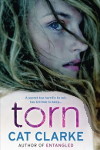
Cat Clarke – Torn
Posted 21st May 2012
Category: Reviews Genres: 2010s, Angst, Paranormal, Psychological, Romance, Social
2 Comments
No matter what, do what is right.
Publisher: Quercus
Pages: 372
Type: Fiction
Age: Young Adult
ISBN: 978-0-85738-205-4
First Published: 22nd December 2011
Date Reviewed: 18th May 2012
Rating: 4/5
Something happened on the school trip to rainy Scotland. Tara died. And although it was an accident, it could have been prevented. Alice knows all about it, she would do. But it’s difficult to tell people because of the repercussions – on her, on her friends. Yet not telling also leads to difficulties. When Tara appears as a ghost to Alice, asking her to do something about it, or rather, knowing Tara, jesting her about it all, Alice knows she has to do something. But can she, especially when there’s love in the air for her, a love that is now somewhat impossible?
Here. Now. Jack. Me. And a room full of dead lizards.
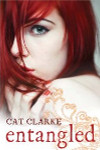
The first thing that strikes you about Clarke – it did in Entangled and does again in Torn – is just how blunt and straight to the point her writing is. Clarke doesn’t hold back, confining views and words to subtext, no, she lets it all out, hitting you smack in the face so that you are under no illusions. And it means that you become more invested in what’s going on than you might have otherwise, because if you are going to read the book, then you are damn well going know everything and accept it.
You would think that this would make for an offensive style, but Clarke is one of the best authors of young adult literature in getting to the real issues and not glossing over them. She doesn’t use lovely language in order to make her stories bittersweet, but she succeeds every single time in presenting the reader with exactly why they should do this or that or believe in something.
Because Clarke’s talent is most certainly in her storytelling, and it’s clear that she has something to say. And while she is blunt, there is no pressure, which mixed together makes a strong impact. You follow Alice’s story, her days when she wonders what she should do, and while the emphasis is on doing the right thing, Clarke does show you why it would be tempting to keep quiet, to think of how speaking out would affect your self, your life. The book is a very easy read with no slow moments, it looks like it will take no effort, but the power lies between the words, it’s woven around them and before you know it you’re knee deep in a multi-threaded story.
While the overall concept is basic, it allows the author to really analyse everything and to go into the small details. What is most interesting is that there are no sub-plots. Although at first it appears that some plot points are secondary stories, every part relates back to the main plot. You get the present, you get the future, you get the back story and the back back story, and you get it from various points of view while never straying from Alice’s first-person present tense monologue.
Alice proves an interesting choice of character because her strength takes a long time to develop, and for the most part she is very passive. Yet she represents the average teenager who wants to fit in while making sure others aren’t left out, and wanting a good life while acknowledging that doing so would cause issues. Ultimately it’s a case of everything happening at the wrong time, and the worst things that could happen colliding with the best things that could happen. And when things don’t happen as they should, there are repercussions.
The bluntness of Clarke’s writing, together with the passiveness and very much usual (in YA) personality of Alice means that the book can appeal to and catch the eye of the regular paranormal and dystopian teenage audiences, whilst giving them a few life lessons. Indeed while Lauren Oliver’s Before I Fall is a great example of how to present issues to readers, there is a lot of emphasis on the romance that somehow blurs your thoughts to the other issues at times. Clarke, on the other hand, uses romance purely to aid what she wants to say, and to demonstrate just how bad things can get. Romance is a big draw in teenage stories, and she adheres to it, but she’ll use it to get the result she wants. Not surprisingly the romance in Torn is very believable and true to life. You can believe in it because you can relate to it in some way.
And when it comes to the romance, Clarke uses her influence as a writer to educate on safe sex, in fact she makes it so that it’s the boy who points out that there is no contraception and thus it would be an idea to wait. And again, it’s real, and Clarke doesn’t portray Alice in a bad light for having said that contraception didn’t matter. The author shows that forgetting things in a moment of lust is natural and okay, but be sure you realise what the consequences would be before you continue so that you don’t continue – in other words, lust is there and that’s fine, but don’t let it control you. And always put one on. It’s a short scene with a strong message, but because she has used the message as content for dialogue it does not sound like preaching, it sounds natural, the sort of conversation a person should have, and will thus surely make readers think.
Clarke isn’t one for finishing her books with a full ending, and her work is surely better for it because it leaves you wondering about all the possibilities and dissecting which one is most likely from what you have read. She does give you all the information you need to work it out, however.
Entangled was a very promising start. Torn has cemented Clarke’s importance and talent in the young adult market.
Related Books

Asko Sahlberg – The Brothers
Posted 6th March 2012
Category: Reviews Genres: 2010s, Angst, Domestic, Drama, Historical, Political, Translation
1 Comment

A lot of surprises and shocks in a very short amount of time.
Publisher: Peirene Press
Pages: 116
Type: Fiction
Age: Adult
ISBN: 978-0-9562840-6-8
First Published: 2010 in Finnish; 2012 in English
Date Reviewed: 2nd March 2012
Rating: 5/5
Original language: Finnish
Original title: He (They)
Translated by: Emily and Fleur Jeremiah
Henrik and Erik are back from the war between Sweden and Russia, where they were fighting on opposite sides. But this isn’t the only issue between them as they arrive home at different times. There has been animosity between them, and between Henrik and his family since childhood, and yet there is something else lingering in the darkness, ready to pounce.
Once again Peirene Press has delivered a stunning novella from the minds of continental Europe. However where previous publications have brought a few particular issues to the forefront of the mind, it is more the structure of this book that stands out. Entirely different in every way, it really does feel as though you are being introduced to Sahlberg, and perhaps Finnish writing in general, in a way that suggests that like the Nordic countries’ most internationally recognised musicians, their writings are in a wonderful realm all of their own.
What is perhaps most striking about the book is the way that it has been told and structured. The sectioning off of the story into short pieces, into the different points of view of the several characters, reads like a script from theatre. While Sahlberg (for although the book has been translated one can assume that Emily and Fleur Jeremiah have been as accurate as possible) does not break the fourth wall, the way that his characters tend to speak in the present tense, as a monologue, comes very close to it. And the very way in which each monologue begins is reminiscent of the strong introductions from the sorts of productions that critics of drama herald as magnificent. One cannot help but imagine how the book might be performed on stage, the monologues being strong enough in themselves that a group could simply sit on the stage with a spotlight to highlight the one speaking and the effect would be powerful enough to warrant use of props or set design as absolutely unnecessary.
The monologues are of varying lengths, indeed some are so short you would imagine that the structure would render those characters minor, and yet the separate elements of both the differing points of view offered, and the inclusion of the “quieter” characters in the speeches of others, means that almost every character is given full description and development by the end of the book. Ironically, it could be said that The Brothers manages to make a better attempt at fleshing out characters than many a longer and more linear novel. Here it is impossible not to imagine a director in future seeing it as perfect for the stage, Peirene Press’s description of it as a Shakespearean drama is surely most apt. And it would be noteworthy to include the fact that while you read each person’s point of view, the story never repeats old ground. The book continues to flow forward (accept for the odd flashback), as though the characters had got together beforehand to decide who would narrate each scene.
Moving on to the content itself, there is an interesting thing in the way that Henrik is the person everybody hates, yet he is the only one who can see how the house is falling apart. The way he speaks of it suggests that it is more than simply the house. And indeed there are tensions which it seems no one picks up on besides the individual themselves. Everyone hides everything from everyone else.
Should everyone direct their thoughts to Henrik? There are many times when Sahlberg implies that the reader ought to look at other people more critically, and remember that while Henrik is disliked widely, there are biases at work.
For such a short book, there really are a lot of twists, and you may find yourself wanting to adopt Anna’s period-centric response of putting hands to face in shock. A couple of the twists are more or less obvious from the outset, but it’s almost as if Sahlberg has made them obvious as a sort of compensation for the utter surprise that comes with the out-of-the-blue moments. The family is both closer and more estranged than you think. And the manifestation of their pain can be difficult to read.
Hate and love are two sides of the same coin, and where one party may think they are providing from one side, the other party may think the reverse is true. Such is the case often here. And those who have caused us pain may actually be the ones wanting a relationship where others have given up. Sahlberg’s story may be historical, but there is a great deal that is relevant on an eternal level. Intriguing, mesmerising, upsetting in so many ways, and always surprising, The Brothers proves that length and time are not necessary ingredients in order to take a person on an immense journey.
I received this book for review from Peirene Press.
Related Books

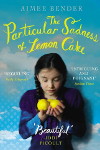
Aimee Bender – The Particular Sadness Of Lemon Cake
Posted 23rd January 2012
Category: Reviews Genres: 2010s, Angst, Domestic, Magical Realism, Paranormal
Comments Off on Aimee Bender – The Particular Sadness Of Lemon Cake
Some books really take the biscuit – and do wonders with it.
Publisher: Windmill (Random House)
Pages: 322
Type: Fiction
Age: Adult
ISBN: 978-0-099-53826-4
First Published: 2010
Date Reviewed: 22nd January 2012
Rating: 4/5
Rose has always loved her mother’s cakes, but one day she finds the enjoyment ruined – as she eats, her mother’s feelings somehow swamp her and the reality of what the woman’s life is like is distressing. In a short time she learns that this is now the case with every food, finding that eating anything at all handmade results in her discovering the feelings and thoughts of every single person who has aided in the creation of the food. She will learn a lot about her family in the process, but it will affect her life ever more.
The Particular Sadness Of Lemon Cake is a very strange book. At once depressing and intriguing, the latter for its paranormal element, it is a book that doesn’t really fit into any genres.
The reader should know that by picking up the book they are enveloping themselves in hours or days, depending on reading speed, of upset – indeed this reviewer had judged that this book was going to leave her an emotional wreck, and she read it on a dull Sunday when there was no studying to do and no reason for her to need to feel positive. It proved to be a good decision.
The story is told in the first person, and Bender’s style of writing is curiously interesting. She writes dialogue without quotations and the text itself falls somewhere between a child’s and an adult’s as she speaks as nine year old Rose. It can be hard to get used to, but as Rose gets older the mix of styles makes more sense and looses its oddness to be something very enjoyable and refreshing.
This theme of a paranormal gift could have gone horribly wrong, and let’s not forget that in fiction such as this – quite “literary” and not featuring vampires – there tends to be an emphasis on the realistic. The basic summary and Rose’s gift may not seem too fantastical for such fiction, but Bender later takes it further into realms that straddle the fence between the very imaginative and the horrifying. Yet Bender’s story is so readable and well thought out, that the weirdness doesn’t matter, and instead what matters are the feelings of Rose. It’s a sort of acceptance where you step beyond reality to embrace Rose’s world unconsciously, meaning that although you can pinpoint the fantasy, it doesn’t effect you in a way that makes it unbelievable – although there is one element that is difficult to accept and that requires an interpretation in order to read without mirth (for it could be said that in a way the book is more metaphor than literal). Simply put, the reader can emphasise with Rose, truly putting themselves in her shoes in every way. Although that doesn’t mean that Rose is a good character to read about, indeed some of her more real-life choices are quite disappointing.
The book is bogged down by depression, family issues, communication problems, and anxiety. It is one of those works where you can give it as high a rating as you want, but still have trouble saying whether you actually enjoyed it. The domestic situation it presents is one that is very real to some families – the reader is likely to know of a real-life situation similar, be it close to them or through stories in the news. As someone who grew up in a dysfunctional family, although she cannot say it was the same as Rose’s, this reviewer can report that some of the success in the reader’s mind is very likely to depend on how much they can relate to the situation. And the story is a good representation of how issues are passed on down the generations – Rose’s grandmother has problems loving others, and it’s a similar sort of issue that has passed down to Rose and her brother. The family in the book is of a dysfunctional nature that aligns with an inability to communicate.
Rose’s brother is cause for discussion that can’t happen in a review, many times you wonder what happened and why, but piecing everything together an explanation can be found in his relationship to his mother and the way she made him feel. Her actions and his do seem to align, albeit in a peculiar way. You can also see where he feels trapped, although the feeling of wanting to be alone is not explained. In fact, the lack of explanation in most cases plays a big reason why this book did not receive a higher rating.
Bender does provide stark contrasts throughout to demonstrate where the family has gone wrong and how problems, especially for Rose, could be solved. She presents the minor and secondary characters as a ray of hope, and shows the way in which relations between Rose and those people deteriorate. Hindsight may be a wonderful thing, yet one senses that Rose’s situation is so bad that she might never experience it. But even if Rose cannot see her way out at times, the positive nature of the minor characters is like a beacon when you’re reading and helps lift the mood enough to allow you to read on.
A lot has been said by others on the themes of coping with your life. While this was not the focus of my reading (I concentrated on the communication issues and negative family situation) it fits in with elements I picked up on, such as Rose’s determination to keep an old stool her father had made for her mother – Rose’s hope being to retain some of the love and presence of regular marriage between her parents. Indeed the way that Rose’s choices are disappointing collides with this topic of coping in the way that the only way Rose can live is to keep things the way they are, even at the expense of her happiness. She recognises hope and difference in her relationships with her friends and her first love, but actively pulls back from them. While not really explained, it is easy to see Rose as a guardian of her own feelings, as well as being so stuck in emotional poverty that she is too scared to try alternative ways of living. It becomes a case of a girl who is very astute at knowing how others feel, not really knowing what she wants herself. And in the poor choices she makes for her life, for surely they are poor choices, one can see how she’s become so used to her life that she doesn’t want to leave it.
The Particular Sadness Of Lemon Cake is difficult to discuss as words elude a thorough description just as they are not a part of the gifts presented. It is most certainly recommended with the advice to look beyond the text at what words cannot say.
Related Books



Alois Hotschnig – Maybe This Time
Posted 10th September 2011
Category: Reviews Genres: 2000s, Angst, Psychological, Short Story Collections, Translation
4 Comments
Are you sure you know who you are?
Publisher: Peirene Press
Pages: 99
Type: Fiction
Age: Adult
ISBN: 978-0-9562840-5-1
First Published: 2006 in Austrian; 2011 in English
Date Reviewed: 25th August 2011
Rating: 4.5/5
Original language: Austrian
Original title: Die Kinder Beruhigte das Nicht (That Didn’t Reassure the Children)
Translated by: Tess Lewis
In this collection of short stories, Hotschnig examines identity, it’s loss, and the desire to find or create it.
In Maybe This Time, the locations never appear to be what they first seem – neither do the people, or indeed the narrators. The effect it has is similar to what happens when a near-sighted person takes off their glasses. One moment you can see everything clearly, or at least you think you can see clearly. Then you take off your glasses and everything is blurry, in fact sometimes the more you try to focus, the harder it becomes. And then a bit later you might realise that some things are clear again – it’s only a few things, those close up, but you can see them even better now than you could with the glasses. The stories in Maybe This Time are layered, and you’ll likely only ever understand some of it, and you’ll likely have a different idea of what’s happened than someone else.
This is a lot of what works about the book, the mystery. Like Peirene Press’s other releases, Maybe This Time is a short book that stays in the mind much longer than many long books, but because of the abstract nature of it you’ll be pondering on it even longer than, say, Tomorrow Pamplona. There really is nowhere to establish your bearings for any period of time and when you do think you’ve a grasp on what’s happening something that doesn’t relate to your idea pops up.
And before you know it, just as you think you might be getting somewhere, it’s ended. In fact some of the stories don’t even span two pages. Hotschnig will not provide you with an explanation either, and there are no conclusions in his tales.
The stories are very poetic, and although you have to take into account the translation (by Tess Lewis, who has made splendid work of the descriptions) it is hard not to believe that in Austrian German the effect would be similar.
And speaking of the descriptions, which are so detailed and given you a real sense of life as though you are an art gallery patron who has viewed the same work for an hour and have thus notice the smallest of brush strokes, these too help the stories sound poetic. Truly the book is poetry in prose.
The stories are about loss of identity, which makes a lot more sense than the stories themselves for their abstract structure. Because the general theme is so specific the book favours a dip-in approach rather than the usual recommended single sitting of Peirene Press. That’s not to say you can’t read it all at once but the characters can become blended together. Then again, judging by that general feel, they could be one and the same!
Each of the narrators is male and the book has a definite masculine feel to it. And there are some very strange and sometimes spooky things that go on, for example the last story is reminiscent of the book, Before I Fall. It would appear that each one is searching for something – themselves, certainly, and in different ways, but also a better world. Where the man in the last story keeps meeting people who know him for different reasons and in what seems to be a different sort of guise, there is the sense of crowds and the rush of people going about their day.
In fact, there is an atmosphere of expectation in the stories. The characters want or need to act as expected and it is this that runs most perfectly alongside the goal of Hotschnig to present identity in today’s world.
As someone who openly accepts that they have only come to a bit of an understanding of the book, and would only be prepared to discuss with others a smaller part of that bit for fear of being totally wrong I must say that rating this book is most hard. On the surface you have a collection of mostly mundane stories, on another level confusing ones, and on a third deep stories with a powerful message. Please excuse me for taking everything into account when I rate it.
Maybe This Time is marvellous, and Hotschnig very clever. So clever, in fact, that he has left this reviewer baffled. Highly recommended, particularly for those who can read it in a group.
Translated by Tess Lewis, received for review from Peirene Press.
Related Books

Jan van Mersbergen – Tomorrow Pamplona
Posted 6th June 2011
Category: Reviews Genres: 2000s, Angst, Domestic, Spiritual, Translation
4 Comments
An intensive look at ourselves, humans, that can’t really be summed up.
Publisher: Peirene Press
Pages: 183
Type: Fiction
Age: Adult
ISBN: 978-0-9562840-4-4
First Published: 2007 in Dutch; 6th June 2011 in English
Date Reviewed: 1st June 2011
Rating: 4.5/5
Original language: Dutch
Original title: Morgen zijn we in Pamplona (Tomorrow we are in Pamplona)
Translated by: Laura Watkinson
Danny is a boxer, and right now he’s running away from his life. Something seems to have happened in the boxing ring (the reader doesn’t know) that’s made him rethink things. He’s also had trouble with the woman he loves. Robert lets him hitchhike in his car to Pamplona, where Robert is going to run from the bulls in order to get away from his routine life, something he does once a year. It may seem a simple decision, but nothing is simple to Danny anymore.
Every now and then a book comes into my life where I know that there is a deeper meaning in the words but I have trouble finding it. Tomorrow Pamplona is one of them. This isn’t to say it is too highbrow to be fully enjoyed, rather that the way Van Mersbergen has told his tale requires the reader’s undivided attention. Of course you’ll be wondering if I worked it out by the end, and the answer is yes, at least sort of.
But although this not knowing is frustrating it gives the book a real staying power. I find myself wanting to pass my copy around for others to read, not just because it would make an interesting discussion but because I think part of the way to gain a truer understanding is to talk about it with at least a few people. One thing that this reviewer will definitely be musing over for some time is just who Robert is or what he is supposed to signify. I got the feeling that although he’s incredibly regular there is something else about him.
If Paulo Coelho provides food for thought then Van Mersbergen provides the ingredients – but you’ll have to roast the chicken yourself. And you get less of a finished story than a lot of books that leave you with multiple options for what happens next – yet at the same time you instinctively know what will happen.
This book is spiritual, borders on angst, and may even be psychological. One of the themes is inevitably coping with loss, Danny’s development focuses on it, and we see this right at the beginning where he copes by leaving home, and later when a minor character copes by staying where the loss occurred.
And characters are everything in this book. Robert may seem to take a metaphorical backseat (and again I wonder about who he is, is his position as car driver relevant in a spiritual sense to Danny) but he is as important as Danny, albeit that the book revolves around the latter. The stage is Pamplona but it’s more about how the place reflects the mind at the time and what is needed by that person.
They drive past fields that are crisscrossed by straight drainage ditches. […] He rolls the car across his palm.
There is a beautiful simplicity in the way the novel is written. Told in both present tense and flashbacks, it seems abstract, disjointed even, but in fact it is meticulously detailed – Van Mersbergen has thought deeply about human actions and the world around us, and used words that read like a soothing lullaby.
The style isn’t particularly poetic and yet the way it makes you feel is as though you’re reading a poem. The writing is comparable to Markus Zusak’s, and if you’ve read my review of The Book Thief you should be able to get a sense of the way I feel about Van Mersbergen’s text, albeit that Tomorrow Pamplona is a translation (by Laura Watkinson). I should probably add that there are a few sex scenes in the book. They are there to help illustrate what is going on in the character’s mind.
Never before have I felt I’ve given a book such an unsatisfactory write up, but I know that I could do no more without revealing it’s entire contents. Truly the only way you are going to find out if this book is worth your time is to read it, because it’s really not the sort of thing you can decide upon without having the words in your own hands.
Tomorrow Pamplona was originally written in Dutch, and was translated into English by Laura Watkinson.
I received this book for review from Peirene Press.
Related Books


