





Rosie Travers – The Theatre Of Dreams
Posted 22nd August 2018
Category: Reviews Genres: 2010s, Drama, Mystery, Social
Comments Off on Rosie Travers – The Theatre Of Dreams

Lights, camera, and action… are all badly needed by this group of people.
Publisher: Crooked Cat
Pages: 300
Type: Fiction
Age: Adult
ISBN: 978-1-721-12292-9
First Published: 1st August 2018
Date Reviewed: 21st August 2018
Rating: 4/5
Actress Tara’s director boyfriend becomes interested in a rising reality star and the resulting fallout shatters Tara’s professional image. When she receives a letter from an elderly woman, inviting her to take over a dance school (the real reason is to help save the old pavilion) she decides to go for it, moving from London to the south coast. But there’s more to Kitty’s request than she included in the letter, more than any meetings and debates with councils.
The Theatre Of Dreams is a contemporary story of historical conservation, with a healthy dose of mystery. Told via two characters, one in the first person, the other in the third, it gives a good view of the past and present and ensures all questions, whether explained openly to other characters or not, are answered for the reader.
Travers has constructed a good tale; seemingly nice but ordinary for a while, there comes a point where the first mystery element makes an appearance, and this then runs parallel to the main story, pushing the interest up several levels. It adds a completely new dimension and genres that move the novel, particularly the final third, into page-turner territory, somewhere between a casual whodunnit and a cosy mystery, whilst never losing the easy-going nature of the narrative.
Characterisation is fair, with most time understandably going to Tara, who gets a complete, realistic, life change. She’s as important as the fight to save the pavilion.
The pavilion itself is what the story revolves around but it would be prudent not to expect to see a result here – the book is about the journey to start the restoration rather than about the restoration itself, with Kitty desperate to find a way out of the bind her family have put her in of selling off the pavilion to developers. The fictional history looks at stories from factual places (the building is based on Lee-On-Solent’s old Lee Tower) and calls to mind similar, factual, stories of campaigns to save history.
There’s but one issue and that’s in the book as a product; there are a lot of proofreading errors – spelling, grammar – that, whilst not on every page, are numerous enough to be noticeable and do on occasion mean you have to stop reading to work out the meaning behind the sentence. The language itself is good and Travers’ style confident – the errors are an editing stage problem.
Besides the errors, the book is great. It’s one you can pick up for a chapter or two but quickly find yourself wanting to carve out time for, and the subtle elements of mystery that Travers includes make you want to race through the end to find out what’s happened.
I’ve met the author a couple of times.
Related Books
None yet
Next Stop Procrastination #11
Posted 17th August 2018
Category: Next Stop Procrastination Genres: N/A
Comments Off on Next Stop Procrastination #11

This photograph was taken by Clarence.
I knew when I started thinking about compiling another of these that it had been quite a while since the previous; it turned out to have been March last year. I wondered how I should go about it – would there be too many, would some be irrelevant? What I came to acknowledge was that some might be old postings, in relative terms, but they were still good. The list has been checked for broken links.
Book-Related Links
Is There Such a Thing as a Good Book Review?
When Being a Disabled Writer Means Being an Educator
Where Old, Unreadable Documents Go to Be Understood
Church in the Netherlands converted into transformer library: books by day, party room by night
My life as a bookworm: what children can teach us about how to read
Chimamanda Ngozi Adichie Comes to Terms with Global Fame
The Secret Origins of Amy March (Which Might Make You Hate Her a Little Less)
What’s gnawing on Jane Austen’s hair?
Visiting an Experimental, Do-It-Yourself Library in Brooklyn
Samanta Schweblin on Revealing Darkness Through Fiction
‘Don’t do anything with long-term consequences’ (novelist Phillip Lewis looks at teenage fatherhood)
Amy’s Pickled Limes: Little Women
How libraries served soldiers and civilians during WWI and WWII
The Unsung Delight of a Well-Designed Endpaper
Found: Pages From One of the First Books Printed in England
The Other Stories in Tolstoy’s Anna Karenina: A Translator’s Perspective
Miscellaneous Links
Why do Dwarves Sound Scottish and Elves Sound Like Royalty?
Exit Interview: Scott Kelly, an Astronaut Who Spent a Year in Space
List of foods named after people (Wikipedia)
Have you found any interesting online articles you could share?
On Referencing And Changing It
Posted 15th August 2018
Category: Chit-Chat Genres: N/A
2 Comments

I’m getting either studious or pedantic about referencing. I really can’t say which it is, perhaps it’s both. As I find myself wanting to write more academic, or at least more studious, posts – that word again because who am I kidding on the academic front – there’s been a parallel increase in desire to use a referencing system, and, more to the point, to do it properly. In the past I’ve used both in-text links and end-of-text references, but the pedantic part of me is looking at the benefits of standardising the whole thing except perhaps in cases when it would look silly (I can’t see myself always referencing a regular blog post academically for example, and in-text links are the standard for websites).
I’m very aware right now that I’ve been spending too much time with techy people who use newfangled vocabulary.
This idea of standardisation has occurred mainly due to my own folly; the first several times I used end-of-text referencing I did it in a different way each time, enough that when I’ve recently looked to use my own posts as a template there was no template. I’ve tried various university systems for referencing and done a lot of research; sometimes there are no options for the sort of reference you need to provide. It was bad enough when I was taking university classes and went to cite a quotation that was a quotation itself.
So I want to standardise and the easiest way to do it on this blog looks to be a sort of amalgamation of various styles with my own ideas thrown in for good measure. Less continual comma…isation…, more brackets, and less reliance on web links that will almost certainly lead to a 404 error a year later.
I’m also getting far too excited about the idea of using footnotes for their intended purpose, and recently went and added a useful contextual note for a recent further thoughts post. Oh dear. (On that in-text link note, my own posts will remain links. Anything else is unthinkable.)
All this may make the blog look pretentious. It may mean that on the surface it looks to newcomers to be the work of a scholar in a book-lined room who knows what she’s about rather than the reality of a girl who over thinks literature and is unfortunately aided by the existence of Google, but that will hopefully just be a minor downside. Footnote: I have found evidence of people quoting my posts in essays and hope they research what I’ve written to check it works!
The question you fully expect: do you or have you used referencing in a non-university (and so forth) manner and how did it go?
Curious Arts Festival: Sunday
Posted 13th August 2018
Category: Events Genres: N/A
Comments Off on Curious Arts Festival: Sunday
Disclaimer: I was invited to cover this festival on a press pass.
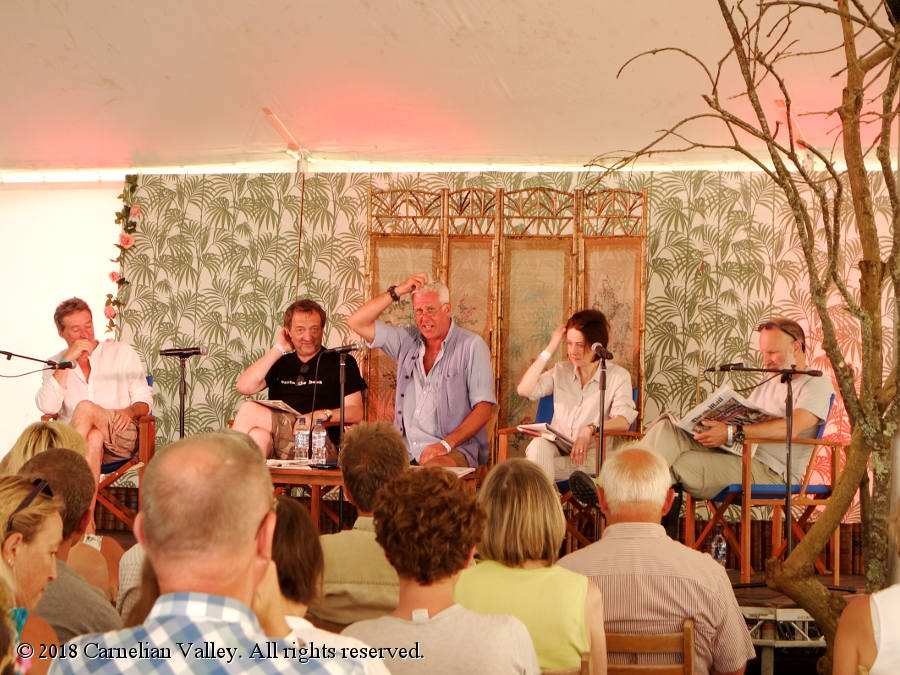
The Breakfast Club at Curious is a regular feature, held each morning of the festival. It is presented by Paul Blezard and a member of the team of magazine The Week, who are joined by other festival guests. On the Sunday the panel was Simon Nixon of The Times, Misha Glenny, Paul Blezard, Caz Moore (The Week), and Simon Evans. The Breakfast Club is a discussion of that day’s headlines, so there is a lot of politics involved but also lighter stories. This morning, Brexit was front and centre, with the talks about deals taking up many first pages (each panel member discusses stories from a certain newspaper). The news is a couple of weeks old now, so I’ll refrain from repeating it.
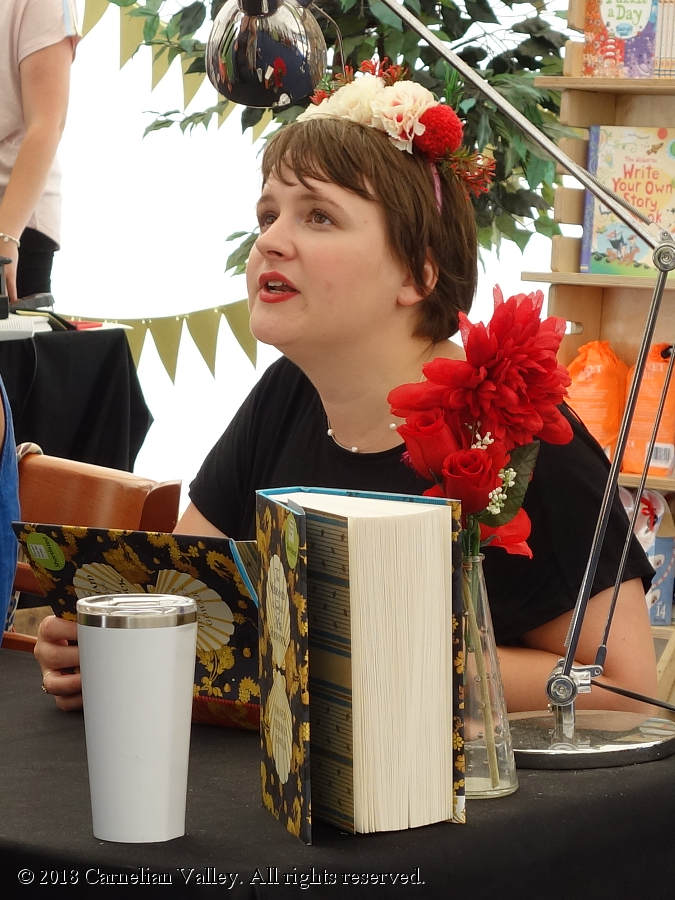
At the age of eight, Imogen Hermes Gowar, author of The Mermaid And Mrs Hancock, wrote a book about a mermaid that she sent to a publisher, gaining her her first rejection letter. This she told Rowan Pelling and the assembled audience, her head dressed in a fun, colourful headband, the likes of which had started to permeate the festival late the previous day.
The author, who always tries to get an idea about someone from their objects rather than written sources, had worked in the British Museum where there is a ‘mermaid’ tail. She described it as a grotesque thing (it appears to be this one) and it inspired her; she looked at the idea of a gentleman from the past ordering a ‘mermaid’ and not getting what he’d expected. Even though, she said, the reality of the mermaid is horrible, we still have this idea of beauty.
Speaking of symbolism, Imogen said that the mermaid echoes the idea of a woman having personal agency, which was compelling in the context of the 18th century (in which she sets her story). 50,000 women – 1 in 5 – in London at that time, were involved in sex work. If one’s husband died, sex work was one of the only ways to survive. And it provided agency. It was part of both a luxurious and a wasteful world. A woman who started young might not make as much money as she grew older, but she’d have a lot of secrets in her arsenal she could use as blackmail.
Imogen referenced the life of Emma Hamilton: married to a Lord, later the mistress of Lord Nelson, and the muse of artist George Romney – she’d started out as a sex worker. The author also referenced Kitty Fisher, a prominent courtesan who was one of the first people to be famous for being famous. (She is mentioned in the letters of Frances Burney and Horace Walpole.) She researched sex workers through Harris’s List of Covent Garden Ladies, an annual directory of prostitutes in London. A 1791 report of the List estimated a circulation of 8,000 copies a year.

I left Imogen’s talk to pop into the biggest tent where Matt Haig was talking to Dolly Alderton.
Matt is worried about the idea that he’s at a computer and there’s a wall between him and other people. He spoke of the way the internet can be a short-term distraction that has a long-term effect – ‘everything now is out to distract us’. Today’s young people, he said, are the most knowledgeable about the addiction, and are the best at taking breaks from electronic devices.
The author called the daily news “the drip-feed of doom,” a problem; the need to be completely up to date. He feels more knowledgeable when away from it all.

Next up was Guy Gunaratne talking to Georgina Godwin. A couple of days after this talk Gunaratne’s book was longlisted for this year’s Man Booker.
Guy talked about his familial background. His father was originally from Sri Lanka, coming to England in 1981 and visiting bookstores, Foyles in particular, to learn English. Guy recently tweeted about his book being in Foyles and it went viral because people erroneously thought there was a connection to Windrush1. Guy was then asked by various outlets to talk about Windrush rather than his book, which he couldn’t do because his ancestry was not that of the generation in question.
What his book, In Our Mad And Furious City, is actually about is terrorism. The thoughts began for him when he thought that a person who was then thought a terrorist looked like someone he knew – the person was not someone he knew but this sparked the idea of an acquaintance with connections to terrorism. He thought of how the person could be him, could be anyone, saying we all have things that could turn us.
Guy felt it was more important to describe the feeling he had than to tell stories. He chose to write about this via 5 characters. He said it was an organic process: 3 characters came to him at first, and he followed them to see where they went. He went where he was led, talking about the method of writing wherein the character leads the author. Language is very important to him.
The estate in the book is inspired by Neasden, a suburb of north London, residence to many Muslims and Hindus. For his writing he embraced the fact that in places, nothing around you says you’re going to be anything special in life, and considered the idea that a person can think they can be the exception and work towards that. If a book is authentic, he said, you talk about readers’ experiences. If it comes from a marginalised community, it can become a way to re-marginalise. We have to be careful.
Originally a film maker, Guy used to pitch human rights stories to news outlets, films that he said would meander rather than have a definite point (he likes that kind of exploration in novels). What he likes about writing books is that it’s private and you’re in your own head space; he said that when you confront things it’s private, no one knows your thoughts. Writing was one of the furthest things away from what he thought he could do in life as a career, though he has been writing since childhood.
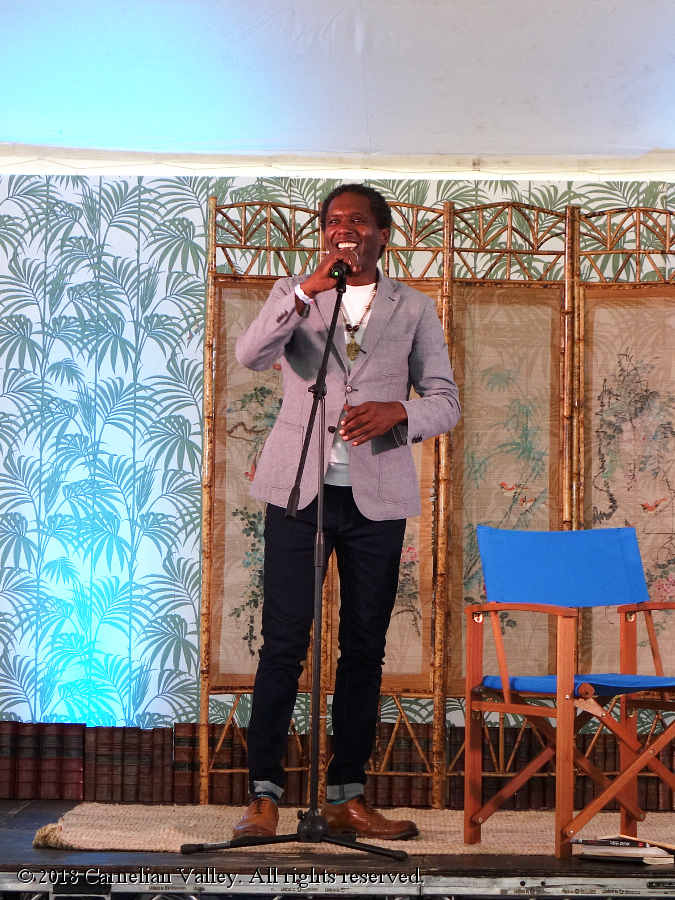
Lemn Sissay’s poetry reading started in a big way. Paul Blezard introduced him and it became comedic, with Lemn jumping on his back and later pretending to be Usain Bolt, the signature pose.
Lemn’s performance reminded me a lot of spoken word. In between readings he would tell funny anecdotes: “It’s easy to exaggerate when you’re a poet – ‘Lemn Sissay has performed all over the world!’… Wigan [note: where he used to live].” It was Lemn who was heckled by a Curious dog. He told an anecdote about meeting a woman in a restaurant for a date and, when she asked him what he did for a living, jumping up on the table to perform a big poem, which resulted in her having left by the time he had finished it, the yelling scaring her off.
His poems were great – moving, clever, various – but it was the note he ended on that will stay with me. He talked about his time as a fostered child and the ‘care’ he received from social workers – he recently won his court case against the man who took his parents away from him.
(Lemn’s mother arrived in Britain from Ethiopia, gave birth to him, and then foster parents were found to look after him while she went to finish her studies. However instead of Lemn being fostered, the social worker who took him told the people who came to look after him to treat it as an adoption. Once the couple had their own children, and felt that Lemn had become difficult – he was “eating cake without permission and staying out late at night” (Hattenstone, 2017) – they left him in a children’s home and told him there would be no contact. He subsequently suffered poor treatment in the care homes. It was only after he left the care system that he was able to find out about what happened. In his case file was a letter written by his mother to the original social worker, begging him to return her son. Lemn finally met her at 21 years of age.)
The poet has written plays and given talks about his childhood. Now he is making a documentary on the care system.
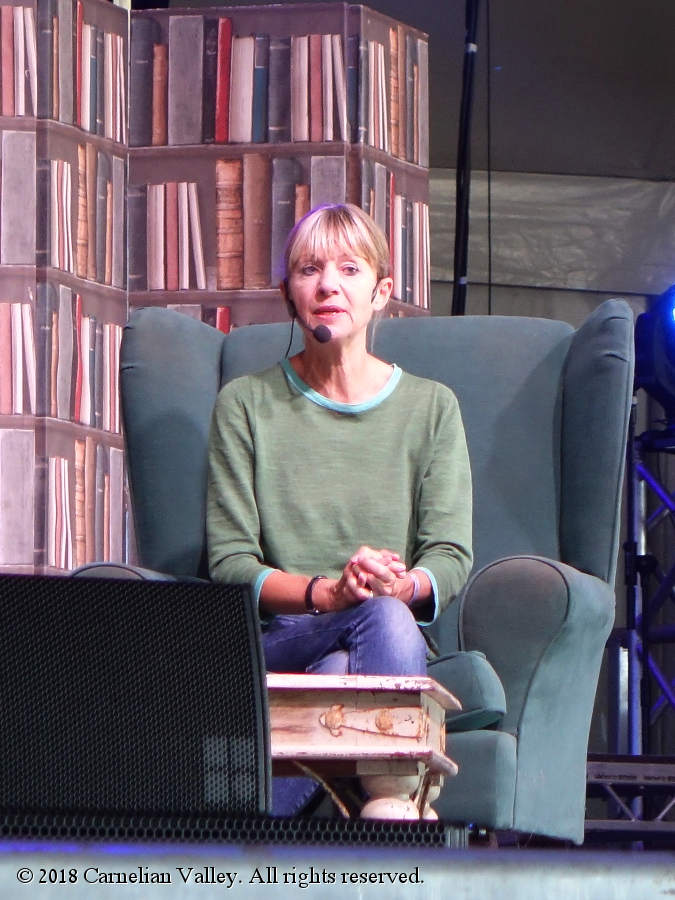
“For me,” said Kate Mosse, responding to Rowan Pelling’s very first question, “it’s never the topic, it’s the place”.
Kate found out about the Huguenot diaspora that travelled to South Africa, then found a family that went by the same name as those in her first book, Labyrinth. Wine-making Huguenots were invited to South Africa; the French and South African wine industries come from each other. The research inspired a new quartet of novels – the session at Curious was for her newest novel, The Burning Chambers.
Kate loves the idea of her character going to work as normal, with history playing its part later in the day – in her version a war begins. “History is a view,” she said, “we will never know exactly what happened… We don’t need to know every statistic to know what people felt… those emotions don’t change.” She is interested in the people who don’t appear in the history books.
The author starts her stories with the research so it’s “just there” once she starts writing. She doesn’t plot, instead she just writes with the history behind her. Somewhat echoing what Guy Gunaratne had said a couple of hours previously, she said, “There’s always a moment when a lead character presents themselves.” She dislikes writing graphic violence but believes novelists have a responsibility to make it real – “You owe it to history not to make it pretty”.
Two interesting facts she told us:
- By throwing the Huguenots from their country, France lost its craftsmen, because most craftsmen were from that group of people.
- During the dissolution of the British monasteries, lots of French bookshops opened because they had access to all the books the English no longer wanted.

Comedy headliner, Al Murray, walked onto the stage holding his customary pint of beer. The household name, who calls this persona The Pub Landlord, always ensures there will be biting views that can be laughed at. At Curious he brought the front rows into the proceedings, getting a man to go and get his wife a drink so that she could be asked about their relationship in his absence.

As the sun started to dip and the sky clouded over, the final act of the festival, Gareth Malone, rehearsed with his team in the Gorse tent and then took a ten minute break whilst everyone swarmed in. Gareth is well known for his TV choir documentaries/series – in one he grouped together disadvantaged youths and in another, which spawned a hit single, he gathered a group of military wives – some in the military themselves – to sing at the Royal Albert Hall. But on this occasion, he shared the stage with a much smaller group of people – several members of a choir and a team of four beside him. They sung less musically-layered versions of famous songs – Sting’s Fields Of Gold, Avicii’s Wake Me Up, Toto’s Africa (the last was particularly excellent) – and a few of Malone’s own compositions.
I left as everything was winding down; the last parties and celebrations in force in the main area, the music booming and beautiful, and the food vans starting to pack away; as I prepared to walk through the box office for the final time, I was approached by a member of staff from the Purbeck van, who gave me a serving of my favourite ice-cream, left over from the day. It was a lovely gesture and a lovely way to end a fantastic weekend.
Footnotes
1 The Windrush generation are people from the Caribbean who emigrated to Britain in the mid 20th century. It is currently a huge story over here due to the political scandal of government departments telling those who have legally been here for decades that they are here illegally and must go home. More information can be found at Wikipedia.
Online References
Hattenstone, Simon (2017) ‘I was dehumanised’: Lemn Sissay on hearing his harrowing abuse report live on stage, The Guardian, accessed 10th August 2018.
Kirsty Ferry – Watch For Me By Candlelight
Posted 10th August 2018
Category: Reviews Genres: 2010s, Drama, Fantasy, Historical, Mystery, Romance, Social
2 Comments

Not only at the first stroke of midnight.
Publisher: Choc Lit
Pages: 302
Type: Fiction
Age: Adult
ISBN: 9B079H1LTJB (ASIN)
First Published: 3rd April 2018
Date Reviewed: 8th August 2018
Rating: 4/5
Kate lives in Suffolk where she runs a local history museum, set up in a row of old cottages. Originally from Cambridge, she fell in love with the village she found there, feeling drawn to it. One day a new visitor to the museum, Theo, arrives; Kate begins to slip back in time, into the shoes of someone who looks very similar to herself and who knows someone who looks similar to Theo.
Watch For Me By Candlelight is a time-slip romance with a well-constructed fantasy thread. At first understandably seeming to be an editing error, Ferry’s seamless integration of Kate into her historical past is excellently done, with Kate effectively becoming her historical counterpart whilst remaining herself, able to apply modern concepts to what she is hearing but knowledgeable of what she actually ought to be saying in context. On occasion she does lose herself completely in Cat, Ferry intentionally bringing the history further into the proceedings so that you get to know Cat as well, albeit not as much as Kate.
Partly as a result of all this, the romance is a good one – well plotted and paced. Ferry doesn’t dwell long on minor conflicts, letting the plot go where it will – for example a problematic, more minor, part of life will be solved in good time to aid the path of the main story.
The author’s decision to use a pretty ordinary backdrop and characters allows the spotlight to be on the fantasy, and allows the story to feature a strong dose of reality (the time-slip itself being not so unrealistic). Kate is friends with the family who own the local historic estate, and counterpart Cat was a relative of their ancestors – neither are particularly privileged. Theo/Will (it’s not a spoiler to say he has a counterpart) is well placed in an equally ordinary situation, and it’s this that creates the main conflict in the historical sections.
The writing is good – any anachronisms are the result of the time-slipping and thus not an issue, and the grammar on most occasions is refreshingly super.
There are little things at odds, but the main element that invites question is the ending – it’s not at all as the plot leads you to believe; the mystery is not predictable but might have been better if it was predictable, more suitable.
Apart from that, as described, Watch For Me By Candlelight is a good book. It’s understandably an easy read, enjoyable both in terms of its genre and for the cleverness of the construction, putting genre first to great effect. It’s the second in a series but can be read as a standalone, the references to the first book intriguing and informative.
Related Books
None yet


