




July 2018 Reading Round Up
Posted 8th August 2018
Category: Round-Ups Genres: N/A
4 Comments
For the first time in many years, I didn’t read lots of books in July. It was a busy month, not least in terms of events.
All books are works of fiction.
The Books

Ben Okri: The Famished Road – A ‘spirit’ child in Nigeria visits the inn, spends time with his father, runs away from home, and has visions, for over 500 pages. Nope, not for me. (I reviewed it at Shiny New Books for their Man Booker celebration.)

Claire Fuller: Bitter Orange – Facing death, Frances looks back to her 40s; she was asked to work at a historic estate and fell into trouble when she met a charismatic couple, there for a similar reason. A good book with a tremendously written ending.

Kirsty Ferry: Watch For Me By Candlelight – A woman who moved to a Suffolk village to run the local museum begins to have dreams and visions about a woman from the 1800s who looks very much like herself; the man with whom there was a spark when he visited the museum seems to be a part of it. A well constructed time slip romance that isn’t perfect but isn’t all that far off – you’ll have to excuse the cover as it doesn’t do the text justice.
I enjoyed two out of the three books in July; at a pinch I might pick the Ferry as my favourite because of the construction – it was very unique, with the author moving back and forth between the modern and historical versions of her character very well. But the Fuller was a great read and brought up discussions that we need to have more of in the world.
Now into August, I can say I’m reading Rosie Travers’ book from the launch I attended last week, a Nick Spalding, and I’m dipping into Americanah every couple of weeks, reading chunks of it at a time. All good books.
What are you reading at the moment and did you take part in the reverse Readathon?
Curious Arts Festival 2018: Saturday
Posted 6th August 2018
Category: Events Genres: N/A
3 Comments
Disclaimer: I was invited to cover this festival on a press pass.
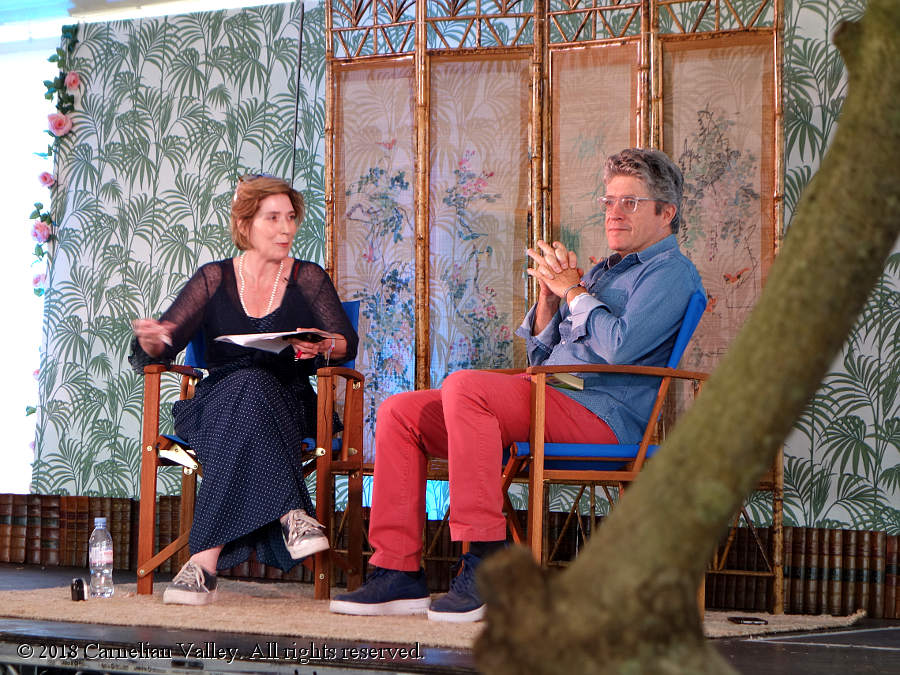
Saturday began bright and early, the first of the two full days of the festival. In the Drift tent, nearest the house, festival mainstay Georgina Godwin introduced her brother, Peter Godwin, for a discussion about their childhoods in Zimbabwe in the context of Peter’s memoirs.
The world of Peter’s memoirs is one that people from those times would recognise; Peter noted that the Rhodesia of before looked different to other places on the African continent, that some said it looked like Scotland. That world has now disappeared; since the wars, everything has changed. Peter and Georgina were both exiled by the Zimbabwean government, Georgina for being part of a radio station that supported an opposing view, and Peter due to his writings about the regime. Georgina left thinking she’d be in the UK for 6 months; it’s been 17 years.
The siblings’ older sister and her husband were killed in a Rhodesian ambush; their next door neighbour also. Peter was accepted at Cambridge but was conscripted for the army in Rhodesia. He postponed his offer, finally going to Cambridge with 6 days in between the start of his classes and his time at war. Many white Zimbabweans came and went in 1980. By the end of the war, 1 in 4 white men were dead; the relative number of those killed exceeded the numbers for WWI.

When the siblings’ father died, only Peter could attend the funeral, and getting a funeral proved very difficult. After failing to get something relative to their father’s background (they had found out quite late in their time with him that their father was a Polish Jew), Peter asked a group of local Hindus if they would cremate him; there was no gas at the crematorium. The Hindus said that the father would have to convert, which of course stumped Peter as his father was dead. (Humour was found in death.) But due to Hindu beliefs on the cycle of life, this was possible and Peter was able to give his father a good send off.
Next up in the Drift tent was another literary talk, this time between broadcaster and now writer Dolly Alderton, and Paul Blezard. The subject was Dolly’s book, Everything I Know About Love, which Paul summarised as being about ‘the honesty of growing up and learning from it’. This particular memoir is about a time in Dolly’s life that was, at the time of writing, coming to a close. She believed it was important to talk about it.

As a teenager, Dolly had wanted to spend time with adults rather than her peers; she’d prefer to be 80 than 14 again any day. During her teens she was a goth, wearing black as a protest against… well, she didn’t know exactly, but she did know she wanted meaning in her life, which she felt she didn’t get as she lived in a privileged London suburb.
Dolly worried about writing about alcohol, sex, and drugs, due to the ways people view women differently to men in this respect, but she isn’t ashamed of having glamourised that lifestyle, saying that moderation is the majority’s experience.

Of social lives she said that the problem with prioritising romantic relationships is that we know how to keep that spark going whereas we don’t know so much about how to keep friendships going; friendships can be harder work. She wishes she hadn’t spent her youth trying to make people happy; she was desperate for people to like her and views this action now as a way to try and control the world around you when you’re young.
Of therapy and depression, she said that examining ‘your stuff’ is becoming more and more a part of being human, and that 90 percent of people who are being difficult are in pain. Her advice to young women is to hold friendships close; being able to talk about your own past is very important.
Popping outside the main festival area, I joined for a time the poetry performance by Little Grape Jelly, three friends whose written collection is composed of emails in verse they wrote to one another, each person taking the theme of their email a piece of the one they were sent. It is an interesting concept that yielded a lot of variety. They called their collection Hell-p me. Their emails are posted as screenshots on their website.

The comedy on Saturday was headlined by Simon Evans who said he hadn’t had much time to prepare but made us laugh for a good while as he recounted the effects on ordinary life when you’ve injured yourself – he was in a leg brace. Bringing spilled teas, cats, and the forgetfulness that comes from too much to think about into the mix, he brought his jokes round in a circle, in turn bringing a nice uniqueness to the comedy evening.
In the music tent, after opening acts Outlya and Flyte, John Newman took to the stage, having very recently arrived back from his stag party in Ibiza, as he told us with pride. Dressed up for the occasion he performed an excellent set, wowing the festival goers who had decided to join him – most of them!
As I trundled my way back to the entrance late into the evening, a few music sets could be heard; Curious always providing more than one option, keeping the party going and the spirits flowing long into the night.
Book Launch: Rosie Travers’ The Theatre Of Dreams
Posted 3rd August 2018
Category: Events Genres: N/A
Comments Off on Book Launch: Rosie Travers’ The Theatre Of Dreams
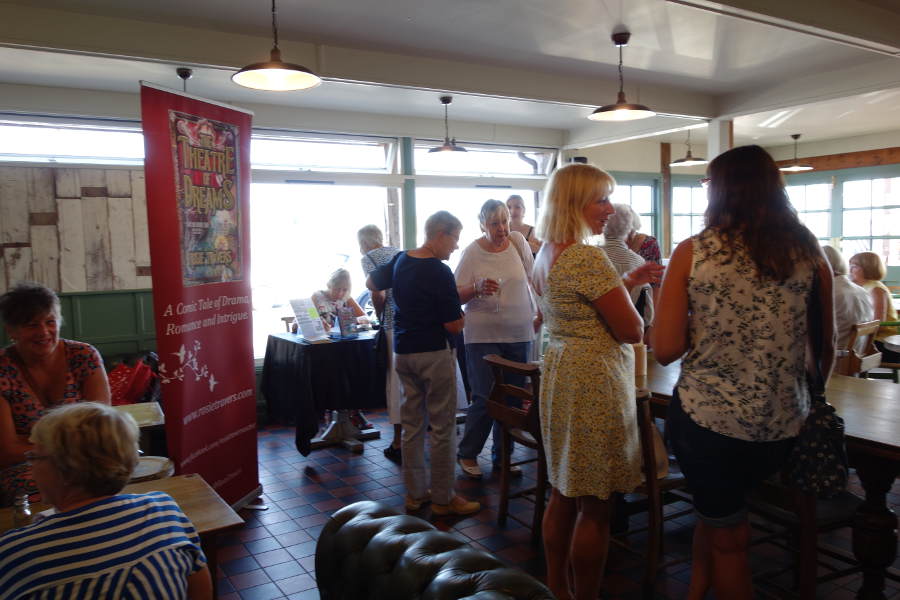
Wednesday evening saw the launch of Rosie Travers’ debut, The Theatre Of Dreams. Held at the Boat House Cafe in Swanick, just a few miles from Southampton, it was a lovely setting – casual, with the marina surrounding us, and the weather was blissful. It was also packed – this photograph was taken very early on and does the evening no justice.
I met Rosie a couple of months ago at a local author meet up. She has had an interesting journey to publication; her first manuscript was accepted by a small publisher, but only on the condition that she changed the book to suit their house style and any future books followed a pattern. The book would have required a lot of rewriting. Before making her decision as to whether or not accept the offer, Rosie sent a pitch and then the first three chapters to a big publishing house. Whilst they didn’t take her on they said they liked her writing and so she rejected the offer she had had, choosing to carry on looking.
That book is not published but Rosie found a publisher, Crooked Cat, and The Theatre Of Dreams was taken on.
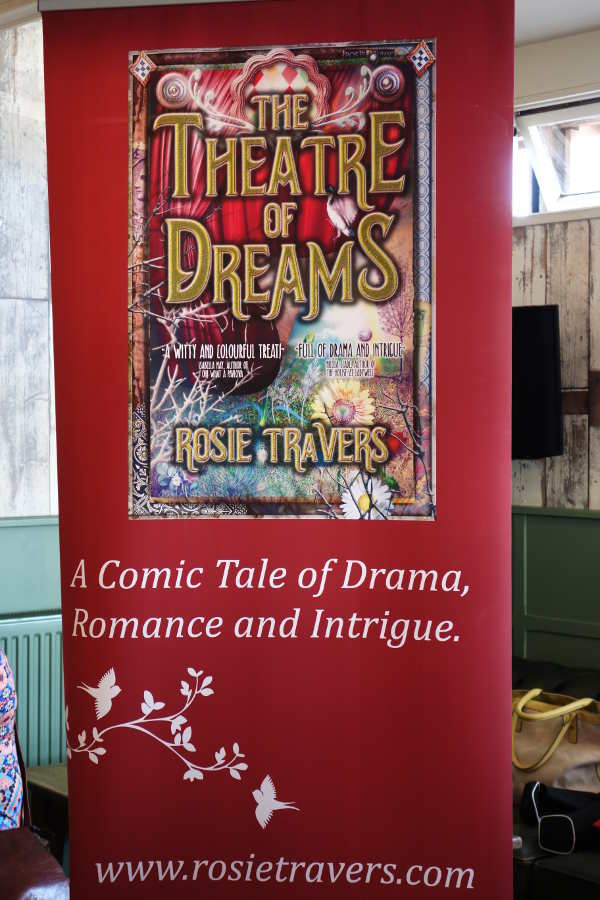
Rosie was inspired by the history of Lee Tower, a structure that no longer stands. Situated in Lee-On-Solent, a place the author rightly states isn’t well known beyond those who live nearby (it really should be more of a tourist spot, it’s lovely), her fictional version in the equally fictional Hookes Bay earned her an article in a local paper where Lee Tower was accounted for. The book as a whole is about a down-on-her-luck actress who is invited to take over the running of a former dance academy from a terminally ill 80 year old, whose invitation is not as nice as it seemed – the Lee Tower complex boasted a ballroom and cinema among other venues.
I’m yet to read the book in full; I bought a copy and have browsed through it; I’m looking forward to it. Rosie has a very good writing style and a knack for opening sentences. The very first is:
I met the man who orchestrated my downfall in a Soho nightclub.
She carries on in this strong manner for the next few chapters, making the most of the concept of good openings. I can feel a first analyses post coming on…
Curious Arts Festival 2018: Friday
Posted 1st August 2018
Category: Events Genres: N/A
1 Comment

Disclaimer: I was invited to cover this festival on a press pass.
For the first literary event, Emma Healey spoke to Georgina Godwin, mostly on the subject of her recently released second novel, Whistle In The Dark.
Speaking of her relevant history, Healey started with the time she was a student of book binding. At that point she had decided she was never going to be a writer and didn’t want to do something academic as a career. This feeling came as a result of the depression she suffered in her teenage years1. She went on to do an MA in Creative Writing.
In the year between the publication of Elizabeth Is Missing and her journey writing her next book, Healey’s life changed substantially. She got married and had a baby – she wrote whilst her daughter was new born. On this subject, she said it was stressful, but her experiences hadn’t changed her perspective as a writer, instead they had given her nuggets of ideas she could use in her book.
The author had wanted to include teenage depression in this book without referring to her own experiences; she didn’t want to write about the illness from a teenage perspective. She thought it would be interesting to write from the mother’s point of view, and inform that point of view with the teenager’s thoughts and feelings.
Looking at social media, which plays a part in the book, Healey pointed out that the exploration she wanted to do was easier when written from the perspective of someone to whom it was alien, and so she chose the mother, Jen. She was interested in the idea of Jen looking at daughter Lana’s online accounts and thinking there would be information there that would help her understand her.
Between readings – Whistle In The Dark is written in short chapters/vignettes – we also heard about the inspiration for Elizabeth Is Missing: one of Healey’s grandmothers suffers from dementia; sparking the idea for the book, she had asked if her friend was missing. The rest of the content was inspired by Healey’s other grandmother, who doesn’t have dementia.
Healey doesn’t write chronologically; she stated that this works for her but it is inefficient. Finishing books is difficult. She prefers as characters ‘ordinary people’ who have great things happen to them than characters who start the book in a great position.
After a very welcomed ice cream from the Purbeck van (they warrant a shout-out because they were lovely in general, and on the last evening gave me a serving of my favourite for free), I popped into Jamie Reid’s discussion about Patrice des Moutis, an insurance businessman who was a compulsive gambler in the 1950s to 1970s. With a backlist including a couple of books about horse racing, Reid is well-read on the subject of gambling as a whole. (His book on des Moutis is Monsieur X.)
Reid spoke of a man hounded by the French government and the media, who would have found it easier to do what he did (he was also a gangster) because of his looks and charm. His wife came from a respectable background and was uneasy at first by the idea of gambling but then starting putting bets on for him. Of gambling in general, the writer said that online gambling poses huge problems for society, that it’s too easy to spend more money when you’re doing so on a phone. The change from deciding yourself to letting a machine choose for you is sad.

Whilst the children got bedtime stories, the evening’s entertainment for adults began with comedy and continued with some fantastic music in the Gorse tent. I stayed for the first set performed by bülow, lowercase intentional, who I’d describe as somewhere between Katy B and Dua Lipa vocally and, at least live, not too far from Ellie Goulding. (Studio recordings sound more like Lipa and Anne-Marie.)
For the first afternoon at the festival it was spot on. Enough things happening to ease you into the weekend and get you excited about the rest of your time at Pylewell.
Footnotes
1 Healey was almost sectioned for depression. She had made a number of suicide attempts and her doctor had recommended a hospital; she was turned away because it was for adults (Walsh, 2018).
Online References
Walsh, Rowena (2018), Author Emma Healey draws on history with depression in new book, Irish Examiner, accessed 1st August 2018.
Claire Fuller – Bitter Orange
Posted 30th July 2018
Category: Reviews Genres: 2010s, Drama, Psychological
Comments Off on Claire Fuller – Bitter Orange
When friendships sour.
Publisher: Fig Tree (Penguin)
Pages: 274
Type: Fiction
Age: Adult
ISBN: 978-0-241-34182-7
First Published: 2nd August 2018
Date Reviewed: 30th July 2018
Rating: 4/5
When a historic estate is purchased in 1969, the new owner asks Frances to stay at the house for a time and create a report on a bridge in the grounds. Upon arrival, she meets Cara and Peter, a couple who are there so that Peter can report on the house itself. Cara’s moods change quickly, her stories fantastical, and Peter sometimes seems overwhelmed by her actions. Staying in the attic above the dilapidated rooms Cara and Peter have been assigned, Frances finds a Judas Hole that gives her further information about their strange relationship. The couple captivate her, Peter in particular, but as she starts to find her rooms amiss, she wonders what is going on.
Bitter Orange is Fuller’s very fine third novel. It’s a tale that balances the aspects of a great summer read with a fantastically subtle suspense thread that may well surprise you at the end but in a good, literary, manner.
The book revolves around Frances’ acquaintance and interactions with Cara and Peter but particularly the former. Told in the past tense, we see an older, very ill, Frances looking back on her life to the time when she was impressionable, feeling grown up but with mistakes and misunderstandings she was yet to mature out of, and easy to win over. Coming across at times as somewhat of an unreliable narrator, Frances’ younger thoughts of the couple can be at odds – though not too much, which is where the ‘somewhat’ of the ‘unreliable narrator’ comes in – with what the reader sees under the surface.
Suffice it to say the characterisation is very good. There is a lot of depth in Frances as a character – you see a lot of her personality, insecurities, and Fuller spends a good amount of time showing the effects of Frances’ childhood on her adulthood. Cara and Peter are well drawn, too, and only held back from being easier to read due to us knowing them through Frances’ understanding of them; Cara the self-described Italian who creates melodrama in church, tells stories of death, and makes awful threats, and Peter who, seen though Frances’ rose-tinted eyes which may or may not tell the truth, is constantly trying to keep the peace, stop Cara going off the rails, and saving himself.
Woven in carefully, the effects of Frances’ childhood are excellently explained. The older Frances speaks to the reader (or to herself – she is talking because an old acquaintance is asking about her life but whether she’s actually voicing the thoughts are not always known) of the emotional and psychological abuse she suffered at the hands of her mother – the major reason for her lack of understanding when it comes to reading the personalities and interactions of others and making the correct choices. It’s a sobering story that highlights how abuse that is often not recognised can impact someone’s sense of self so fundamentally and for years and years after the abuse has finished, defining the novel in a quiet way.
Set in August and published in August, late summer is a great time to read this sun-drenched book. It has all the breezy laziness of a heat-glazed day and all the fantastic history and surprises of a good historical fiction, the setting of the 1960s interlaced with stories and ideas of a house from an earlier period, with spooky goings on that would be right at home in a ghost story.
The fruits may not taste very good but the packaging is brilliant; Bitter Orange is a great novel that rewards its reader handsomely with luscious writing and literary pleasures… which is just as well because by the time you come to the end you’re going to want something sweet you help you mull over the final revelations.
I received this book for review.
Related Books


