




The Effect Of The Cover On Your Reading Experience
Posted 28th September 2016
Category: Chit-Chat Genres: N/A
8 Comments

We all know that ‘don’t judge a book by its cover’ rarely works, but today I want to look further into the effects of this, what it means in actuality.
This post has been brewing in my mind for a while because the action behind it is something that’s often happening but not always noticeable, subconscious – the way a book’s cover informs and affects your reading of the book, particularly, I think, in the case of hardbacks where you can see the edges of the flaps.
It was Sunjeev Sahota’s The Year Of The Runaways that first alerted me to this concept. The book is rather depressing, it’s depressing in its content and I personally found it not too great a book, but I wondered how much the cover of it – the yellow and burnt orange, the autumnal leaves, the murky brown background – was affecting the overall atmosphere of it for me. Because I don’t expect Sahota had the cover, designed later by someone else, in mind whilst he wrote the book.
Certainly the colours and the slight wishy-washy nature of the brownness fit the content but did it not make the book seem even more dark and dirty than it was? A fitting visual but somehow depressing on a literary enjoyment level – it wasn’t the concept or theme of the book that made it a long read for me and there was something else going on other than the plotting issues (those did make it long).
I wonder if I’d have enjoyed the reading experience more if mine had been the lighter coloured paperback edition.
This leads me to colour choice. Colour choice can have a big affect though with modernity has come jazzy covers and with jazzy covers more expression (compared to standard old works, for example, where the books look mature but not very appealing). Colour is pretty subjective – one’s ‘reminds me of the ocean and I love sailing’ might be another’s ‘my old school uniform, yuck!’ I think the way people often like to shelve their books by colour shows a bit of this interest we have in them.
(I got to thinking about colour and the notion to write this post when reading Sara Taylor’s latest, The Lauras. It sports a fun, map-filled, cover that also evokes scrapbook paper sets and pin boards but the resounding colour of it, blue, well, it corresponds to a road trip to me, the shade of blue, the way I can see Florida and the ocean in it. If it had been brown, to use the Sahota example, would I have found it more sophisticated than fun?)
Another thing I’ve been thinking about is associated with this – the way colour is part and parcel of your reading experience can mean that if you read the book again using another edition, whilst the story is obviously the same you are having a new experience of it, physically. Your current age may be a factor, but I reckon if you read a book twice over, once then a second time immediately following the first, with two different editions, those two times would seem different. The second may even seem wrong. In this way font choice also holds sway.
I’ll have to look into those last two factors in greater detail sometime.
Have you found this connection between reading and book cover in your own experiences? What colours draw you in?
Exciting Announcement!
Posted 26th September 2016
Category: The Worm Hole Genres: N/A
10 Comments
I have been eagerly counting down the days to this announcement. A sense of unexplained positivity may have been apparent in some of my recent posts.
It started with an idea last September that slowly took shape over the course of the following few months. Then came the day I looked at the A2 page littered with notes and realised it was time. I’ve spent the last 6 months planning up a storm – finding a venue, booking an author, advertising.
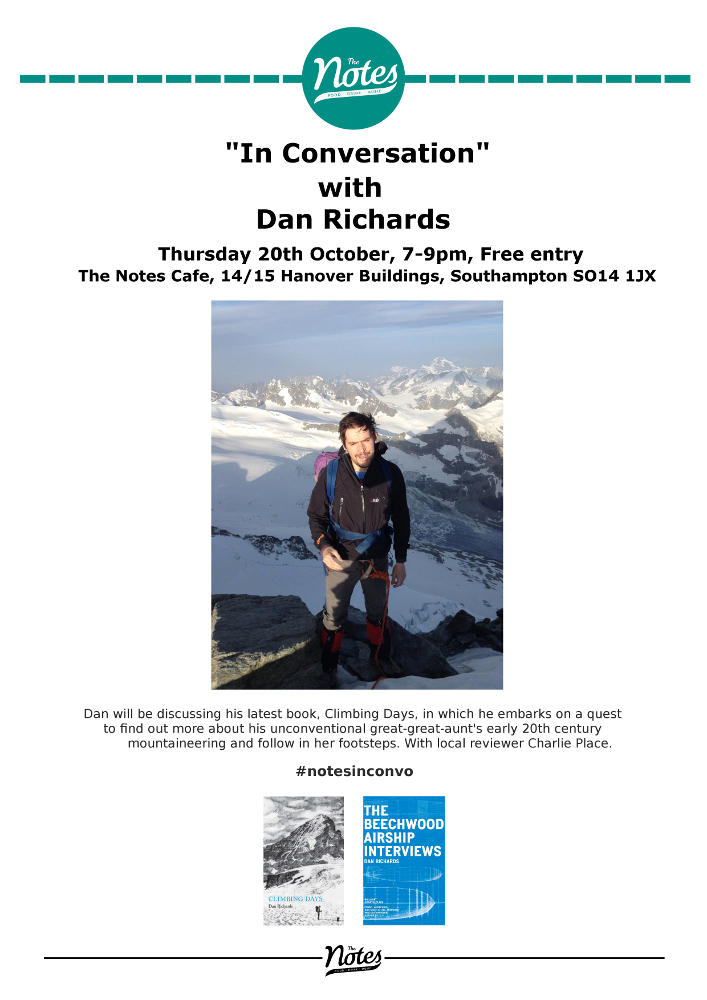
This is to say that on Thursday 20th October I will be hosting a literary event, between 7-9pm, in Southampton. Dan Richards is the author and we’ll be discussing his awesome Climbing Days, a book full of history, humour, adventure, independent women, and great writing. Books will be on sale, both Climbing Days and Dan’s previous work, The Beechwood Airship Interviews, which will also get a mention in the conversation.
For the venue, The Notes Café, a wonderful independent eatery/coffee shop in the city centre. Primarily musical, as of late they have started open mic poetry nights and are keen on the idea of pursuing the literary route further. It’s a business I’m very excited to work with. Their decaf is super, their jacket potatoes quite honestly some of the best.
If you could spread the word in any way: tweets, posts, telling friends and family who live nearby, I would be extremely grateful. The event Facebook page is here. Hashtag: #notesinconvo If you’re able to join us on the night, fantastic! Do let me know.
I know I haven’t been a very good blog commenter recently – you now know the reason. It’s been a crazy few months but also a very fulfilling few months.
Helen Slavin – Crooked Daylight
Posted 23rd September 2016
Category: Reviews Genres: 2010s, Angst, Domestic, Drama, Paranormal
3 Comments
The definition of magic?
Publisher: Ipso Books
Pages: 204
Type: Fiction
Age: Adult
ISBN: 978-1-911-29567-9
First Published: 24th August 2016
Date Reviewed: 20th September 2016
Rating: 3/5
When their grandmother dies, Anna, Charlie, and Emz inherit her cottage and the woods that surround it, but, already having homes of their own (well, Emz lives with Mum) they decide to let it as a holiday rental. One of these rentals is to a mysterious young woman who likes to bathe in the lake they’d always been told to avoid, and when they spot a man in the woods the sisters are worried. And it seems their grandmother is still around, helping them. Amidst this are the sister’s own stories of relationships, deaths, and young adulthood.
Crooked Daylight is the first book in a planned series focusing on three modern sisters who may have a little magic about them.
This is an interesting take on the idea of magic. It’s the sort of thing that’s been done many times before but not quite in this way which sounds like a paradox and therefore requires explaining. The three sisters – Anna, Charlie, and Emz (whose full name is Emma but as that isn’t revealed until near the end there’s plenty of space to speculate whether, perhaps, Slavin had thoughts of the Brontë sisters in mind) – are people living in our present day with our mobile phones and conveniences. This time period isn’t so much explained as it is shown through slang and the sisters’ often abbreviated language. (Sometimes it can seem as though they are a lot younger than their ages which may be a turn-off for some.) The various housing involves terraces, town houses, and their mother’s new state-of-the-art home… but then there’s also their late grandmother’s cottage in the woods that Slavin’s descriptions infer to be your fantastical wooden thatched cottage. So it’s a meeting of modern reality and slightly older fantasy, but it’s still not that simple. Slavin doesn’t explicitly address the magical elements until near the end which has the effect of pulling you deeper into the narrative as you try to work it out. Is there any magic, really? What sort? Is it just something supernatural?
So Slavin has aimed for something between reality and fantasy that skews more towards reality. It’s the sort of usage that brings to life those times when we wonder how something no one could have had a hand in could be so coincidental. It all works very well.
However, to go back to those characters and their ages that are hard to believe, it can be difficult to relate to them. It’s not that they are dislikeable per se, but they do at times get into drama and other people’s business when they should mind their own, for example one time they have a quite valid worry about a person’s safety but instead of approaching them – a tenant – to mention it, they use their privilege as the holiday home owners to enter the cottage and look around without asking whilst the woman hides in another room, uncomfortable. Another occasion sees one of them becoming quite snotty with some women who so far have done nothing to her (barring trying to stop her and her sisters when they run off with their grandmother’s body to cremmate it in the way they, the sisters, feel it should be done). There’s a disconnection between action and reason.
A seemingly minor element but a compelling one – the sisters’ mother, Vanessa. Vanessa is very different to her daughters and her own mother alike; whereas Hettie (the sisters’ grandmother – Vanessa’s mother) had something magical going on about her and so, it seems, do Anna, Charlie, and Emz, Vanessa is a scientist who lives in an incredibly modern home. Her home is so modern her daughters can’t work out how to use it and whilst this factor may bring about an extra few centimetres in the gulf between mother and daughters, there’s the slight suggestion in it that Vanessa is trying to forge her own path. Whilst the daughters are modern but affected by this magic of their grandmother’s, Vanessa is left out. Her daughters may feel neglected, and that may be true, but it’s an interesting thing to ponder on – why is Vanessa so different? Is it simply that Slavin wants to bring to the fore the difference between traditional magic, superstition, and up-to-the-minute scientific findings, or is it a look at how a person left out will try to forge their own path, their own identity? It may be something, it may be nothing – this reviewer may be over-thinking it – but it’s interesting to contemplate and the difference between mother and daughters will doubtless be further explored as the series continues.
There is no major plot-line in this book which can make it difficult to keep up with the goings on. Various threads and a large number of secondary characters make it feel like a soap opera at times but when the narrative focuses it’s pretty good. It takes a while for that particular thread to become less blurred, to show what it actually is, but the pace gets swifter once it’s settled into. It’s a case of having a lot of information at once, presumably to set up the scene for the series, but it would’ve been better for it to be unwound slowly.
The writing is generally good. Slavin often uses unconventional words – onomatopoeias, for example – that are distinct because we tend to use other words, but this becomes a quirk you look forward to and the meaning of these words is always obvious. But there is a shortage of commas – sometimes clauses that are meant to mean one thing read as something else.
Crooked Daylight is a nice read but quite disjointed. It ends well, suggesting the next book will be very good (and a lot higher in magical content) so if you like the general idea you may want to read it or at least keep the series in mind for when the next one is out.
I received this book for review from the publisher.
Related Books
None yet
When You Are Given A Book You Already Own
Posted 21st September 2016
Category: Chit-Chat Genres: N/A
8 Comments

I’ve spoken before about having multiple copies of books (and will always remember Jeanne’s comment about how she and her husband gave away any duplicates they had when they set up home) and I’ve spoken about that gift-giving situation where there’s discomfort if you ask if the person’s read the book yet. Today I’m combining the two topics.
There have only been a few times in my life where I’ve been given a book I already own and almost all those occasions have involved people thinking about what I’d like and simply not knowing I already had the book they chose for me. The gifting presents a question: what should you do – give away the new copy, give away the old copy, or keep both? The last is usually a bit much but I’ve a story about that in a moment (this is besides the research copy/reading copy I mentioned in my multiple copies post). I’m personally not fond of the idea of saying, ‘thanks, but I already own this,’ as it’s asking for hurt feelings – whatever you choose to do, between the choices of giving away a copy or keeping both, you’re going to end up with an item that the person will presumably spot on your shelves and positive assumptions should be made.
My most recent story, then, the one mentioned above, is one I’ll always remember. I once read a book series in order and didn’t read any other books in between volumes. I mainly read them in the living room, a common room. That Christmas, I received, from someone who didn’t live with us but was often around, the next book that came after the one I’d just finished. But I already had a copy of this book waiting for me, just not in a common room.
The thing is, this present showed me how much effort the person had gone to in choosing me a suitable present. We had briefly spoken books but not about the series; they had obviously noted not just what I was reading but which was the next book in the running order. In terms of effort and thought, it is the best present I’ve ever received and the person was more acquaintance than friend. Both copies were the same but then they weren’t – one was just a book on my shelf, the other was a thoughtful gift. That the person passed away shortly afterwards made that copy all the more special to me and so I have kept both my own previous copy, which I use as my flick-through, and the one they gave me which will be kept for sentimental reasons and because I will in due course pass it on to one of their relatives.
Another story: a friend who, during my ‘Lisa Jewell phase’, when I was just re-entering the world of books as my post-school hatred started to wane and I was following her career in earnest, bought me Jewell’s latest. I’d already read it as I lapped up every new release within the first week of publication, but the gift showed a lot of thought. I passed this copy on.
There is a time and a place for multiples and things you wouldn’t normally keep. There are also times to pass a book on.
Have you any book present stories you’d like to share?
Tahmima Anam – The Bones Of Grace
Posted 19th September 2016
Category: Reviews Genres: 2010s, Angst, Domestic, Political, Romance, Science, Social, Spiritual
Comments Off on Tahmima Anam – The Bones Of Grace

One epic love letter.
Publisher: Canongate
Pages: 407
Type: Fiction
Age: Adult
ISBN: 978-1-847-67977-2
First Published: 19th May 2016
Date Reviewed: 14th June 2016
Rating: 4/5
Zubaida was studying in America when she met him: Elijah, a man she came to know for just a few days; she had to leave for Pakistan when her university department’s hopes of uncovering an ancient fossil were realised. But when the project came to an abrupt halt, Zubaida went back to her native Bangladesh and married her childhood friend, effectively bringing an end to her acquaintance with Elijah. Years later, after meeting and splitting from him again, she has chosen to tell him everything in a letter.
The Bones Of Grace is a somewhat epic story that also includes another story within the story. It’s the sort of book you’ll likely either love or hate (very difficult to rate!) but either way appreciate the background detailing.
What first strikes you is Anam’s writing – it’s sublime. There are no two ways about it. It’s the sort of writing that is so wonderful, so well put together, so constant, that it has a very real affect on the novel’s flaws. You won’t dismiss the flaws, but you will feel as though you want to dismiss them. But what’s interesting is that this isn’t necessarily Anam’s natural writing style, it’s all Zubaida – during the story within a story, where we hear directly from Anwar (and it’s just that Zubaida has included his words in her letter) the writing is very different. More… male, appropriately. (Anwar is a man looking for his past love who puts his search on hold when he runs out of money.) Zubaida’s words, the flow of her writing, does make up somewhat for what could be called a frustrating narrative.
And I could imagine almost every day of your childhood, because it would have been documented in films or on television – in that way, you had probably lived a deeply unremarkable life, had experiences without specificity, and that had bothered you, the way my own past grated at me. All the things that irrritated you were things that I longed for, and all the things you longed for were things I took for granted.
I want to tackle this narrative before moving forward (hopefully the above extract exudes the quality and how the narrative can be both beautiful in what it says and, to use a word from the extract, grating). Whether Zubaida is annoying is really up to you, your personality, and, likely, down to your own experience of love and heartbreak. That Anam has captured her particular tale in a very honest way is hard to dispute – I think we’ve all had times when we’ve realised we’re dwelling too much on something and need to stop discussing it, and that that doesn’t always mean we stop thinking about it – it’s just a case of whether you’re happy to spend 400 pages on it and, indeed, whether you believe in this woman, Zubaida, writing a 400 page letter of excuse and apology.
Of course without the number of pages, we wouldn’t have a novel, we’d have a pamphlet, a novella at most, so this is where the background and ship-breaking comes in.
“It’s a cruel industry. For years we’ve been working slowly, patiently with the owners. Suddenly she comes and tells us how terrible things are. A film isn’t going to change anything.”
Anam uses Zubaida to look at the end-of-life of ships, in this case a cruise ship. There is the time when the ship is created – overseas – and sets sail, multiple times – overseas – and then, when it’s deemed too old, it comes to Bangladesh where men work for little pay, breaking it into pieces to be sold on. Zubaida comes to the beach as a translator for a western reporter who is looking to make a film (and possibly press charges against the management). Through Zubaida, Anam shows the horrors of the situation – the lack of safety, the deaths, and the exposure to chemicals and other toxic ingredients the workers face. It’s a uniquely-realised story. The inclusion of Anwar’s story, in which he comes to work at a ship-breaking beach, adds to the level of detail involved.
Then there is the palaeontology. Zubaida’s passion is the study of the fossil of a walking whale – a creature that slowly evolved to live under water whilst other creatures evolved to live out of it. Her journey is set around her attempts to get access to the fossil, first overseas then through the removal and sending of the bones to America. The journey shows the conflict between work (the will to, in this case) and relationships. Anam is an anthropologist which means you get a lot of detailing, but her writer self stops it becoming too much.
Amidst this is Zubaida’s lifelong mental conflict – she was adopted, lives in a well-off family and her fiancé is rich, but she doesn’t know anything about her birth mother and starts to feel a need to know where she came from. This is where privilege and class enters, where the underlining of Zubaida’s poorer beginnings limits what there is for her to know. It’s there in the background when she begins to question, no matter what category the question comes under; her thoughts of love, duty, and Elijah are informed by her adoption. In meeting Elijah she finds herself thinking of things she’d never thought about before and quite possibly never would have otherwise, and family duty and a general lack of mental strength hold her back from taking it further. She has all this luxury in consequence of being with Rashid, she’s lucky, she shouldn’t be thinking of Elijah. But she is thinking of him.
And amidst this turmoil is a minor story – minor in how much time it takes up (it’s big in terms of real-world impact) – of war, of the effects of it and of war crimes coming to light. Zubaida’s mother has spent her years working towards justice. Her father’s work and business has been ethical. You see glimpses of the Bangladesh war.
Now the ‘twist’, if it can be called so, that you start to see when Anwar makes his entrance (because if a stranger becomes involved you know there’s got to be a connection somewhere), isn’t as predictable as you might first think. It’s quite likely you’ll guess correctly, and, yes, of course this part of the narrative could be considered a device because how likely is it that it’d all happen in real life and so on, but it’s a novel after all. The reveal is pretty satisfying – it won’t blow your socks off but it may well make up for any frustration you had been feeling due to the way Anam goes about it. Make no mistake – don’t go assuming the twist the main reason for the book. It’s not – the book is all about the journey, the writing, the history, the palaeontology, and the ship-breaking – but it does give it an extra lift.
The Bones Of Grace is a slow-paced book. There’s not really any action in it; certainly that it’s one long letter should suggest this as a possibility. It’s very much a literary book, an issues book, wherein the pleasure is in its bookish sensuality.
If you like the sound of that and if what’s heralded as good about it hits the right notes for you, it’s likely you’ll fall completely in love with it. If it doesn’t hit the right note, you’ll likely still appreciate it but it may take you a while to get through.
Related Books
None yet


