

David Eddings – Guardians Of The West
Posted 12th December 2011
Category: Reviews Genres: 1980s, Comedy, Fantasy
Comments Off on David Eddings – Guardians Of The West

It’s time to battle against evil once more.
Publisher: Corgi (Random House)
Pages: 423
Type: Fiction
Age: Young Adult
ISBN: 978-0-552-14802-3
First Published: 1987
Date Reviewed: 4th December 2011
Rating: 3.5/5
Please note that as this is the first book in a follow-up series, The Malloreon, to The Belgariad (also a five-book series) there may be content in this review that is considered a spoiler for The Belgariad. You might also like to note that despite the book’s cover, all of the books about this particular world were actually written by both Eddings and his wife. It is only in more recent years that this information has come to light.
Garion, now king of Riva with his wife, Ce’Nedra, as his queen, has been finding life suitably routine. It is definitely hard work being the Overlord of his fellow kings, and it’s annoying how everyone comes to him to dump their problems at his feet – but war torn the West is not. But of course there would not be a story if this routine wasn’t to change, and as another prophecy appears to begin and the Orb starts speaking once more of trouble, Garion and his friends are sure to be displaced from peace soon enough. Who is this new Child of Dark and will the Rivan royal couple ever provide the kingdom with an heir?
If you enjoyed The Belgariad, picking up Guardians Of The West feels a bit like coming home. Whereas in the first series the reader was still getting to know the characters and Eddings wrote them accordingly, in Guardians Of The West there is very much the sense that Eddings has relaxed, believing (rightly, really) that his readers know the people he is talking about. He has altered the way that he writes about them ever so slightly – they are most certainly the same characters, but now it feels as though you’ve been invited into their inner circle. This said the plot is largely the same as the previous.
There are more jokes this time round, however this is at once both a very good thing – the jokes are often very funny – and a bad thing – it can become too self-indulgent. For the most part the truly laugh-out-loud moments outweigh the lesser ones, but towards the end of the book the sheer number of lines such as Barak’s constant declarations of liking a person, and the misfit that is humour during what is purported to be a massive bloody battle, doesn’t work. The reader sees a little bit of the battle and then spends the rest of the time listening to the characters, who are all royal or high up in society, discussing strategy or simply bantering amongst themselves. Although the series is a comic fantasy, the total disregard by Eddings to present anything resembling reality in this case is difficult to get over.
Unfortunately this is joined by predictability. As soon as battles happen, nay, as soon as they are a possibility, there is no need to read further as you know exactly how it will end. Such was also the case in The Belgariad. Unlike other authors, Eddings never includes any chances that the characters will fail. Although you know, considering the genre, that good will ultimately triumph, there is never any sense of danger. The characters arrive, talk for a bit, attack, win, find they haven’t won completely, go back to talk more, and etcetera. And winning is all too easy for them.
In regards to strategy, once the main crux of the book begins the narrative always going back to discussions. The discussions take ages, and while there can be interest in the minute details Eddings goes into, one can’t help but wonder if Eddings ought to have joined the army instead of becoming a writer because he clearly has a passion for working things out. Once the characters win, someone comes along to tell them that they haven’t actually won, and that is part of the cycle of repetition; there are a good several strategic discussions within a fifth of the book’s pages. After the first couple of discussions it becomes dreadfully boring.
Interspersed are pointless dialogues, silly ideas, and things the reader didn’t need to know. Indeed when the characters finally discover the true next step, one that needs to be taken then and there, they sit down for alcohol and humorous conversation. And individual characters are always going off to do something secret, something that generally turns the tide on things within the blink of an eye. The extensive use of magic to solve problems, despite the fact that the book is a fantasy and is therefore “allowed” to use magic, can make things that might have been exciting rather dull. And in addition to all of this, Ce’Nedra’s constant refrain of “I want my baby”, despite the reader’s knowledge of her personality, can make a person want to change the text so that she is less selfish and remembers that it takes two to make one.
So while Eddings knows how to plan battles, he does not know how to stage the action. But he does know a lot about showing rather than telling, which of course has a lot to do with the negative aspects but is overall a winner. Although he may be influenced by the likes of Tolkien, Eddings never goes down the path of describing so much scenery that you fall asleep. He prefers to tell his tale through dialogue, which makes his book a quick read. And for the most part his characters are well-defined, they never lose their personality and apart from the times when they are all complimenting each other too much it would be easy enough to be able to read the conversations between small groups without the name labels of who said what.
You have to be prepared that nothing will really happen for the vast majority of the book – unless you don’t mind reading about domestic routine – and that it is filled by short dips into the lives of the characters over the course of several years. Why Eddings felt the need to leave such a gap yet still try and fill the reader in is incomprehensible, he may as well have just begun by summarising. He wanted Errand to be more grown up, and that makes sense, but we do not learn that much about Errand that couldn’t have been condensed into a few pages. Some of the plot points are very interesting, but when Eddings employs a written, and thus longer, version of what film makers do to show the passing of time (think quick shots of scenes and music overlays) one does wonder why he is doing it.
Eddings is good at creating stories, but his writing could have done with more polish. Some phrasing is awkward and the modern Americanisms don’t always fit the rest of the text. This particular edition of the book is rife with errors that should have been picked up during the editing process and it’s just lucky that the story is strong enough to keep the reader from becoming distracted by them.
Guardians Of The West is a rather flawed book, but the setting and characters balance out the problems. It may work as a stand-alone, but is best read after having finished The Belgariad because the characters will likely appear funnier and the information gleaned from that first series helps to explain this one. Fans of fantasy will find it okay, but this series is definitely for those with a love for quick comedy.
Related Books
Claire Robyns – Second-Guessing Fate
Posted 26th November 2011
Category: Reviews Genres: 2010s, Romance
Comments Off on Claire Robyns – Second-Guessing Fate

Putting your entire trust in a fortune teller rather than your man doesn’t tend to be the best thing.
Publisher: Carina Press (Harlequin)
Pages: 142
Type: Fiction
Age: Adult
ISBN: 978-1-4268-9232-5
First Published: 26th September 2011
Date Reviewed: 26th November 2011
Rating: 3/5
Gemma has been unlucky in love. Her previous long relationship ended when the man left her a day from the aisle and it took her some time to get over it. Being anxious that her friend should move on properly, Helen takes her to have her fortune told; Gemma is to suffer heartbreak again before meeting her soul mate, and while she finds nothing credible in the old woman’s tarot cards – indeed the woman didn’t even finish the story – Helen will be there promoting the mystic’s words, every step of the way.
Second-Guessing Fate is, in summary, the Hollywood film How To Lose A Guy In 10 Days. The only major difference between the two tales is that Robyns replaces the writing gig with a fortune teller. But that doesn’t mean that it’s automatically bad for being a duplicate, and in many ways Second-Guessing Fate is better than the film, being that there is more time for character development and that the hero, Nick, is simply sublime.
Gemma is, for the most part, a good character. She doesn’t fall for the fortune teller’s words and laughs at Helen’s thoughts. Depending on the reader’s own beliefs on relationships one may find it difficult to understand why Gemma is so adamant that her time with Nick is going nowhere simply because they haven’t had sex, and her ideas for her business are peculiar, but it’s hard not to like her. Nick is, as said, sublime. He has just been dumped by a woman who told him how bad a boyfriend he was, and is on a mission to change. His development is very apparent, because it is his subplot. Although Gemma throws some awful things at him he takes it in his stride and continues to love her.
So it would be best right now to say what does not work in this book. Unfortunately it is predictable that as the book continues, Gemma suddenly changes her tune and starts to believe in the fortune. It occurs when Helen remarks that Gemma looks exactly like her grandmother, and is just too unrealistic – Gemma would’ve seen the photograph of her grandmother before and should therefore know that she looks like her. The strong woman suddenly changing and becoming silly is off-putting.
However silly it can be, though, it is still rather funny. In fact if Gemma’s story is trying not to love a man she “knows” will dump her, then Nick’s is trying to love a girl despite the sudden changes that come over her when she seemingly becomes a parasite – he clings on right back while she is trying to get him to hate her. The scenes between Nick and his married friends are both funny and endearing, and the way the men come across makes one quite sad that their conversations were written by a woman and not a man.
Gemma is a cook, the owner of a tiny catering company, and Robyns uses this when she’s writing about body parts and sex scenes, and also, sometimes, miscellaneous things. This reviewer doubts that any more description is needed here for the reader to imagine the sorts of things that get included. Besides from the cooking metaphors the sex scenes are comfortable enough to read. There are just as many fades to black as there are full descriptions and there is no awkward terminology.
But the subplot of the burgeoning company is another negative. Gemma wants a contract with a big name supplier and in order to be in with a chance she has to attend a blueberry pie fair. Her blueberry pies get ruined so instead she fills bowls with liquor and puts blueberries in them. A cute idea perhaps, but hardly a show of talent.
Second-Guessing Fate could have done without the sudden yet all too predictable changes in thinking, but it’s not past the use by date (sorry, I couldn’t help myself). And it’s worth the read just to meet Nick.
I received this book for review from Carina Press.
Related Books

Priya Basil – The Obscure Logic Of The Heart
Posted 14th November 2011
Category: Reviews Genres: 2010s, Domestic, Political, Romance, Social
2 Comments
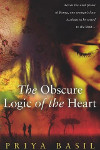
Sometimes you have to make a solid choice, but you don’t.
Publisher: Black Swan (Random House)
Pages: 496
Type: Fiction
Age: Adult
ISBN: 978-0-552-77385-0
First Published: 2010
Date Reviewed: 30th September 2011
Rating: 1/5
Anil loves Lina, and Lina loves Anil – but she’s held back a little by their differing religious views, and a lot by her own indecisiveness. She also has dreams of working for a charity while Anil favours architecture. The differences between them mean that they are constantly at odds over their relationship.
It’s very hard to write a proper summary of this book because there isn’t a true plot to it. Although cited as another Romeo And Juliet, The Obscure Logic Of The Heart is not like the great work of Shakespeare at all, in truth it doesn’t really know what it wants to be. Lina’s indecisiveness is reflected in Basil’s inability to decide just what her book is about.
There’s nothing much this reviewer has to say that is positive about the novel because there are just too many issues with it. One is the issue of time. When is the book supposed to take place? If the book begins by recounting the future, and thus the present is the future, it doesn’t much sound like it. If the present is our current present, then their years at university are too advanced. Lina arrived at her first job two months after 9/11. This would mean she was about 21 or 22 years old in 2001. If the author has set the reunion in the present day – around 2009/2010 when she wrote it – that would make Lina only 30. Therefore the decades that have reputedly gone past could never have happened. This is why some proper timing is required because Lina and Anil should be reuniting in the 2020s or 2030s and yet Basil has made no attempt to make the world any more developed, as it surely will be.
The characters aren’t at all memorable nor, like the world, are they developed. Anil is given more space to grow than Lina – who is silly and hesitant throughout, although she needn’t be – and the rest of the characters, though they have more life in them, aren’t particularly good. The purpose of the book is to highlight social, cultural, and religious issues but the youthful relationship between the protagonists isn’t given any time. The author tells you they are a good match but does not show it. It’s impossible to be convinced that they are – indeed it’s difficult not to feel that Anil has been wasting his time from the word ‘go’.
It’s as though all the characters are acting. The romance is supposed to be mired by religious conflict yet neither Anil or Lina are particularly religious – the former is not religious at all. The hero’s parents aren’t religious. The heroine’s mother is, but could be won over, while her father broke with tradition himself (as shown very early on via some letters that make the recipient obvious). So the relationship is not believable and neither is their trouble.
It’s also quite sad that Basil has formed the basis of Lina’s problems around the fact that Anil isn’t Muslim because this isn’t actually the real issue. From the way Basil has drawn the characters, even Lina’s virtuous mother, it’s difficult to see that a little more effort wouldn’t have overcome these complications. The fact the book tries to present a real issue current in our world today, and presents it so poorly, is worrying. The religious conflict is rather throwaway. What actually keeps the characters apart, even though Basil might not admit it, is Lina’s selfishness. Lina doesn’t particularly suffer when away from Anil, in fact she forgets him most of the time.
And this is where the biggest problem of the book lies. Basil is clearly torn between wanting to write about a forbidden romance and wanting to write about the issues in Africa. Lina leaves Anil and then suddenly all emphasis is on the UN and Basil is dedicating pages upon pages to describing conflict and why things must change. Obviously she’s an advocate, and there is nothing wrong with that, but instead of being compelling as it would be if she had written a book that left out the romance, she just leaves the reader confused. If Lina doesn’t seem to care about leaving Anil, the reader can’t be expected to either.
The characters that work for the UN go on about their expensive products being ruined by sand and have lots of parties and a great amount of sex. The way Basil portrays it really doesn’t give the reader a good impression of a group of people who are meant to be aiding the poorest people of the world.
There is a scene in which Lina is with an American colleague. One – the American does not sound as though she ought to be anyone’s boss, in fact she sounds like a silly teenager. Two – Lina says she loves these kind of conversations – a conversation about rape being used as a weapon in war-torn countries, that is being spoken by a man and the American woman, while the latter is trying her best to display as much cleavage as possible. As mentioned prior to the conversation, Lina doesn’t like this flirty behaviour of her colleague’s – if so, wouldn’t she be wondering about the distaste of a conversation about the plight of African women being spoken by someone who is currently trying to get her breasts out? If in writing this scene Basil was trying to show irony, then she surely would have commented on it.
And whenever things get difficult? Basil dons her Victorian clothes and turns to melodrama, causing accidents in convenient places and getting rid of characters that could have caused interesting moments to happen.
There are some errors that are truly terrible, such as the London Underground signs being written in red (an author who has lived for a while in London ought to know that the signs are written in white against a blue background); and human beings do not have green pupils.
And it’s unfortunate really, because the pace of the book is good and it’s an easy read.
Having religious conflict as a theme requires depth. Having social relations as a theme requires depth. And as this book sadly shows, Basil is not a person who can do it.
I received this book for review from Transworld Publishers, Random House.
Related Books
None yet
Barbara Longley – Heart Of The Druid Laird
Posted 9th November 2011
Category: Reviews Genres: 2010s, Fantasy, Historical, Paranormal, Romance
Comments Off on Barbara Longley – Heart Of The Druid Laird
Where love doesn’t just get your average definition of a second chance.
Publisher: Carina Press (Harlequin)
Pages: 235
Type: Fiction
Age: Adult
ISBN: 978-1-4268-9227-1
First Published: 19th September 2011
Date Reviewed: 16th October 2011
Rating: 3.5/5
Sidney and her friend Zoe work and live together, but neither of them would ever have guessed that they had done similarly before. That’s until Dermot MacKay and his men turn up at their shop. Dermot is immortal, born in the fifth century, and trying to break out of his eternal existence. He knows that the key to doing this is finding the reincarnated soul of his wife. But even if Sidney’s shop holds fantastical items, it’s going to be difficult to get her to believe him and even more difficult to leave the long life he had previously wanted to get away from.
Heart Of The Druid Laird is a book that encompasses many genres, some better than others, to deliver a well-written romantic novel. However, it does start rather quickly, and the reader looking primarily for historical content should know that it’s the fantasy element that is the focus.
It can be a little weird how quickly Sidney’s friend, Zoe, accepts everything, indeed it takes less than a couple of days for her to be spouting information as though she has known it forever, and while that is in part true for the nature of her soul’s journey, a quick reminder of the contents of the women’s shop, largely presented as New Age, shows that she would be quite open to it, even invite it. Of course this leads into the whole idea of reincarnation – the reader who believes only in what can be explained may have to suspend belief in order to enjoy it.
The first half of the book is very enjoyable. The genres weave in together well, the imagery is good, the dialogues too. Sidney isn’t easily swayed by Dermot, even when she finally accepts his story. She doesn’t miraculously fall suddenly in love with him: when she has sex with him it is from pure lust, which the reader can easily recognise. For love to work the reader needs her to transition slowly, but for lust nothing needs work except chemistry, which the characters have in bounds. And even when Sidney starts to acknowledge her feelings, she doesn’t suddenly lose the plot – she remains strong, stubborn, and independent throughout. But this last clause is where the book rapidly begins to fall apart as the chapters continue on – although it is understandable that Sidney would become afraid at what might lie ahead she becomes incredibly soppy. Maybe the reader can accept some of that due to the repetition of the idea that she’s been looking for The One, but because the change happens so swiftly, and she was so strong before, it does affect the satisfaction you find in the novel. And as much as the first episodes with the fae can be acknowledged, when the entire story becomes wrapped up in fantasy and everything comes down to something so easily upturned, no matter whether or not you always knew that it came down to the fae, it becomes lacking.
However the characters are in the main very good and the story well plotted. Longley seems to have had a solid idea of where she was headed from the start, everything is tied up nicely and all the questions that you could ask that are directly related to the text are answered. Longley makes a stellar effort with the accents, even if at times some words don’t fit in, and she clearly knows her stuff.
The world-building is excellent, and even though this reviewer is more attuned to the Tudor period, what she knows of the early AD years ran alongside Longley’s creations. And Longley isn’t happy with just her two chosen time periods, she includes in her interior design Elizabethan furniture too. Longley is certainly a fan of history and this positively exudes from her work.
The sex scenes are brilliant – they are not crass, the word choice is regular, and because of this they are hotter than your standard fare. It’s easy to believe in both the couples in this book. However when Sidney worries about contraception and then lets Dermot off, and he, after they’ve had sex, says he couldn’t have kids anyway, there may be eyebrows raised. Sidney didn’t know he couldn’t have children until after the act, so she shouldn’t have let him get on with it after an almost frivolous suggestion for protection on her part. And if this man came from the fifth century… well even people with no knowledge of the period know that those who lived before, often especially those in power, tended to favour fornication and had no idea about sexual health. Maybe a disease would die a swift death in an immortal body, but the idea would surely have crossed Sidney’s mind. Or at least it should have.
While Heart Of The Druid Laird may not quite meet expectations is isn’t far from the mark and is certainly worth the time it takes. People after a bit of mystery will find it here, there’s a drop of angst for those who wish it, and those wanting some history will be pleased that Longley goes back to the past to provide the full story. If Dermot has been waiting over sixteen hundred years for his life to get somewhere he ought to be proud of his narrator’s presentation.
I received this book for review from Carina Press.
Related Books
Jane Austen – Emma
Posted 4th November 2011
Category: Reviews Genres: 1810s, Comedy, Domestic, Social
1 Comment
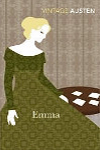
Perhaps the best example of how wonderful Austen’s ability to create characters was.
Publisher: N/A (but I’d wager Vintage’s a good one)
Pages: N/A
Type: Fiction
Age: Adult
ISBN: N/A (Vintage’s is 978-0-09951-1168)
First Published: 1816
Date Reviewed: 13th October 2011
Rating: 5/5
Emma Woodhouse is rather well off, and intelligent and charismatic to boot. She wishes to add to this list a talent for matchmaking, and indeed already has introduced a widowed neighbour to her governess and they are a fine couple. Now she wants to enhance her new friend Harriet’s position in society, and the man who wants Harriet’s hand does not fit the proposed expectations. Emma doesn’t want to marry herself, but will she able to carry on her initial success?
Emma is a fantastic examination of what happens when a person tries to involve themselves in other people’s affairs, and what this means for that person’s knowledge of their own feelings. The events in Emma are largely held in the same one place, in fact Emma herself never leaves her village, and yet Austen succeeds in being perhaps more witty and introducing a more detailed cast of characters than in any other of her books (Mansfield Park aside as this reviewer has yet to read that one).
It cannot be disputed that what makes Austen so readable is her cast of characters. In Emma every single person is very different to all the others so that it wouldn’t be difficult to know who was speaking even if you stripped the manuscript of all names. If it seems that some characters are similar it is only because they are less talkative. Of the ones who speak often you can clearly discern the man of sense, the woman who talks too much, the joker who wants entertainment, the hypochondriac who tries to push his hypochondria onto others, and so on. There is a particular chapter in volume 2 of the book, chapter 11, that is simply sublime – hilarious, all show and no tell, and a prime example of how these very different characters interact. Surely Austen is one of very few authors from whom this reviewer would be happy to read all dialogue and no description.
“Did you ever see such dancing? – Was not it delightful? – Miss Woodhouse and Mr. Frank Churchill; I never saw any thing equal to it.”
“Oh! very delightful indeed; I can say nothing less, for I suppose Miss Woodhouse and Mr. Frank Churchill are hearing every thing that passes.”
Austen undoubtedly had a whale of a time writing this book. The discourses between Mr. Knightley and Emma are brilliant, Mr. Knightley being the one this time round who has a level head. And as usual Austen shows us that she was not only ahead of her time but would fit very well in society today.
Where Emma thinks wrongly, Austen is always ready to have a laugh and put her on the straight and narrow in the form of her Mr Knightley. As is the case with Northanger Abbey, bar the narration itself in that novel, Austen employs a male character to voice her feelings. In a way, the reader may wonder why Austen, a woman in a male-oriented society, would often want to make her male characters the ones with the most sense, but in doing so she opens up her work to a wider audience.
It is this continual discourse between Mr Knightley and Emma that sets the reader up with the knowledge of what is to happen. In the character of Emma we have Austen trying to test the boundaries of class and seeing what happens when people try to get around them, even if it is only for their own benefit and fun.
As a counsellor she was not wanted; but as an approver, (a much safer character,) she was truly welcome.
Emma herself is fun for being so intelligent yet so out of her depth when it comes to matchmaking, and for having the inept ability to choose entirely wrong people for her friends.
It may be possible to do without dancing entirely. Instances have been known of young people passing many, many months successively, without being at any ball of any description, and no material injury accrue either to body or mind…
The reader might say that the set up of matchmaker could have been continued longer, with more people involved, but what is included is so well thought out that it doesn’t really matter. The way that Emma provokes her friends to follow her ideas and, as is once the case, literally follow her around, is worth a lot more than numerous matchmaking attempts.
Pride And Prejudice may be perhaps the most famous of Austen’s novels, but Emma makes a good run for Elizabeth Bennett’s money. Whether or not Emma would have chosen Mr Darcy for Elizabeth however cannot be speculated. The phrase that would conclude this review best is “read it”.
Related Books