

Malinda Lo – Ash
Posted 13th August 2012
Category: Reviews Genres: 2010s, Fantasy, LGBT, Romance
2 Comments

It’s not always the prince you want to go to the ball to meet.
Publisher: Hodder
Pages: 291
Type: Fiction
Age: Young Adult
ISBN: 978-0-340-98837-4
First Published: 2010
Date Reviewed: 4th July 2012
Rating: 4/5
Ash lived with her parents in Rook Hill until her mother died and her father passed away having remarried. Now Ash has been condemned to slave away for her stepmother and stepsisters for the “debt” her father caused the family. Ash has always believed in fairies, and when she meets one she is entranced. But not as much as she is when the King’s Huntress enters her life.
Ash uses the traditional tale of Cinderella as a base, but Lo moves far away from it most of the time, it’s almost as if the tale is there for when she strays too far. But this isn’t necessarily a bad thing, indeed Lo creates enough of her own story that when the reader is introduced to the traditional scenes it can be a shock in that it is easy to forget that Cinderella was incorporated at all.
The book is mature enough that it requires the Young Adult rating, but the writing is rather simple in that mystical, intriguing way of fairy tales. The book doesn’t require much time, however it does require full attention if the reader is to truly appreciate the way in which Lo tells her tale. Throughout the story there are hints of what is to come, the sections that may seem like world building are included to provide a lesson for Ash, and their inclusion makes the dark nature of the tale all the more apparent.
The story feels rather short, but this is in keeping with traditional tales – the book spans a good length of time, several years, but only a few aspects are focused on. Lo knows what is important and what is not and doesn’t spend time on superfluous details. And she manages to do this whilst simultaneously providing her reader with a thorough knowledge of the world she has made.
Ash is quite the strong heroine. She knows when keeping quiet will save her hassle, and she knows when speaking her mind will release her frustrations. Through her Lo demonstrates the difference between a small crush and real love, and whilst a lot of the lessons may not be so relative to real life, for their fairy basis, the overall idea is relevant.
Where tradition is included, Lo still pushes the boundaries of the tale and rarely leaves the elements unaltered, for example one of the stepsisters is rather likeable and a friend to Ash. Where there is stereotypically a good fairy godmother, there is darkness. The fae in Ash consists of a whole other world and there are a lot more mentions of them than just the one appearance. Indeed anyone looking to be totally wrapped in the magical realm will find what they are looking for here. One subject covered is how fast belief is fading, Ash is one of few who appear to still believe in fairies despite the way the two races were integrated in years gone by.
It is well known that the main way the story strays is in the romance department, and truly it would be difficult to review this book effectively without considering it. The bride-finding ball is included, but perhaps Ash isn’t concerned with the reason for it. There is no big literal emphasis on same-sex relationships; loving the same gender in Ash’s land is so natural that such a thing is never addressed, the reader simply witnesses women going off together without any comments from the characters or author. While this obviously brings the story right into the present day, it fits the set up of fairy land well, as often in fairy tales women are entranced by women and the same of men. The relationship itself is chaste, making it ideal for readers who are only just at the age for Young Adult books.
Where Ash fails to hit the mark is in its pace and description. It is true that such issues blend perfectly with the way that traditional tales are told, but because the book is longer than, say, a Christian Andersen story, the requirement for a fast pace is greater. And whilst there is more than enough information on fairies, sometimes the story does feel lacking in appropriate detail. This is where the difficulty in categorising it rears its head – on the one hand Ash feels like a children’s book and in that sense everything works, but the content places it firmly in the realm of Young Adult, causing detail to be important.
Ash is not for the reader who wants a straight retelling of Cinderella. The main character’s name may be a clever substitute, but her life does not mirror the mythical girl’s closely enough to please such a reader. For those not so concerned, especially readers interested in the modern nature of the book, success is likely to be found, if not celebrated.
Some girls do not wish for a prince, and as Lo explains, that’s completely fine.
Related Books


Ella Drake – Desert Blade
Posted 10th August 2012
Category: Reviews Genres: 2010s, Erotic Romance, Science Fiction, Social
Comments Off on Ella Drake – Desert Blade

Love and survival in an apocalyptic world.
Publisher: Carina Press (Harlequin)
Pages: 71
Type: Fiction
Age: Adult
ISBN: 978-1-4268-9367-4
First Published: 23rd April 2012
Date Reviewed: 5th June 2012
Rating: 3.5/5
Derek and Lidia met when Lidia was the doctor in charge of rehabilitating him after he lost his arm. The riots and outright violence that had filled the streets of America threatened everyone’s lives, and whilst the two appeared to strike a rapport, it couldn’t last for long. 10 years later and Lidia still wonders what happened to Derek. When he turns up at her new community’s secured dwelling, looking for a doctor for a young friend, the feelings that had had little time to develop come racing back.
As this is a very short book, giving a basic plot summary without including any “spoiler” information is pretty impossible. However considering that the book’s strength lies in its setting and that the book is fairly predictable in an acceptable way, I do not see summarising it as a bad thing.
Drake once again provides us with an example of how creative and interesting she is when it comes to constructing worlds and elaborating on them. We’ve had sci-fi fairytales, romance in space with cowboys, and now we have an empty apocalyptic world. But this isn’t the apocalyptic world of the Young Adult genre, chilling and tyrannical, no, this is your bona fide obliteration, a world where nature has succumbed to the destructive forces of man and given in. Technology still exists but infrequently, and the world is notable for its desert.
The only issue with this is that there’s undoubtedly much to explore and a lot to learn – whilst the reader does learn a lot, the shortness of the book means that a good deal is left unsaid. Indeed the story itself is so short that it feels less of a novella and more the sort of piece that would fit into a collection. Because of the quick pace and few details you wonder if it would have worked better had it been in a compilation.
However that’s not to say that the book is bad, because as inferred, a book with such world building could not be so. And there is a lot to like about Desert Blade. One such example is the beginning, where everything feels rushed and you wonder if this will be the pace throughout. Once you get to the “10 years later” you realise just how appropriate such a fast pace was, not only because it was provided as background context, but because such a format is used for flashbacks in films – a quick glimpse of something, explosive in its revelations, before the story starts for real. You realise that the entire section was in fact one scene.
Something that was pointed out in reviews of Jaq’s Harp, was the inappropriate nature of a couple casually discussing whether they should revive their sexual relationship – all the while being chased by the enemy. Drake clearly took this criticism to heart, however she wove the criticism around her own preferences to good effect. In Desert Blade there may be enemies chasing the couple, but they will find a safe place before discussing their relationship. That Drake took the criticism of her readers and used it to improve an idea that she liked is to be admired and respected. In this one small element of her writing she has improved as a writer ten-fold, and shown that her readers important.
Desert Blade has a good concept behind it, a fascinating world that begs to be portrayed on the big screen, and an interesting mix of traditional and modern values. It may even have a hint of present media culture in the form of an element not unlike X-Men. The sole aspect that holds it back is its length. While we may know enough to understand the attraction between the characters, especially physically, we do not get to spend enough time with them to truly appreciate their positive roles in the community, and whilst another might say that that’s okay given the romantic focus, the fact that Drake included enough about the context to intrigue us, makes it an issue. The concept of lost and found is completed, but it could have been developed a lot more. Whilst the characters are the focus, it can be easy to instead get lost in the setting.
Something that has so far been left out of this review is the reasoning for this book being an erotic rather than fade-to-black romance. There are a couple of scenes, one in particular, with explicit language and no-holds-barred descriptions. However unlike Drake’s previous books, they are not as prevalent and indeed one of them is woven around the issue of contraception, providing a lesson at the same time. That said, Derek is rather open about his love of women in a way that may prove uncomfortable with some readers, especially when his need to protect oversteps the mark.
Desert Blade is an interesting story combined with a compelling sorry world. Appropriate as an introduction to Drake’s work, it demonstrates the author’s strengths well. It perhaps ought to have been longer but is good on its own merit – and it does succeed in continuing the tradition of making you look forward to whatever world Drake has in mind next.
I received this book for review from Carina Press.
Related Books


Nichole Bernier – The Unfinished Work Of Elizabeth D.
Posted 6th August 2012
Category: Reviews Genres: 2010s, Domestic, Social
2 Comments

Healing the self in an age of unrest.
Publisher: Crown (Random House)
Pages: 305
Type: Fiction
Age: Adult
ISBN: 978-0-307-88780-1
First Published: 2012
Date Reviewed: 1st July 2012
Rating: 3.5/5
Elizabeth died in a plane crash shortly before 9/11, and Kate has found it easier to grieve for longer without people criticising because of the devastation that came afterwards. But did Kate really know Elizabeth? When she’s given Elizabeth’s diaries she finds that their friendship may have only touched the surface of who Elizabeth really was. And in learning about Elizabeth, Kate must reassess the person she has herself become.
It should be noted straight away that while official summaries of the book suggest that Elizabeth died on 9/11, she did not, and thus the story does not refer to the event much except to explain Kate’s state of mind.
The Unfinished Work Of Elizabeth D. revolves around a friend reading the diaries of a recently deceased woman against the backdrop of the woman’s grieving husband, the friend’s strained marriage, and the friend’s issues, which seem to have formed because of the death.
How many things in life are like this, near misses? … Every move you make and a million ones you don’t all have ramifications that mean life or death or love or bankruptcy or whatever. It could paralyse you if you let it. But you have to live your life. What’s the alternative?
Kate is a worrier, and since Elizabeth’s death she has worried about attacks happening in her city and in the places her husband goes to on his business trips, and also about diseases that could claim the lives of her children. As the book continues the reader finds that her worrying is at risk of becoming an OCD and that if she doesn’t get her head around the fact that one has to live with the future unknown, her marriage could reach breaking point and her life become even more of a mess than it is now. Kate is also struggling with balancing her need for a career with bringing up her children.
If Elizabeth’s death was somewhat of a catalyst for the extreme changes in Kate, then it also plays a part in getting Kate back to normality. The diaries of a woman who Kate finds she didn’t really know open her up to the situations she’s put herself in and how she’s let other things in life take over from doing what she wants to do. Elizabeth’s role is to teach Kate how to be, how to do things the right way. Although it may not seem it, especially considering the title, Kate is the main character, not Elizabeth.
Another theme is a lack of communication – between Chris and Kate, between Dave and Elizabeth, between Kate and Elizabeth. Elizabeth’s issues may have stemmed from a particular event, but the way she never let anyone see the real her was the reason for her continued issues and indeed for misunderstandings after her death. That she didn’t discuss important issues with Dave, and this is apparent very early on, caused the equilibrium she was trying to keep to simply just result in more pain. The communication issues between Chris and Kate have obviously been there a long time, but the arrival of the diaries and Kate’s reading of them to the expense of couple time with Chris, brings matters to a head. It is almost as if Kate has brought a third person into the marriage and in discussing the content of the diaries with Chris, Kate is effectively describing a lot of the problems in her own marriage.
But something feels missing in this book. It feels unfinished due to Kate’s feelings about Chris not being confronted – they may have been thoughts but to the reader they are presented as real possibilities and thus needed to be dealt with. And whilst we come full circle with Elizabeth’s diaries there are still a few things that could have been included. The story is good, but not as compelling as others that dwell on the same psychological themes. There are subplots that are left open, such as Max’s bakery and the looming fear that he will have to close it, as well as a wondering of why such subplots were included in the first place.
The ending is very much opened-ended. Will they stay where they are, will there be a separation, how will Kate respond to her discoveries – all the questions that the reader asked the book at the start remain questions at the end. And while it is okay that not every thread is tied, there needed to be at least some sort of resolution so that the reader had more of an idea how things might turn out.
The Unfinished Work Of Elizabeth D. is a nice, somewhat laid-back look at how awful events can effect us in less typical ways, but whether planned or not, the second word of its title is an apt description of the book. The messages and lessons are solid, but the execution could have been better.
I received this book for review from Crown Publishing Group, Random House.
Related Books

Samantha Sotto – Before Ever After
Posted 27th June 2012
Category: Reviews Genres: 2010s, Adventure, Angst, Comedy, Fantasy, Historical, LGBT, Romance
Comments Off on Samantha Sotto – Before Ever After

When “forever” doesn’t mean “forever” for reasons that no one’s considered.
Publisher: Broadway (Random House)
Pages: 294
Type: Fiction
Age: Adult
ISBN: 978-0-307-71988-1
First Published: 2011
Date Reviewed: 18th June 2012
Rating: 4.5/5
Shelley’s husband died from a bomb in a backpack on the subway in Madrid, a few years after they had met. Two years afterwards Shelley is still grieving, and when she answers the door to a man who looks like her husband and says he is Max’s grandson, she wonders if the bruise to her head she gained when she fainted on the doorstep is the reason why she is seeing the impossible. But Paulo isn’t Max. Indeed Paulo has issues of his own, he wants to know who his grandfather is because he knows the man is still alive. And for Paulo to find out who Max is, he must ask Shelley, even if this will be the first she has heard of it too.
Before Ever After is the debut novel of an author who shows much promise. It successfully combines a range of ideas and genres to create something not merely magical but also extremely romantic, up-to-date, and informing. At once a travel log, a historical fantasy, a comedy, and a tragedy, the book presents itself as something incredible.
The story is told through a compilation of flashbacks and present-time reflections. As the basic idea is for the characters to discover who Max is, the flashbacks are used in order to show how Max had hinted at things all along, and the present-time is used for Paulo and Shelley to work out what was going in. Indeed the flashbacks are stories within a story within a story, the book is three layers thick, but the structure and format means that you will never be at a loss for what time period you are currently reading about. The setting of the present day is mostly a plane, which gives the characters plenty of time to chew things over, and while you may find yourself wanting it to be over already so that you can meet Max, the fast pace of the novel means that the satisfaction of reading it and taking in all of the information is much more exciting. Indeed you never know if you actually will get to meet Max in the present time, and that in itself spurs you on because he’s such a great character that you really hope you will. All of the suggestions and especially the very first page of the book, tell you that he is very likely paranormal in some way, but Sotto does a good job of letting you wait to find out if it is true or not. And you will be wondering until the end.
“Now listen campers,” Max said. “Take note of this place in case you get lost during our field trip and need to find your way back home. If you don’t think you can remember where we started from, you can purchase a baguette and leave a trail of bread crumbs. Oh, and before we head off, there are three things you must remember. First, don’t talk to strangers. Second, you need to be aware that your travel insurance does not cover acts of stupidity or alien abduction. Please do your best to avoid them. And third, hold on to your mates.”
[…]
Shelley raised a brow. “Mating?”
“Mating,” Max said, “from the word mate, a word derived from the Old Dutch word maet or companion, which shares the same root as mete, which means ‘to measure’.”
“I see,” Shelley said. “So what you are in fact offering me is a measure of companionship, correct?”
“Indeed.” Max stuck out the crook of his arm. “The length of my arm to be exact. All in accordance with the guidelines of the Poultry Club, I assure you. You won’t get lost, I have a place to rest my arm, and the chickens are secure in my fidelity.”
Max is one of those characters who comes along very rarely. This reviewer would liken him to Mr Rochester of Jane Eyre and Max de Winter of Rebecca for his difference – whilst he is not like them he shares with them this certain uniqueness in quality. Max is surely a great romantic hero, yet on the face of it, for his dialogue, he is anything but. Shelley may be a strong heroine in herself, but Max is the winner here.
The inclusion of Shelley allows Sotto to show her reader a widely known issue, that of being afraid of relationships because of prior hurt. Shelley is almost paranoid about being a relationship, keeping a list on her at all times that tells her when to jump ship from dating a man – to ensure she doesn’t end up like her widowed mother, who in turn showed her how much depression could come with loss. Max too is worried about losing people, and this is apparent throughout the book; it is the way the couple figure out their relationship in a way that works for them that is so compelling.
Another factor in the book is the number of everyday issues and taboos Sotto fills her story with, and the way that she includes them like any other element. This is done through the secondary characters. Max and Shelley met when Shelley decided to sign up to join the tour group Max was taking to the continent, and it is the people on the tour with them that make the novel so valuable. The tour group consists of a young American called Dex – Shelley’s cultural male counterpart, Rose and Jonathan – an elderly couple in the prime of their sexual lives, and camera-wielding Brad and his partner Simon. Rose is very open about her sex life, and Brad and Simon are just a gay couple – there is no reasoning behind anything, Sotto has included subjects to be as normal as anything else, and this lack of pointed political correctness in a book that otherwise oozes it is particularly refreshing. With the historical content and present-day happens race is also included, and Max’s nature as a possibly paranormal person is drenched in issues of morality.
She sank her teeth into melted cheese and summer, unleashing a silk stream of eggs and cream in her mouth. A buttery earthiness lingered on her tongue. She gulped orange juice to keep from moaning from the world’s first egg orgasm.
Rose gave Shelley a knowing look. “I came as well, dear. Twice.”
Jonathan sputtered, turning a shade brighter than the raspberry preserves on his baguette. “Ah… um… yes, yes, wonderful eggs, Max. Très magnifique.”
Shelley did not recover quite as elegantly, and was still choking on the juice that had spurted out of her nose and onto Max’s shirt. Max came to her rescue with a couple of solid pats to her back, a napkin, and a grin.
Considering Rose’s frankness about her sex life, it should not surprise you that at times the book is hilarious. Whilst it is not graphic, Sotto lets the jokes run wild and there are numerous references to loud noises and length as much as there is travelling around the continent.
And travel makes up a huge section of this book, providing the basis for the character’s meeting, the reason for the history, and what Sotto wanted to talk about as a keen traveller herself. There is a great deal of information on the places visited, which are diverse in location and culture. What is interesting is that Sotto is relentless in her goal of introducing her characters, and thus her readers, to lesser-known gems in Europe. Through these lesser-known places, Sotto is able to create the world she wishes for Max to explain to his tourists, and it gives her free reign in the historical fiction department. Quick research will show you what is factual and what is not, and this is another part of what makes the book so appealing, that you are reading a blend of travel log and history and learning so much all at once. The historical rewrites are something in themselves, with Sotto often referencing well-known figures in order to provide background context, and twisting both facts and possibilities, such as the idea that Marie Antoinette’s Petit Trianon was a place of debauchery, in order to produce the result she wants. Stretching from the 1970s all the way back to Ancient Rome, across different religions and cultures, with a variety of fantasy characters and just plain interesting ones, there is bound to be something to interest you in the history chapters.
“I told you it was nothing,” Adrien said. “Although the duchess did appear to be the tiniest bit cross with me. But then again, I could be mistaken.”
“Mistaken? How so?”
“Well, I was rather busy dodging the various heavy brass objects she was throwing my way to really pay attention to what she was saying.”
There are a couple of less positive factors to the book and these concern the way Sotto uses description. There is an excess use of similes where what is really happening is sacrificed for descriptive and poetic metaphors. The issue with the similes is that they create melodrama in places where melodrama is not needed and can sometimes cause confusion as to what is happening. And there are short bursts of info-dumping and a few clunky dialogues. However these negative parts are rather like the excessive use of humour in a Terry Pratchett Discworld novel – it is easy to accept because the good vastly outweighs it and it is understandable that Sotto is still coming into her own as a writer, still working out her style and voice. The plot and characters are what’s important, and they are enough to keep you reading when the written word falls down a bit.
Before Ever After is a very apt name, giving you everything you need to know about the book without really giving you anything at all. If this is what happened before, then what happens after? Is there an after? Was there ever really a “before”?
The scent of strawberries, or rather what strawberries might smell like if they were made from melted plastic and disinfectant, filled the white-tiled room.
It is impossible to do justice to this story. Let that statement be the conclusion.
I received this book for review from Crown Publishing Group, Random House.
Related Books



Speaking to Samantha Sotto about Before Ever After, Love & Gravity, and A Dream Of Trees (spoilers included)
Tune in as Charlie Place and Samantha Sotto discuss characters that join you in your car in the midst of a traffic jam, time travelling with Issac Newton, switching from your fully researched work in progress to a story that needs to be told, and… chickens?
If you’re unable to use the media player above, this page has various other options for listening.
Shannon Stacey – Slow Summer Kisses
Posted 22nd June 2012
Category: Reviews Genres: 2010s, Romance
2 Comments

If work is your everything, where does life fit in?
Publisher: Carina Press
Pages: 64
Type: Fiction
Age: Adult
ISBN: 978-1-426-89386-5
First Published: 4th June 2012
Date Reviewed: 21st June 2012
Rating: 4/5
Cam was quite happy living at the camp until he heard Anna was coming back. Remembering her as an irritating ten year old he’s not exactly prepared when the beautiful woman arrives at the house next door. But Anna doesn’t plan on staying long as she’s looking for a new job in the city, and as Cam knows that she’s career-driven, the odds she’d stay for him aren’t in his favour. He keeps his thoughts of kissing her to himself, but inevitably that won’t last for long and it remains to be seen how Anna will view their relationship.
Slow Summer Kisses is a fun novella that uses romance as its backbone to talk about living for yourself. This may not have been the goal in Stacey’s mind, who knows, but if ever there was a lesson to take away then this is it. Cam is more of a rural boy, not literally, but in that stereotypical way we as a society have of thinking of such a person as lacking drive. Anna is his polar opposite, career-focused and happiest when in a suit. The whole idea behind their relationship being considered a fling is that both are set in their ways, and whilst they are attracted to each other they aren’t willing to sacrifice their respective lives for the other. Stacey moves through these concepts – the self, the desire to live your dream, compromise – that despite the short length managed to be discussed well enough to make an impact on the reader. They might not be discussed as thoroughly as, say, a lifestyle coach’s manual, but the fictional aspect, the romance and realistic characters, mean that you learn it from a perspective of experience. And it really doesn’t matter that that experience has been gained by two people who only exist on a page.
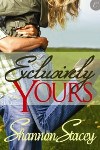
The characters. Cam is a good hero, and while he may share the protective elements of the Kowalski men of Stacey’s backlist, he is of a very different mould. Indeed if you are a fan of the Kowalski series do not expect this book to be in any way the same because barring a similarity to Keri’s job in Exclusively Yours, it isn’t. But then that isn’t a bad thing and the difference allows Stacey to explore new ideas, as previously discussed. Anna is an intriguing character. At once she is one person and another, and that makes her accessible to any reader – readers who prefer their female characters to be more traditional, domestic, and readers who prefer women to be working just as much as their partner does. Stacey’s writing of Cam succeeds in creating a bias against Anna at first, which is rather clever really because it means that the reader comes to love Anna at the same pace as Cam, albeit that the reader’s love is platonic. You get to know the characters very well in the short time it takes to read the book as they are finely written. The story is driven equally by characters and plot, but it can be hard sometimes to factor in just how important the plot is, the characters taking all your attention.
She was painting the top edge of the window trim. And she was doing it by standing on a step stool, which was balanced on the table she must have dragged over to the wall. She was going to break her neck.
“Dammit,” he yelled without thinking.
She stopped painting and looked over at him, one eyebrow raised.
“Why are you doing something stupid while I’m trying to avoid you?”
“Why are you trying to avoid me?”
He growled and shoved his hand through his hair. “So I don’t kiss you again.”[…]
“You don’t have to avoid me,” she said. “If you don’t want to kiss me again, don’t kiss me.”
“I do want to kiss you again. That’s why I’m avoiding you.”
“Ah,” she said, as if it made any more sense to her than it did to him. “Maybe you should just kiss me again and get it over with.”
The relationship seems to happen very quickly, rather it does happen quickly. This can jolt you out of the story for a time but it is the reasonable result of the book being a novella. However there is a great attempt to slow things down. That “slow” is in the title is telling because Cam wants Anna to slow down, to relax, and of course their relationship becomes part of that.
As for the passion in the relationship there are a few sex scenes that are detailed but not particularly graphic. And as usual Stacey has given her characters a good sex education and they are responsible each time.
Slow Summer Kisses takes a quick story format and asks “what’s the rush?” In the same way that Cam teaches Anna to live in the moment and love it, so the story shows us that a lesser word count doesn’t mean a hurried or lacking tale. Perhaps the best part is that the book demonstrates that women can be breadwinners just as much as men, and, as such, are just as liable nowadays to let life run away with them as their male counterparts.
Pull up a chair, get your knitting out, and read this book. It’s what Cam suggests, book aside, and you might just find it works for you too.
I received this book for review from Carina Press.
Related Books