




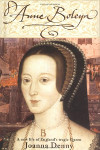
Joanna Denny – Anne Boleyn
Posted 7th September 2012
Category: Reviews Genres: 2000s, Biography, History
2 Comments
It’s all well and good to be positive about your subject, but you can’t let it allow you to be hateful to all opposition, especially when the opposition is long dead.
Publisher: Piatkus
Pages: 327
Type: Non-Fiction
Age: Adult
ISBN: 978-0-74995-051-4
First Published: 2004
Date Reviewed: 5th September 2012
Rating: 3/5
Denny presents us with a biography of Anne Boleyn, the first wife to be executed by Henry VIII. Claiming to reveal the truth and to be unique, Denny recounts Anne’s life from young lady-in-waiting to Queen facing death.
The author begins well. Although she may be wrong about her book’s uniqueness – other historians such as Eric Ives had already produced detailed biographies – her overall purpose includes the sadly true snippet that Anne was vilified in her lifetime. She also says, “tradition has presented us with a totally unconvincing one-dimensional picture”, suggesting that she will work through this ‘picture’. And she does.
Denny provides good background context. Throughout the book she makes much use of the accounts of the Spanish ambassador, Eustace Chapuys, but cautions the reader, saying that Chapuy’s English was poor and he could only rely on spies. Likewise Denny debunks popular ideas to good effect, for example she points out that if Anne was truly as unattractive as Nicholas Sander described, she, Anne, would never have captured and held Henry’s attention for over a decade. Sanders was the person who gave us the idea of Anne being a witch with six fingers – with all Henry’s superstitions and worries, Denny’s points stand to reason, especially when you consider that Henry refused to sleep with Anne of Cleves because she looked like a horse. Yes, the description there was Henry’s own.
Something that is vastly in Denny’s favour is the way she backs up her statements. Even when she is using questionable opinions she adds a reference for where she found the information or a reference that aids her in making her point. This system enables her to bypass an issue found in many non-fiction works – unlike other writers, when Denny writes something that sounds overly romantic or fictitious, such as saying “Anne thought…” or “it was an exhausting journey” there is always a reference, in these cases state papers or the accounts of Anne’s friends. Work like this is utterly refreshing and it’s nice not to have to read such assertions with a sceptical mind.
The points that Denny makes are quite often simply fascinating, and whilst her unnecessary hatred of some of the leading players is cause for complaint (to be discussed later) this scorn of hers yields some particularly interesting facts, such as Catherine of Aragon’s silence over the issue of her virginity, silence that she kept up until Henry planned to divorce her. Intriguing too is the surprise of the Pope’s that, given Henry’s conviction that his marriage to Catherine was unlawful, he [Henry] hadn’t just gone and married Anne already. Henry was certainly an anomaly in his family when it came to scruples, as his sisters didn’t have many – Denny remarks that Margaret sought and won a divorce on similar grounds to her brother and that Mary had married the bigamist Charles Brandon without batting an eyelid.
In regards to Catherine of Aragon’s sudden revelation, to the court, of her virginity, it is interesting that this was a second concept she’d hidden from Henry, as Denny remarks on an earlier event when Catherine had pretended she was pregnant. Denny’s point is that Henry must have remembered this “pregnancy” when Catherine showed the decree of virginity, but what is truly captivating is the fact that Catherine pretended to be pregnant at all. Pretence you can understand of a woman who is aware she is considered responsible for producing heirs, but pretence would lead to sex being suspended, sex that could have made her truly pregnant.
Here it would be appropriate to discuss the overall way in which Denny portrays Catherine. Unfortunately no allowances can be made because there aren’t any – Denny hates Catherine with a passion and it is clear that her [Denny] love for Anne means she sees Catherine as a she-devil. The author does later provide a couple of quotations in evidence but isn’t it ironic that one of those references is not included in the bibliography? Plowden, who is not described and could be either a primary or secondary source for all this book is concerned, called Catherine arrogant, stubborn, and bloody-minded. This description is not enough, it is like a get out of jail free card that Denny snitched from another player, and it does not stand to reason.
The second quote is a better-known source and intriguing. Given that Catherine was Spanish and aligned her interests with Spain, it is rather telling for Denny’s conviction that the source is the Spanish ambassador, Campeggio. The man said:
“I have always judged her [Catherine] to be a prudent lady, [but] her obstinacy in not accepting this sound council does not please me.”
Compelling; but the problem with Denny’s use of this source is that Campeggio speaks of a single event, Catherine’s refusal to become a nun – which would have ended the Great Matter (Henry wanting a divorce) – and her insisting that her case went to Rome. It would have ultimately been in Spain’s interests for Catherine to become a nun as the Pope was having a difficult time with Henry; Campeggio’s words could easily be the result of in-the-moment frustration. Though this is all as much speculation as Denny’s own, the difference is that Denny gives decorum and other possibilities the cold shoulder, making herself quite the wretched writer.
Like mother, like daughter: Denny hates the youthful Mary, Catherine’s heir, as much as Catherine herself. Because of her love for Anne, Denny on occasion puts on rose-tinted glasses when viewing Henry’s actions, to the effect that she overlooks some terrible behaviour by the King towards his daughter. A prime example of this is Denny’s statement that refers to Mary’s refusal to acknowledge herself as a literal bastard, illegitimate on the grounds of Henry’s discomfort in his first marriage.
“Henry had been irritated… by her unnatural hatred.”
Here Denny calls “unnatural hatred” the anger of a daughter for a father who has treated her and her mother with distain, casting her mother aside, denying their marriage, and forcing the daughter to live away from her mother. Henry’s actions caused Mary a lot of stress. There was nothing unnatural about Mary’s hatred at all, indeed her refusal to comply with Henry’s requests was the very natural response of a girl whose father repeatedly demonstrates that he despises her.
There are two possible birth dates cited for Anne, with a few years between them. Historians have given varying reasons as to which is the more likely, but Denny’s reason is a little off. She says that since Henry preferred women to girls the older birth date must stand. But Henry did like girls – he courted and married the 15-year-old Catherine Howard when he was in his 50s.
Accounts by Chapuys, one of the Spanish ambassadors, are included throughout the book. Denny says we must take his words with a pinch of salt because he didn’t speak English and had to rely on spies, that he never met Anne. This is commonly accepted – Chapuys can’t be trusted. But when it comes to opposing evidence, Denny takes Chapuys’s word over Jane Dormer’s as to Anne’s true birth date. She takes Chapuys’s words, “that thin old woman”, as good evidence, yet Chapuys was surely being derogatory, his words are hardly nice and he despised Anne. Dormer didn’t like Anne either, but at least her words are neutral.
And in relation to Anne’s birth date, Denny says that Anne wouldn’t have bemoaned lost youth and chances of marriage if she was only in her mid-twenties. Yet mid-twenties was considered old, especially when it came to marriage.
Denny takes a very romantic view of parent-child relationships. Of the letter by Anne to her father that talks of love and obedience, Denny says that this demonstrates closeness. But in those days it was usual for such things to be written, so while it’s possible, the letter is not compelling evidence.
So Denny is struck with a hatred of Spain as well as a sort of semi-romantic notion not unlike the literal romantic notion of Fraser when dealing with Marie Antoinette and Count Fersen. Whilst it is not a case of Denny being wrong, per se, her presentation of her thoughts being undeniably correct is an example of a possible lack of interest in opposing evidence due to her convictions of Anne’s goodness. Denny has all the qualities of a historian and a fine debater but lets her bad qualities take over.
Anne Boleyn is a good book to read if you want interesting additional information. It also offers some alternative interpretations, but the reader will have to wade through malicious slander to find it, and there is a lot more of it than could be covered in a review. There is plenty of content in the book that could be used as research for other work but due to the nature of it one should be sceptical of using Denny’s opinions in any academic debates.
Related Books

Kate Morton – The House At Riverton
Posted 5th September 2012
Category: Reviews Genres: 2000s, Domestic, Historical, Mystery, Romance, Social
4 Comments

What the elders want the elders will get, but it will come at a cost.
Publisher: Pan Macmillan
Pages: 591
Type: Fiction
Age: Adult
ISBN: 978-0-330-44844-4
First Published: 2006
Date Reviewed: 27th August 2012
Rating: 3.5/5
At 98, Grace is approached by a film-maker who is creating a movie about the murder mystery surrounding the house she, Grace, used to work at. What the world doesn’t know, however, is the truth; and this Grace has kept to herself her entire life. Only now, facing inevitable death, does she decide to create some cassette tapes for her grandson explaining everything, including what really happened on the night a famous poet killed himself at the lake.
The House At Riverton is a long look at the early decades of the 20th century and how society came to dictate lives in such a way that people made drastic choices they wouldn’t nowadays. The book could have easily been cut by about 300 pages – the back story, whilst fascinating, especially for those with a particular interest in the era, is unnecessary, and it takes three quarters of the book for the story to actually begin. The build-up is for the most part predictable and thus all the extra details surrounding it are irrelevant. It’s nice to get an idea of what went on in the characters’ heads (so far as Grace can determine) but what would otherwise have been a big reveal is, of course, not there.
However this doesn’t mean that the book is a failure, indeed even if it required heavy editing, the superfluous content does illustrate well the life and society of the time. If you’re a reader looking for a thrilling mystery you won’t find it here – this is a book for people who enjoy period dramas and the sorts of incidences that were considered monumental back then but would be a non-issue today. Family structure is discussed, such as marriage in order to produce heirs to keep hold of property. And seeing as the book follows the lives of a couple of generations of the same family, Morton also details, through the characters themselves, how change occurred as the children of the 1910s became the adults of the 1920s and began to challenge the strict rules imposed upon them by their elders. Both these issues, woven together, cause the most conflict in the family, as well as the streak of feminism and want for equality that comes as second nature to one of the young women, Hannah.
It would be fair to say that although the characters are well written, their purpose is to enable Morton to put her point across and to explain history and society, and so whilst the reader knows them enough they are not the sort to commit to memory in a fond manner.
It should be noted that The House At Riverton isn’t all that much of a romance story and that the mystery aspect of the book is hampered by the fact that the reader knows the basics, even if the true mystery does remain a secret. Yet, in these two factors there does remain some interest – the romantic threads form more of the commentary on society, and as there are a few of them Morton is able to look at the issue as a whole in detail. The veils over the classes are pulled down and Morton shows the reader that the relationship between upstairs society and downstairs subservience was a lot more complicated than either section would have admitted, maybe than they would have known. The romances also highlight the need for loyalty that is often inherent in us. The true mystery is what the film-maker, Ursula, is after, but only Grace knows it, and the reader is only party to it from being inside Grace’s head; thus the ending is good, as it ties everything together and the reader being given all the ingredients to work out what would happen next. Indeed the reader may know more than the characters, even after those happenings happened.
The House At Riverton is too long for what it sets out to accomplish, and the real thrill takes a while to get going; it is recommended thus as a good resource for gaining knowledge of past society and exploring the class system inherent in the day.
Related Books


Thomas More – Utopia
Posted 29th August 2012
Category: Reviews Genres: 1510s, Philosophy, Political, Social, Theological
Comments Off on Thomas More – Utopia

Utopia may not be Utopia, but does that matter?
Publisher: N/A (I read Penguin’s version)
Pages: N/A
Type: Fiction
Age: Adult
ISBN: N/A
First Published: 1516
Date Reviewed: 10th August 2012
Rating: 4.5/5
Please note that the version I read was translated by Paul Turner (from the original Latin).
Utopia is a work of fiction, however it does overlap with reality and depending on the edition you read the editor and/or translator may or may not have included a couple of letters that sound very much like true correspondence. The plot is simple and detail is everything: More meets his friend Peter and Peter introduces him to Raphael, a man who has lived in the New World. Raphael spends time conferring upon the friends the knowledge he has learned from the country, and discusses his convictions that life in Utopia is fairer than Europe and that Europe ought to use Utopian society and politics as an ideal to aspire to. Filled with references to Plato, the conversation is seemingly an attempt by More to preach his suggestions for a different system of government and living.
The book is quite a feat, yet whether or not the author himself knew just how much of a feat it was, and would remain to be, is a subject that would require a differing style of writing to a review; one can assume he knew something of it as Wolsey had made him publish it under the name of William Rosse1. Utopia is at once a product of its time and ahead of its era. Although some of the topics it addresses fall solely in the realm of the late medieval/early modern period, the vast majority are relevant today in a rather scary fashion. Indeed More is so accurate in his ruminations of structures that continue, even now, to be used in the (western) world, that he would be well placed were he to sit in the British House Of Commons tomorrow.
More’s book contains a lot of thoughts that successfully appeal to both a minority of people in his day – or maybe they were a majority? Who really knows what the common person thought? – and to us in our 21st century world. There are “discussions” on subjects such as capital punishment for burglary:
“We’re hanging them all over the place,” he said, “I’ve seen as many as twenty on a single gallows. And that’s what I find so odd. Considering how few of them get away with it, why are we still plagued with so many robbers?”
“What’s odd about it?” I asked – for I never hesitated to speak freely in front of the Cardinal. “This method of dealing with thieves is both unjust and socially undesirable. As a punishment it’s too severe, and as a deterrent it’s quite ineffective. Petty larceny isn’t bad enough to deserve the death penalty, and no penalty on earth will stop people from stealing, if it’s their only way of getting food. In this respect you English, like most other nations, remind me of incompetent schoolmasters, who prefer caning their pupils to teaching them. Instead of inflicting these horrible punishments, it would be far more to the point to provide everyone with some means of livelihood, so that nobody’s under the frightful necessity of becoming first a thief and then a corpse.”
Here More, through his character Raphael, speaks out against the fatal punishment meted out to thieves. More points out that a great many of the thieves apprehended are poor and that they are not in a situation where they can act upon the fact that thieves are executed. And More quite rightly suggests, although at least in the western world he can be happy that such extreme measures no longer exist even if jail applies to both, that there being no difference in punishment for a thief as for a murderer does not change the way a thief will behave; indeed a thief may as well have been a murderer in the 1500s.
And when it comes to bringing up the youth of society, More’s words are seemingly even more political than before as what he says is incredibly relevant to Britain today, as 21st century Britain struggles with crime which many link back to unemployment and few opportunities in both childhood and adulthood. More remarks:
“You allow these people to be brought up in the worst possible way, and systematically corrupted from their earliest years. Finally, when they grow up and commit the crimes that they were obviously destined to commit, ever since they were children, you start punishing them. In other words, you create thieves, and then punish them for stealing!”
If you do not help people to get out of their poor backgrounds they will have no way to get onto the career ladder, to make money legally. And, to go back to a 1500’s issue, how can stealing money equate to a death sentence? Both are against the Ten Commandments and surely murder is worse than stealing.
More doesn’t leave it there – he goes on to explain why there are these issues in the first place. What is interesting is that he speaks out against the way the church would take land for its own use and how the begging for alms by monks would effectively leave less money available for true beggars – this being interesting because More was himself a strong Catholic. One could liken his thinking to that of Erasmus, who also spoke out against the church whilst remaining one with it. Yet it is interesting how these two writers, More and Erasmus, were effectively giving a prior warning to their readers about the Reformation action that was to come, being people who remained loyal whilst others who spoke out fell out of love with Catholicism and became Protestants.
As a last look at examples of how More’s work fits so well into our world may we consider the information he provides that it is the expense of raw materials, created by a greedy government, that caused many people to be out of work?
It is interesting and ironic how some of the items More discusses were to happen so soon after publication. These are the references to the men employed by government turning against that government – this is what the New Model Army did in the 1600s, the turning point towards England becoming a republic for that short time – and the use, by a king, of ancient laws that everyone had forgotten, in order to raise money – exactly what Charles I did to fund his fight against the afore-mentioned NMA. So uncanny are these discussions, so spot-on in their warning, that it’s hard to believe that More was writing five monarchs previous when the country was, if not completely, better settled.
As to be expected in our modern society, though the book may have great relevance, it is difficult to agree with everything More is saying. Indeed there are observations made about Utopia that prove quite disagreeable, such as that the “mentally deficient” (read “mentally disabled”) ought to be laughed at whilst being looked after – because that is the right way to communicate with them if one is nursing them. This by itself is typical of views at the time, but what makes it particularly difficult to accept is that it is comes before a paragraph that urges acceptance of the physically deformed and ugly (read “physically disabled or deformed”) because such deformities are not their fault. Whilst one could perhaps surmise that the phrase “mentally deficient” is More’s way of saying “those who haven’t bothered to try to improve their intellect”, the fact is that coming straight before a statement about the physically disabled does very much suggest that More is speaking of the mentally disabled, and this is a point on which the translator of the text agrees. The only thing that truly suggests More is talking of intellect-by-choice is that he says those who are physically deformed did not choose to be so, thus possibly inferring that the mentally deficient are their opposites – because which mentally disabled person has had a choice over whether or not they are mentally disabled? It is not their fault, just as it is not a physically disabled person’s fault. However, a fact trumps all these charges to single this piece out as prejudice by More – physically disabled people were more understood; the mentally disabled, for a very long period of time, were simply viewed as mad or strange with no real studies conducted to find out what was really going on. With a physical disability, even doctors of the 1500s would have recognised a limp, a wounded arm, or an inability to move, as a medical issue.
Then there is the idea of religious tolerance. Through the fictional Raphael, More announces that Utopia is home to a variety of religions and that the citizens are free to believe in what they will – then he says that everyone goes to church and kneels before the priest. Unfortunately here, in our modern eyes, More is but confirming his own beliefs, firstly by the use of the word “church” – a Christian term – and secondly because people of differing religions should not be made (as you soon realise that Utopia is in fact more akin to an apocalyptic dictatorship than heaven) to use one priest and one all-encompassing service, at least not as their sole form of community worship. And if beliefs are allowed to be different, then the prayer More details makes no sense as it talks about a “true religion”. “More was intolerant of all dissident opinion,” wrote the historian Joanna Denny2. Whilst Denny was incredibly biased against More, it cannot be denied that More’s own words back her up.
But these negatives in no way set the modern reader back, for later on comes such comments as this one on the elderly poor:
Having taken advantage of them throughout the best years of their lives, society now forgets all the sleepless hours they’ve spent in its service, and repays them for all the vital work they’ve done, by letting them die in misery.
It seems 1500s Britain was as notorious as the 21st century version in its care of the older generation – a quick bit of research on the part of anyone not acquainted with the UK system will find that the above quotation could quite easily have been taken from a leaflet about the current non-treatment of the aged population.
So we have a book that was ahead of its time whilst being a product of its time, that is philosophical and political – almost dangerously political given that More was the friend of the oft-cited tyrant Henry VIII – and is eternally relevant. But what we don’t have, and this is intriguing given that the very word “utopia” is in our dictionaries thanks to More’s usage of it, is a particularly Utopian society. Utopia the country, for all More’s debate – albeit that More does criticise it from time to time – is in fact more deserving of the terms undemocratic, unfree, police state, and lots of other words beginning with “un” that end in a description that brings to mind strict governmental control. The Utopians have free time every day, but they live in regimental housing, eat at certain times in huge communal dining halls, have one set of clothes, and if they fall out of line at all, are punished by slavery or enforced celibacy. These falls include premarital sex (understandable given More’s religion, but surely a Utopian society would simply suggest the couple get married since they obviously have a connection) and disobedience to one’s husband – children must confess to their parents, wives to their husbands, but there is no mention of whom a husband confesses to. There is no money because the country produces enough for everyone, which sounds idyllic, until you learn that there is in fact money in the country because they collect it to pay other armies to go to war for them. Indeed their whole process of war is abhorrent, for all its notions of peace.
So Utopia is not Utopia, and even More supports this conclusion. Whether or not he intended to be ironic in this way cannot be fully known, especially as a lot of what he pronounces is so good. But surely there is a case to be made in favour of More being intentionally ironic in order to show that even the best places on earth can get it wrong in some aspects. Maybe he just wanted to create a slighter better place than England, if Turner is correct.
What, then, was More definitely trying to do here? It would not be wrong to say that he wanted to use his exalted position in court and society to try and influence people to change Britain into the way he felt it ought to be. And whilst this would have been the case for any number of individuals, one cannot help thinking that a lot of what More said would have been very good to implement. Was More in part preparing the way for the burgeoning Protestantism that was happening in Europe? This is possible but rather unlikely given that More produced a diatribe of Martin Luther’s views that, according to secondary sources, included plentiful swear words – clearly More was not as tolerant as he suggests in his fiction; yet he could still have wanted to change things somewhat. The one thing that can be said for certain is that whilst More liked Henry VIII he saw a great many things that were not particularly savoury in his friend and doubtless would have been happy had Henry read the book and introduced to his court some of the suggestions. Sadly considering that Henry would not have been amused by much of the content, and given that the monarch passed on books he was given for others to read instead of him, that was very unlikely to happen.
There is so much in Utopia to discuss, which is remarkable for such a short book. More never wastes a moment, giving only a few sentences to background set ups, and his various references to Plato, combined with the detail and constant stream of information provided, only stands to further the idea that More is attempting to emulate to a degree the great ancient philosopher’s work. Such is the content in Utopia that you are bound to find both items you agree on and items you disagree on, and plenty for debate. To ask whether it is a good book is irrelevant in the usual way – as pure fiction a plot solely of discussion is horrendous – but apply the “philosophy” label to it and suddenly you are in the correct territory.
Utopia forces you to think about the past, the present, and the future – what you like about your country and its past and how far your society has come since times long gone. Whilst it may be concentrated on Britain/Europe and contrasted with a mythical Native America, much of it can be applied to the world at large, both historically and in relation to our modern era. In terms of philosophical debate, to use an extremely bad pun, the more the better.
1 Denny, J. (2004) Anne Boleyn, Britain, Piatkus, p.102.
2 ibid., p.171.
Related Books


Subscribe to this site via email and you’ll receive 3 posts a week. If you use Gmail, you may find the posts are stored in your ‘social’ or ‘promotions’ tab.
Dodie Smith – I Capture The Castle
Posted 24th August 2012
Category: Reviews Genres: 1940s, Books About Books, Comedy, Domestic, Romance, Social
3 Comments

The continuation of 1800s novels.
Publisher: N/A (but I’d wager Vintage’s a good one)
Pages: N/A
Type: Fiction
Age: Young Adult
ISBN: N/A (Vintage’s is 978-0-099-46087-9)
First Published: 1949
Date Reviewed: 16th August 2012
Rating: 5/5
Cassandra lives with her family in a house adjoining a ruinous castle. From having a fair amount of money they have become poor, and it doesn’t look like Mr Mortmain will start writing again anytime soon – despite his wife spending time outside in the nude in order to commune with nature. But then the Cottons arrive, American brothers who have just inherited the estate the castle stands on. And far from being angry about the unpaid rent they’re positively entranced by what they’ve found.
I Capture The Castle is a rather quirky novel about relationships and the power of money. It presents itself initially as relaxing and intriguing, but as soon as it gets a hold of you it branches off, showing deeper colours, just like the women’s dresses after they decide to dye them into new life. What’s particularly appealing about the book is that it is heavily influenced by Victorian literature, both obviously and subtly. There are worded references to Jane Austen and the Brontës, but further than that the book’s story itself feels like it could have been written by, say Austen. Indeed it can be so easy at times to snuggle down, knowing that you’re reading the work of an admirer, that when Smith diverts from the era of chasteness it’s rather a shock. It would not be wrong to say that I Capture The Castle is Austen without the limitation of Victorian etiquette.
I am not so sure I should like the facts of life, but I have got over the bitter disappointment I felt when I first heard about them, and one obviously has to try them sooner or later.
And the book truly strikes a chord. Told from Cassandra’s point of view, via her diary, often she will say something that is so compelling and always considered by ourselves, but rarely shared, such as her ruminations over the idea of her sister wanting a wedding rather than a marriage.
“As we’ll never be able to stop her turning on the Early Victorian charm, we ought to accentuate it.”
Referring back to the Victorian influence, it is apt to discuss the characters. Rose, for example, is paramount in Smith’s dedication of her work to Victorian literature; the character has gathered her knowledge of how to conduct a courtship via the processes in place a century before her own, and the reactions her “victim” experiences due to her theatrics are duly recorded by Cassandra. Rose feels it is time she had money after having lived in near poverty for so long, and if the opportunity arises she will take it. Cassandra is less passionate than Rose, and tends to keep her feelings to her journals, but her potential to love is huge. The Father, Mortmain is rather random in his actions and one never knows if he is working or not, and Topaz, his wife, is completely bohemian. The family is completed by a brother, Thomas, and Stephen, an unpaid servant who is devoted to Cassandra. The Cotton family are colourful too, if less so. The collection of such a set of characters means that whenever the narrative slows down – which it does a lot because the plot as a whole is slow and rather simple – it’s not long before you’re laughing, and as such it’s difficult to want to put it down.
Of course a big draw for the reader, considering that the novel has a simple, fairly predictable plot, is surely the factor of the house/castle in addition to the cast of characters. Though difficult to imagine at times, it is an interesting and individual setting that permits the exploration of history without the burden of superfluous or detailed information.
The romance may be a love square, or perhaps even a love hexagonal – Smith, although agreeing to honour the well-established trope, takes a while to release her hold on the information, so that whilst certain parts are predictable, she might attempt to lead you down the garden path, protesting against readers who have worked it out already.
I asked him if he liked Rose’s dress – mostly to change the conversation.
He said: “Not very much, if you want the honest truth – it’s too fussy for me. But she looks very pretty in it. Knows it too, doesn’t she?”
There was a twinkle in his eye which took off the rudeness. And I must admit that Rose was knowing it all over the place.
I Capture The Castle attempts and succeeds in being the very sort of book a lover of both classics and contemporary work wishes to read – it combines all the trappings of the 1800s novel with the boldness of the early 20th Century, and such boldness enables there to be a further blend of the 1930s and our current 21st Century present. Indeed so wrapped up in the past can Smith become, that mentions of technology, for example a gramophone, may cause you to pause for a moment so that you can adjust your visions of women in Victorian dresses to women of later fashions.
And in addition to all of the above, I Capture The Castle is surely a novel of the arts. Cassandra likes writing, the text is structured as her diary, and the family is forever trying to get Mr Mortmain to author another book. Topaz is an artist and model, and the Cottons are bathed in the world of literature.
“Look, Mortmain, look! Oh, don’t you long to be an old, old man in a lamp-lit inn?”
“Yes, particularly one with rheumatism,” said Father. “My dear, you’re an ass.”
Smith’s work is an absolute triumph.
Related Books
None yet.
Sarah Pekkanen – Skipping A Beat
Posted 17th August 2012
Category: Reviews Genres: 2010s, Domestic
2 Comments

Love and money – two sides of the same coin?
Publisher: Washington Square Press (Simon & Schuster)
Pages: 321
Type: Fiction
Age: Adult
ISBN: 978-1-4516-0982-0
First Published: 2011
Date Reviewed: 7th August 2012
Rating: 4/5
Michael and Julia have been strangers living in a marriage that’s not been much of a marriage for a long time. Julia is somewhat used to it now, but even more used to the riches that Michael’s self-made company has created for them; so when Michael dies and is resuscitated, wanting to give everything up and live a simple life, Julia has some thinking to do and decisions to make.
Skipping A Beat explores an area of life that is little experienced but widely discussed – after death experiences – and couples it with a more grounded issue. What makes the riches to poverty aspect in the book so unique is that those involved were not born into luxury and have not, especially in Julia’s case, found the years long enough to get fully used to it. Enjoy it, yes, at least somewhat, but it’s rather ironic that Julia has never felt completely “there”, that her situation strikes her as temporary. This was an intriguing idea from Pekkanen.
Julia is the character most detailed, and Pekkanen pays a lot of attention to explaining why Julia feels the way she does; although it isn’t until very late in the book that the reader hears anything less than positive about her. This makes sense in a way, as Julia is the narrator, but not knowing the information leaves you more in the dark than Michael. Considering that Michael knows nothing of what the reader knows – otherwise – this isn’t good. This may have been Pekkanen’s plan, whilst she presents a pretty person in Julia, we are never given the sense that she is wonderful, yet we don’t get to see just how effected Julia has been by Michael’s lack of care. And really, we should have seen this a lot earlier.
But other than this, there is a lot of good, solid, discussion about Julia’s issues. It’s interesting, and rather telling, that although she does have some major problems with Michael, the one that Julia chooses to focus on is money. Whilst she may have always felt uncomfortable and a little lost in the wealthy world Michael’s success threw her into, the sudden jolt out of it gives Julia a lot more anger towards Michael than, for example, the time he never made for her. It’s very telling and very honest, because we can say that money isn’t everything all we want, but how many people would seriously be completely happy to give up wealth after having had a modest life previously? Julia’s plight of whether or not to stay with Michael through this change affects her friend, Isabel. Born with a silver spoon in her month, Isabel is used to wealth, but suffered her own problems when she gave up her daughter for adoption. The two friends boost each other’s confidence and help to bring clarity when the way forward is blurry.
Julia must make her decision based on love – is her love for Michael enough that she would be prepared to give up their wealth? It is this that she must realise the truth of, and Pekkanen shows how invisible objects can stand in the way of love. The only issue is that a lot of the thinking done by Julia isn’t particularly hard hitting.
The ending is rather quick, sudden, and unfortunately an overused plot point. It fits the story, and when one looks back hints can be found throughout, but it still remains incredibly convenient. The book suits a nicely tied ending, threads neatly knotted in bows, but this ending just makes the whole issue almost irrelevant. Irrelevant isn’t a good word to use, considering what happens, but it is apt. It’s almost as if all that thinking was for nothing. It wasn’t – the crux of the story is that Julia had to realise which path to take, and that she did – and perhaps the issue was to provide a life lesson, which is important; but in a book it doesn’t work. In real life it does, heck it does, I can tell you that one, but in literature it’s just too much.
Skipping A Beat makes you think, makes you question, and it will shock you. Hopefully it will make you delve deep too. The issues raised are important and handled rather well. But as a whole package it could have done with a little more thought. Go into it ready for a ride, but be aware of the drawbacks.
Related Books
None yet.


