




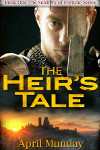
April Munday – The Heir’s Tale
Posted 26th January 2018
Category: Reviews Genres: 2010s, Angst, Domestic, Historical, Romance, Spiritual
Comments Off on April Munday – The Heir’s Tale
More to learn after the war.
Publisher: (self-published)
Pages: 150
Type: Fiction
Age: Adult
ISBN: B075KQ3HX4
First Published: 29th September 2017
Date Reviewed: 25th January 2018
Rating: 3/5
Ancelin returns home from the war he fought alongside his brothers. His betrothed, Emma, has been waiting a long time and is happy to see him, but so is his sister-in-law Alice, whose husband is now dead. Ancelin has always loved Alice and her sudden interest in him causes him to rethink his betrothal.
The Heir’s Tale is a coming-of-age romance set in the medieval period, and the start of a series of books about a set of brothers.
The research in this book is of a very high standard. Munday strikes the right balance of detailing and holding back to the extent that there are a good few times when it’s easy to get lost in the history. The amount of research is evident but only on consideration, leading to the best of reading experiences where you can relax into it without any worries of the author including too much or any errors. The writing backs it up; it’s solid. There are no anachronisms and the text reads smoothly.
It’s apt to talk about Ancelin’s growing maturity in terms of relationships. The character continually darts back and forth – one minute he knows he likes Emma, the next he’s tempted by his sister-in-law – and it’s a long-term thing, the main conflict in the book. On the surface, Ancelin is a frustrating person to read about however upon reflection it’s quite realistic – it’s all too easy to ascribe modern notions to this young-twenties man and think that he should be better, but when put in the context of his lack of experience and the sudden turnabout of his romantic situation, wherein he has loved Alice for years without her paying any attention and now she’s turned full circle, it makes a lot of sense. The continuation also has another role – it allows Munday to look at the character further.
Here the best example is probably in the character’s gender. Rather than look at Ancelin with an eye to the sort of romance that’s often included – where the male character will act in ways that’s romanticised and dreamed about but not often true to reality – Munday unashamedly puts sex before romance, so that there is more physical action (aside from sex itself which, true to history, doesn’t happen during the betrothal) in places where you might have been expecting roses. This said, there are also roses.
The characters as a whole are good – Emma is very patient with Ancelin but is by no means meek, in fact she’s the strongest character. Ancelin’s brothers get a lot of look in to set up the other books but it doesn’t actively detract; his father is a fair secondary character. Alice however does present a problem.
Alice has very good reason for suddenly showing romantic interest in the brother-in-law she’d previously not spent any thought on – she’s a widow in the medieval world and about to be sent off to a convent against her wishes. It’s obviously rather wretched that she’s trying to break up a prior betrothal, but she doesn’t have many options and as caring as her father-in-law is, society rules will go on ahead.
Where the issue lies is in the actions, the way Alice goes about trying to get Ancelin. You know from the moment Ancelin arrives home from war that Alice is the villain and she’s quite cardboard cut-out. In itself she is just one character but as this becomes part of the conflict of the book, the continuation makes it difficult. It comes to a head towards the end, where it’s obvious to the reader what’s happening but the characters don’t put two and two together. It means it’s a bit too angsty.
There is a lot to like about The Heir’s Tale but it can be overshadowed – the scenes in which Alice is absent, and there are many, are good and show Munday’s work well.
I received this book for review. The author is a friend.
Related Books
None yet
Philip Pullman – La Belle Sauvage
Posted 22nd January 2018
Category: Reviews Genres: 2010s, Adventure, Commentary, Fantasy, Spiritual, Theological
2 Comments

Genesis.
Publisher: David Fickling (Penguin)
Pages: 544
Type: Fiction
Age: Young Adult
ISBN: 978-0-385-60441-3
First Published: 19th October 2017
Date Reviewed: 22nd January 2018
Rating: 3.5/5
The first months of Lyra Belacqua’s life: when not at school, Malcolm works at his parents’ pub, regularly visits the convent across the river, and paddles down the water in his canoe. One evening, the pub is visited by three men who politely decline the invitation to dine in the main room instead of the more private one they chose upon entering. Malcolm overhears snippets of conversation, and over the next few days it starts to come together. Baby. Prophecy. The Magisterium. Meanwhile Dr Hannah Relf is studying the Bodleian Library’s Alethiometer, using it to gain answers to questions that a secret group of people have hired her to find.
La Belle Sauvage is the first book of The Book Of Dust, the decades-awaited follow up trilogy to His Dark Materials. It serves as a prequel. Written in a way that’s similar to the Young Adult tone of the ’90s books but with enough nods to those readers who have since grown up, it’s (likely) accessible to new readers but certainly best read by those who’ve read the originals.
Looking at the book in isolation, it’s mostly solid. The writing is good, there’s some scary content, and whilst the second half is monotonous it remains a page turner. Possibly due to the fact that Pullman long ago established his aim, the use of religious fervour in this book is even stronger than before. Here Pullman constructs a system that mirrors many religious and political methods in history, his League of Saint Alexander creating snitches of children in order to flush out any hints of rebellion and scare people into submission. There’s a lot of background detail provided but it’s in order to further express how awful the rulers are rather than a case of infodump.
Malcolm’s a believable hero if not particularly compelling, and his counterpart – who I won’t name because it takes a while for them to be identified – is a fair match, even better, perhaps, despite having little to do. Hannah Relf is okay. One of the villains is only there to ramp up the horror and disappears with his own sets of unanswered questions. But in more important news, if you’re looking for Lyra, you’ll be disappointed, and this is where the long wait and the present come into conflict – Lyra remains a speechless baby throughout.
Is it a fair book? Yes, but when the set up of Lyra as a resident of Jordan College was established in Northern Lights, enough back story was provided. We know where Lyra’s going to end up so the worries in La Belle Sauvage aren’t of any import. And it’s difficult to say that the horrors in His Dark Materials are not somewhat damaged in impact by this new book – one can’t help but think that the people of Lyra’s world might have been on the look out for the Magisterium’s next move and thus not been quite so shocked by the happenings in the north ten years later.
There’s also the world-building. There’s not much of it – presumably because it’s expected that readers are well-versed in Lyra’s Oxford – but what is included doesn’t ring true. In the course of the book we see Malcolm collecting disposable nappies and baby formula, which is at odds with the old-fashioned steam-punk that defined Lyra’s world before.
In sum, this book, isolated from its literary context, is a good enough read. Even the monotony isn’t enough to hold it back. But in the context of history it’s an average and rather jarring addition that would’ve been better as a short story.
Related Books


Sarah MacLean – A Rogue By Any Other Name
Posted 15th January 2018
Category: Reviews Genres: 2010s, Angst, Domestic, Historical, Romance, Social
Comments Off on Sarah MacLean – A Rogue By Any Other Name
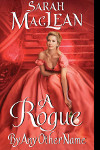
Or name(s) – he has two already.
Publisher: Avon (HarperCollins)
Pages: 386
Type: Fiction
Age: Adult
ISBN: 978-0-062-06852-1
First Published: 2012
Date Reviewed: 15th January 2016
Rating: 2.5/5
Michael, Lord Bourne, has been gone for a decade; he left after his guardian, Langford, lured him into gambling away his land and fortune. Michael’s childhood friend, Penelope, is swiftly aging away from eligibility in the marriage market; her father adds to her dowry Bourne’s old lands, which the family have since gained. Now part owner in a casino, Michael is a very different man, but he remains determined to get back his heritage. And if marrying Penelope is the way to do it then so be it.
A Rogue By Any Other Name is a book that begins very well. The set up works; the characterisation is good, the use of a casino different, the writing strong – everything holds a lot of promise. Penelope and Michael are great characters – Penelope’s wanting to have a different, more interesting, life than that which is usual means she’s adventurous and generally not afraid to say what she thinks and whilst Michael has changed a great deal since she knew him, the way they interact indicates a good book ahead.
At this stage the romantic element of the book is easy to read and enjoyable, and the inclusion of letters the younger Penelope sent to Michael is a nice touch. In terms of relationship content, it quickly becomes apparent that Michael will be taking the lead but it’s of a type that is supposed to be alluring and will be to some readers and just not alluring but likely readable for others. (Mostly – I should point out that there are a couple of things that could be called either way depending on personal preferences.)
However as the book continues, the promise of the beginning first flies out of the window, then comes back to not only shut it but lock it several times over. The story and development is ever more manipulated, the angst overdone to the point of becoming boring. The characters continue to believe things can never be good between them, which works whilst they are having problems but as the relationship takes a turn for the better – as you knew it would because this is a romance – still this ‘it won’t work’ carries on. It’s a constant refrain from both even when they’re in each others arms and giddy with love, an obvious device to keep the book going.
Change too does Michael’s nature – he becomes domineering to the extent you might wonder whether Christian Grey was the inspiration in terms of control, the problems here being similar in their effect, if not their content (though there are some minor similarities), to E L James’ series.
And the writing takes a turn. Anachronisms, historical errors, and the constant use of repetitive thoughts.
Had the angst been curtailed and literary devices limited, A Rogue By Any Other Name may have kept its promise, but by the end of the book, when the love is fully established and known by both, and yet the angst is still going on, you’ll be wondering if another name might indeed have made a difference.
Related Books
None yet
A J Waines – Girl On A Train
Posted 8th December 2017
Category: Reviews Genres: 2010s, Psychological, Thriller
1 Comment

Sometimes there’s a lot more going on than meets the eye.
Publisher: (self-published)
Pages: 426
Type: Fiction
Age: Adult
ISBN: 978-1-508-64794-2
First Published: 20th June 2013
Date Reviewed: 29th November 2017
Rating: 4/5
Anna gets on the train and finds a seat. The girl next to her won’t stop fidgeting and as Anna considers whether to confront her about it, the girl gets up, gives her a beseeching look, and leaves the train a stop before the one printed on her ticket; minutes later the train slams into something on the track. As all the passengers are told to leave the carriages, Anna’s bag is stolen and then found. She finds a locket inside that she reckons is the girls’.
Girl On A Train is a fantastic thriller; published a few years before Paula Hawkins’ novel, it has been mistaken for it many times, however it is entirely different -a book about a troubled outsider trying to make the most of what’s good in their lives – and very much worth a read in its own right.
Waines uses a dual narrative to tell her story; beginning with Anna, switching to Elly for the middle, and returning to Anna at the end, you get a fully-fledged story without any need to question; it also allows for you to get to know Elly in her own right which is a wonderful element as you can empathise with her even more.
Anything that might seem unlikely or implausible is dealt with well, Waines knowing that may be how it appears and working to overcome it, which she does. The ending may divide opinion as it’s likely not the outcome you were expecting, but in terms of red herrings it’s super; because of the different parts of it and the subtleties, you will quite likely not guess what happened.
The characterisation is very good, with Anna and Elly sharing enough traits to make the narrative work – their thought patterns, for example; otherwise they’re two very different people. The writing is good, too – there are some editing errors, but the use of language is solid and the book flows well.
A few topics bond the stories together – the question of suicide and death in general that is asked two-fold as Waines explores the possibilities of Elly’s last days as well as Anna’s marriage. (You learn about the marriage early – this isn’t a spoiler.) Sexuality has a place. And religion is explored in terms of the possibilities to take money. Anna is well placed to look at topics in detail; as a journalist she’s initially thinking of Elly’s death as one that may make her name.
Girl On A Train is a good blend of page-turning fiction and details that will make you want to take your time; it manages to explore a lot whilst not losing track of its genre and whilst it’s down to each reader as to whether or not the subjects themselves will be memorable, the book itself will stay with you for a while. A very well crafted novel.
Related Books

Claire North – The End Of The Day
Posted 7th December 2017
Category: Reviews Genres: 2010s, Commentary, Fantasy, Philosophy, Political, Social
Comments Off on Claire North – The End Of The Day

In life, only two things are certain…
Publisher: Orbit Books (Hachette)
Pages: 401
Type: Fiction
Age: Adult
ISBN: 978-0-356-50733-0
First Published: 4th April 2017
Date Reviewed: 7th December 2017
Rating: 4.5/5
Charlie is the Harbinger of Death – the Milton Keynes office sends him the details of his next appointment, he gets on a train, bus, or aeroplane, and goes to see someone who is dying or whose world is fading away. It’s a tough job at times, very tough, but Charlie enjoys it; his role is to honour life.
The End Of The Day is a philosophical literary fantasy novel that explores many moral and ethical questions and issues we have in our world today.
This book is original; starting with the potential of a Terry Pratchett influence in its basic concept, it uses a gentle fantasy-type humour, and whilst it appears at first simply to be a solid addition to the genre, it soon reveals itself to be a blend of this and literary fiction.
The plot is scant – in fact it’s more a series of events than anything else – and the character development is not big, but both these things are intentional and with good reason; this is where the philosophical nature comes in. North’s book is primarily a study – a very good, enjoyable-in-its-own-right study – and secondly a good old work of fantasy. Death here is of a distinct type – whilst quite likely being fond of cats (its the personality, the basic construction of Death that is like Pratchett) – the defining nature of North’s Death, which doubles as one of the points the author wants to get across – is that it doesn’t just appear at the end of someone’s life, but at the end of an idea, at the end of a world, a culture in decline.
And it’s not just the usual thought of a cultural element ending (though a language dying along with its last speaker is one of the things North looks at) but also things like the end of a tradition that excludes black or poor people, and the start of a society that denies LGBT rights. Here Death comes at the last instance of the old way to usher in the new.
The above is part of the philosophy North includes – most of the blunter referencing, that becomes blunt the more you read, happens in extracts that aren’t directly related to Charlie. It’s apt here to bring in the writing as it’s part and parcel of this; North uses various different writing methods and markings to deliver her commentary; poetical verses sit alongside sentences full of ellipses, dialects, accents; different languages – even different scripts – are scattered throughout; bunches of sayings, stereotypical sentence beginnings, opinions, and presentations are added as paragraphs and verses, the different sentences of one whole effective conversation jumbled up with the others – a handful of different thoughts displayed at once. To summarise (the following statements are here as examples of the sorts of topics covered) “I’m not racist but…”; “won’t anyone think of the children?”, “well I think”; “but they come to this country…”; “I might be a woman myself but I’m not going to go employing young women – they’ll all go off getting pregnant”.
I only get seventy-two pounds a week to cover everything… will that stop, now I’ve got money for my flat?
And the copper wasn’t sure but wondered if maybe it would, if perhaps now that Jeremiah had savings and no roof over his head, the government didn’t regard his welfare as its concern.
There is a great number of ideas, thoughts, political and social points included so often-times these sentences are generalised or simply provide more insight into what North is doing, but on occasion – more than a few occasions – the author looks at something in more detail. The more generalised do include a certain amount of detail for the sheer amount of insight they provide in just a couple of sentences, it’s just that the chapters (very short in most cases) have more space to give a concept.
Speaking of chapters and thus the writing as a whole, North’s use of language is exceptional. Then there’s the way she goes about her philosophy openly, the obscurity near the beginning of the book there only due to the fact you’ve not yet realised what it’s all about.
And then the world turned, and someone tweeted something new, and everyone retweeted it and moved on, and nothing fucking changes.
The subjects are heavy, and North sends Charlie all round the world, showing that it’s not one place but the entirety. One of the more poetical, experimental aspects included – the only experimental (this is an easy enough read) – is the different number of repetitions of the words ‘human’ and ‘rat’ that are used in all parts of the book – both statements and sentences, and Charlie’s narrative. What is it to be human? What separates us from animals? When are we good or bad? There are a variety of ways this can be interpreted.
The one drawback is the book’s length. There is a lot to cover and it’s all excellent but there comes a point where Charlie’s journeys and the philosophy becomes less powerful simply due to the amount to think about. It’s a difficult one because it’s all important and relevant to North’s study but still just a bit too much, and there’s the possibility with it that you’ll become over-exposed to the point of it becoming less powerful.
But then is that the point? Is it, to reference a completely different book that nevertheless shares a few ideas, rather like The Hunger Games, wherein Suzanne Collins seems to be using over-exposure on purpose, making the reader reach a point where the absolute horrific violence ceases to produce a response because they’ve seen so much of it, and then using that lack of response to make her point? Is North showing you what she wants to both to the point where you ‘get’ what she’s saying but also to the point where you become so used to it that it’s easy to just keep reading without being constantly shocked, rather like we’re so used to seeing pictures of starving children in Africa and the many different charities that promote other causes that it becomes a sort of background worry, spoken about, but then left? It’s open to interpretation.
If you’re looking for either a literary book or a fantasy book this isn’t the one to go for because it’s both and neither at the same time and is the opposite of escapism. But you absolutely do want to make the time to read it and see for yourself. As much as any review can tell you what it’s about, there’s a great level of individual interpretation here, a resonance for each reader and, in a very unique way, there is something for everyone.
I received this book for review. The book has been shortlisted for the Young Writer of the Year Award.
Related Books
None yet


