

Kristy Cambron – The Butterfly And The Violin
Posted 20th August 2014
Category: Reviews Genres: 2010s, Domestic, Historical, Inspirational fiction, Political, Romance, Spiritual
3 Comments

This is the first time I’ve read Christian fiction (besides C S Lewis and Tolkien) and I’ll be reviewing this book as I do any other so it may be the case that this review differs in its main focus than it ‘ought’.
Finding a painting, discovering history, and perhaps (hesitantly) falling in love.
Publisher: Thomas Nelson
Pages: 323
Type: Fiction
Age: Adult
ISBN: 978-1-401-69059-5
First Published: 8th July 2014
Date Reviewed: 19th August 2014
Rating: 3.5/5
Gallery owner Sera has been searching for a painting, seen once as a child and instantly loved, for several years. When her assistant tells her another is looking for it and wants the gallery’s help, she jumps at the chance and flies to the other side of the country. The family looking for the painting is wealthy but that wealth is in jeopardy and the painting is the key. In 1940s Austria, the subject of the artwork and the daughter of a general of the Third Reich is branded a traitor and sent to Auschwitz after it is discovered she aided an attempt to provide safe passage to a Jewish family. Both Adele and Sera search for security and happiness, hoping that God will provide.
The Butterfly And The Violin is a Christian dual plot line historical that looks at art, the Holocaust, and the plight and faith of two young women.
It’s often the case that a reader will prefer one plot line over another when there are two of them, however The Butterfly And The Violin is a book less likely to pull you one way. This is because although very different, both stories are of equal strength, the characters somewhat similar, and the stories well balanced. Though of course nowhere near as significant as Adele’s, Sera’s life has that present-day regularity that is compelling simply because of the emotions included in it. Whilst the time periods are fairly standard for dual plot stories, the fact of the Holocaust and Adele’s ‘role’ in it make the book stand out from others. Although Adele may be in a place of privilege, even in Auschwitz, Cambron never shies from showing you what was going on.
The biggest similarity between the women is their faith. We know more about Sera’s, descriptively, than we do Adele’s, but still it is not simply that both women are Christians. In The Butterfly And The Violin the emphasis is on the way faith is playing its part at that very moment, and for both Sera and Adele, at the time we join them, falling in love and being happy in love are two of the most important aspects of their lives. Both look to God for help, Adele prays she will see Vladimir again, and Sera prays that she will trust another after having had her heart broken. Indeed Sera’s faith is a little shaky – she still believes, and would never not believe, but the disappointments and losses have taken their toll and she hasn’t made much time for her faith since.
Obviously there are quite a number of references to God, faith, and Christianity (also Judaism, but as that isn’t a ‘subject’ so to speak, Christianity is what I’ll be focusing on). More often, at least for the first two thirds or so of the book, God is present in Adele’s story. On the surface it can seem that the references are too many and placed at inappropriate times. However if you step back from your reading and put yourself in the situation of the characters, in this case Adele, it seems perfectly natural. It is really more the case that where faith happens so much more in the mind than in conversation (generally) it’s simply that it can seem odd being actually stated, the things most often thought but not said are here, being voiced. This said, there is a sudden increase in references towards the end in both stories that do not work as well for different reasons. In Adele’s case it’s inevitable that in a crisis, a group of faithful people will look to God – it’s simply that the constant references slow down the pace and pull the focus away from the tragedy of the situation at hand. In Sera’s case it’s that it becomes a bit confusing, although it’s well placed as part of her self-discovery and improvement.
The confusion is part of a larger aspect that needs discussing. There are a few sections of the story that don’t quite add up and occasions where there is too much detailing. People tap their feet a lot, for example, and we have many descriptions of hair. Some of the phrasing doesn’t work. And there are also frustrating occasions wherein questions – literal, spoken questions – are not answered for a while and it seems the case that it’s so Cambron can keep the story going longer. There is one place where answers are ignored so that the author can detail a room, and by this time the reader just wants to know what’s going on. It’s not that the characters ignore the questions, it’s that they are left out completely until detail has been included.
Where Sera and the confusion come in is in the numerous references to faith. The problem is that the issues get lost behind the references so that you realise Sera’s faith has been tested and that she wants to trust and get back to God more fully, but you’re not always sure what’s happening to cause this transition. As it’s not a transition from faithless to faithful (Sera never speaks of going to church but one can assume she does sometimes) it is a problem. Simply put, sometimes narrative is not clearly explained.
Unclear is the way the inheritance issue is concluded. That William and everyone else is happy is not believable and the grandfather’s plans come across as thoughtless, having emphasised William’s role and not really considered the rest of his family. Yes, it allows William to be able to choose the life he has always wanted, but it leaves his family in the lurch and we’re not given all that much information about it. It may work for William, but are his family going to be happy with what is effectively a loss for them? It’s also not clear exactly why the grandfather decided to change his will and leave the fortune previously left to his family to someone else.
Yet still on the whole, The Butterfly And The Violin works. There is a lot of information about the Holocaust, including much that isn’t covered by your usual school education, and Cambron has taken a path rarely if ever used, applying a specific sort of artwork and using that as the basis for one of the stories.
The romance, too, works very well. Whilst we don’t read all that much about Sera and William, appropriate time passes off stage to suggest they make a good couple and the somewhat inevitable discovery of a shared faith is included to very good effect. Adele’s relationship with Vladimir successfully details both the horrors of WWII and your everyday social prejudice. And both the painter and the owner of the painting may prove to be unexpected (but welcome).
And finally the characters are believable and people you’ll find yourself rooting for. Adele’s impulsive choices are maddening sometimes, but exactly the choices you’d expect a naïve, hopeful person in her situation to make, and whilst Sera becomes cross and can’t always see what’s staring her in the face, again, in her situation it makes perfect sense.
Definitely, obviously, this book will be appreciated most by those who share the characters’ faith, but there is enough here for a general historical romance reader or dual plot line lover to enjoy as well.
The Butterfly And The Violin isn’t perfect, but nevertheless you may find yourself racing through it.
I received this book for review from the publisher.
Related Books
None yet
Suzanne Collins – Mockingjay
Posted 4th August 2014
Category: Reviews Genres: 2010s, Angst, Political, Science Fiction, Social
7 Comments

The beginning of the beginning.
Publisher: Scholastic
Pages: 436
Type: Fiction
Age: Young Adult
ISBN: 978-1-407-10937-4
First Published: 24th August 2010
Date Reviewed: 3rd August 2014
Rating: 4.5/5
Katniss was rescued, Gale helped her mother and Prim to safety, and now everyone who could flee has left District 12. District 13 is more controlling than they would’ve thought, but it’s a lot better than the torture Peeta is almost certainly facing. The president of 13 believes that now is the time, even if they’ve Katniss when they’d prefer Peeta.
Mockingjay is the final book of The Hunger Games trilogy and is a tough call. On one hand the difference between this and the previous books is welcome – we couldn’t really have yet another Hunger Games because Collins was admittedly pushing her luck somewhat in Catching Fire. (I think Alice’s comment sums it up well, for all I enjoyed that book.) On the other hand the book being so different means that you will possibly find it less interesting or at the very least not what you were expecting. For starters Mockingjay takes Peeta away from us for a long time. This of course affects everything and whilst the remainder and his treatment are realistic, the mood is changed.
The pace is still there and if you rushed through the first two you’ll likely rush through Mockingjay, but whereas the first two were fast because you wanted to know what would happen and because the books pulled you along, here the pace is only down to the first point. Mockingjay is fast because having read the others you just want to find out how it will end.
This lack of interest (it’s a perfectly fine amount of interest when considered on its own; very lacking when placed in the context of the trilogy) is in part to do with the inevitable comparisons with other dystopian novels and films. The rebels that are everywhere, the underground city not unlike Zion from The Matrix, the samey-ness of love triangles that Collins books had previously just about stayed away from. The book is been-there-done-that. It’s like any sci-fi video game and whilst there were comparisons to Battle Royale before, this time the comparisons are numerous.
I’m not going to discuss the ending in any way as I have too much to say to fit in a review (a further thoughts post is forthcoming), but I will point out that many people will be disappointed. I actually think it’s better to know that disappointment is a possibility because you may then like it more.
The issue with Mockingjay is that it doesn’t satisfy. You want a final book to be triumphant whether it ends well or not and this one just isn’t the send off it could’ve been.
As said, however, the book is good on its own. Katniss remains the reluctant heroine and the battles are strong. The mental workouts are good, more for Katniss than the reader this time, but Collins does run with the thought of ‘remember who the enemy is’, keeping Katniss focused on what’s most important. The prelude to the end is really very good and it could be argued that it’s even better for the ambiguous finale. In essence, there is an ending but the part you truly want to know about is left unanswered. This is important – Collins leaves it up to you. Perhaps you’ll decide that ultimately who the true enemy was isn’t what matters, and if so you’ll see another layer to the story.
District 13 is controlling, necessarily so – but it’s edging close to the control in Panem. This is also something to think about. In order for there to be freedom, some liberties must be given up – this Collins says… or does she? Certainly the start of the end suggests that no matter what, those in Panem will never free.
There are cameras in this one as there were in Catching Fire; the cameras of the rebels. Collins shows that even those doing the reporting are often part of the war, suggesting that it’s more important to actively take on a role – a hero may be considered best safe, but that won’t offer the best outcome.
Mockingjay is very good, it’s just not excellent. And in many ways, Katniss does not get to choose.
Read it – you should end the series – but be aware of the issues.
Related Books


Andra Watkins – To Live Forever
Posted 30th July 2014
Category: Reviews Genres: 2010s, Domestic, Fantasy, Historical, Social
2 Comments

Missions, when successful, lead from purgatory to the afterlife.
Publisher: Word Hermit Press
Pages: 253
Type: Fiction
Age: Adult
ISBN: 978-0-615-93747-2
First Published: 3rd February 2014
Date Reviewed: 29th July 2014
Rating: 3/5
Meriweather Lewis (a real-life explorer) is stuck in the bar of Nowhere, world between the worlds of life and death. This is his last chance to pass over – a child in 1977 is in need of help. The girl’s mother was granted custody but her lifestyle is seedy and Emmaline wishes to escape to her father.
To Live Forever is a fair offering that blends genres as well as mixing fact with fiction, but could have done with more work.
What’s good and interesting is the blending – history (social and your bog standard), fantasy, fact, fiction, and the road trip theme. Whilst it feels strange to be reading about the afterlife of a real person from history, you can see why Watkins chose to write Lewis into it as his time as an explorer and the mystery surrounding his death fit what she wanted to say. On a related note it’s recommended that you prepare yourself for the unrealistic as besides the fantasy the book rests somewhat on dei ex machina.
And it’s nice to see a book focus on a person you don’t read about every day. To an degree, Watkins keeps his story mysterious – an intriguing balance of supposition and silence means that you will read what Watkins thinks but then wonder later if you did actually read it. Watkins may have a fully-fledged opinion, but the book is more an introduction, an invitation for you to find out more and decide for yourself.
In addition to all this the book is successful at showing rather than telling. You do get a bit of backstory now and again but Watkins has kept it to an acceptable amount and the vast majority of what you learn is through dialogue that is bereft of info-dumps.
However the book could do with another round of edits. The language the characters use does not always fit their situation – it’s easy to forget that Lewis is from history because he uses language from our modern time, indeed often the language is straight from our present day rather than the ’70s, rendering it out of place entirely. The characters who come and go are all stereotypes and leave little to recommend them, most notably a pair of conjoined twins who are always ‘dragging’ each other across the room. It is sometimes hard to remember if the story is set in the 70s or if it is set a number of years earlier, and Em doesn’t always act her age, seeming to be a lot younger or older at any given time.
There are ellipses that go on to the extent that you would think the key got stuck on the keyboard, and there are many, many commas in the wrong places. Characters ‘cut their eyes’, which turns out to be bloodless. A couple of plot holes, not so bad by themselves, are unfortunately magnified by the rest of the issues.
Perhaps most problematic, though this does depend on the individual’s view, is the Judge, the bad guy. He is the bad guy, so it makes sense that he’s cruel, but given that he thinks young Em is his wife, his remarks are particularly creepy. He surely should be a lot nicer to the host of his wife’s spirit, especially as he’s willing Em/Ann to remember him. On this note of inappropriateness, however, it should be noted that although Em’s mother’s particular win in court seems unbelievable, it’s meant to be and Watkins will explain all in due course.
The very end invokes a particular Indian folk tale. I won’t tell you which one because for some of you that would spoil the ending, but I will say that if you do know which it is, your knowledge of it may make the ending even better. There is nothing to suggest that Watkins was inspired by the tale (indeed I only know of it thanks to a Bollywood film) but it does add a layer to the ending that is interesting to consider.
To Live Forever has a good premise and will teach you a fair amount. It also sports a nice dual narration that really adds to the tale. But, pun unintended, it could have used more time.
I received this book for review from the author for Historical Fiction Virtual Book Tours.
Related Books
None yet
Jessica Clare – Wicked Games
Posted 21st July 2014
Category: Reviews Genres: 2010s, Romance
2 Comments

Where a very rare situation is the conflict.
Publisher: (self-published)
Pages: 142
Type: Fiction
Age: Adult
ISBN: N/A
First Published: 4th March 2011
Date Reviewed: 1st July 2013
Rating: 3.5/5
To continue being a book reviewer for the newspaper, Abby must agree to take part in a survival reality TV show. She’s not interested in the show and sees through it all, but the rewards offered by her employer (besides keeping her job!) are too good to miss. She gets on the plane to the Cook Islands. It’s evident she doesn’t fit in with the other contestants and it’s also evident she may have betters skills than them as well. But she wouldn’t have bet on finding the arrogant one attractive. Teaming up with Dean may help her win, but how real are people’s personalities when $1million is at stake?
Wicked Games is a novella that uses a basis everyone will be familiar with. Clare holds to the stereotype, making her reality show exactly what you’d expect. But she doesn’t let it take over.
This is both good and bad. It is good for the obvious reason – why would anyone want to read about a (regular – considering we’ve The Hunger Games) reality show when there are plenty of them to watch? It’s bad because it inevitably means that once the romance begins a lot of what could have been written about the show (the concept of survival, for example) is lost.
The characters are pretty good. Abby loses herself a little once she falls for Dean, but she never changes completely except in circumstances where the premise of the book dictates the need for it (interviews, for example). Abby is one of the better prepared contestants and her position as a reluctant participant provides the reality check for the rest of the understandably stereotypical cast. (In this case that the cast is stereotypical is understandable – the undeveloped characters make sense and it would be hard not to assume that their very lack of development was not a conscious decision.) Dean, too, is stereotypical, and again, he’s meant to be – though Clare has cause to show the reader how appearances can be deceptive.
So it would be fair to say that Clare uses the premise as much as her audience would be okay with, and instead of looking into uncomfortable ‘challenges’, focuses on the longer-term consequences, the sort that take a while to be covered in the media. The book is predictable enough that you know what will happen, detailed enough that that doesn’t matter.
Except in certain cases, for example the set up between Abby, Dean, and a few other contestants. The idea of teamwork to win is in itself understandable, but the way Clare goes about it suggests a lack of belief in reader intelligence. The reader can see through the set up so much that it’s an unnecessary addition – Clare makes Abby suddenly oblivious to something the Abby of the previous pages would have spied from the first moment. Inevitably when the ruse is revealed it is of no surprise to anyone but the characters.
Wicked Games has a fair premise, an understandably predictable plot, and good exploration of reality, fantasy, and that in-between that makes up television. But it could have used more planning.
It’s nice that it’s not a wicked game in terms of the show itself, and not wicked when you consider the reality of humanity and competition, but it may be wicked for the reader who has to wade through the water. It’s light, it can be fun, and it’s ripe for summer, but whether it comes in first place is up for discussion.
Related Books
None yet
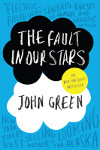
John Green – The Fault In Our Stars
Posted 7th July 2014
Category: Reviews Genres: 2010s, Angst, Romance, Social, Spiritual
14 Comments
There is life in cancer.
Publisher: Penguin
Pages: 311
Type: Fiction
Age: Young Adult
ISBN: 978-0-141-34563-5
First Published: 10th January 2012
Date Reviewed: 30th June 2014
Rating: 5/5
Hazel has cancer. She’s not likely to ever be in remission but she’s able to live a fuller life than she had with illness so far. At the support group her mother insists she goes to she meets Augustus, someone who matches her in wit and thought. He’s lost a leg but is in remission, and although things will always be difficult, the two teens begin to fall in love.
The Fault In Our Stars is every bit as good as you’ve heard. Green’s writing is very unique and rather excellent, no matter that he has a few novels already under his belt. The book moves far away from the idea of pity, allowing you to see reality.
Green writes teenagers very well and the dialogue seems true to life. There has been no attempt to make the book beautiful – this is no literary feat and frankly it would suffer if it was. To be sure it’s a particular type of writing (this reviewer took a good few pages to get used to it even though she liked it), and it may not appeal to everyone. This is perhaps the only possible issue – where everything is so fresh and specific the book may put readers off by it’s technical nature.
Putting that aside, however, the characters are fantastic. These are teens of a particular personality. They use ‘big’ words, often to excess, and there are so many subjects covered as metaphors and evidence for otherwise simple conversations, it’s unlikely you will know all of them. The sheer life implied by the way the characters act just goes to emphasise how awful it is that we have these diseases that kill. They are simply two fictional people, but they represent a great many more, real, people.
The metaphors are many. A particularly prominent concept throughout is of cigarettes and the potential to kill. Augustus disgusts Hazel when he takes a cigarette from his pocket, but he explains the theory behind his action, that something that kills, stripped of the power to kill by his failure to light it, is not a threat. There are semi-subtextual ideas, such as Hazel’s naming transition, changing what she calls her boyfriend, and there is the controversial scene in Anne Frank’s house in which the teenagers cause a stir.
There is, as you may expect, a lot of humour. You are meant to laugh. You are meant to have a good time. You are not meant to pity, but you are of course meant to feel. There is the sadness – of course there is, you may say, but the point here is that because it’s balanced by the humour and normality, it is all the more powerful.
A special mention must be made of the novel Hazel loves, that she passes on to Augustus. It forms a big part of Green’s book and contains a great many concepts and metaphors. Does it signal what will later happen in the book? The scenes with the author of this book within a book remind you that sometimes life sucks, and it can continue to suck even when it’s already reached the lowest of lows.
Metaphors, concepts, themes. These, apart from the C word, are what The Fault In Our Stars is about. Green wants you to get to the heart of the matter and knows that often, subtlety is the best way. The book gets you thinking, analysing as though it is literature set for class discussion, and will leave you considering it for days.
Both a fast read and a slow burner, The Fault In Our Stars will change you by way of making you think. It’s not out to change the way you approach disease (or even, it could be said, disability). At least not obviously.
Think. Consider. Laugh. Cry. There is a fault in the stars, but it isn’t Green’s book.
Related Books