




Alois Hotschnig – Maybe This Time
Posted 10th September 2011
Category: Reviews Genres: 2000s, Angst, Psychological, Short Story Collections, Translation
4 Comments
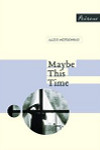
Are you sure you know who you are?
Publisher: Peirene Press
Pages: 99
Type: Fiction
Age: Adult
ISBN: 978-0-9562840-5-1
First Published: 2006 in Austrian; 2011 in English
Date Reviewed: 25th August 2011
Rating: 4.5/5
Original language: Austrian
Original title: Die Kinder Beruhigte das Nicht (That Didn’t Reassure the Children)
Translated by: Tess Lewis
In this collection of short stories, Hotschnig examines identity, it’s loss, and the desire to find or create it.
In Maybe This Time, the locations never appear to be what they first seem – neither do the people, or indeed the narrators. The effect it has is similar to what happens when a near-sighted person takes off their glasses. One moment you can see everything clearly, or at least you think you can see clearly. Then you take off your glasses and everything is blurry, in fact sometimes the more you try to focus, the harder it becomes. And then a bit later you might realise that some things are clear again – it’s only a few things, those close up, but you can see them even better now than you could with the glasses. The stories in Maybe This Time are layered, and you’ll likely only ever understand some of it, and you’ll likely have a different idea of what’s happened than someone else.
This is a lot of what works about the book, the mystery. Like Peirene Press’s other releases, Maybe This Time is a short book that stays in the mind much longer than many long books, but because of the abstract nature of it you’ll be pondering on it even longer than, say, Tomorrow Pamplona. There really is nowhere to establish your bearings for any period of time and when you do think you’ve a grasp on what’s happening something that doesn’t relate to your idea pops up.
And before you know it, just as you think you might be getting somewhere, it’s ended. In fact some of the stories don’t even span two pages. Hotschnig will not provide you with an explanation either, and there are no conclusions in his tales.
The stories are very poetic, and although you have to take into account the translation (by Tess Lewis, who has made splendid work of the descriptions) it is hard not to believe that in Austrian German the effect would be similar.
And speaking of the descriptions, which are so detailed and given you a real sense of life as though you are an art gallery patron who has viewed the same work for an hour and have thus notice the smallest of brush strokes, these too help the stories sound poetic. Truly the book is poetry in prose.
The stories are about loss of identity, which makes a lot more sense than the stories themselves for their abstract structure. Because the general theme is so specific the book favours a dip-in approach rather than the usual recommended single sitting of Peirene Press. That’s not to say you can’t read it all at once but the characters can become blended together. Then again, judging by that general feel, they could be one and the same!
Each of the narrators is male and the book has a definite masculine feel to it. And there are some very strange and sometimes spooky things that go on, for example the last story is reminiscent of the book, Before I Fall. It would appear that each one is searching for something – themselves, certainly, and in different ways, but also a better world. Where the man in the last story keeps meeting people who know him for different reasons and in what seems to be a different sort of guise, there is the sense of crowds and the rush of people going about their day.
In fact, there is an atmosphere of expectation in the stories. The characters want or need to act as expected and it is this that runs most perfectly alongside the goal of Hotschnig to present identity in today’s world.
As someone who openly accepts that they have only come to a bit of an understanding of the book, and would only be prepared to discuss with others a smaller part of that bit for fear of being totally wrong I must say that rating this book is most hard. On the surface you have a collection of mostly mundane stories, on another level confusing ones, and on a third deep stories with a powerful message. Please excuse me for taking everything into account when I rate it.
Maybe This Time is marvellous, and Hotschnig very clever. So clever, in fact, that he has left this reviewer baffled. Highly recommended, particularly for those who can read it in a group.
Translated by Tess Lewis, received for review from Peirene Press.
Related Books


Jan van Mersbergen – Tomorrow Pamplona
Posted 6th June 2011
Category: Reviews Genres: 2000s, Angst, Domestic, Spiritual, Translation
4 Comments
An intensive look at ourselves, humans, that can’t really be summed up.
Publisher: Peirene Press
Pages: 183
Type: Fiction
Age: Adult
ISBN: 978-0-9562840-4-4
First Published: 2007 in Dutch; 6th June 2011 in English
Date Reviewed: 1st June 2011
Rating: 4.5/5
Original language: Dutch
Original title: Morgen zijn we in Pamplona (Tomorrow we are in Pamplona)
Translated by: Laura Watkinson
Danny is a boxer, and right now he’s running away from his life. Something seems to have happened in the boxing ring (the reader doesn’t know) that’s made him rethink things. He’s also had trouble with the woman he loves. Robert lets him hitchhike in his car to Pamplona, where Robert is going to run from the bulls in order to get away from his routine life, something he does once a year. It may seem a simple decision, but nothing is simple to Danny anymore.
Every now and then a book comes into my life where I know that there is a deeper meaning in the words but I have trouble finding it. Tomorrow Pamplona is one of them. This isn’t to say it is too highbrow to be fully enjoyed, rather that the way Van Mersbergen has told his tale requires the reader’s undivided attention. Of course you’ll be wondering if I worked it out by the end, and the answer is yes, at least sort of.
But although this not knowing is frustrating it gives the book a real staying power. I find myself wanting to pass my copy around for others to read, not just because it would make an interesting discussion but because I think part of the way to gain a truer understanding is to talk about it with at least a few people. One thing that this reviewer will definitely be musing over for some time is just who Robert is or what he is supposed to signify. I got the feeling that although he’s incredibly regular there is something else about him.
If Paulo Coelho provides food for thought then Van Mersbergen provides the ingredients – but you’ll have to roast the chicken yourself. And you get less of a finished story than a lot of books that leave you with multiple options for what happens next – yet at the same time you instinctively know what will happen.
This book is spiritual, borders on angst, and may even be psychological. One of the themes is inevitably coping with loss, Danny’s development focuses on it, and we see this right at the beginning where he copes by leaving home, and later when a minor character copes by staying where the loss occurred.
And characters are everything in this book. Robert may seem to take a metaphorical backseat (and again I wonder about who he is, is his position as car driver relevant in a spiritual sense to Danny) but he is as important as Danny, albeit that the book revolves around the latter. The stage is Pamplona but it’s more about how the place reflects the mind at the time and what is needed by that person.
They drive past fields that are crisscrossed by straight drainage ditches. […] He rolls the car across his palm.
There is a beautiful simplicity in the way the novel is written. Told in both present tense and flashbacks, it seems abstract, disjointed even, but in fact it is meticulously detailed – Van Mersbergen has thought deeply about human actions and the world around us, and used words that read like a soothing lullaby.
The style isn’t particularly poetic and yet the way it makes you feel is as though you’re reading a poem. The writing is comparable to Markus Zusak’s, and if you’ve read my review of The Book Thief you should be able to get a sense of the way I feel about Van Mersbergen’s text, albeit that Tomorrow Pamplona is a translation (by Laura Watkinson). I should probably add that there are a few sex scenes in the book. They are there to help illustrate what is going on in the character’s mind.
Never before have I felt I’ve given a book such an unsatisfactory write up, but I know that I could do no more without revealing it’s entire contents. Truly the only way you are going to find out if this book is worth your time is to read it, because it’s really not the sort of thing you can decide upon without having the words in your own hands.
Tomorrow Pamplona was originally written in Dutch, and was translated into English by Laura Watkinson.
I received this book for review from Peirene Press.
Related Books
Véronique Olmi – Beside The Sea
Posted 23rd March 2011
Category: Reviews Genres: 2000s, Angst, Domestic, Psychological, Translation
3 Comments

When obsession takes over everything else.
Publisher: Peirene Press
Pages: 103
Type: Fiction
Age: Adult
ISBN: 978-0-9562840-2-0
First Published: 2001 in French; 2010 in English
Date Reviewed: 9th March 2011
Rating: 5/5
Original language: French
Original title: Bord de Mer (By The Sea)
Translated by: Adriana Hunter
A mother takes her children out of school to go on a trip to the seaside. She wants to take them and herself away from everything and thinks that they should see the sea. They spend the time in a grotty hotel and have little money to spend. It will be the last journey they take.
All that I’d heard about this book could never have prepared me for what I was going to experience. Beside The Sea deals with depression, obsession, and mental illness, although the only one of these issues actually confronted by the mother in words is depression, and then only swiftly. A big part of the problem is that the mother is having a hard time accepting that she has a problem, rather than everything that affects her being caused by society and the world in general. Practically every sentence uttered is to do with a certain issue.
The way the book is written aptly projects the mother’s mindset. Short sentences, the sudden inclusion of swear words and other harsh statements indicate she’s become extremely irrational, as does the way she recounts the conversations of others. This means that the book is, to use a metaphor, one punch after another, repeatedly, beginning in a way that you feel you can understand her reasoning and ending in a way so incomprehensible to anyone but the mother.
It’s been the same sailor for thirty years, what I mean is the way I see him’s still the same, he’s still got his torn clothes and holes in his boots because it’s the bit about “boots all worn” that really matters, it’s terrible having sore feet, and shoes are the ruination of many a mother.
Olmi also shows us how troubled the woman has become by allowing us to see how others have responded. We are told about visits from the social worker and about things that other people have commented on, all described from the mother’s point of view. This means that the reader can understand what other people have done to try and help, and we see the reasons why the woman is against it. Unfortunately it also means that the reader is the one in the middle, wishing the social workers had made more inquiries in order to know what they, the reader, do.
The sad thing is that although the woman is staunchly against her children mixing in the world and she’s afraid of it for herself, you can tell that a part of her is desperate to be included and that perhaps if she was accepted by people, no matter how many (for it seems she has no friends) she might be alright. But then she is her own worse enemy in that respect, making a point of only leaving her home when others aren’t around outside.
One of the biggest issues is a spin-off of the woman’s personal problems – neglect. Because the woman thinks mostly of herself, even when she believes she is thinking of her children, we see, through what she says, that the children, especially the eldest, are not coping. The youngest is still at an age where he doesn’t understand but Stan is nine and has ultimately become the adult in the family. The mother sees what Stan does as being against her, and at times she’s right, but when he is against her it is because he is becoming both frustrated and depressed himself. Stan’s actions, such as the episode at the seashore where the mother describes how he runs into make-believe walls, show the boy’s torment. Stan clearly understands what has happened to his mother and understands that he has to look after both her and his younger brother, but at the same time he sees that the world isn’t as bad as his mother makes out. The wall incident provides the metaphor for the times when he is trying to get through to his mother and fails, and the later dream his mother has of his walking into the sea but not drowning shows her misunderstanding of the other situation. Stan walks into the sea. The sea represents the world, but unlike what the mother is expecting, the sea doesn’t swallow him up, rather he walks through it boldly. Although we are shown that Stan is bullied we are also shown his strength and when he hits his mother all the hurt and burdens he carries with him are presented.
The above is summed up by the following statement:
…he looked so alone… how could he cope so well without me?
Unfortunately because of the difference in age and understanding of the two boys, Kevin and Stan are not always happy together, but the reader can see where Stan is trying to pull Kevin to “safety” as his mother holds onto the child’s unconditional love.
…it’s like he’s laughing to hear himself laugh, that he’s making the most of that laughter, having fun with it, and I know that a laugh like that runs away the minute you grow up.
To refer back to Stan’s strength I would like to comment that the metaphors and usage of imagery to demonstrate the other character’s emotions is absolutely fantastic. It’s rare to find a book so powerful in so many respects.
Why did the mother tell this tale? We are not given an explanation – was it just because she was thinking of it as one might as they write a diary, are we seeing it as it plays out, or is she giving a statement to the authorities? The last is a possibility purely because of what occurs – the book ends without the reader knowing what happens afterwards. But it gives you a glimpse as to how a mind can be thus affected, even if we do not know how long she has been like this or if there was a specific event or thought that triggered it.
The book has a truly haunting quality in that the issues at hand are never resolved and because they are supplied in such detail they are more difficult to accept than the unresolved issues in many other books.
The writing, and dare I say this English translation, for we must give Adriana Hunter her good due, is exquisite, the structure is superb, and what is at once a simple book and a complex one is just incredible.
Beside The Sea is a difficult read but is of great importance for the frank reality it shows of the workings of a mind in such turmoil.
Beside The Sea was originally written in French, and, as previously said, was translated into English by Adriana Hunter.
Related Books
None yet
Paulo Coelho – Eleven Minutes
Posted 22nd April 2010
Category: Reviews Genres: 2000s, Spiritual, Translation
1 Comment
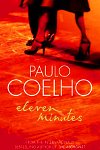
Paulo Coelho’s books, as the book covers declare, have changed lives. He writes about spirituality in a very fresh and modern way without being biased religiously or morally – though he has tales of morality to tell. It’s perhaps ironic then that his stories are so short.
Publisher: Thorsons
Pages: 288
Type: Fiction
Age: Adult
ISBN: 978-0-007-16604-6
First Published: 2003 in Portuguese; 2004 in English
Date Reviewed: 3rd September 2009
Rating: 3.5/5
Original language: Portuguese
Original title: Onze Minutos (Eleven Minutes)
Translated by: Margaret Jull Costa
I don’t know much about the success of Eleven Minutes but I’d hazard a guess that it hasn’t been as well-received.
Maria lives in a small Brazilian town but knows that there is more to the world and wants to experience life to the full. For her this means travelling and living abroad. She journeys to Rio de Janiro where she signs up as a dancer and is whisked to Switzerland, dreams of happiness, money, and a husband leading her by the hand. But the dancing is boring and after an agency unintentionally set her up with a man willing to part with a thousand francs for a night with her she makes a decision that will set her on a path entirely different to the one she was on. Down the Rue De Berne, where the nights are scented with sex and the days are reserved for slumber she begins to discover the truth of intercourse and how the world has come to rely so heavily on it.
Let’s get down to business. Is there a lot of sex in this book – yes. But although quite graphic in places Coelho has managed to keep the story tasteful and one feels that whenever he does write graphically it’s with a specific purpose, he has a message to get across each time. Nor does Coelho stick with one type of sex, covering a good number and subtly weighing them up. Interesting here is how he will come to one conclusion and then later on change it in the way one does when they make a further discovery about something for which they’d previously had a strong opinion. He does this without apologising for as discussed above he remains for the most part neutral and non-judgemental.
Apart from Maria, or maybe even including Maria, the characters aren’t very important in themselves. They are there as props to get the message across. None of them are hateful though neither are they particularly fabulous. Maria is a personification of Coelho’s thought process and moves back and forth through opinions with him. You can’t sink your teeth into these characters and you won’t miss them after finishing the book but in this man’s publications that is neither here nor there.
It’s hard to talk about the language used in the book because unless you are reading the Brazilian version the words will have been translated from the original Portuguese. I can’t remember finding any errors in the print.
Eleven Minutes promotes the view that sex can be sacred; the world has just forgotten this. It explains convincingly how we’ve come to use sex as a method of healing when really what we need lies within us, and that using sex as an excuse only serves to keep the cycle going. This is done by weighing up elements such as asexuality and pain for pleasure and detailing the cause and effects. It won’t have the impact on you that The Alchemist had but there’s enough here to make you reconsider what you’ve learned and been taught and perhaps even apply parts of it to your own life.
Eleven Minutes was originally written in Portuguese, and was translated into English by Margaret Jull Costa.
Related Books


