




Suzanne Collins – The Hunger Games
Posted 11th July 2014
Category: Reviews Genres: 2000s, Fantasy, Political, Science Fiction, Social, Thriller
7 Comments

A dystopian future. An ancient-style blood lust.
Publisher: Scholastic
Pages: 434
Type: Fiction
Age: Young Adult
ISBN: 978-1-407-10908-4
First Published: 14th September 2008
Date Reviewed: 9th July 2014
Rating: 5/5
The reaping. Every year the Capitol picks from each district two children, a boy and a girl, to face all the others in a fight to the death. Whoever is left last wins and is ensured food and shelter for the rest of their days. This is the final year Katniss is eligible to be chosen. It’s her sister’s first. Her sister wouldn’t survive, but maybe Katniss can.
The Hunger Games is the first book in a trilogy about a deprived dystopian world. With a big helping of Battle Royale, a seasoning of Lord Of The Flies, and a side dish of reality TV, the book is an unapologetic violent young adult novel that brings horror, suspense, and fine characters to an often-lacking list of books.
That it is violent is of course something to be considered, but in a way you could say that Collins is respecting young people’s intelligence. Young people know a lot about violence and horror, with video games and advertisements never far from view, and by not treating her readers with kid gloves, Collins better aligns herself with her target audience. Yet, whilst violent, The Hunger Games doesn’t linger over the gore for very long at a time, only once spending more than a couple of pages on a scene that even then is told whilst narrator Katniss is hiding from it. The gore is often something the reader conjures up themselves – the first bloodbath is related third-hand.
The characters win you over, whether they are good or ‘bad’ (because the villains are only villains because they have to be). Katniss is a hunter, a poor person transported to a rich person’s world. She never succumbs to the damsel-in-distress syndrome that claims so many other intelligent young women in today’s YA, and the stereotypes remain flipped over. Peeta may be a hero, a protector, but the terms are equal. Despite the fact that many characters will die before this first book ends, Collins give each a personality. You might not know them for long, but by and large you would be able to take a fair guess of who they were in life.
The plot keeps moving; the pace is pretty fast. The author has split the story into sections, meaning the the Games themselves are not too long. (It’s fair to say that if it had been the entire content, you may have become almost used to the horrors.)
This being used to horror, this immunity, is a fascinating aspect of the book – the way Collins interacts with her readers. Through the not long but long enough Games, and also through the relative lack of (reported) gore compared to the numerous deaths that occur, Collins effectively exploits the idea of normality. What I mean by this is that the reader won’t ever see the violence as okay, of course they won’t, but because you get all the extra plot threads you start to see how the horrific practise has become acceptable to the city residents. And the part of your reader-self that is involved in the bare basic task of reading the book from start to finish does become somewhat immune.
Awful, isn’t it? To think that there might come a point in the reading when the horror ceases to affect us so much. But whilst this could be attributed to a lack of knowing when to call it a wrap on the writing of the Games, given that Collins’s book is to teach children about war (further information here) it could be said that this immunity was planned. (As I learned after writing this, it was indeed planned, as this interview implies.) It is such that you know it is happening to you and you wonder why you’re not as moved by it. Isn’t this what happens in real life? We see so much war that we can often just turn off the television, make a coffee, forget about it. Then something ‘worse’ is reported and the immunity is gone. And the cycle starts again.
Back to the writing. Collins’s text focuses on story and meaning rather than sounding nice. The balance of the sections works well, as said, and the build-up to the Games leaves you fully informed. The reality TV nature of the book keeps you in context.
Beyond all this it must be said that the book offers some true survival tips. This is not nearly as important, obviously, but readers interested in roughing it will find an additional source of reader pleasure.
There is so much to his book, both in-text and otherwise, that you will be spending a lot longer than I have here, discussing it all. And I think I’ve discussed enough. The Hunger Games is excellent, no matter the comparisons to other works. It has much to offer even as it forcibly takes away. As a reader you are in a similarly safe position as the city dwellers. Make the most of it – even if this sounds bad, enjoy the book.
Related Books


Irène Némirovsky – Fire In The Blood
Posted 9th July 2014
Category: Reviews Genres: 2000s, Angst, Domestic, Social, Translation
3 Comments

Passion before everything – even love.
Publisher: Vintage (Random House)
Pages: 151
Type: Fiction
Age: Adult
ISBN: 978-0-099-51609-5
First Published: 2007
Date Reviewed: 30th June 2014
Rating: 4/5
Original language: French
Original title: Chaleur du Sang (Blood Heat)
Translated by: Sandra Smith
Silvio sees his relatives a fair amount, as well as the various other people of his village. Their lives are full of intrigue, but as for himself he is boring and set in his ways. He would tell you this himself; he used to be far more active, travelling around the world. Now others can live life.
He does indeed sound dull, doesn’t he? Némirovsky’s Fire In The Blood is a slow read that ambles on, being everything about everybody else until the conclusion.
The book is very short; an afternoon read. It spans many seasons, switching suddenly, which has the effect of illustrating both how monotonous Silvio’s life is, and how long people willing live unhappily. It’s not as literary as Suite Française, in the way that there are fewer themes to study, and it is a step down from the masterpiece, its length suggesting what its nature is. Considered on its own, however, it’s not bad at all.
Silvio is boring (repeated because this is something you will be thinking constantly as you remember Lockwood and the accompanying wish that another had told that tale) but this allows his narration to be good. He never gets distracted. There are few themes in this book, understandably. Passion. Love. There is the sense of a question – how/when do we break the cycle started long ago, of children following in their parents’ mistaken footsteps? Némirovsky looks at why people do what they do, which, given the time in which she lived, is inevitably caught up in appearances, marrying for money and marrying because it is expected and so forth. And she looks at how people can give up when things don’t go according to plan. She looks, too, at pretence, at faux normality, and at how a change on either person’s upkeep of pretence can bring everything crashing down. In this Némirovsky makes you question all you’ve read so far, beckoning that desire to want to read the book again because no matter what former ideas you had, you’re going to want a second look at that series of events.
Short but not sweet, Fire In The Blood is relatively untaxing but a fair choice of reading material. It may not be Némirovsky’s best but when her best exceeds all else, anything a little less is quite fine enough.
Related Books

John Green – The Fault In Our Stars
Posted 7th July 2014
Category: Reviews Genres: 2010s, Angst, Romance, Social, Spiritual
14 Comments
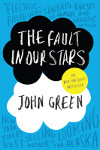
There is life in cancer.
Publisher: Penguin
Pages: 311
Type: Fiction
Age: Young Adult
ISBN: 978-0-141-34563-5
First Published: 10th January 2012
Date Reviewed: 30th June 2014
Rating: 5/5
Hazel has cancer. She’s not likely to ever be in remission but she’s able to live a fuller life than she had with illness so far. At the support group her mother insists she goes to she meets Augustus, someone who matches her in wit and thought. He’s lost a leg but is in remission, and although things will always be difficult, the two teens begin to fall in love.
The Fault In Our Stars is every bit as good as you’ve heard. Green’s writing is very unique and rather excellent, no matter that he has a few novels already under his belt. The book moves far away from the idea of pity, allowing you to see reality.
Green writes teenagers very well and the dialogue seems true to life. There has been no attempt to make the book beautiful – this is no literary feat and frankly it would suffer if it was. To be sure it’s a particular type of writing (this reviewer took a good few pages to get used to it even though she liked it), and it may not appeal to everyone. This is perhaps the only possible issue – where everything is so fresh and specific the book may put readers off by it’s technical nature.
Putting that aside, however, the characters are fantastic. These are teens of a particular personality. They use ‘big’ words, often to excess, and there are so many subjects covered as metaphors and evidence for otherwise simple conversations, it’s unlikely you will know all of them. The sheer life implied by the way the characters act just goes to emphasise how awful it is that we have these diseases that kill. They are simply two fictional people, but they represent a great many more, real, people.
The metaphors are many. A particularly prominent concept throughout is of cigarettes and the potential to kill. Augustus disgusts Hazel when he takes a cigarette from his pocket, but he explains the theory behind his action, that something that kills, stripped of the power to kill by his failure to light it, is not a threat. There are semi-subtextual ideas, such as Hazel’s naming transition, changing what she calls her boyfriend, and there is the controversial scene in Anne Frank’s house in which the teenagers cause a stir.
There is, as you may expect, a lot of humour. You are meant to laugh. You are meant to have a good time. You are not meant to pity, but you are of course meant to feel. There is the sadness – of course there is, you may say, but the point here is that because it’s balanced by the humour and normality, it is all the more powerful.
A special mention must be made of the novel Hazel loves, that she passes on to Augustus. It forms a big part of Green’s book and contains a great many concepts and metaphors. Does it signal what will later happen in the book? The scenes with the author of this book within a book remind you that sometimes life sucks, and it can continue to suck even when it’s already reached the lowest of lows.
Metaphors, concepts, themes. These, apart from the C word, are what The Fault In Our Stars is about. Green wants you to get to the heart of the matter and knows that often, subtlety is the best way. The book gets you thinking, analysing as though it is literature set for class discussion, and will leave you considering it for days.
Both a fast read and a slow burner, The Fault In Our Stars will change you by way of making you think. It’s not out to change the way you approach disease (or even, it could be said, disability). At least not obviously.
Think. Consider. Laugh. Cry. There is a fault in the stars, but it isn’t Green’s book.
Related Books
Helene Wecker – The Golem And The Jinni
Posted 27th June 2014
Category: Reviews Genres: 2010s, Angst, Domestic, Fantasy, Historical, Social
9 Comments

In Britain, the book is changed from ‘jinni’ to ‘djnni’, but as ‘jinni’ is more well-known and I can think of no good reason for what is so minor a change, I will be using ‘jinni’.
Who needs Aladdin?
Publisher: Blue Door (HarperCollins)
Pages: 484
Type: Fiction
Age: Adult
ISBN: 978-0-007-48017-3
First Published: 1st April 2013
Date Reviewed: 25th June 2014
Rating: 5/5
In the 1890s, Chava is created with spells and awoken on a ship bound for New York. But when her master dies she is alone and the intelligence and curiosity that were instilled in her come to the surface in ways not intended. She is found by a Rabbi who takes her in and gets her a job at a bakery. Across the city a tinsmith cleans his neighbour’s flask and awakens a jinni who has been confined to human form; from a choice of names the jinni picks Ahmad as he can no longer say his own name. Both golem and jinni must find their way, alone, and possibly with each other.
The Golem And The Jinni is a fine historical fantasy about freedom and acceptance, wrapped in delicious writing with a few notes on racial tolerance. It is one of those rare works you can truly get lost in. It’s not epic in the adventure or time-span stakes, but the term applies all the same.
Wecker’s command of language is what you would expect of an established author. The Golem And The Jinni doesn’t feel like a début, even if you could of course suggest that some of its finesse is owing to the editor. It’s hard to point to something in the specifics; it’s the entire package that is special.
The book is technically historical fantasy, more than technically, but in many ways it is more the plain historical. Chava and Ahmad are of course fantastical characters and no doubt Wecker had a great time creating them, but nevertheless their reason for being, as such, does seem to be more about the difference they can provide, the obvious contrast to the rest of the world that a simple human-only story could not. Yes, it’s possible that the characters could have been substituted with humans, but in that case the themes would not have been so successful in what they were employed to show. In a way it’s the fantastical itself that ‘makes’ the themes – the fantasy adds to the setting and language, and illustrates in a unique way the issue of freedom, of agency.
In creating a golem, Wecker can look at social mobility, individual agency, and women’s issues of the time, far better than she could have with even the most fearless of 19th century human women. Somewhere along the line a woman would have been caught up short, or heckled, derided, unless Wecker wished to make a crime novel heroine, and using a golem bypasses that problem. Of course Chava is still restricted, but it’s more a case of wanting to fit in, of having to fit in, and as she moves away from that notion so can Wecker look at things in more detail.
This isn’t to say that the lives of the period’s women is the biggest theme, because Chava, as a golem, is somewhat exempt. But it is part of the larger theme of freedom and creating your own life and destiny. Ahmad was trapped, and remains so – he longs to be free. Chava’s never known any different, but as he teaches her, you see her flourish, ironically flourishing in a role that is the antithesis of the one she is supposed to be living. In this way, Wecker also explores the concept of choice and what being unrestricted can do for a person. Furthermore, both represent constraints, Chava’s being invisible – society’s rules, not always relevant. Ahmad’s obvious and omnipresent – not society’s but due to society’s fear and the power that comes when someone exploits that fear. The golem and jinni balance each other out.
We see the lack of freedom in Sophia, a human who meets the jinni. Sophia shows us the more ‘human’ (as much as he can be) side of Ahmad, but she also provides a contrast to Chava, being a woman who wants to define her own life but is unable to, versus Chava’s reservations but ultimate prime position. The character is one of a few that illustrate the restrictions society placed on women, and the way they were treated.
There is a little of race and emigration, too, though this is in the background for the most part. That said, Chava and Ahmad’s actions explore the positives to be gained from connecting with others from outside our own cultural spheres.
It should be noted that the book isn’t solely about the mythical, that there are sections about various people, and the humans are given just as much space. These people are those particularly affected by the golem and jinni in some way – a lover, a past acquaintance, a person affected by an issue falling in the fantastical realm of the otherwise factual world. These sections allow us to observe the period and cultural relations. They allow you to witness the stark differences in fortune, placement, and sometimes, luck.
Whether or not you work out the twists shouldn’t affect your enjoyment. Talking of twists, however, the ending is very well plotted. All questions are answered, in a particularly intriguing way. They are answered simply and quickly (this is the end, after all) yet there remains a subtlety to them, something that enables them to be revealed clearly, yet in a way that doesn’t get you racing to finish the book. It’s a slow burner and you are meant to be able to enjoy each answer before moving on.
The Golem And The Jinni is, simply, a magnificent book. Beautifully written, magical both in character and temperament, and a tale that is fairly long already but one which you’ll wish was even more so, it has a lot to offer. And it keeps on giving, even though the jinni would prefer it not to.
Related Books

Jenny Barden – The Lost Duchess
Posted 4th June 2014
Category: Reviews Genres: 2010s, Historical, Political, Social, Spiritual
4 Comments

America – freedom.
Publisher: Ebury Press (Random House)
Pages: 424
Type: Fiction
Age: Adult
ISBN: 978-0-091-94924-2
First Published: 7th November 2013
Date Reviewed: 4th June 2014
Rating: 4/5
Emme was lured into a room by Lord Hertford, who raped her. Unable to tell anyone, knowing that her reputation would be shattered, and worried about her position as a lady-in-waiting to Queen Elizabeth if it was revealed, Emme sets her sights on joining a ship-full of colonists heading to the New World.
The Lost Duchess is a rather good book that is so well-written and entrenched in its history you might have to remind yourself of the differences in views between then and now to fully appreciate it.
The book is about the first voyages to America and the confrontations with the Native Americans, however given the context of Emme’s inclusion and the unfailing and careful consideration, by Barden, of Emme’s abuse, it would be impossible to write about the book without speaking of the inclusion at length.
The abuse happens at the very start of the book and it’s the catalyst for much of what happens, informing the narrative. What is good about Barden’s handling of the aftermath is the consistency. It’s a careful inclusion, so thoughtful that you may at times think that Emme will suddenly move on from it. Ultimately Emme learns to live with what has happened to her, but it isn’t forgotten by the book. It informs her feelings; it makes her actions towards the man she comes to love hot and cold. Readers are asked to understand Emme in our modern context, but lest we forget that Emme is of her time, Barden, both to show us and to simply portray the era, fills Emme’s thoughts with worries that she is ruined, that to speak will be her downfall. There is also some arrogance in Emme that could be the result of her previously semi-independent self trying to claw back who she was.
He was nothing but a knave trying to dominate her, just as every man she had ever known had tried to dominate her, and she wanted no more to do with him.
The above is about a man who never harms or does Emme any wrong. At once you see the way Emme’s mindset has changed, but it could also be read as a no-holds-barred statement of the era in general. This historically-focused, more than ‘usual’, storytelling is what makes you appreciate what Barden is saying about difference.
Leading on from Barden’s concentration on the era, nowhere in the book are there questions about the ‘right’ to use land that does not belong to England. The only place this concept arises is in the speech of a Native American chief. To our modern selves this seems crazy; Barden’s book is very realistic and isn’t about morality or lessons. Instead of being mollified by a 1500s Englishman questioning the right to invade (which, let’s face it, likely happened on a very limited basis), the reader has to do the thinking. You’re left to think about why no one brought this idea up, why Kit, who is a ‘good guy’, doesn’t respond to the chief’s very true statement, why caring Emme thinks about a future where the city of Raleigh thrives without considering anything else. Kit does discuss the irony of calling an intelligent, peaceful people, ‘savage’, but that is all. That said, there is true compassion to be found in the relationships between the English sailors and the Native Americans. (Here ‘relationship’ means both love and friendship.) These relationships are about love, about sacrifice, and show how peace could have been created had it not been for the racist leaders in the group of sailors.
There is little to speak of in terms of setbacks. Barden has written a good book, obviously conducted a lot of research, and knows the period well. She wishes to explore personality and society as well as take a look at the mystery of the initial settlers (whilst Barden provides an answer, her Author’s Note explains that the colony she has written about is lost to history). There are a couple of modern slang phrases but then the book is written in modern English, and there are a couple of scenes in which Barden wants to inform the reader of facts but goes on a little too long.
The plot is important, very important to Barden, but it should be noted that the book is much about Emme and to a lesser extent Kit, and so although the voyage and trials are there all along, they might not always be as exciting as you expected. This is definitely a book for those who like their stories character-driven.
The Lost Duchess looks at history and asks us to forget our modernity. It looks at ageless issues and respects all, and it does this whilst never being sorry for what it leaves out.
Emme is brave and it could be said that Barden is, too. The reader must fall in line if they wish to sail across the sea with them.
I received this book for review from the author for Historical Fiction Virtual Book Tours.
Related Books
None yet


