




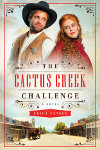
Erica Vetsch – The Cactus Creek Challenge
Posted 4th May 2015
Category: Reviews Genres: 2010s, Angst, Domestic, Historical, Inspirational fiction, Romance, Social, Western
2 Comments
Guns, outlaws, and women included.
Publisher: Shiloh Run Press (Barbour Publishing)
Pages: 309
Type: Fiction
Age: Adult
ISBN: 978-1-630-58927-1
First Published: 1st July 2015
Date Reviewed: 3rd May 2015
Rating: 3/5
Schoolteacher Cassie loves sheriff Ben, but Ben still sees her as a child. When they are paired together, tasked with doing each other’s jobs, both are confidant they can rise to the challenge. Then there is new resident, baker Jenny, a widow with a past she’s not divulging, who is paired with another widow, stable owner Carl. Whoever does their temporary job best wins money for a certain sector or the town but it’s likely they’ll win each other, too.
The Cactus Creek Challenge is an inspirational (Christian) western romance that focuses on domestic and social relations.
The story is simple and mostly predictable but that’s no bad thing; it leaves Vetsch able to look at her other themes. There are two romances. The reader is likely to vastly prefer one to the other due to how much more natural it is. The slow burn of Carl and Jenny’s relationship is rather special and it’s written very well. The addition of Amanda, Jenny’s child, only adds to it. Yes, Amanda is included a lot and almost too talkative (in the way of info-dumping) but the relationship and development of the new family is rather lovely.
Cassie and Ben, on the other hand, is a relationship that’s more forced. There is a nice passage in which Ben realises Cassie has grown up but otherwise their relationship isn’t so believable. It’s hard to see why Cassie likes Ben, particularly when we’re told they are like siblings but never shown any true evidence of it or any friendship. The relationship rests on what we’re told, that Cassie loves Ben but she’s always moaning at him, that Ben now likes Cassie (that nice passage) but it doesn’t really blossom.
Carl and Jenny are the stand outs in this book; both work hard to do the other’s job and to understand life from that point of view. Carl’s efforts to bring Amanda out of her shell and his love for her are written brilliantly; he is a very endearing character. Jenny worries about her past but Vetsch keeps it from becoming frustrating – there is no constant pushing away as there can be in other books.
One of the problems with this book is that Cassie is a bit of a mismatch. Vetsch presents a woman who was a tomboy in her youth, a woman who loves the idea of being sheriff for a month, and who shows promise to the reader as such – and then has Cassie prettifying the jail in a way that makes no sense and bares no relation to the set-up. This second Cassie does not comprehend why Ben is angry she’s added curtains and crockery and cushions to the jail, does not understand why it’s inappropriate to have a tea party there with all the ladies of the town, whilst simultaneously wanting to be the sheriff.
In the main the story reads well, but there are a few issues. Foremost is the way two of the characters kill a kidnapper – they are worried about the child which is understandable, but there is no mention of any remorse or prayers to God, which in the context of the Christian background is difficult. The body is pulled back home and will be planted in the ground; no prayers, nothing. The man is shot and anything else is simply ignored by the text.
Otherwise religion is included well. There is one time wherein an entire hymn is included, which is a bit much and lessens the effect, but otherwise faith lingers in the background, naturally informing the character’s lives. The romantic scenes show well how a book can be perfectly steamy without the characters ever adjourning to the bedroom. Carl and Jenny’s scenes stand out as their scenes do in general, but there are some lovely moments between Cassie and Ben near the end.
Throughout the book you know there’s a fair chance of a particular event occurring – it’s something that is reported as a possibility in line with Jenny’s leaving her old home. It’s something that’s almost expected as an element. However when it comes down to it Vetsch decides to use the concept itself but place it in an entirely irrelevant context, an unimportant plot device sort of context, that could be considered frustrating due to how successful and meaningful the alternative would have been. It’s a case of close but no cigar – not bad, per se, but the alternative was so remarked upon that it does feel as though the story’s going down the wrong path.
There are continuity errors, for example a character says that a person should follow them outside and moments later the second character leaves by themselves with no mention of changing the plan. Chairs are pulled out, never to be referred to again. Part of the story is made up of accident after accident after accident. Lastly there is a great amount of info-dumping and the text is overwritten (excursions that are simply to introduce someone to the reader rather than having an actual raison d’etre).
The writing itself is strictly okay. Here again there is too much description (to paraphrase, there are lots of sentences akin to ‘he took the chair from the desk and sat on the seat’), factually inaccurate statements and anachronisms.
The Cactus Creek Challenge isn’t as refined as, say, A Bride’s Portrait Of Dodge City, Kansas, but it’s generally well set in its era and the twist of women doing the men’s work is as fulfilling as you might have hoped upon reading the blurb. It’s also a fair choice for those looking for faith in their fiction without it being a theme. It’s not going to ‘wow’ you, but you may find yourself lingering over it all the same.
I received this book for review from the publisher.
Related Books

Nancy Bilyeau – The Tapestry
Posted 24th April 2015
Category: Reviews Genres: 2010s, Historical, Political, Social, Spiritual, Theological
1 Comment

Youth must have some dalliance1.
Publisher: Touchstone (Simon & Schuster)
Pages: 380
Type: Fiction
Age: Adult
ISBN: 978-1-476-75637-0
First Published: 24th March 2015
Date Reviewed: 23rd April 2015
Rating: 3.5/5
Joanna Stafford, ex-novice of Dartford Priory has been summoned to London but when she gets there she’s led away by someone who wishes her harm. She doesn’t know who he is and is unable to find out but finding protection she stays, meeting Thomas Culpepper and later her relative, Catherine Howard. Joanna just want to live her life, but she’s a way to go before she can.
The Tapestry is the third and last book in Bilyeau’s series on Joanna. It is well written and, as always, wonderfully blended with the true history, though perhaps not as strong as the previous books.
To the writing then: it is lovely. There are no two ways about it; Bilyeau’s work makes for a good read. There are your odd phrases and words that are a little too colloquial but not glaring when considering the fact the story could hardly be written in Middle English, and Bilyeau continues to evoke the Tudor period in a very natural way; you never feel you’re being taught.
The book is slow to start, in fact the story on the whole is a lot slower than the previous. There is far less action this time around and there isn’t one definitive plotline – this isn’t all about a tapestry. It is nice in that it aids the wrapping up of the series but it does mean there are times you can easily put the book down. Given the content of the story, Joanna comes across as weaker than before though this really is more of a ‘comes across as’ rather than a reality. Sometimes the character seems to take a while to realise what will likely seem obvious to you and this is something that is difficult to either defend or criticise. On one hand Bilyeau is writing about popular history and it’s very likely the reader will know the history prior to reading, ergo you know a certain person is going to become queen number five. On the other hand you’ve got to remember that Joanna Stafford (and so, in this respect, any real person who might have been a semi or regular stranger to the court) would not have known any of it so it makes sense she would take a while to catch on. Hindsight is everything. Joanna does over-think things sometimes; it is fair to say it’s down to the reader to let things unfold as they will.
The best aspect of the novel is one shared with The Crown and The Chalice: the blending of fact and fiction. On top form as always, Bilyeau fills gaps, sometimes to an astounding degree; it’s almost cheeky the length the author goes to but it’s cheeky in a very good way. The blending is exceptional – if you’re not familiar with the series, what Bilyeau essentially does is write her fictional characters into the factual history in a way they can be added and removed without leaving a mark. And this time around, Bilyeau has aimed higher than ever, using our scant knowledge of Catherine Howard’s life to construct one possibility of who the girl was. Joanna does not change anything at a fundamental level; Bilyeau rewrites without rewriting. (This can mean that some subplots seem irrelevant and confusing for a while as Bilyeau seeks to keep the timeline in check and provide background context. The major reasons for the sub-plots become evident in time.)
There is but one element that brings the novel down a couple of rungs. Grammar issues, changing names, and missing words feature throughout the book; the text isn’t always fluid and it can be difficult to stay focused, to not be jolted from the story. The writing itself remains lovely, which is testament to Bilyeau’s talent, but the book does suffer quite a bit from the errors.
The Tapestry takes someone who is surely beloved of many Tudor fiction fans and gives her story, her journey, a firm ending. It is slow (but steady) and does have its drawbacks but it’s a fair end to the series and, no matter how many times you may have read about the history of Catherine Howard, it manages to make you feel as frustrated or sorrowful or angry as you likely did when you first found out about the situation. And that is quite the boon.
1 Line from Pastime With Good Company by Henry VIII.
I received this book for review from the author.
Related Books


Speaking to Nancy Bilyeau about the Joanna Stafford trilogy, The Blue, and Dreamland (spoilers included)
Charlie Place and Nancy Bilyeau discuss the lifestyle of Dissolution-era nuns, using a website’s ‘contact me’ form to great success, there being more relics than there were items, using your family’s name in your work, and the grand amusement parks and luxury hotels of New York’s past.
If you’re unable to use the media player above, this page has various other options for listening.
Barbara Comyns – Our Spoons Came From Woolworths
Posted 30th March 2015
Category: Reviews Genres: 1950s, Autobiography, Domestic, Social
2 Comments

A long time before you could buy Britney’s latest single for £3.99.
Publisher: Virago (Little Brown)
Pages: 196
Type: Fiction
Age: Adult
ISBN: 978-1-844-08927-7
First Published: 1950
Date Reviewed: 28th March 2015
Rating: 5/5
Sophia marries Charles; neither family is happy about it. The couple lives on the poverty line; Sophia becomes a model for art students, Charles tries to make something of his artwork. They aren’t well matched and the conflicts are worsened by Charles’s outspoken relatives.
Our Spoons Came From Woolworths is a mostly-autobiographical book about the hard years of a young woman.
It is quite difficult not to look at the way in which this book relates to Comyns herself; the way it’s written suggests it was a therapeutic exercise. It is a long tale told in a short time, spanning several years in 196 pages.
The writing – mainly the grammar – isn’t particularly good, however there is the sense that this is part of the problem the heroine suffers. It’s not that she’s uneducated, rather the writing is a subtle addition to what is actually said. Our heroine is weak, a doormat if you will, but does not really realise it. She takes a lot of flack that women, even in her time, would not have put up with. We are never given a direct reason, but one can assume her wish for a nice life and the death of her parents has much to do with it. The prose reads as though hurried, as though if she doesn’t write it all quickly everything will be forgotten.
Sophia’s problem is her husband, Charles. He blames her when she falls pregnant (her knowledge of contraception was non-existent at the time), he lives his own life, expects her to do everything he says, and his family only add to it. The book provides an incredibly damning portrait of a manipulative, highly selfish person, and at times other people.
So this is by and large a sad story, the cruelty is heartbreaking, but Comyns has the odd laugh. Her jokes are jibes at silly social ideas and customs, of local cultural issues. Because they are in keeping with the written style, they end up sounding somewhat innocent even when they aren’t.
The biggest social issue, then, is of the changing domestic situation of the time. Sophia works. She earns more than Charles ever will and this is simply not correct according to Charles and his family. What Charles wants he should get and so this is as much an issue of adults spoiled as children as it is a married couple not seeing eye to eye. Any children Sophia has will be spoiled only if it suits those looking after them. And as Sophia comes to find, Charles is far from unique.
Poverty is a close second. Charles uses up a lot of money but they would be poor anyway. Comyns shows how hospitals could be awkward for the poor even if they had support. Sophia gives birth and from her story emerges a lack of communication. Perhaps Sophia lacks knowledge, but it’s more likely those in charge simply didn’t bother trying to explain to her what was happening, why they were doing what they did. (The book is told from Sophia’s perspective.) There is a marked difference between this and a later hospital stay during which the character has more money.
What’s interesting about Our Spoons Came From Woolworths is that the story isn’t particularly, well, interesting, but the book manages to utterly captivate. There isn’t even much of an ending; there’s no climax, just happier times. It’s the story of a woman who is poor, has some luck, but lives an average life overall. You’ll learn a lot from this book – it’s so far away from our present day.
This is a book that makes you get involved. It doesn’t ask you to cheer happiness or emphasise with sadness, but it does pull you in and whilst the author may have planned this – who knows? – the character seems oblivious to the effect.
We can’t know why Sophia wrote her book but we can guess why Comyns did, and she succeeds in all she sets out to do. Woolworths may no longer be around but Sophia’s spoons remain and in that fact lies an excellent book.
Related Books
None yet.
Emma Healey – Elizabeth Is Missing
Posted 23rd March 2015
Category: Reviews Genres: 2010s, Commentary, Domestic, Historical, Mystery, Psychological, Social
2 Comments

Or is she?…
Publisher: Viking (Penguin)
Pages: 275
Type: Fiction
Age: Adult
ISBN: 978-0-241-00350-3
First Published: 13th March 2014 (in translation); 5th June 2014
Date Reviewed: 21st March 2015
Rating: 4.5/5
Maud can’t seem to get through to her family (or anyone else for that matter) that her friend is missing. Everyone says that nothing is wrong, that Elizabeth isn’t missing, but all the signs seem to point towards the opposite. As a child post-WWII, Maud lost her sister, Sukey, and as she goes about her search she remembers this.
Elizabeth Is Missing is a rather excellent novel about old age and the way others treat the elderly.
Our narrator, accidentally unreliable, is an octogenarian who has become very forgetful. Maud thinks the same things over and over, says the same things, and forgets where she is moment by moment. It is in the details that Healey shows us what she is trying to get across: it’s all very well getting frustrated by those who forget, but remember to view things from their perspective. Maud is patronised and knows she is patronised; she also knows that no one is listening to her even when they should. And the reader knows, even when Maud doesn’t notice, that people are not respecting her, are laughing at her. In amongst this is the question of care homes, of old age care in general, and how the wishes of the person should be respected.
Healey’s writing of Maud is simply incredible. She is believable and, though it does not matter in regards to whether it would affect the tale, very likeable. Because you’re on this journey with her, in her head, you don’t feel any frustration or boredom; Healey makes you understand what it is like. You’re able to chastise Maud’s daughter, Helen, for not listening to her mother (whilst understanding the pressure Helen is under); you’re able to think up the rest of what Maud should say yet be satisfied that she does not say it.
Maud’s memory isn’t static – Healey’s story incorporates the progression of memory loss. She manages to make you feel upbeat whilst you begin to loiter on the edges of upset for the character. Something that is never answered (this is not a drawback) is how long we are with Maud. It’s plausible that we spend a few weeks or months but it could just as easily be days.
The structure of the book is quite simply genius. It makes you keep questioning what snippets of information relate to which part of the story, and of course, ultimately, you have to decide which versions of Maud’s many retellings are true. It’s prudent to say that this book isn’t a thriller in the usual sense – ‘thriller’ is the description on the book, but it’s far from edge-of-seat nail-biting drama. You soon work out a few possibilities for Elizabeth and none of them are particularly amazing. The page-turning factor of this book lies in the way Healey makes you want to stick around, to hang out with her expertly-written main character.
What you may find irritating is the almost predictable way no one will tell Maud where Elizabeth is even when it’s obvious they know. There are two points to this withholding. The first is that there would be no story if people told Maud where her friend is. Of course. And as much as this in itself is obvious, you have to just accept that you’re going to have to keep reading to find out for certain, even if you don’t feel it’s much to look forward to. The second point is that it makes perfect sense no one is telling Maud where Elizabeth is. Maybe they have; she’ll have forgotten. Maybe they don’t because they’re sick of repeating themselves. Maybe, if Elizabeth is dead (which is of course possible given her age) they don’t want to upset her. The end of the book is very much a look at the entirety of this second point.
The second ‘plot’, then, concerns the disappearance of Maud’s sister. It’s a long time before the reason for its inclusion, its creation, comes to light. You’re invited to feel confused and perhaps a bit miffed that Sukey gets all this time when the book is about Elizabeth. This plot is confined to Maud’s childhood so the book is effectively part historical fiction. Maud’s long-term memory allows her to tell the reader about this period of her life in a generally usual way.
The only shortcoming can be found in the words Healey uses for Maud’s own descriptions. Some of the terms are too modern or colloquial and not what a British person of Maud’s age would use. These terms are therefore jarring and can pull you out of the text for a bit if you’re susceptible to them (for example, this may not affect American readers but it is going to affect British readers old enough to have witnessed the introduction of the terms). This, however, is a minor issue overall.
Elizabeth Is Missing is driven by all three ‘drivers’ – character, plot, and society. (I realise society isn’t generally thought of but this book’s commentary on issues requires it.) It’s fabulously character-driven, slow but steadily plot-driven, and what it offers for thought will stay with you for a long time and likely affect the way you think and deal with others (or at least make you constantly aware). It’s not going to take you on a whirlwind journey – Maud can’t take the bus with you alone – but it is going to leave you highly satisfied no matter what conclusions you reach in regards to the excellent and superbly devised climax. (Some questions are left unanswered, but there are enough hints.)
Take your place at Maud’s side and prepare to take note of when the gas needs to be turned off and when the kettle’s on the boil. This is a journey without travel and one you’re likely to enjoy very, very much.
Related Books


Jessie Burton – The Miniaturist
Posted 18th March 2015
Category: Reviews Genres: 2010s, Angst, Drama, Historical, LGBT, Magical Realism, Mystery, Social, Theological
4 Comments

He knows when you are sleeping; he knows when you’re awake.
Publisher: Picador (Pan Macmillan)
Pages: 424
Type: Fiction
Age: Adult
ISBN: 978-1-447-25089-0
First Published: 3rd July 2014
Date Reviewed: 16th March 2015
Rating: 2.5/5
It’s 1686 and Nella moves to the home of her new husband in Amsterdam. She expects happiness but instead receives a frosty reception – she’s not particularly wanted, her sister-in-law is clearly mistress of the house, the servants seem too big for their boots, and her husband makes no move to consummate the marriage. Instead of the life she thought she would have, Nella finds herself living in a mystery and this only increases further when her husband buys her a miniature of their house and the creator she assigns to complete it appears to know an uncanny amount about the family.
The Miniaturist is a book that could have been amazing but is sadly held back by a lack of focus, poor writing, and a decisive gap between the characters and the readers.
Burton seems to have chosen the 1600s to gain the attention of history lovers. The book could have been set at some other time at no cost, and the characters do not at all conform to the time period. By this I do not mean the way they defy convention – indeed servants on a par with their masters is not unbelievable – more it’s the way Burton wields power that is an issue. As an example, Nella has a fit over something most of her era would naturally have a fit about, before doing an about turn and completely changing her opinion within hours, emulating views of the present day.
Is Nella confident or nervous? Burton cannot decide. One moment her character is close to being obnoxious, the next she’s a delicate flower who will not speak a word. She leaves the house without question one day, then stays in her room and lets people make all the decisions for her the next. It is clear that Nella is a device – this is a plot-driven novel – but there is nothing to hang on to, so to speak. Burton hasn’t made up her mind and wants both worlds.
The characters never come into their own. You’re never given a reason to care about them; they are distant from the first page to the last. A lot of this is down to the way the author chose to write her story – the particular way she uses the present tense, third person narration, does not allow the reader to feel they are at all close to what’s happening. Instead there’s the sense Burton realised, at some point, that she should have been writing in the first person but didn’t want to rewrite what she already had. Nella does lots of thinking and imagining when dialogue would work better. Everything is too detailed, info-dump is common.
Much of the issue is that The Miniaturist is full of drama. Full of drama to a melodramatic, unnecessary degree. As the book progresses it reads ever more like a prose version of a theatrical production, the problem being that theatre has to be expressive to reach the audience at the back of the room but a book by its very nature has no requirement for it. Disaster follows disaster to a silly level and social issues are packed in like sardines.
As said, this book is not very well written. Whilst modern language is natural – a book in old English would be difficult to read – very modern slang and colloquialisms pull you out of the story. Burton moves between ‘oldy-worldy’ English grammar, modern English grammar, and American grammar, making for dialogue that doesn’t ring true. (The characters may be from Amsterdam, but they would not have peppered their language with Spanish grammar, for example.)
Lastly, it must be said questions are not answered. The question of the miniaturist is never answered. There is a half answer that spells out who they are in terms of background, but you never learn the mystery nor do you ever really meet the miniaturist. The question of what will happen to these characters now they are in a bad position is completely forgotten.
The Miniaturist is strictly okay. Read it if you will, but don’t pass up the chance to read another book for this one.
Related Books
None yet.


