

Rowan Hisayo Buchanan – Harmless Like You
Posted 11th January 2017
Category: Reviews Genres: 2010s, Angst, Art, Commentary, Domestic, Social
2 Comments

Not being admitted, or keeping one’s distance?
Publisher: Sceptre (Hodder)
Pages: 305
Type: Fiction
Age: Adult
ISBN: 978-1-473-63832-7
First Published: 11th August 2016
Date Reviewed: 6th December 2016
Rating: 4/5
Following his father’s death, Jay flies to Berlin to find his mother to hand over the keys to the family home; Yuki has been absent as long as Jay can remember yet his father still wanted her to have the house. Yuki’s teenage years and early adulthood were troubling times; as an artist and Japanese American growing up in the 1960s she always felt uncomfortable, distanced, and the few relationships she does have are not enough to change that, particularly as they aren’t all healthy.
Harmless Like You is a rather well-written dual narrative novel that looks at discomfort, identity, isolation, and social-racial issues in mid twentieth century America, in turn examining the effect of an absent parent on their child as well as the effects of artistic frustration on a person. Both subtle and to the point it uses interesting turns of phrase to create something rather new and full of interest but doesn’t quite make the most of the setting and characters.
The writing in this book is really something. Hisayo Buchanan favours a poetry in prose sort of style that fits somewhere between the experimental and the more usual, a narrative that could have easily swung towards the self-indulgent but doesn’t. Rarely does the author fall back on common metaphors, preferring to look at things in a different manner that fits well with the idea of an artist, a very creative style wherein you can see how much time has been spent on every sentence:
The small, female oblong stood in the shadows beyond the doorway. Sun buttered the sidewalk where I stood, but she was dressed for a colder season.
In the playground, bodies swirled to the door like so much dish soap draining away.
Told in both the first and third person – one for each of the two narratives – the use of the two ‘persons’ boosts the overall atmosphere of distance and closeness; Jay, very much a part of society and in a loving relationship, even if it’s been strained recently by the birth of his daughter, speaks to the reader directly; Yuki, always feeling at arms-length to everyone around her and only at peace in an abusive relationship in which equates outbursts to love, is chronicled by the author. Yuki would probably be happy to narrate herself… sometimes. This use of third person means that although you spend a great deal of time with Yuki, far more than with Jay, and thus know a lot about her, the lack of the character’s own voice means you are distanced from her yourself. In any other book this would be a problem, and indeed some might say that even here it’s a problem, but it does reflect the author’s character and point well.
Yuki was a chīzubāgā [cheeseburger] – enough to make a Japanese person sick and still inauthentically American.
Of points, Hisayo Buchanan uses a fine mix of the frank and the subtle. Yuki struggles with knowing where she fits in the world due to her heritage, ethnicity, and nationality – she looks Japanese and speaks it but does not want to live in Tokyo because it would not be a good fit, would not offer her what America can, which are things that match who she is. What and who she is are questions she asks herself often if not in so many words. In the same vein, this is a book in which Asian Americans – Japanese here – are both accepted and not, where many people have got past colour and many haven’t and the author shows both sides, where colour is irrelevant and unremarkable upon as well as that simple prejudice where it may or may not be discussed but certainly has an impact. It’s the latter that informs the text most, particularly because, like her usage of distance in her writing, the author shows unvocalised prejudice, the only vocalised questions and statements made by those who like Yuki and those who may or may not. It makes for an interesting reading experience because it allows Hisayo Buchanan to really look into Yuki’s anxieties, to show how many different elements make them up – she shows how the underlying feeling can have a big impact. Sometimes – we could even suggest it’s often – the girls who seem to dislike Yuki (because we see things from Yuki’s perspective ever time) have different reasons for disliking her, particularly as Yuki is what we’d now call flaky, other times you have to piece things together along with Yuki’s perception of what’s going on. And where there is room for debate, where it’s not definite whether Yuki’s thought is correct, there is Hisayo Buchanan’s frankness to show how Yuki has reached her opinion. (There is also a look at female friendship where distance and possible misunderstanding has eroded the connect, but this is distinct from the rest.)
Then there is the author’s own feeling, scattered throughout the text in a way that means you see it and the point of it but toes the line between the author being directly involved and not, about race and how we discuss it, of identity. It’s best to use an example:
‘So,’ Yuki’s boy asked. ‘Where’re you from?’
‘Six blocks away. Oh. My family,’ she replied. ‘Japan.’ When she moved back would she say she was from America?
There is also Yuki’s later exhibition, based on eating only white coloured food for a month, which is titled Shit’s Still Brown. It’s not commented on directly, but one can read subtext in it.
So this book is about being apart from people because of physical differences, perceived differences, and that stereotypical creative isolation – Yuki isn’t Cassandra sitting bin the sink, she’s Mr Mortmain in his room at the top of the house, staying away from relatives. Through its theme of artistry it also looks at the Vietnam war, Yuki using the Napalm girl photograph as a base for a photography series, contrasting the situation depicted with the childhoods she sees in action on the streets of America. It looks at artistic frustration and misunderstanding when Yuki photographs food for a series and people write to ask her about the restaurants instead of discussing the work itself.
And it looks at a life without a parent, parental neglect as well as purposeful separation, and the effects both have. Would Yuki have been happier if she’d not stayed with her friend and had followed her parents back to Japan? Would she have been a different person, capable of being a mother? Would she have left her abusive boyfriend earlier instead of finding comfort in the relationship? (That is something else the book looks at – why people stay, the reasons the have.)
This book does a very good job portraying characters – the main ones, at least; others aren’t so well drawn but that appears to be the point – and it does an excellent job in evoking the setting. It’s easy to imagine place and time. However the plot is minimal and this is only emphasised by the fact you know how Yuki’s life ends out because the author brings Yuki and Jay together as the introduction. The substance of this novel lies entirely in its themes and the ending isn’t particularly engrossing, Yuki remains roughly the same person as she begins. And as the theme work can be very subtle at times you do need to be happy with the idea of a gentle flow rather than something that you’re going to want to sit up and pay attention to. At times the writing becomes the best part. You may well very much enjoy the book but is it one you’d recommend to a friend?
Harmless Like You is a good début full of fine writing, well-written characters, but it wouldn’t be wrong to say that Yuki won’t be for everyone. And perhaps that’s also part of the point, falling very much in line with the thinking in the book. If you’re looking for something in particular, a literary element, you may find it middling; this is a book that uses broad strokes of the calligraphy brush liberally so there are patches where the ink inevitably misses.
Related Books

Paul McVeigh – The Good Son
Posted 30th November 2016
Category: Reviews Genres: 2010s, Historical, Political, Social, Spiritual
2 Comments
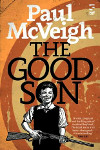
The Milkybar kid is strong and tough.
Publisher: Salt
Pages: 234
Type: Fiction
Age: Adult
ISBN: 978-1-784-63023-2
First Published: 15th April 2015
Date Reviewed: 29th November 2016
Rating: 3.5/5
Mickey Donnelly lives in Troubled times. Northern Ireland is at war and he can’t go too far from home or he’ll end up on the wrong turf; he has to be careful of the Protestants. Living with the shadow of a new, unwanted, school in front of him he tries to get to grips with girls and with being cool, particularly as the other children believe him to be gay. And there’s always his Da upsetting his Mammy, the parent he loves most.
The Good Son is a book set some time during the 1980s and 90s that looks at the conflict but concentrates on its coming-of-age storyline, blending profound commentary with the ordinary.
It would be quite natural to expect this book to hinge on the conflict but whilst it doesn’t quite do that, there is a fair amount in it that shows how life was, how split the country. McVeigh never shields the reader from the violence and he makes it clear in the way the fighting effects Mickey, physically most often, that he’s going to be blunt. Mickey takes a lot of metaphorical and literal punches, including from his mother. McVeigh also includes raids and the British – English – actions in the conflict, the disturbance of the regular people due to the worry, often founded in truth in the case of this book, that there were weapons and IRA members around.
But McVeigh’s setting acts more as context, as the difficult background information that shows what fuels Mickey’s behaviour. Violent evenings preface run-of-the-mill days in the streets, skipping and playing chase with the neighbours. Neighbours who may be harbouring army members. Just as Mickey’s family could be.
Mickey is ten years old so there are a lot of sudden changes of scene and a lot of talking about things that he doesn’t understand. McVeigh has written the book in the first person in full Belfast dialect; it’s quite unusual especially when joined by everything else and makes the book a little like Marmite – you will likely either love this book or dislike it (‘hate’ is a bit too strong). What’s true across the board is that Mickey comes across clearly, enough that one could speculate some autobiographical elements to his character. And the rendering of a ten year old is perfect in all its minor pomposity and silliness.
The drawbacks to the book rest in the structure, that use of childhood amongst the conflict. It’s that Mickey’s story takes place during one summer and whilst there is an ending the relative shortness of the book means that it’s relatively minor. It’s more ten-year-old character study than story, the voice being superb but the plot – away from the conflict – being pretty average; whether it works for you will rest on how much more you want to hear about the social history rather than the growing up. It’s your evening television series rather than a film destined for the cinema, an apt comparison to make considering the number of then-popular cultural references included (there are enough that one could argue there are too many even if it does show Mickey’s love of television).
The Good Son is good but as is often the case in situations where labels are assigned, there are also not-so-good times. It is best to go in with few expectations so that what works will work very well.
I received this book for review from FMCM Associates.
Related Books
None yet
Magda Szubanski – Reckoning
Posted 25th November 2016
Category: Reviews Genres: 2010s, History, LGBT, Memoir, Political, Social
Comments Off on Magda Szubanski – Reckoning

Baa ram ewe.
Publisher: Text Publishing
Pages: 371
Type: Non-Fiction
Age: Adult
ISBN: 978-1-925-24043-6
First Published: 30th September 2013
Date Reviewed: 22nd November 2016
Rating: 4.5/5
British-born, Polish and Scottish rooted, Australian household name Magda Szubanski writes about growing up as the daughter of a man who rebelled against the Nazis – leading him to want the best for his children – finding herself as a comedian after years of academia, working through her sexuality, and the stories of her ancestors.
As the purposefully long heritage-detailed sentence hopefully shows, Reckoning is a book of both Szubanski’s own life, and the life of her Polish relatives living during World War Two. It’s a stunning book that is all the more poignant for the historical information Szubanski includes and it’s a bit of a literary experience to boot.
Szubanski, known best outside Australia for her role as Esme Hoggett in the film Babe as well as Sharon in Kath & Kim, details her life as her family made the move from gloomy Britain to brighter Australia right up until recent professional work. Weather differences, A-grade tennis, convent school. The author sports an open, easy writing style that shows off all her influences. It’s a text full of general cultural and more specific references – films old and new, classical literature – that help to bring clarity to what she says and makes it very readable. Brontë spars with black and white Polish cinema and the book is soaked in philosophical references, the latter in particular owing to Szubanski’s educational choices.
One of the themes is sexuality; in Szubanski’s telling of her life story you see the contention and confusion of a lesbian woman – or, as she puts it, ‘gay gay gay gay gay not gay gay’ – growing up in the 1960s and 1970s, the way Szubanski came to understand her feelings and the changes in society’s views. It’s a constant element that looks right back to childhood and right up to her coming out during which she details what was going on in her head, the confusion, her discomfort and later embrace of terminology. Another theme is Szubanski’s weight, as she talks openly about the way her size has often corresponded to the goings on in her life and also the way she has and is happy with her weight, indeed feels more like herself. Szubanski’s career in comedy lends the book a certain slant; the way the humour is written, opinions conveyed.
The book is also harrowing. One of the most important aspects of it is the look at the German occupation of Poland. Szubanski’s Polish heritage and in particular her father’s life, means that her work is full of information of the sort that is often forgotten.
We arranged to meet up again and I rejoined my family. As we shuffled through the cemetery, something caught my eye. A long line of wonky headstones, uniform and yet misaligned.
‘What does it say? Who are they?’ I asked Uncle Andrzej.
‘Girl scouts,’ he replied. ‘Among the first to be killed by the Nazis. Enemies of the Reich. This is how they frighten people. Killing girl scouts.’
Szubanski’s telling of the occupation and her father’s role in the Polish resistance is hard-hitting and superbly told. She leaves out nothing; there is a lot of shocking violence in this book that puts the spotlight on things that get lost in amongst the publication of the larger scale happenings. The killing of children, the choice to kill or be killed, the constant acting required of young people delivering anti-German information. To see this solely as a memoir of a modern day icon would be a mistake.
‘…a very evil man put this number on me.’
‘Why?’
‘Because he wanted to kill me.’
‘Why?’
‘Because I am a Jew.’
I didn’t really understand what a Jew was. Or why anyone would want to kill such a nice lady. Was she related to the Little Jewish boy Dad was always going on about?
‘I am telling you this, Magda, because it must never happen again.’
I nodded. I felt bad that this had happened to the nice woman. And I agreed it should never happen again. And I remember now – as I looked up, the other women all held out their arms and showed me their numbers.
At least on the face of it, Reckoning is bound to appeal more to Australian readers and those outside Australia who are familiar and interested in its popular culture, but if there’s one memoir you should read this year regardless of whether or not you know the author, it’s this one.
I received this book for review from FMCM Associates.
Related Books
None yet
Andrew McMillan – Physical
Posted 11th November 2016
Category: Reviews Genres: 2010s, Angst, Commentary, LGBT, Romance, Social, Spiritual, Theological
Comments Off on Andrew McMillan – Physical

In all its flaws, in all its beauty.
Publisher: Jonathan Cape (Random House)
Pages: 45
Type: Poetry
Age: Adult
ISBN: 978-0-224-10213-1
First Published: 9th July 2015
Date Reviewed: 1st November 2016
Rating: 4.5/5
Physical is a short collection of poems that’s focused on the male body and sexuality – relationships, encounters, day-to-day life. It uses a specific style to focus attention on a few ideas at any one time. (It is also apparently inspired by poet Thom Gunn – I don’t know enough about his work to comment on this properly; I can only say there is similarity in the themes and the approach to them.)
There are some fantastic passages in this book that have the power to leave you a little stunned in the way of all great poetry (that sort of pause effect this reviewer is coming to love). As it’s short it can be good to read it slowly and it pays to take your time over the lines, to really read into what is being said; McMillan often uses double meanings that are rather clever, a line ending acting also as the start of the next line.
taken allegorically he is beating on himself
until the point at which the inner river of the word grace
runs passed and everything lays down in calm
and walking back across the stream to his possessions
he feels the bruise that is staining his thigh
and he wonders at the strength of one so smooth
One of the stand outs is the very first entry, Jacob With The Angel, which takes a biblical tale, looking at it from both the usual and another angle. It’s a variation full of artistic license and provocation that asks you not to look at the story in another way exactly, but in a way that asks you to consider a potentially different meaning or possibility behind the words. McMillan explains himself outright, saying, “taken literally” then “taken allegorically” – it’s a story exploration of possibilities that makes you admire the thinking behind it.
At the risk of making it seem as though this review only concerns the very first few poems (because an example of style using the third poem follows this paragraph), another stand out is Urination. The whole being just as blunt as its title, this piece looks at discomfort in public situations, childhood memories, having to use the toilet at home when in a relationship. It seems an almost odd choice of subject but McMillan makes it important, stylist choices making it so much more than you’d think it might be. (And to get away from the first poems the multiple-page-spanning-or-is-it middle section of the book is worth reading just for the use of white space.)
In terms of McMillan’s use of pause, white space, to denote meaning and so forth, The Men Are Weeping In The Gym – about power and things that are seen as weaknesses – is one poem that illustrates the method constantly and consistently, so that you can just extract a couple of lines from the rest to show the method in action. For example:
the bicepcurl waiting staring
straight ahead swearing that the wetness
on their cheeks is perspiration
A good use of language, a play on grammar, sentence clauses, and when added to McMillan’s tendency to put words together that aren’t ‘supposed’ to be together but could be – twelveyearold; slowpunctured; shortflightstopover – words that in McMillan’s collection become their own entity, it’s quite something.
Quite something – that’s it in a nutshell. Physical is powerful, stunning, mind-blowing, but not quite perfect – a word which of course has value here because in the context of the collection not being perfect is sometimes the point. The collection repeats itself to interlink, to draw connections between poems, but it also repeats itself literally, subjects that are in reality separate scenes but on the page sound very similar. Is that a problem? The answer is subjective – it really depends on how much you’re enjoying reading about the themes; McMillan’s writing itself never waivers. It’s another reason to take your time.
However you feel, it’s safe to say that McMillan’s book is a valuable addition to the world of poetry. To be taken literally.
This book is shortlisted for the 2016 Young Writer Of The Year Award. I’m on the Shadow Judging Panel.
Related Books
None yet
Louisa Young – The Heroes’ Welcome
Posted 4th November 2016
Category: Reviews Genres: 2010s, Angst, Commentary, Domestic, Historical, Psychological, Social
2 Comments

We’ll meet again.
Publisher: Borough Press (HarperCollins)
Pages: 322
Type: Fiction
Age: Adult
ISBN: 978-0-007-36147-2
First Published: 22nd May 2014
Date Reviewed: 16th August 2016
Rating: 3.5/5
Riley returned from WWI a changed man, half his jaw missing. Surgery made up for some of it; Nadine still wants to marry him though her family worry about his prospects – it doesn’t seem to matter to employers that he served his country when he’s disfigured and thus deemed a discomforting presence. Riley’s worried about how Nadine will view him and in turn Nadine is worried about Riley’s depression; she doesn’t care that his looks have changed. Then there’s Peter and Julia – Peter served with Riley and came back physically unharmed but the war has taken its toll on his mind. Julia, in an attempt to reach him, experimented with cosmetics and has damaged her skin. Will either couple return to how they were?
The Heroes’ Welcome is the sequel to Young’s previous book, My Dear, I Wanted To Tell You. This fact is not noted; fortunately the book works as a standalone or at least it seems to – readers of the first book say it does matter, that you need to read them in order. The Heroes’ Welcome is a fair look at disability in the context of the war, it just doesn’t have much of a plot or character development going on.
On that word, ‘fair’, it’s fair to say the book goes a good way towards showing social issues and personal rehabilitation but doesn’t go quite as far as one might hope. It shows PTSD and the effects of the disorder on families – one of those topics that doesn’t get looked at much – but the main bulk of the development in this way is confined to a few pages. Young knew about the hospitals and healing through the work of her aunt (I discovered this after having read the book) which means that when the subject is concentrated it’s special. In those few pages is a wonderful overview of what you’re already starting to understand, the juxtaposition of society saying, ‘welcome back and thank you for your service!’ and ‘I’m not sure you can do this work and anyway you’ll scare people – no job for you’. It both harks back to the post-war days and illustrates what is unfortunately still the case today.
The writing is pretty good. It flows well and in the main rings true, however there are some anachronisms – ‘epically’, ‘those ones’, and the rather odd ‘losable’, for example. Young slots a first person thought narrative into the third person narration which makes the text choppy at times. Phrasing can be vague.
Young was inspired by the work of another writer who used Homer in conjunction with the events of WWI, showing how related the ancient text is to the later war. It’s interesting but the sense of fascination and seeming originality in Young’s book is marred by this fact of copying – something only divulged in the afterword, after you’ve finished it. And if you haven’t read Homer or don’t know the stories well, it may be a problem. It may be best to read Homer or to get your knowledge of The Iliad down to pat first… which given the nature and length of that text…
In sum, The Heroes’ Welcome sports nice language, good ideas, and isn’t a bad read, but there’s not much going on and for all the promise in the veterans’ stories, the book is lacking in substance. The ending is a bit of a rushed, convenient, job. The book would work best as further reading, say if you’ve completed Anna Hope’s Wake and want something that looks at the war in a similar light. It’s not, as the quotation on the cover says, the book to read about the war if you’re only ever going to read a single one.
Related Books