

Erin Morgenstern – The Night Circus
Posted 19th April 2012
Category: Reviews Genres: 2010s, Fantasy, Magical Realism, Paranormal, Romance
2 Comments

The circus is all fun and games, right?
Publisher: Harvill Seeker (Random House)
Pages: 385
Type: Fiction
Age: Adult
ISBN: 978-1-846-55523-7
First Published: 13th September 2011
Date Reviewed: 17th April 2012
Rating: 5/5
Almost every night a circus appears in an undisclosed location, staying there for a short while before moving on. To the patrons it’s spectacular but still a circus with tricks. Yet for those who work for it, especially a select few, it’s more than your average magic box, being a stage for some truly amazing spells and illusions, and one particular thread of illusions in particular.
The Night Circus is a fantastic fantasy-orientated novel that lures you in unknowingly. What is most important to discern, in many ways, is that while the promise of supernatural events seems evident from the first page, from, indeed, the cover of the book, it does take a while to really show its colours. For a good length of time, although there is magic there, true magic, it does not infiltrate the circus as much as you might have thought. In many ways the circus appears to be too realistic to warrant the supposed magic and sometimes the story does not appear to be heading anywhere. But when you reach the end of the book, you can’t help but wonder if that was part of the magic in itself. The supernatural element of the book becomes very important and becomes the book’s sole reason for being towards the end.
The story is told from the third-person points of view of a number of characters. The tense usage is present which adds to the mystery. On some occasions Morgenstern brings the reader into the story, addressing them directly, and describing the circus in the second person. It’s rather like listening to a meditation instructor, the words and the overall picture being one that you don’t want to walk away from, even if at times it seems incredibly regular. While the passages about the reader obviously symbolise the present day, the chapters from the characters’ points of view are written about various difference times, jumping back and forth between the late 19th century and early 20th.
And at first all that jumping seems silly and needlessly confusing, but like the circus managers who want the audience to be able to see the performances from every angle, so Morgenstern wants to tell her story through everyone, wanting to provide the back story and future story as well as numerous “present” stories. Of course this means that for a long time it gives the impression that Morgenstern is just describing her concept, that there isn’t actually a real plot and that the book is character led – but that is where the long ending comes into play, suddenly bringing all the different threads together, explaining everything you hadn’t thought to query, and sweeping you up into a magical realism written to perfection.
Whilst one can point to two main characters in this book, there are very few characters that would be considered secondary. Each person plays a specific role, roles that often only become apparent much later. And whilst you may feel you do not know the characters well, for Morgenstern spends little time detailing their general personalities, you find that actually, you know more than you thought. And you find that the characters probably know more about you than you know about them.
The magic and paranormal elements are of two kinds; the first of the kind that people often dream is real (illusions, controlling things with the mind), and the second, which is more to do with telling the future and with premonitions. Being that the second kind is quite widely accepted, that Morgenstern employs the less realistic, so woven into the first, actually succeeds in making the illusions and manipulations a real possibility in the world.
With a book so tied up in magic and fantasy, a romantic thread comes as no surprise. The way Morgenstern writes, her use of phrases, and the way the romance blends with the fantasy, makes for a new fairytale. Both epic and regular, the romance thread heightens the overall atmosphere and adds much to the plot.
Yet the book is dark. A dark fairytale more suited to huntsmen told to kill and having to turn into sea spray upon losing the prince, than fairy godmothers and kingdom-waking kisses. It is both very modern and very traditional, and it is clear from the detail that Morgenstern knows her subject very well. When the reader is sitting there in wonder, basking in the magic going on, Morgenstern takes a knife and tears it apart, showing that where there is skill, there is also abuse. That where there seems to be freedom, there is slavery.
It is difficult to talk of a book like The Night Circus in a way that does it justice without revealing everything; such is the way the story opens up to the reader. This review could never hope to truly present it convincingly unless the writer of it were able to conjure doves from paper, Ice Gardens that never melt, and never-ending mazes.
So let those three pictures be the conclusion. The Night Circus may stay around for a while, but no one knows when it will disappear, or when it will return. In order to visit you must go when it arrives and not hesitate. Thus it is the same with this book. A book is in the spotlight for a time, and then fades. Do not let this one be forgotten.
Related Books
Madeleine Thien – Certainty
Posted 13th April 2012
Category: Reviews Genres: 2000s, Domestic, Historical, Political, Romance, Social
Comments Off on Madeleine Thien – Certainty

If you love someone, stay with them.
Publisher: Faber & Faber
Pages: 304
Type: Fiction
Age: Adult
ISBN: 978-0-571-23419-6
First Published: 2006
Date Reviewed: 20th December 2011
Rating: 2/5
This book’s plot is best summed up by giving a true (as in not what the back cover says) insight. Ansel was married to Gail but she recently died. Matthew was in love with Ani but ended up marrying Clara. Both men continue to live in the past – for one of them it’s sort of reasonable, for the other it’s really not right.
Certainty is a book that promises much but fails to deliver on all accounts. It details the day-to-day as well as the past, and while the information on war is interesting and worth reading, the rest is forgettable. The book brings all the characters together to celebrate Gail’s life before moving on to discuss Ansel’s present situation and then Matthew’s past. Gail, although dead, lives through both their memories and Thien’s inclusion of a short piece told about her actions before death. The issue is that the male characters are depressed and neither of them have a true reason to be since they set themselves up for upset; nor do they recommend themselves as good husband material.
This reviewer felt sorry for Ansel as Thien presented him as someone very much in love with his wife. Then a little further into the book she, Thien, tells us how Ansel went behind Gail’s back. This reviewer put the book down, and only returned to it over two months later because she likes to finish what she starts. She felt as betrayed as Gail had. Thien had been making me feel for Ansel and then suddenly told me how he cheated. Instead of feeling sorry for his loss I now found irony in the fact that Gail had died a short while after it all. Neither was I satisfied by Ansel’s admittance or the way he acted towards Gail in future – it all seemed false.
Then there’s Matthew. Clara gets with him and he tells her about the hard life he had, and about Ani, and Clara has to deal with his continuing depression over his father’s death. If it were that simple, okay, but the fact that Matthew is obviously also moping about Ani (who didn’t die) is just stupid. It sets Clara up as a weak follower who does Matthew’s bidding for nothing in return. Matthew should have stayed with Ani, should have waited until he finished university and gone back to her.
Thien’s characters have nothing redeemable about them, except Gail who is unfortunately already dead. The author obviously wanted to write a literary novel that would win awards, and it’s obvious, the writing is too flouncy and pretty and every sentence is short.
Thien goes into irrelevant details, telling us how things are made or prepared that have no bearing on the story whatsoever. And the use of flashbacks is ridiculous. Not only are they used far too much but also there are flashbacks within the flashbacks with no attempt to specify where one ends and another begins.
There is no story to this book – it’s as if the flowery language is supposed to be enough – the characters are pointless and unpleasant, and the women need to stop looking after men who love others instead of them.
The idea behind the book may be about not trusting that things are guaranteed, but all this reader took away from it was the feeling she’d wasted her time. Perhaps this has value as an art form, but barring that there are plenty of other books in the world that should be read and reading this means that one of the valuable ones won’t get a look in.
Related Books

Kimberly Derting – The Last Echo
Posted 10th April 2012
Category: Reviews Genres: 2010s, Paranormal, Romance, Thriller
1 Comment

If love hurts, what does no love do?
Publisher: Headline (Hachette)
Pages: 358
Type: Fiction
Age: Young Adult
ISBN: 978-0-7553-8915-5
First Published: 29th March 2012
Date Reviewed: 4th April 2012
Rating: 4.5/5
Violet has joined Sara Priest’s team, joining others who have abilities. When an anonymous caller tips the police off about a body, Violet goes to find it – another body that adds to a list of girls a man has killed. When another girl goes missing, the hunt begins again and Violet sees how each person on her team has talents that she believes best hers. Yet hers may turn out to be the most important.
The Last Echo is the third in the series of books that is one of those where the author could keep writing and writing and never be considered taking it too far. Never employing filler tactics, Derting heads towards each book’s conclusion, ensuring there are no dull spots and that the strength that begins each book continues until the end.
The book moves away from the singular nature of The Body Finder and Desires Of The Dead. Whereas the first book was all about Violet, and of course Jay, and Desires Of The Dead bore the light inclusion of Sara Priest and Rafe, The Last Echo pulls in a bunch of characters which ensures that while the basic idea – find crime, find victim, get caught by killer, solve case – may be the same, there is ample reason to want to read on. And while the inclusion of several main characters into a previously single-character story often serves as the beginnings of a waning talent, Derting’s usage only improves her tale and allows her to develop Violet further. In fact this usage is a part of an overall element that pervades her work – she never uses ideas to excess, constantly only using things minimally – and it is completely refreshing.
But what does this mean for the other section of the plot, the development of Violet and Jay’s relationship? Inevitably there is less time given to it, which might seem a pity at first because it is another example of where Derting excels, but thinking about it is rather appropriate as well as being understandable. In order for Violet to progress and thus for the story to remain interesting, Derting cannot let things stay the same in the way she tells her story. Therefore more time has to be given to Sara’s team. And the fact that a lot of time has been spent previously on the relationship means that what Derting does include – hot and realistic as usual (another plus) – feels enough. The reader knows about the relationship and unless there is a break-up, moving it to the back seat is entirely rational.
However this doesn’t mean that nothing happens in the relationship at all, for of course we have this potential angst-maker in Rafe. Jay doesn’t like Rafe, because he worries about having a rival, but that doesn’t mean he puts his foot down. On the contrary he trusts Violet and lets her do what she needs to do. And best of all, Derting treats this potential triangle with care; she doesn’t fall into the trap of dramatising it and doesn’t make it the be all and end all of her book. The reader looking for romance over thriller will be disappointed, because Derting won’t get bogged down in issues that don’t relate to her plot.
There are a couple of fantastic twists, including, as always, a hint of the path the next book will take. Or maybe it won’t follow it – that possibility in itself being a reason to keep reading. And Derting doesn’t let the climax move in the way previous experience may have led you to expect, though as before she allows it to play out slowly, a true thriller thread that makes no allowances for those who want things to end quickly.
So she’s a master at relationships, at structuring her story, at slow but sure character development, and at writing a creepy young adult thriller. The only Derting could rethink is her literal use of language – there are quite a few repetitions and “interesting” usages. But if a good story overrides perfected prose then Derting is a competitor for the crown, and her stories, her knowledge of people, and the obvious research that prevents errors, means that the words themselves don’t matter anywhere near as much as the whole. Even her villain is well characterised and given lots of time for presenting his side of the story.
The Body Finder was great, so too was Desires Of The Dead, but like the top authors, Derting has taken it up another step and the potential for the fourth book is incredible. Knowing Derting, she won’t disappoint.
If Violet could create an echo for the book, it would be short and would reflect the fact that you really ought to read this book.
I received this book for review from Headline publishers.
Related Books


Elizabeth Chadwick – The Marsh King’s Daughter
Posted 3rd March 2012
Category: Reviews Genres: 1990s, Domestic, Historical, Romance, Social
1 Comment

For richer, for poorer, whether worked for or stolen.
Publisher: Sphere (Little Brown)
Pages: 406
Type: Fiction
Age: Adult
ISBN: 978-0-7515-3940-0
First Published: 1999
Date Reviewed: 22nd February 2012
Rating: 4.5/5
Miriel had never seen eye to eye with her parents and, being unable to deal with her as both his daughter and the object of his lust, her step-father throws her into a convent. But Miriel won’t be staying – this she decides immediately. On finding a wounded man and bringing him to the convent, she comes up with a plan. Nicholas, for his part, is on the run from his captors, and upon leaving the convent goes in search of the treasure he had taken and hidden. When he sees Miriel following he agrees to guard her passage – but just as he didn’t bet on falling for her, he also didn’t bet on her running off with the money.
The Marsh King’s Daughter contains a very different story to other books by Chadwick you may have read. Set in the midst of bustling towns and featuring a cold ancient convent and merchant trips across the sea, it is quite the world away from tales of castles and battles for land. Indeed the book sports a somewhat nautical narrative that provides a good if brief background to medieval shipping.
There is a lot of content about commerce, with plenty of looks at the economy at large and the day-to-day workings of production and trade. This is not only a boon for the story, it also sets further background context for the era that Chadwick favours.
The author likes a brave hero, one who is strong and has morals that fit our present day, yet is undoubtedly a historical person. Nicholas is the subject this time and while he is not as spotlight stealing as Miriel – neither, for that matter, as stubborn – he nevertheless is someone to root for. Miriel is stubborn, as said, sometimes a little too much, but then she is always aware of the discomfort of her position as a female business owner. The characters are delightful and hateful in turn, and as always Chadwick has created memorable personalities. Some of them even truly existed.
The setting and subjects in the book make it perhaps more detailed than others, but it allows for a study into gender roles in the Middle Ages, and shows what could happen when they were turned on their head.
The romance is complex. It’s a case of wondering what could have been while making up for time. So of course memories surface, and there is a sort of anti-romance in the marriage Miriel makes. Miriel’s husband is another good blend of medieval and modern only in his case Chadwick makes things not as positive. Possession is nine tenths of the law.
The book is good in the way that it can command interest, however towards the end it’s easy to wonder why it is still going, even if the inevitable ending is yet to come. There is a lot of angst that is heartbreaking but it fits the story and characters. Miriel is a trooper but her decisions can be hard to comprehend for their foolhardiness. Though sometimes it is the decision of others that are hard to swallow and the reader is presented with the tough lives lead before equality and healthcare.
The Marsh King’s Daughter succeeds in creating a detailed vision of the trading business and of illustrating the way people at the lower to middle section of society communicated and treated one another. And it delves into piratical realms often forgotten about. Miriel may not allow the crown out of her sight, but Chadwick can at least add a feather to her cap.
Related Books



Shannon Stacey – Undeniably Yours
Posted 10th February 2012
Category: Reviews Genres: 2010s, Domestic, Romance
1 Comment

Not as undeniably yours as the other books in the series are likely to be.
Publisher: Carina Press (Harlequin)
Pages: 204
Type: Fiction
Age: Adult
ISBN: 978-1-4268-9072-7
First Published: 2010
Date Reviewed: 30th January 2012
Rating: 2.5/5
Kevin Kowalski met Beth when he chucked her boss out of his bar, costing the woman her job. When they meet again – Kevin and Beth that is – the inevitable happens. But then inevitable takes a hike when Beth gets pregnant despite all precautions. Kevin wants to give a relationship a chance, but Beth’s unwilling.
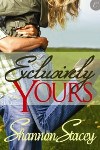
Sadly, Undeniably Yours does not have a patch on the other two books in this series, in fact it’s rather like the rebellious middle child who doesn’t fit in with the rest of the family. Whereas Exclusively Yours and the later Yours To Keep are fun-filled family-orientated romances that stir the heart and take you on a journey with the Kowalskis, Undeniably Yours sits by itself in the corner pushing all the chances for fun away. And that’s quite the literal description.
Beth was nomadic before falling pregnant, and while her viewpoint of losing her freedom is understandable, the way she keeps Kevin at arms length is not. Kevin is overbearing in the way that he tries to help Beth but the reasons Beth gives for shutting him out are just silly. She is afraid they might break up if they got together, and doesn’t consider the possibility that it might actually work out.
Beth doesn’t think this once, she spends the entire book repeating her thoughts over and over. There is also the fact that suddenly, from being so inviting in Exclusively Yours, the Kowalski family are difficult to read about. Here they come across as overbearing, like Kevin, never leaving Beth to work things out for herself. And in regards to Beth’s own parents, one minute she’s missing them, the next she’s remembering why she kept herself away from them, yet when the time comes for the reader to meet them they seem incredibly accommodating. There may be some truth in the idea that Beth may have read them wrongly, but it still doesn’t add up.
The set up was good, but Undeniably Yours is a world away from the other books. The focus is all on the pregnancy, or rather all on Beth’s repetitious mind, and barring the interludes for Paulie’s story (which is a welcome respite) there is nothing else. Even when the other Kowalskis are there they aren’t there for long.
If you’re okay with the idea of a plot about a silly woman pushing the father of her baby away while happily living a few steps away and spending time at home with his family – and nothing else – you might find it alright. But anyone who has read and thoroughly enjoyed other Kowalski books should note that this is nothing like Stacey’s standard Kowalski fare.
I received this book for review from Carina Press.
Related Books